Maine Abandonment
About this form
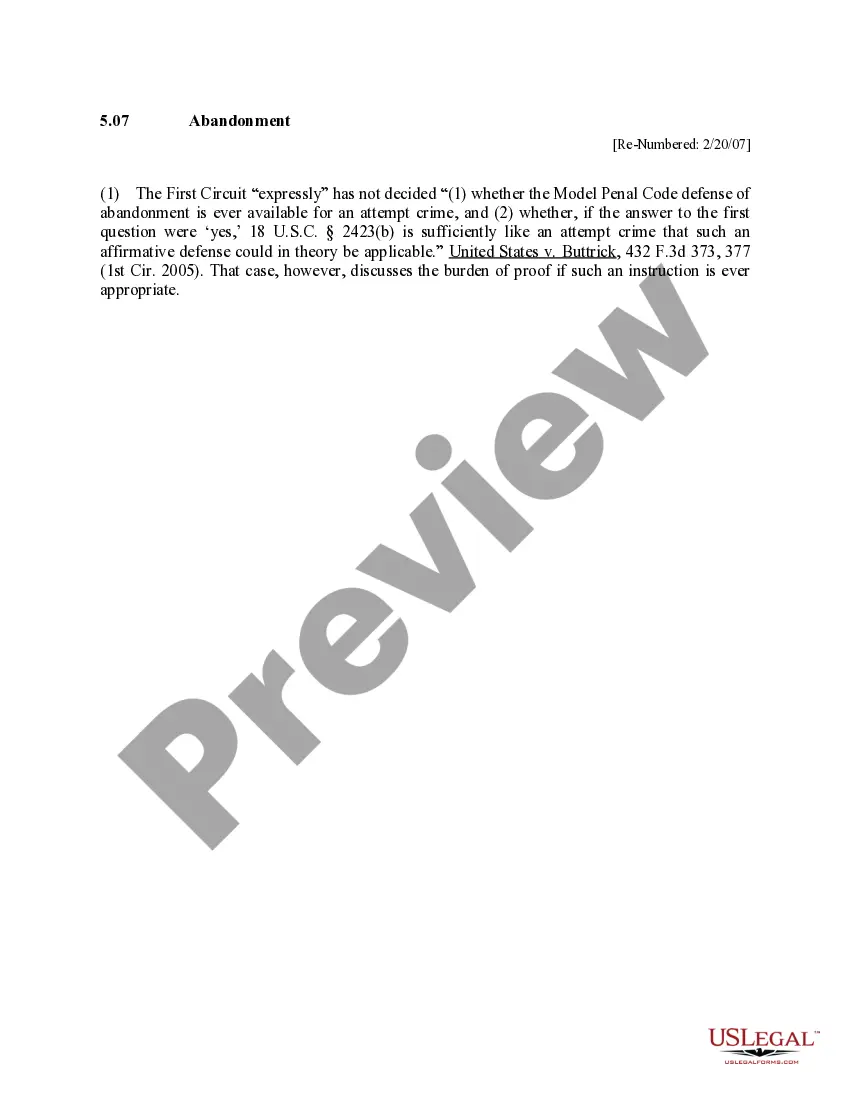
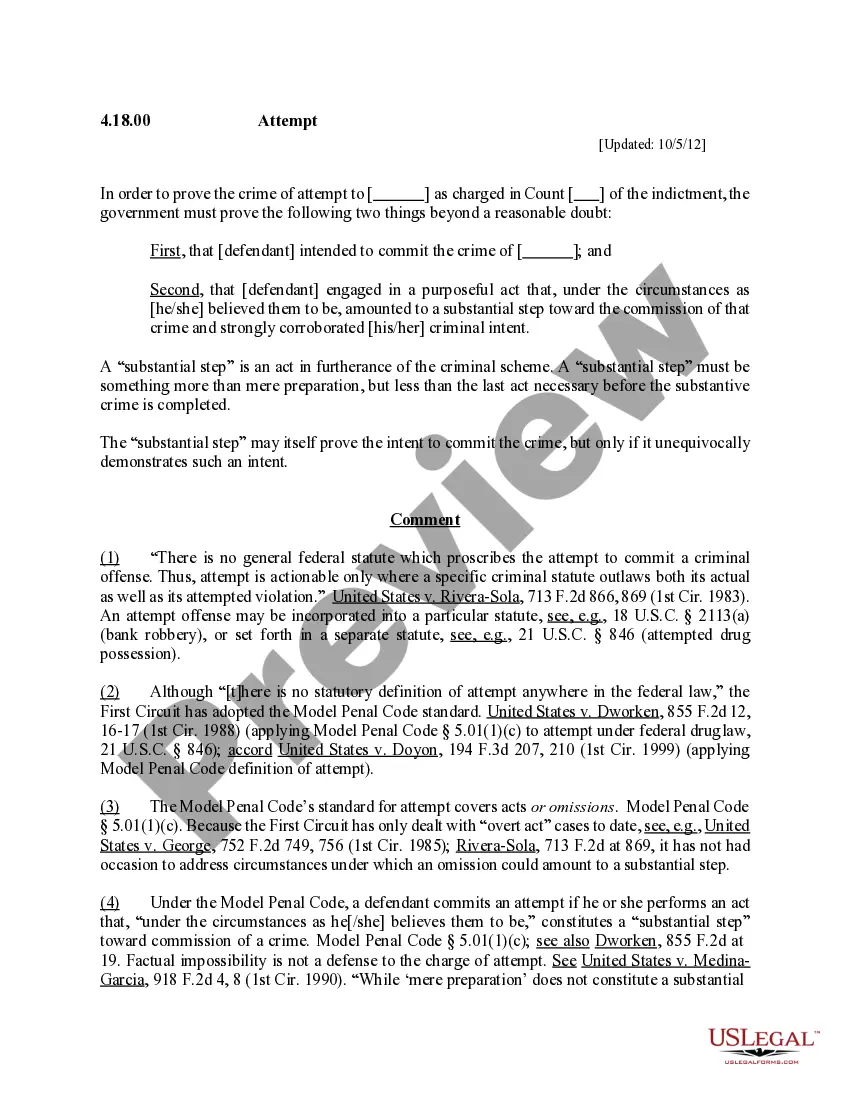
The Abandonment form provides essential instructions regarding the defense of abandonment in criminal cases, particularly in the context of attempt crimes. This form serves as a guide for jurors in Federal District Court of Maine, explaining the legal nuances of the abandonment defense as it relates to federal statutes. Unlike other forms, it focuses specifically on legal instructions rather than evidence or testimonies, making it unique in its application within the judicial process.
Main sections of this form
- Definition of abandonment as a defense in attempt crimes.
- Legal standards governing the burden of proof.
- Relevant case law that underpins the legal instructions provided.
- Methods of utilizing the abandonment defense in court proceedings.

Common use cases
This form is used during jury trials in Federal District Court where the defendant presents an abandonment defense for an alleged attempt crime. It is applicable when legal counsel seeks to clarify the parameters of abandonment for jurors, assisting them in understanding the applicable law and evidence related to the defendant's actions.
Who needs this form
- Defense attorneys representing clients in federal criminal cases.
- Judges overseeing jury instructions in cases involving attempt crimes.
- Legal professionals seeking clarity on the abandonment defense.
Completing this form step by step
- Identify the specific case details, including the defendant and the charges.
- Review the pertinent laws regarding abandonment as a defense.
- Incorporate relevant case law as precedents to support the defense.
- Clarify the burden of proof expectations for the jury.
- Finalize the jury instructions to comply with federal standards.
Does this form need to be notarized?
This form does not typically require notarization to be legally valid. However, some jurisdictions or document types may still require it. US Legal Forms provides secure online notarization powered by Notarize, available 24/7 for added convenience.
Get your form ready online
Our built-in tools help you complete, sign, share, and store your documents in one place.
Make edits, fill in missing information, and update formatting in US Legal Forms—just like you would in MS Word.
Download a copy, print it, send it by email, or mail it via USPS—whatever works best for your next step.
Sign and collect signatures with our SignNow integration. Send to multiple recipients, set reminders, and more. Go Premium to unlock E-Sign.
If this form requires notarization, complete it online through a secure video call—no need to meet a notary in person or wait for an appointment.
We protect your documents and personal data by following strict security and privacy standards.

Make edits, fill in missing information, and update formatting in US Legal Forms—just like you would in MS Word.

Download a copy, print it, send it by email, or mail it via USPS—whatever works best for your next step.

Sign and collect signatures with our SignNow integration. Send to multiple recipients, set reminders, and more. Go Premium to unlock E-Sign.

If this form requires notarization, complete it online through a secure video call—no need to meet a notary in person or wait for an appointment.

We protect your documents and personal data by following strict security and privacy standards.
Avoid these common issues
- Failing to clearly define abandonment in the context of the specific case.
- Neglecting to address the burden of proof adequately.
- Using outdated case law that may no longer be applicable.
Why use this form online
- Easy access to updated legal forms drafted by licensed attorneys.
- Convenient download in Word format for easy editing and customization.
- Ensures compliance with current federal legal standards.
Looking for another form?
Form popularity
FAQ
1. Petition for termination; adoption petition brought solely by parent. A petition for termination of parental rights may be brought in the court in which a petition for adoption is properly filed as part of that petition for adoption.
Sir Henry Maine- ing to him, possession means that contact with an object which involves the exclusion of other persons from the enjoyment of it.
Rule that requires a party seeking to gain title to property by adverse possession to have hostile intent, or an intent to take the property with knowledge that it belongs to someone else.
"Abandonment" means any conduct on the part of the parent showing an intent to forego parental duties or relinquish parental claims. The intent may be evidenced by: A. Failure, for a period of at least 6 months, to communicate meaningfully with the child; PL 1995, c.
If, even after 14 days, the tenant still does not physically claim his or her personal property or has made no oral or written claim to the property within 7 days, then the landlord may either condition the release of the property as stated above, or sell or dispose of the property.
You must claim your property within 7 days after the notice was sent. If you do this, your landlord must store the property for at least 14 days from the date the landlord's notice was sent, giving you time to get your things. Pick up your things within the 14 days.
Maine is an equitable distribution state, and only property acquired during the course of the marriage is subject to division following divorce. Some factors considered by Maine courts in a property division case include non-monetary contributions and a list of other factors defined in Maine law.
Adverse Possession Definition In Maine, if a person uses a part of another person's property for a period of at least 20 years and satisfies all the other requirements for adverse possession, they can attain ownership of that part. Adverse possession is sometimes referred to as ''squatter's rights.