Maine Previous Trial
What this document covers
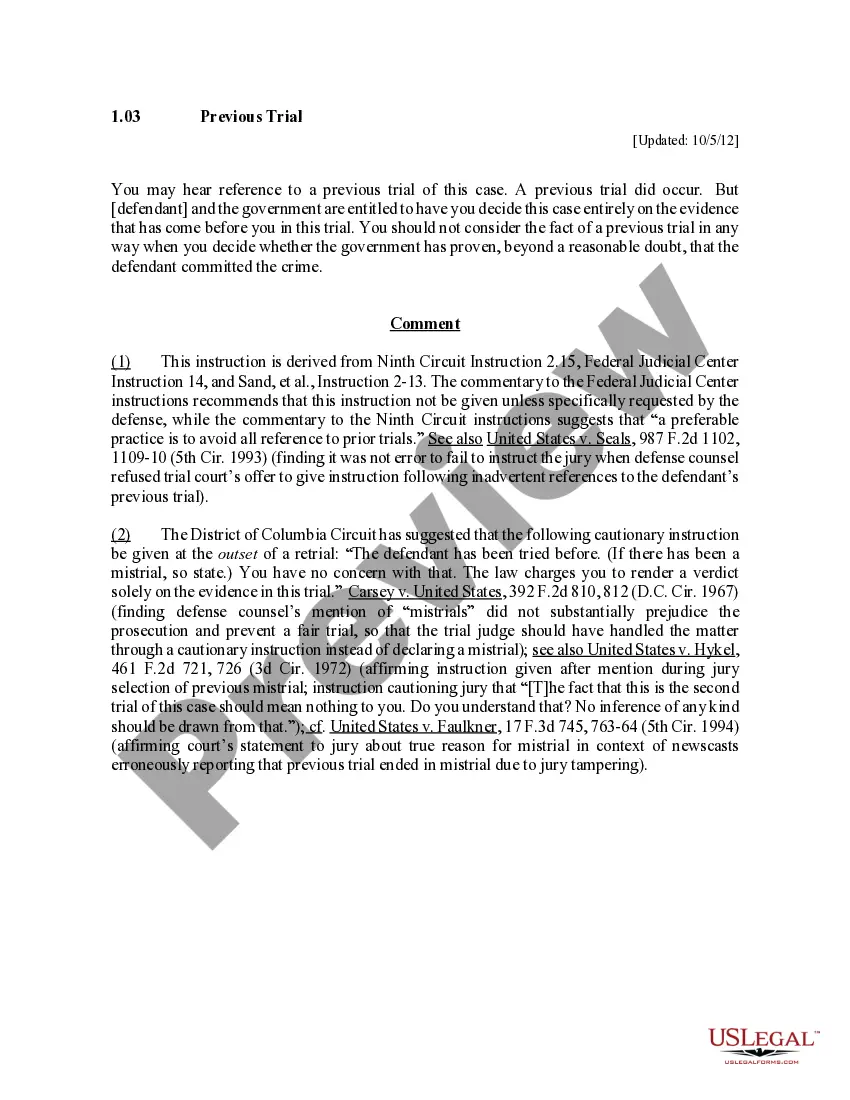
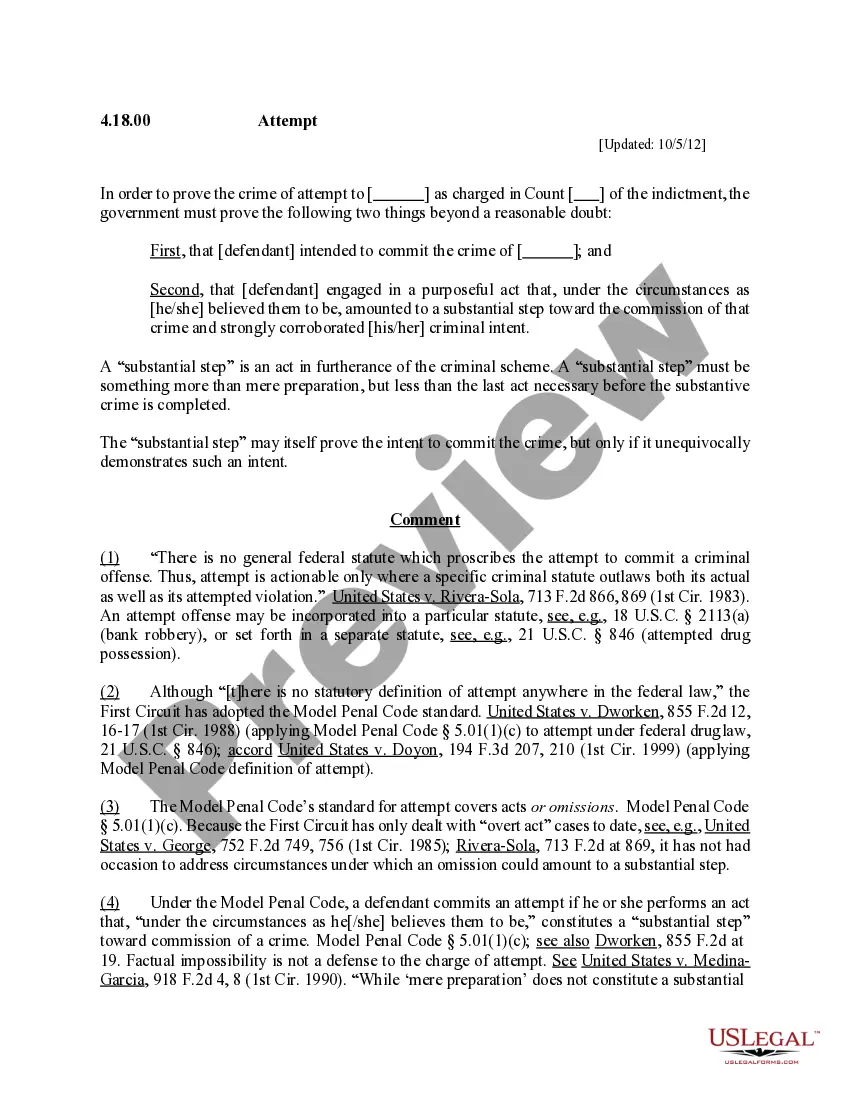
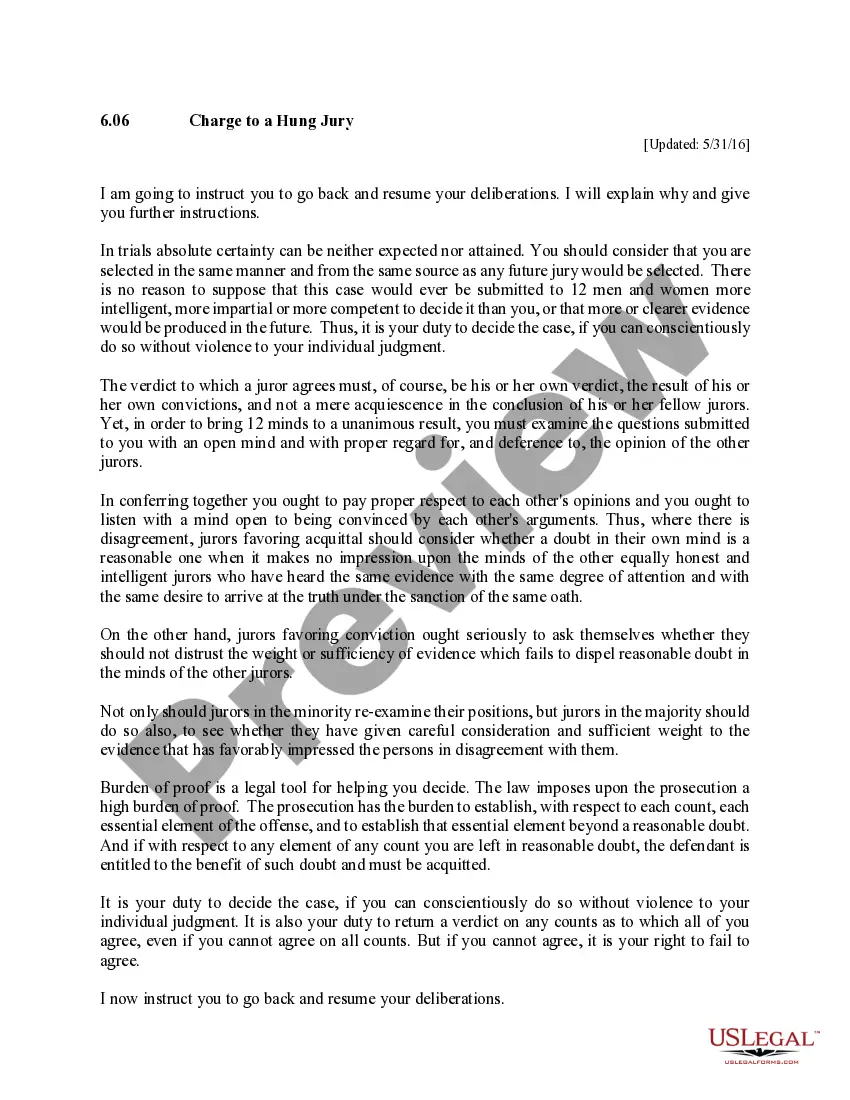
The Previous Trial form provides official jury instructions for criminal cases in the Federal District Court of Maine. Its primary purpose is to ensure that jurors remain impartial by emphasizing that their decision must be based solely on the evidence presented in the current trial. This form differs from other jury instruction forms by specifically addressing the consideration of any previous trials related to the case and clarifying that such references should not influence the jurors' judgment.
What’s included in this form
- Explicit instruction to jurors to disregard references to previous trials.
- Clarification that the defendant and government are entitled to a fair judgment based on current evidence.
- Guidance derived from established circuit instructions and legal cases.
- Potential cautionary instruction regarding prior trials if mentioned by defense counsel.
- Advice to jurors on focusing exclusively on the current trial's evidence.
When to use this form
This form should be utilized in scenarios where a case has undergone a previous trial, particularly in retrials. It prevents jurors from forming biased opinions based on the outcome of earlier proceedings. The instructions help uphold the principles of justice by ensuring that the jurors evaluate the case on its current merits, regardless of any past trials.
Who needs this form
- Judges presiding over federal criminal trials in Maine seeking to instruct jurors accurately.
- Defense attorneys who wish to ensure that jurors do not consider prior trial information during deliberations.
- Prosecutors aiming to uphold legal standards and promote a fair trial process.
How to complete this form
- Identify the case for which the jury instruction is being provided.
- Clearly state that a previous trial has occurred but instruct jurors to focus only on the evidence presented in the current trial.
- Include relevant legal citations to support the instruction.
- Modify the form language as necessary to suit the specifics of the trial, including any details about the prior trial.
- Provide any additional context that may be needed, such as explaining mentions of mistrials if applicable.
Does this document require notarization?
Notarization is generally not required for this form. However, certain states or situations might demand it. You can complete notarization online through US Legal Forms, powered by Notarize, using a verified video call available anytime.
Get your form ready online
Our built-in tools help you complete, sign, share, and store your documents in one place.
Make edits, fill in missing information, and update formatting in US Legal Forms—just like you would in MS Word.
Download a copy, print it, send it by email, or mail it via USPS—whatever works best for your next step.
Sign and collect signatures with our SignNow integration. Send to multiple recipients, set reminders, and more. Go Premium to unlock E-Sign.
If this form requires notarization, complete it online through a secure video call—no need to meet a notary in person or wait for an appointment.
We protect your documents and personal data by following strict security and privacy standards.

Make edits, fill in missing information, and update formatting in US Legal Forms—just like you would in MS Word.

Download a copy, print it, send it by email, or mail it via USPS—whatever works best for your next step.

Sign and collect signatures with our SignNow integration. Send to multiple recipients, set reminders, and more. Go Premium to unlock E-Sign.

If this form requires notarization, complete it online through a secure video call—no need to meet a notary in person or wait for an appointment.

We protect your documents and personal data by following strict security and privacy standards.
Common mistakes to avoid
- Failing to clarify to jurors that they must ignore any prior trial information.
- Neglecting to use updated legal references when drafting the instruction.
- Inconsistently applying the instruction across different jury instructions in the same trial.
Why use this form online
- Convenient access to legal language drafted by licensed attorneys.
- Editable format allowing for customization to fit unique trial circumstances.
- Instant availability to ensure timely and proper jury instruction.
Key takeaways
- The Previous Trial form provides essential jury instructions for criminal cases.
- It emphasizes evaluating the current trial based solely on the evidence presented.
- This form is crucial for maintaining fairness in retrials and preventing bias from previous trials.
Looking for another form?
Form popularity
FAQ
Chief Justice. Chief Justice Valerie Stanfill is a graduate of Bryn Mawr College and the University of Maine School of Law.
Judges and Justices are appointed by the Governor, confirmed by the Senate, and serve seven-year terms.
The Supreme Judicial Court is the State's highest court and the court of last resort. It has seven justices, presided over by the Chief Justice, who is the head of the Judicial Branch.
Chief justices #JudgeResidence1Prentiss MellenPortland2Nathan WestonAugusta3Ezekiel WhitmanPortland4Ether ShepleySaco23 more rows
Jury service compensation All jurors are paid $15 per day by the State, plus mileage reimbursement to and from the courthouse. These amounts are set by the Legislature.
Records placed under a protective order by the commission pursuant to the Maine Rules of Civil Procedure, Rule 26 (c) in ance with this section, are within the scope of a privilege against discovery within the meaning of Title 1, section 402, subsection 3, paragraph B and are not public records while under the
The supreme courts do not hear trials of cases. They hear appeals of the decisions made in the lower trial or appellate courts. The number of justices on each court varies between five and nine from state to state.
The Maine Supreme Judicial Court is the highest court in the state of Maine's judicial system. It is composed of seven justices, who are appointed by the Governor and confirmed by the Maine Senate.