Maine Attempt
What this document covers
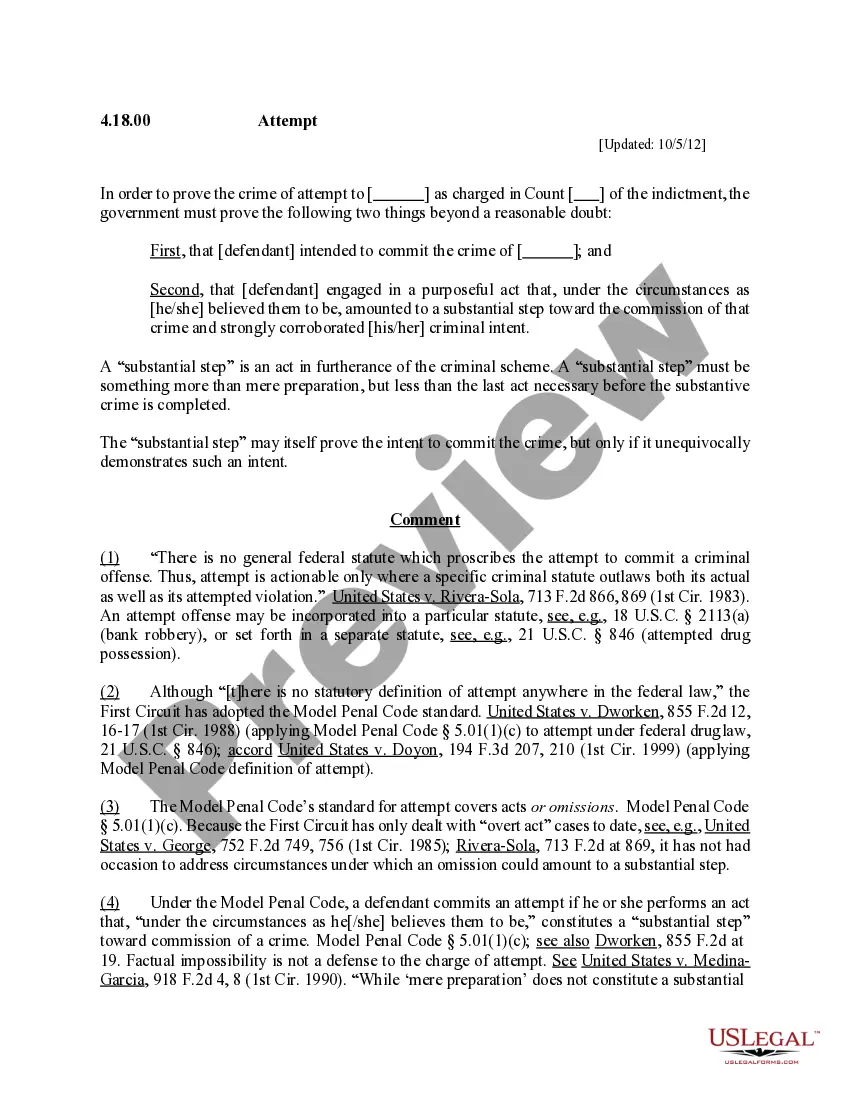
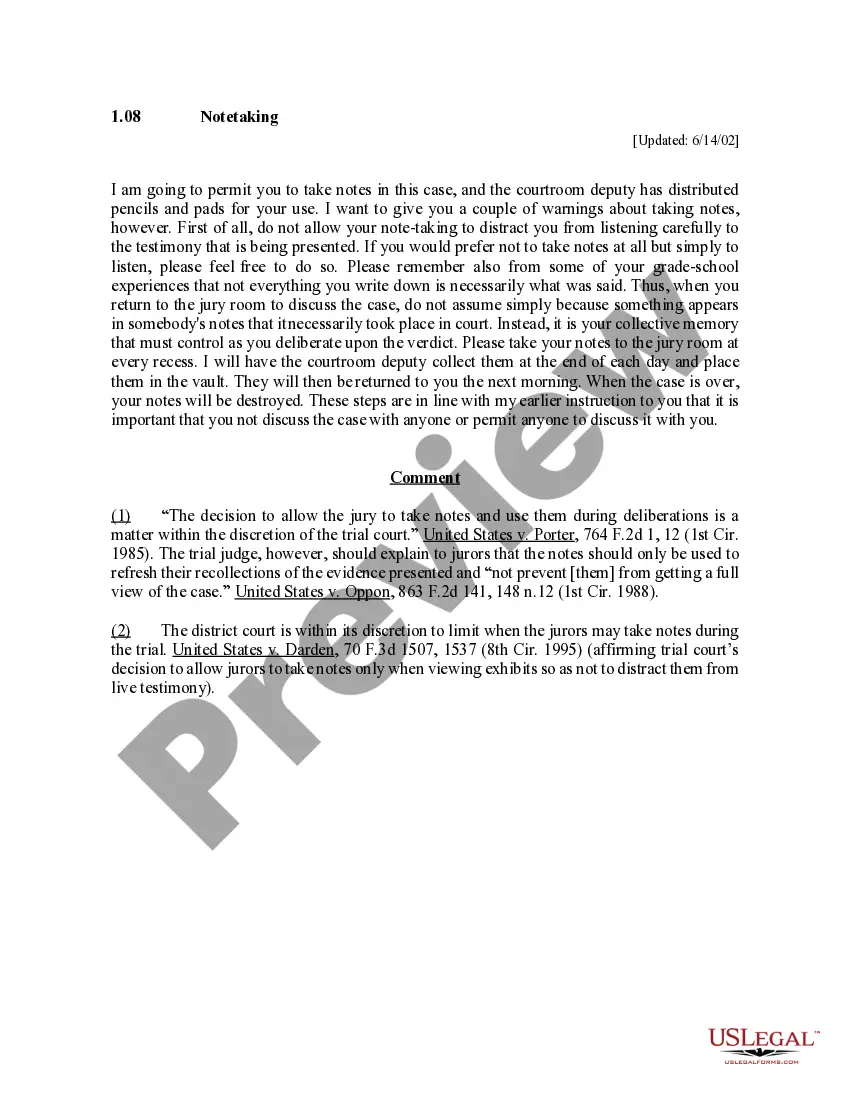
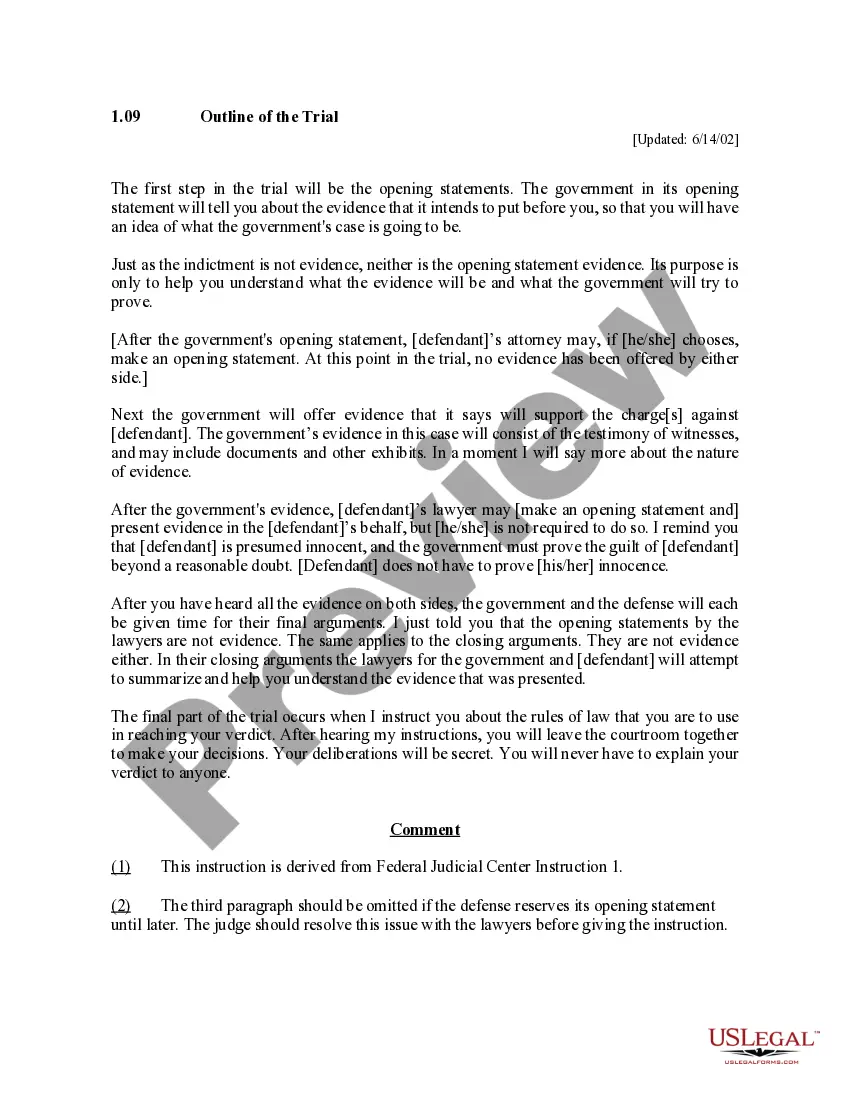
The Attempt form provides a clear set of instructions for establishing a charge of attempted crime in federal criminal cases within the jurisdiction of the Federal District Court of Maine. This form helps clarify the elements required to prove an attempt, distinguishing it from other forms that may handle different aspects of criminal law.
Form components explained
- Intent to commit the crime: Must establish that the defendant had the intention to commit a specific crime.
- Substantial step: Requires evidence that the defendant took a purposeful action towards committing that crime.
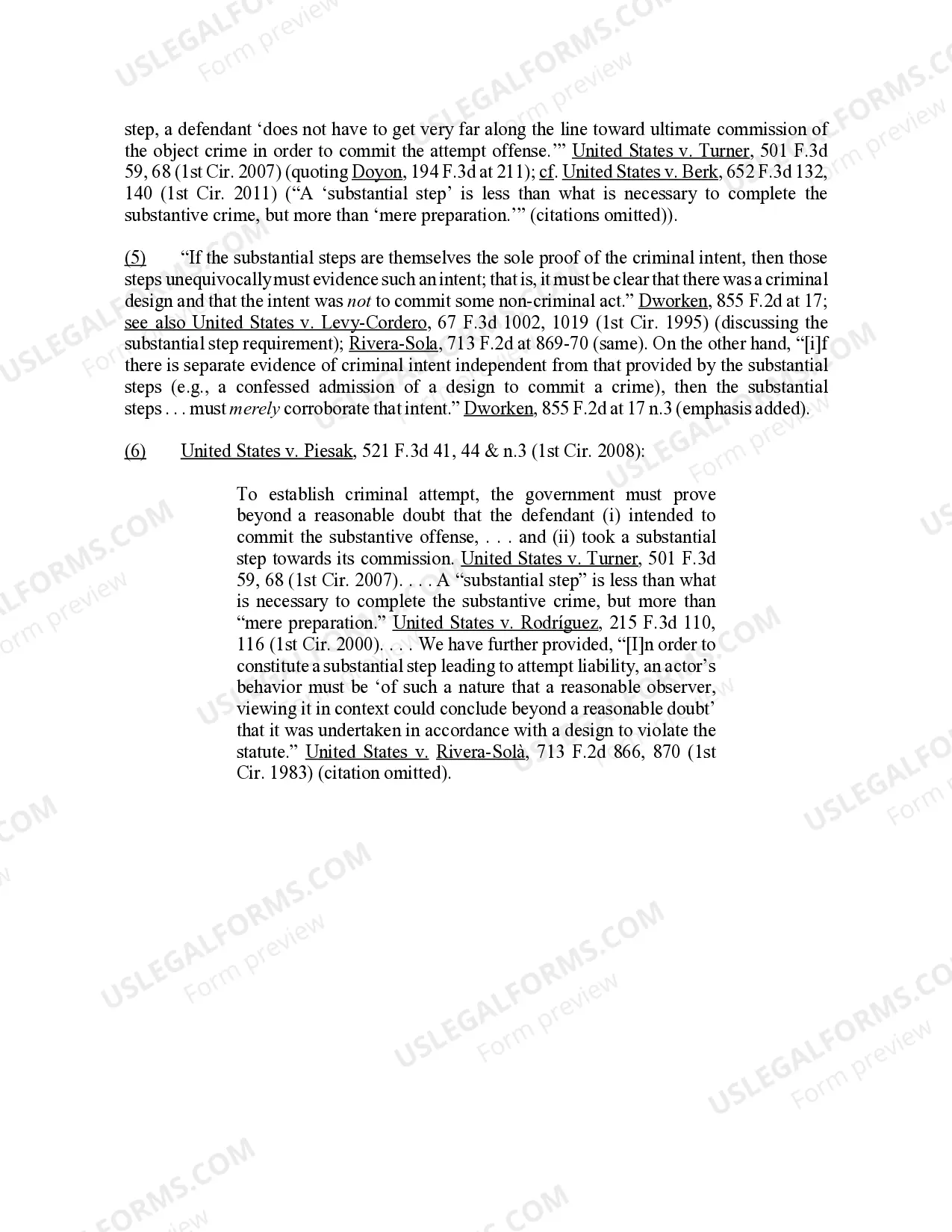
- Legal context: Includes case law references that elucidate the required elements for a charge of attempt.
- Definitions: Clarification of terms such as "substantial step" and "mere preparation."
Common use cases
This form is applicable in scenarios where a defendant is charged with an attempt to commit a specific crime, such as drug possession or robbery. It assists in presenting the necessary legal framework and descriptions of actions that qualify as an attempt, thereby guiding legal practitioners or defendants in understanding the charge.
Who can use this document
- Legal practitioners representing defendants in federal criminal cases.
- Defendants seeking to understand the legal framework of their charges.
- Students or researchers studying criminal law in the context of federal prosecution.
Instructions for completing this form
- Identify the crime: Clearly specify the crime the defendant intended to commit.
- Document the defendant's intent: Include evidence or statements that indicate the defendant's intent to commit the crime.
- Describe the substantial step: Provide detailed accounts of actions taken that demonstrate preparation beyond mere planning.
- Cite relevant case law: Reference applicable legal precedents that support the charge of attempt.
- Review for clarity: Ensure all information is clear and substantiates the intention and actions related to the attempt.
Does this form need to be notarized?
Notarization is generally not required for this form. However, certain states or situations might demand it. You can complete notarization online through US Legal Forms, powered by Notarize, using a verified video call available anytime.
Get your form ready online
Our built-in tools help you complete, sign, share, and store your documents in one place.
Make edits, fill in missing information, and update formatting in US Legal Forms—just like you would in MS Word.
Download a copy, print it, send it by email, or mail it via USPS—whatever works best for your next step.
Sign and collect signatures with our SignNow integration. Send to multiple recipients, set reminders, and more. Go Premium to unlock E-Sign.
If this form requires notarization, complete it online through a secure video call—no need to meet a notary in person or wait for an appointment.
We protect your documents and personal data by following strict security and privacy standards.

Make edits, fill in missing information, and update formatting in US Legal Forms—just like you would in MS Word.

Download a copy, print it, send it by email, or mail it via USPS—whatever works best for your next step.

Sign and collect signatures with our SignNow integration. Send to multiple recipients, set reminders, and more. Go Premium to unlock E-Sign.

If this form requires notarization, complete it online through a secure video call—no need to meet a notary in person or wait for an appointment.

We protect your documents and personal data by following strict security and privacy standards.
Typical mistakes to avoid
- Failing to adequately demonstrate the defendant's intent to commit the crime.
- Describing actions that qualify as mere preparation instead of a substantial step.
- Neglecting to reference relevant case law that supports the attempt charge.
- Overlooking the importance of clarity in detailing the relationship between intent and actions taken.
Advantages of online completion
- Convenience: Easily access and download the form from anywhere at any time.
- Editability: Customize the form as needed to fit specific legal circumstances.
- Reliability: Forms are drafted by licensed attorneys, ensuring compliance with current laws.
Legal use & context
- The form can be used in federal criminal court to support charges of attempted crimes.
- It is essential to establish both intent and substantial steps to secure a conviction for an attempt.
- Failure to meet these criteria may result in dismissal of the attempt charge.
Summary of main points
- The Attempt form is critical for proving criminal intent and actions in federal criminal cases.
- Understanding the substantial step is crucial in differentiating between an attempt and mere preparation.
- This form is tailored specifically for the Federal District Court of Maine and incorporates relevant case law.
Looking for another form?
Form popularity
FAQ
Failure to appear. A defendant who has been admitted to either preconviction or postconviction bail and who, in fact, fails to appear as required is guilty of: A. A Class E crime if the underlying crime was punishable by a maximum period of imprisonment of less than one year; or PL 2003, c.
A person who engages in conduct intending to aid another to commit a crime is guilty of criminal attempt if the conduct would establish the person's complicity under section 57 were the crime committed by the other person, even if the other person is not guilty of committing or attempting the crime.
The mandatory minimums are: 4 years for a Class A felony, 2 years for a Class B felony, and 1 year for a Class C felony if a defendant used a gun against a person in the commission of the drug crime, or for aggravated drug trafficking (see below).
Aggravated assault is a serious criminal offense under Maine law punishable by fines, county jail time or state prison time, probation, and other penalties.
Murder, first or second-degree criminal homicide: no statute of limitation. Class A, B, or C crimes involving unlawful sexual contact or gross sexual assault: 20 years.
A person is guilty of aggravated assault if that person intentionally, knowingly or recklessly causes: A. Bodily injury to another that creates a substantial risk of death or extended convalescence necessary for recovery of physical health. Violation of this paragraph is a Class B crime; PL 2015, c.
A person is guilty of theft if: A. The person receives, retains or disposes of the property of another knowing that it has been stolen, or believing that it has probably been stolen, with the intent to deprive the owner of the property. Violation of this paragraph is a Class E crime; or PL 2001, c.
A person is guilty of assault if: A. The person intentionally, knowingly or recklessly causes bodily injury or offensive physical contact to another person. Violation of this paragraph is a Class D crime; or PL 2001, c.