Maine Assisting Escape, 18 U.S.C. Sec. 752
What this document covers
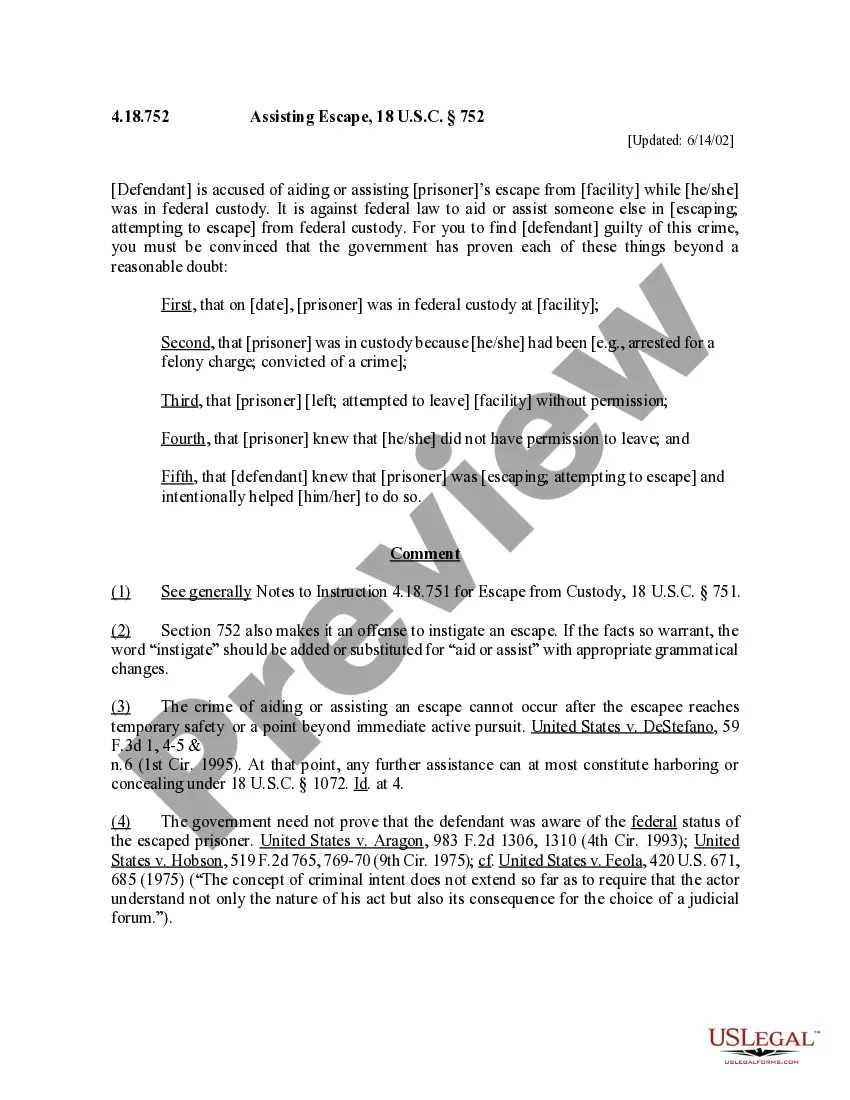
The Assisting Escape form, governed by 18 U.S.C. § 752, is a legal document used in federal criminal cases to outline the accusations against an individual for aiding or assisting a prisoner in escaping federal custody. This form is particularly relevant in criminal jury instructions, distinguishing it from similar forms by focusing on the specifics of aiding escape rather than the act of escape itself.
Form components explained
- Accusation details: Specifies that the defendant is accused of aiding a prisonerâs escape.
- Date and facility identification: Requires details about when and where the incident occurred.
- Custody status: Confirms that the prisoner was in federal custody due to a felony charge or conviction.
- Permission violation: Establishes that the prisoner left without permission.
- Defendant's knowledge and intent: Clarifies that the defendant knowingly assisted the escape.
When this form is needed
This form is used in scenarios where an individual is charged with aiding the escape of a prisoner from federal custody. It is applicable when a law enforcement body seeks a jury's instruction on the definitions and elements needed to establish guilt in relation to assisting an escape from a federal facility.
Who can use this document
- Defendants in federal criminal cases involving escape charges.
- Legal professionals representing clients accused of aiding an escape.
- Jurors needing instructions on evaluating charges related to assisting an escape.
Instructions for completing this form
- Identify the defendant: Enter the name of the accused individual.
- Specify the prisoner: Include the name of the prisoner involved in the escape.
- Outline the date: Insert the date when the alleged escape attempt occurred.
- Detail the facility: Mention the federal facility from which the escape was attempted.
- Explain the charges: Provide a clear description of how the defendant allegedly assisted the escape.
Does this form need to be notarized?
This form does not typically require notarization unless specified by local law. It is advisable to check with local regulations to determine if any additional certification is necessary.
Get your form ready online
Our built-in tools help you complete, sign, share, and store your documents in one place.
Make edits, fill in missing information, and update formatting in US Legal Forms—just like you would in MS Word.
Download a copy, print it, send it by email, or mail it via USPS—whatever works best for your next step.
Sign and collect signatures with our SignNow integration. Send to multiple recipients, set reminders, and more. Go Premium to unlock E-Sign.
If this form requires notarization, complete it online through a secure video call—no need to meet a notary in person or wait for an appointment.
We protect your documents and personal data by following strict security and privacy standards.

Make edits, fill in missing information, and update formatting in US Legal Forms—just like you would in MS Word.

Download a copy, print it, send it by email, or mail it via USPS—whatever works best for your next step.

Sign and collect signatures with our SignNow integration. Send to multiple recipients, set reminders, and more. Go Premium to unlock E-Sign.

If this form requires notarization, complete it online through a secure video call—no need to meet a notary in person or wait for an appointment.

We protect your documents and personal data by following strict security and privacy standards.
Avoid these common issues
- Failing to identify the specific date and facility related to the escape.
- Not clearly articulating the actions taken by the defendant to aid the escape.
- Omitting essential details about the prisonerâs custody status.
Why complete this form online
- Convenience: Downloadable and easy to access anytime from anywhere.
- Editability: Allows for immediate adjustments to tailor the form to specific cases.
- Reliability: Forms drafted by licensed attorneys ensure legal compliance.
Legal use & context
- The form is used to guide jurors on the elements needed to convict someone of aiding an escape.
- Aiding an escape must occur while the prisoner is under immediate federal custody.
- Knowledge of the prisoner's federal status is not mandatory for the defendant's guilt.
What to keep in mind
- The Assisting Escape form is essential for understanding and addressing charges of aiding a federal prisonerâs escape.
- Completing the form accurately is crucial to ensure proper jurisdictional and legal validation.
- Utilizing this form online enhances efficiency and ensures legal accuracy.
Looking for another form?

Form popularity
FAQ
A prison escape (referred as a bust out, breakout, jailbreak, or prison break) is the act of an inmate leaving prison through unofficial or illegal ways.
If convicted, you are facing up to five years in prison for helping someone escape custody when they are confined for a felony case, and up to one year in prison on a misdemeanor case, or charges under immigration laws.
Section 836.6 - Escape (a) It is unlawful for any person who is remanded by a magistrate or judge of any court in this state to the custody of a sheriff, marshal, or other police agency, to thereafter escape or attempt to escape from that custody.
18 U.S.C. § 752(a), together with 18 U.S.C. § 3571, set forth a penalty of up to five years imprisonment and/or a fine under Title 18, for a person who instigates, aids or assists the escape or attempt to escape; and. 18 U.S.C.
In criminal law, escape is defined as the unauthorized departure of a person from a correctional facility or custody of law enforcement.
Escape from Lawful Custody occurs when a person escapes from the custody of a peace officer after they have been arrested or detained. This offense is typically charged during an arrest or for a person in a halfway house failing to return from their work release program.