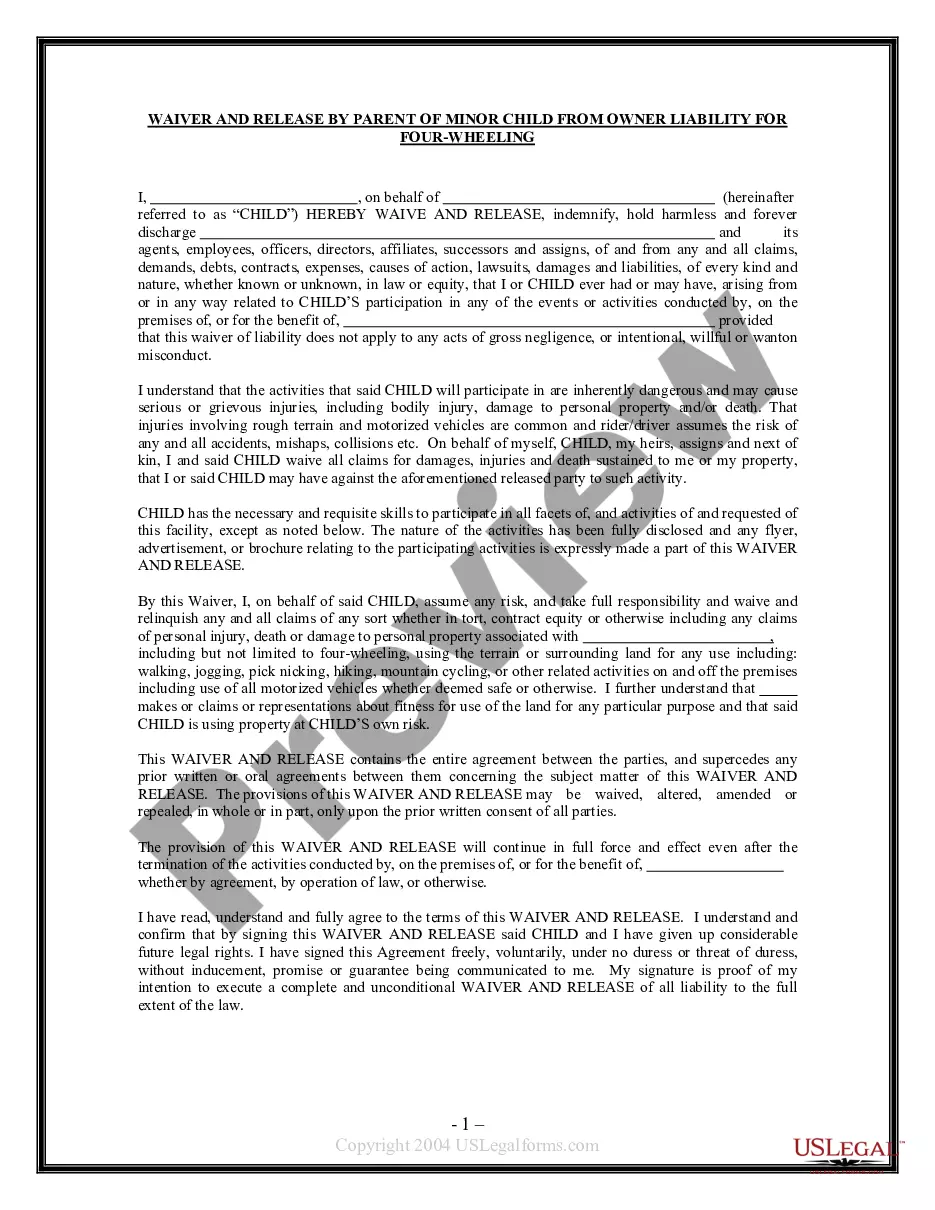
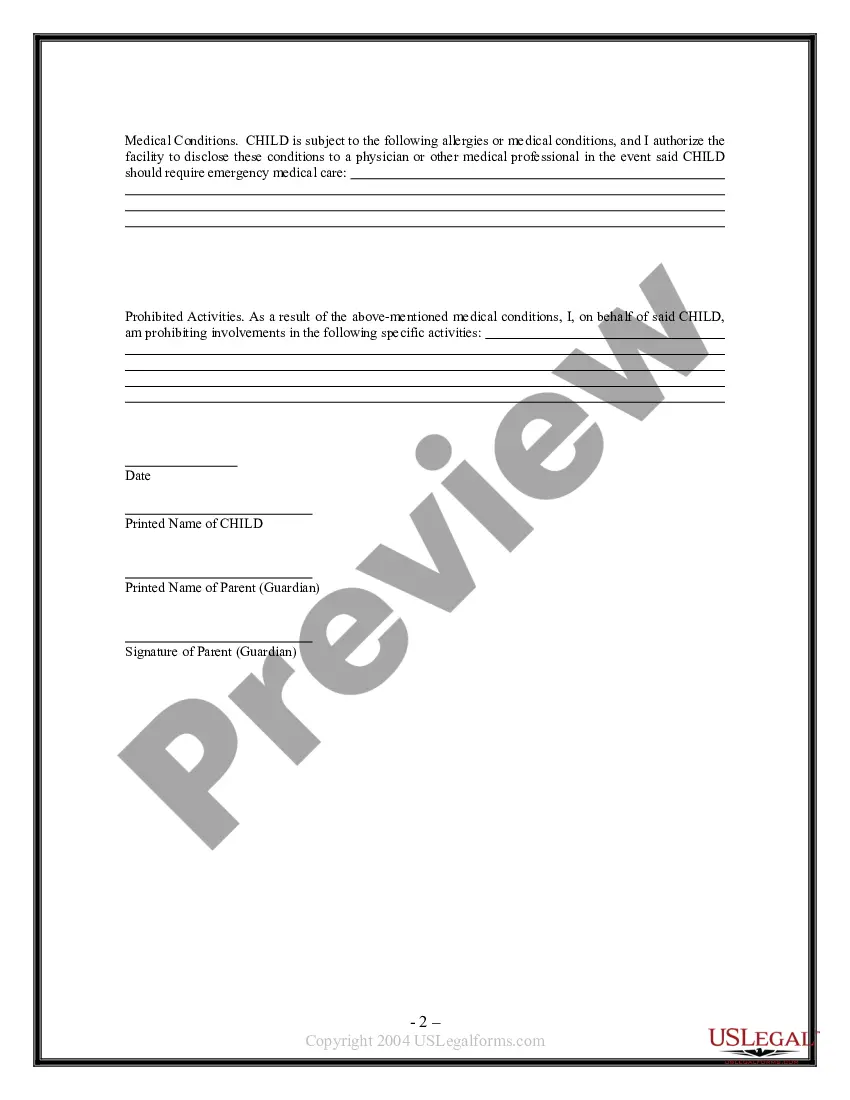
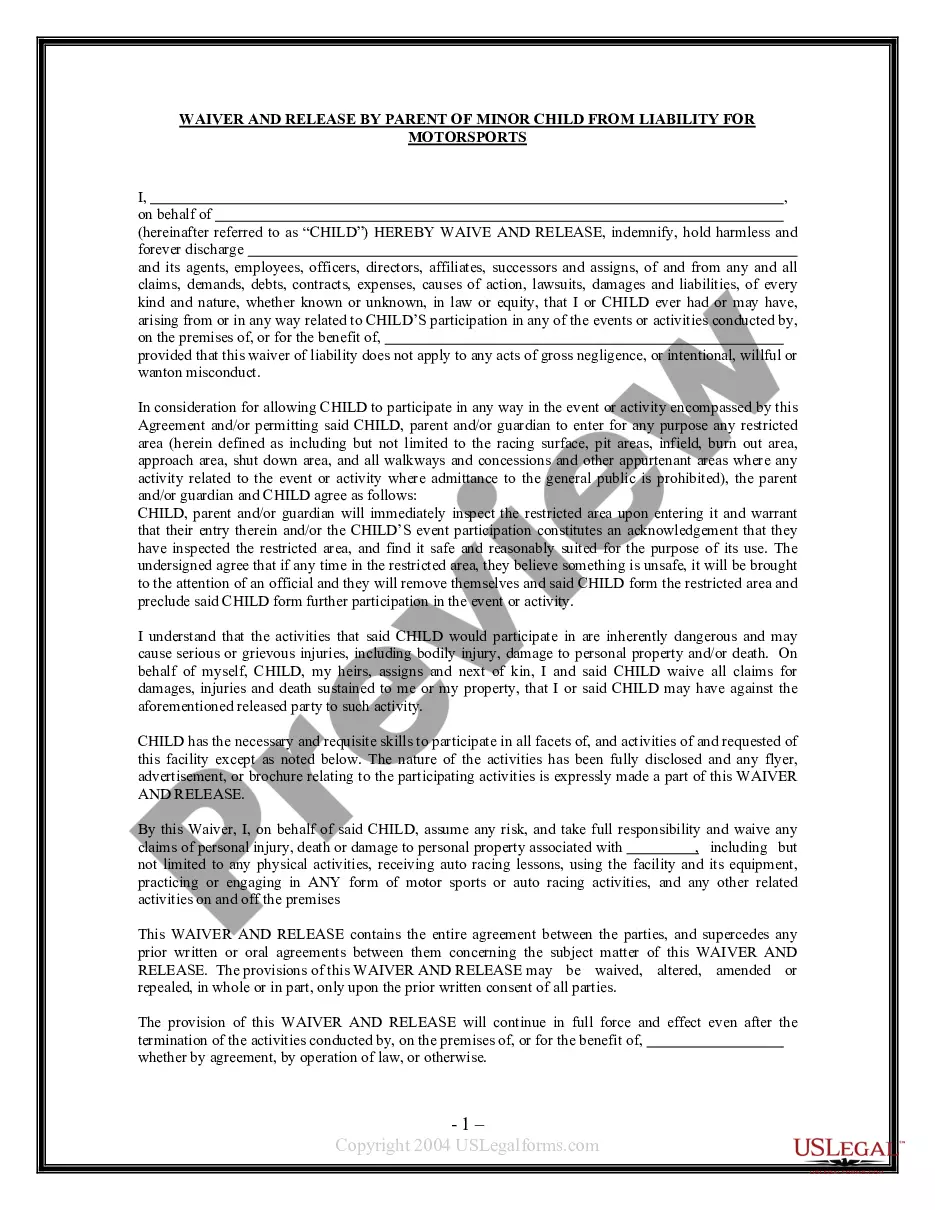
This form allows a parent or guardian to release a four-wheeling facility from liability for injuries which may be incurred by a minor child while on the premises, taking part in activities, etc.
Maryland Waiver and Release From Liability For Minor Child for Four-Wheeling
Category:
State:
Multi-State
Control #:
US-WAV-34M
Format:
Word;
Rich Text
Instant download
Description
Free preview
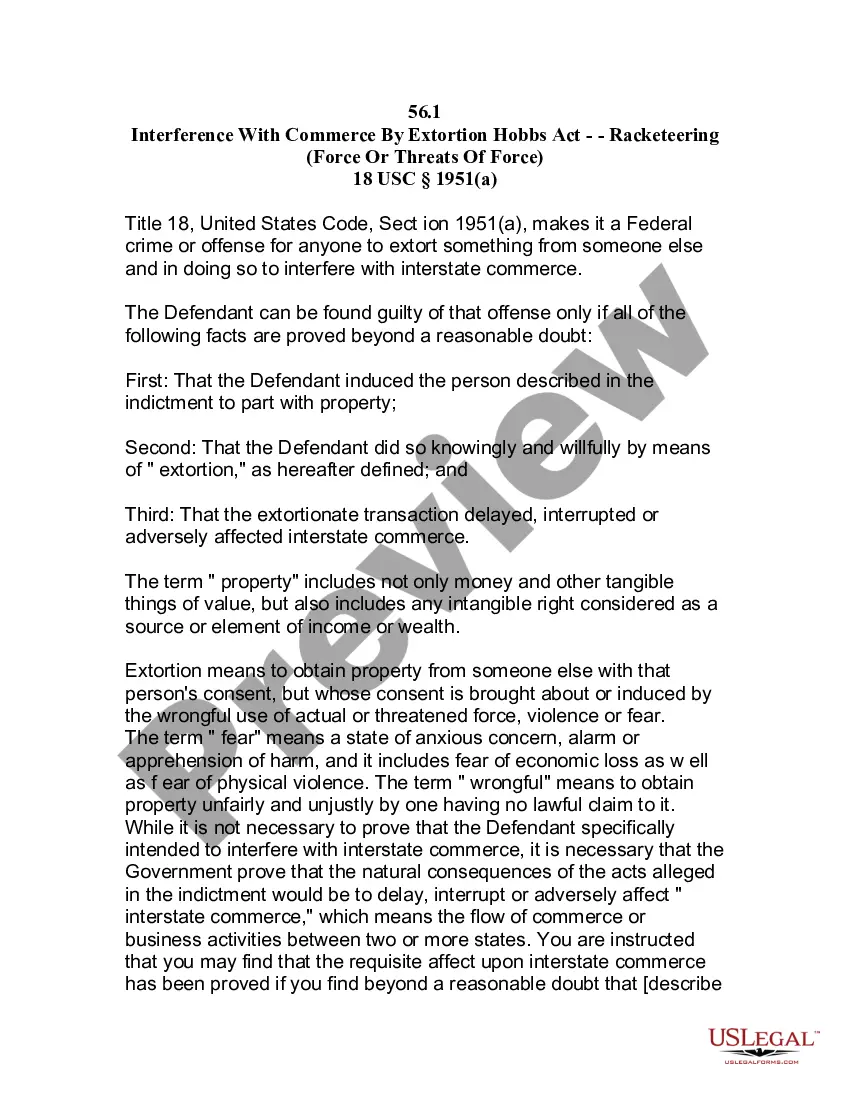
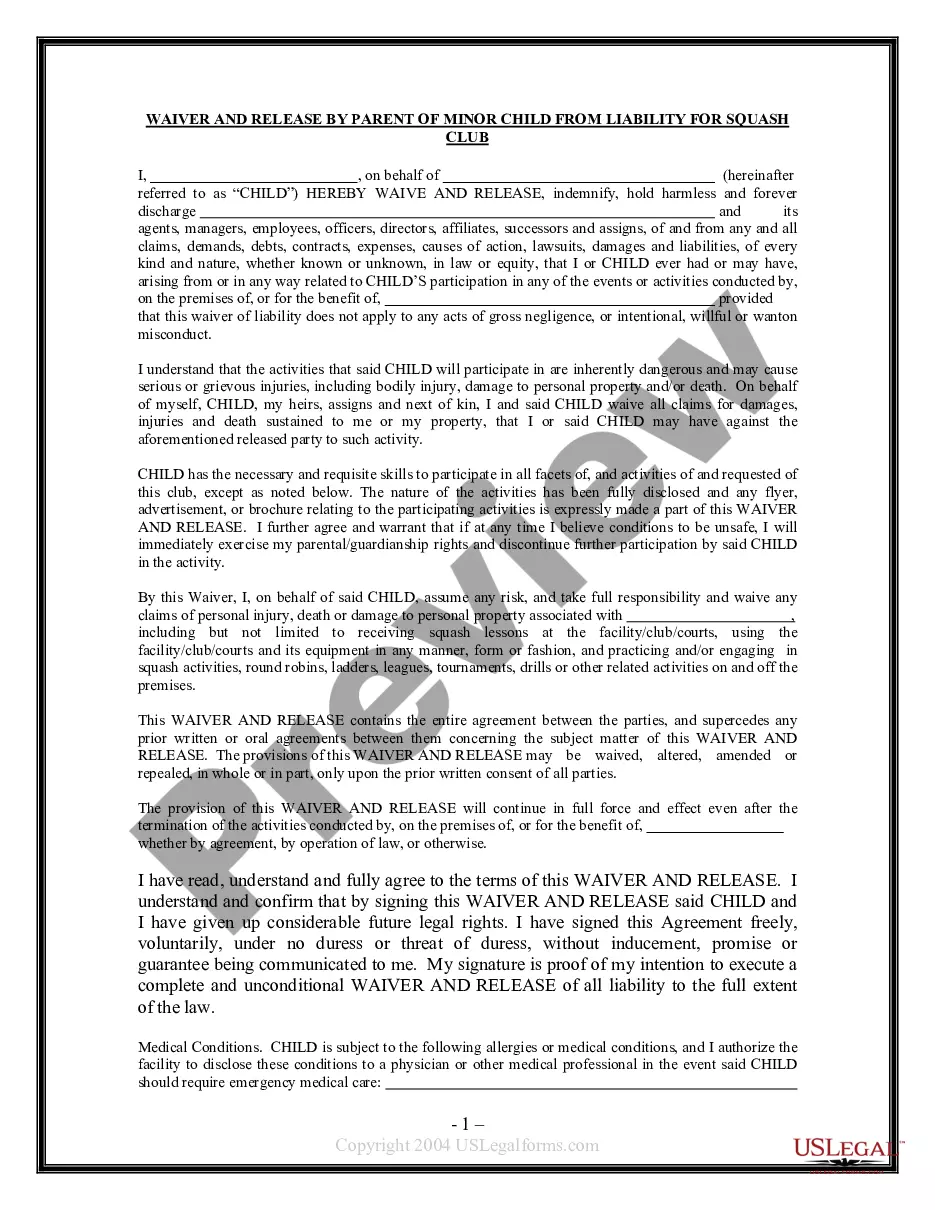

How to fill out Waiver And Release From Liability For Minor Child For Four-Wheeling?
If you wish to obtain, download, or print authentic document templates, utilize US Legal Forms, the largest selection of legal forms available on the web.
Employ the site’s straightforward and user-friendly search to find the documents you require. A variety of templates for business and personal purposes are organized by categories and states, or keywords.
Utilize US Legal Forms to acquire the Maryland Waiver and Release From Liability For Minor Child for Four-Wheeling with just a few clicks.
Every legal document template you purchase is yours indefinitely. You have access to every form you acquired in your account. Visit the My documents section and select a form to print or download again.
Compete and download, and print the Maryland Waiver and Release From Liability For Minor Child for Four-Wheeling with US Legal Forms. There are numerous professional and state-specific forms available for your business or personal needs.
- When you are already a US Legal Forms user, Log In to your account and click the Download button to retrieve the Maryland Waiver and Release From Liability For Minor Child for Four-Wheeling.
- You can also access forms you previously obtained in the My documents section of your account.
- If you are using US Legal Forms for the first time, follow the instructions below.
- Step 1. Ensure that you have chosen the form for your correct city/state.
- Step 2. Utilize the Review option to examine the form’s content. Be sure to read the description.
- Step 3. If you are not satisfied with the document, use the Search field at the top of the screen to find alternative versions of the legal form template.
- Step 4. Once you have located the form you need, click the Get now button. Choose the payment plan you prefer and enter your credentials to register for an account.
- Step 5. Complete the transaction. You can use your credit card or PayPal account to finalize the payment.
- Step 6. Select the format of the legal document and download it to your device.
- Step 7. Complete, modify and print or sign the Maryland Waiver and Release From Liability For Minor Child for Four-Wheeling.
Form popularity
FAQ
An effective waiver of liability, like the Maryland Waiver and Release From Liability For Minor Child for Four-Wheeling, must meet three key requirements. First, it should feature clear language that communicates the risks involved in the activity. Second, the waiver must be voluntarily signed by the parent or guardian, indicating their understanding and acceptance of these risks. Lastly, the document should be properly dated and include the specific details of the activity to ensure enforceability and clarity.
To write a simple release of liability, start with a clear title stating the document's purpose, such as 'Maryland Waiver and Release From Liability For Minor Child for Four-Wheeling.' Include the names of the parties involved, specify the activities covered, and outline the risks associated with four-wheeling. Make sure to include a statement where the parent or guardian agrees to release the other party from any claims arising from the activity. Finally, collect signatures from both the parent or guardian and the minor child to ensure the waiver is valid.
A parental release of liability form is a legal document that a parent or guardian signs to acknowledge the risks involved in an activity and release the organizer from liability. This form is essential for activities such as four-wheeling, where minors may participate. The Maryland Waiver and Release From Liability For Minor Child for Four-Wheeling ensures that parents understand the potential dangers while protecting the rights of both the child and the organizer. Using a reliable platform like uslegalforms can help you easily create this important document.
Yes, liability waivers are generally enforceable in Maryland, provided they meet certain legal criteria. To ensure the validity of a waiver, it must be clear and specific about the risks involved. The Maryland Waiver and Release From Liability For Minor Child for Four-Wheeling effectively protects organizations and individuals from claims related to injuries during off-road activities. It is important to create this document carefully to uphold its enforceability.
Generally, a liability waiver document is a legally binding agreement that relinquishes the right of one party to pursue legal remedy for injuries accrued on the property, regardless of fault involved.
So, if an accident happens and injury occurs, is a Waiver effective in protecting the institution from liability and preventing a lawsuit from the injured party? The answer is that, if properly worded and signed, the Waiver is likely valid and will preclude legal claims for injuries.
You might think that since you signed a waiver acknowledging the risks of the activity, you have no legal leg to stand on to file a personal injury lawsuit. Waivers can make personal injury lawsuits more complex, but you can still seek damages for injuries that could have and should have been prevented.
Liability waivers are enforceable in California solely to the extent they shift to the customer the risk of ordinary negligence. Under California law, a liability waiver cannot excuse an injury caused by a defendant's gross negligence, recklessness or intentionally wrongful act.
Ambiguous language or missing information can invalidate a waiver. The waiver contains errors that make it invalid. The language of the waiver must obey relevant state laws. An improperly worded or drafted waiver, as well as one that violates the law or public policy, may not hold up in court.
As tempting as it may be, you should never write your own liability waiver. Unless you're a fully qualified lawyer with experience in this area, it's likely that you'll omit critical language that puts your business at risk for lawsuits.