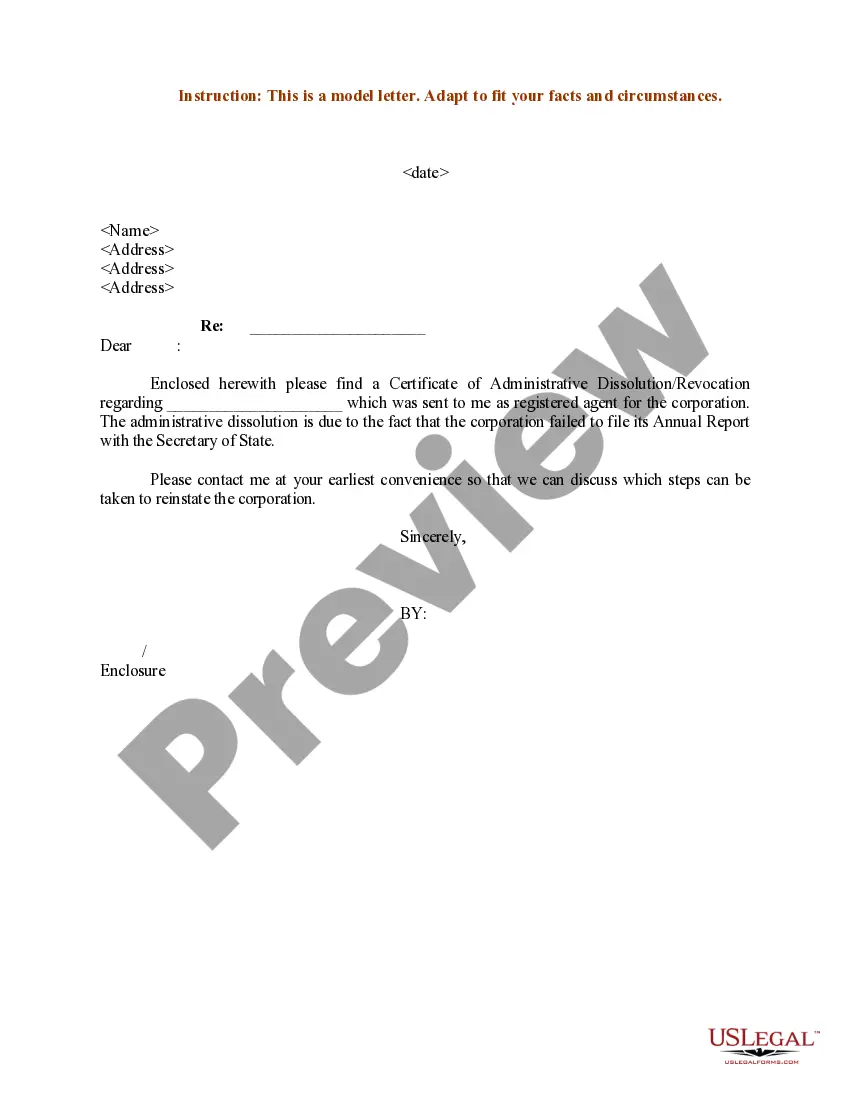
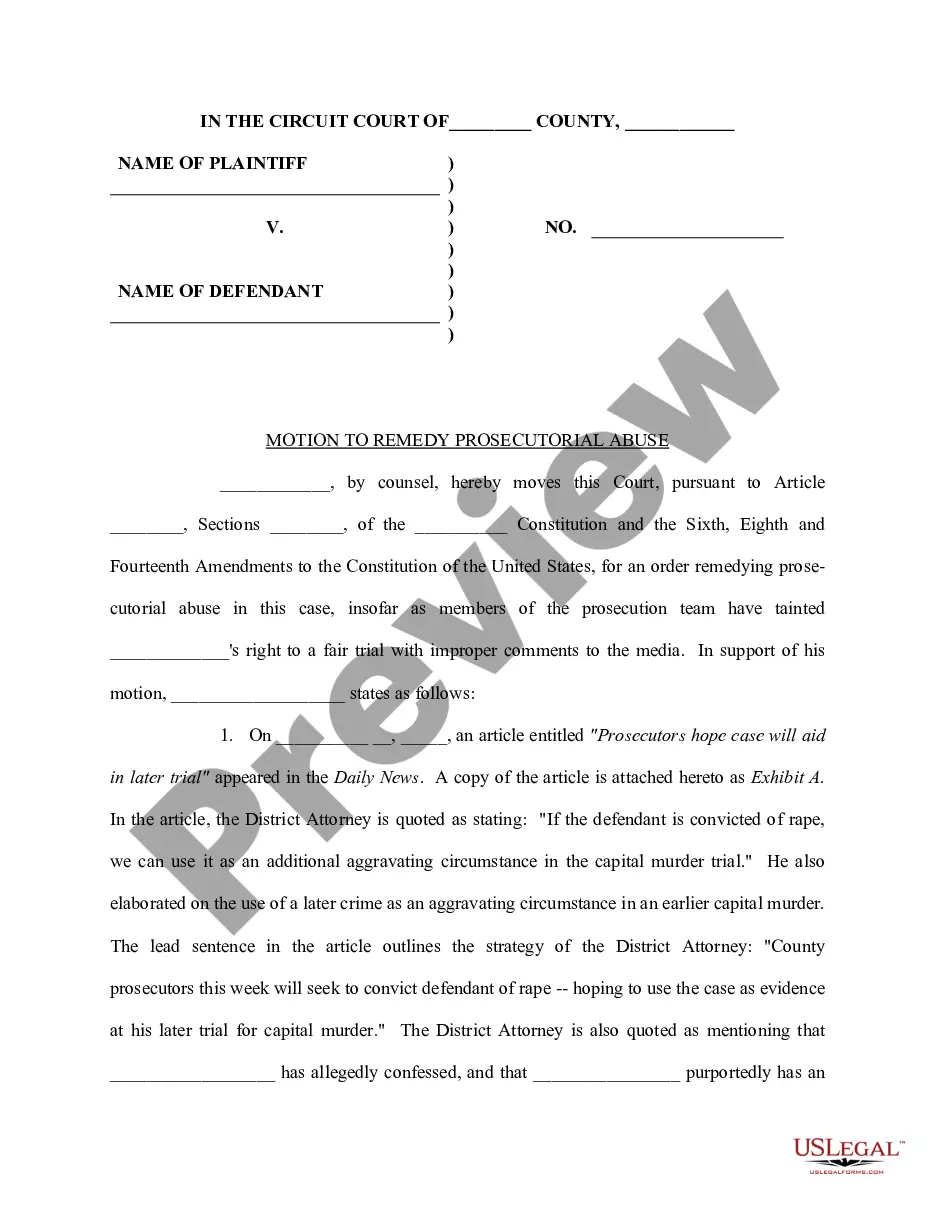
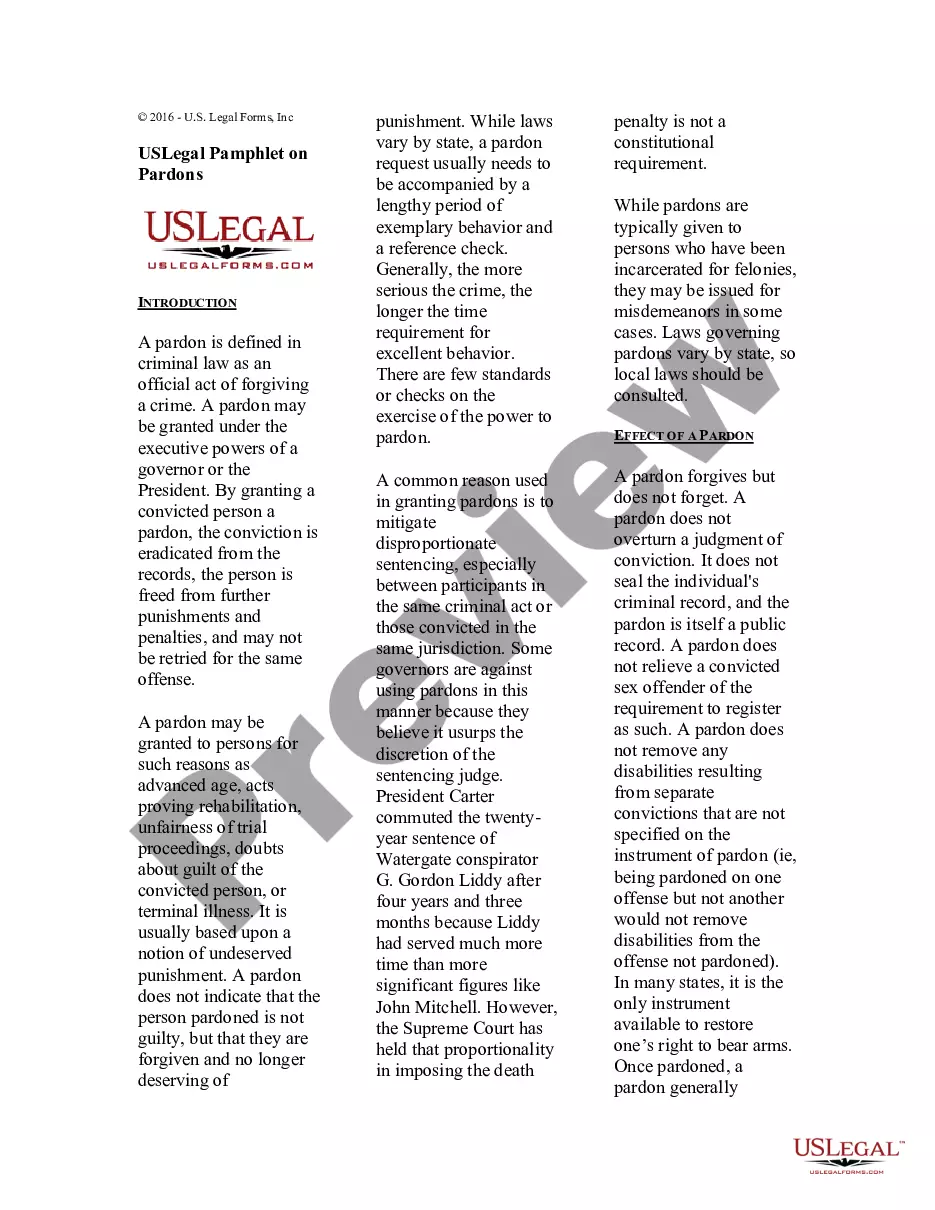
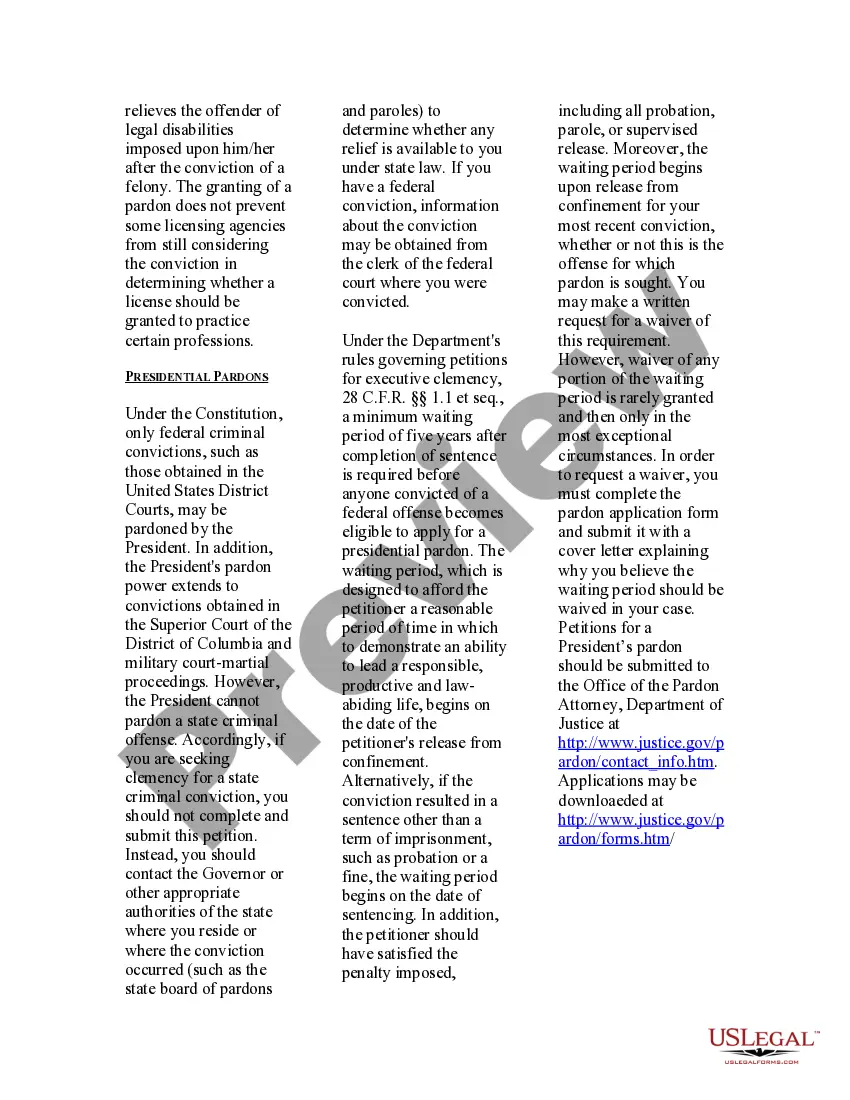
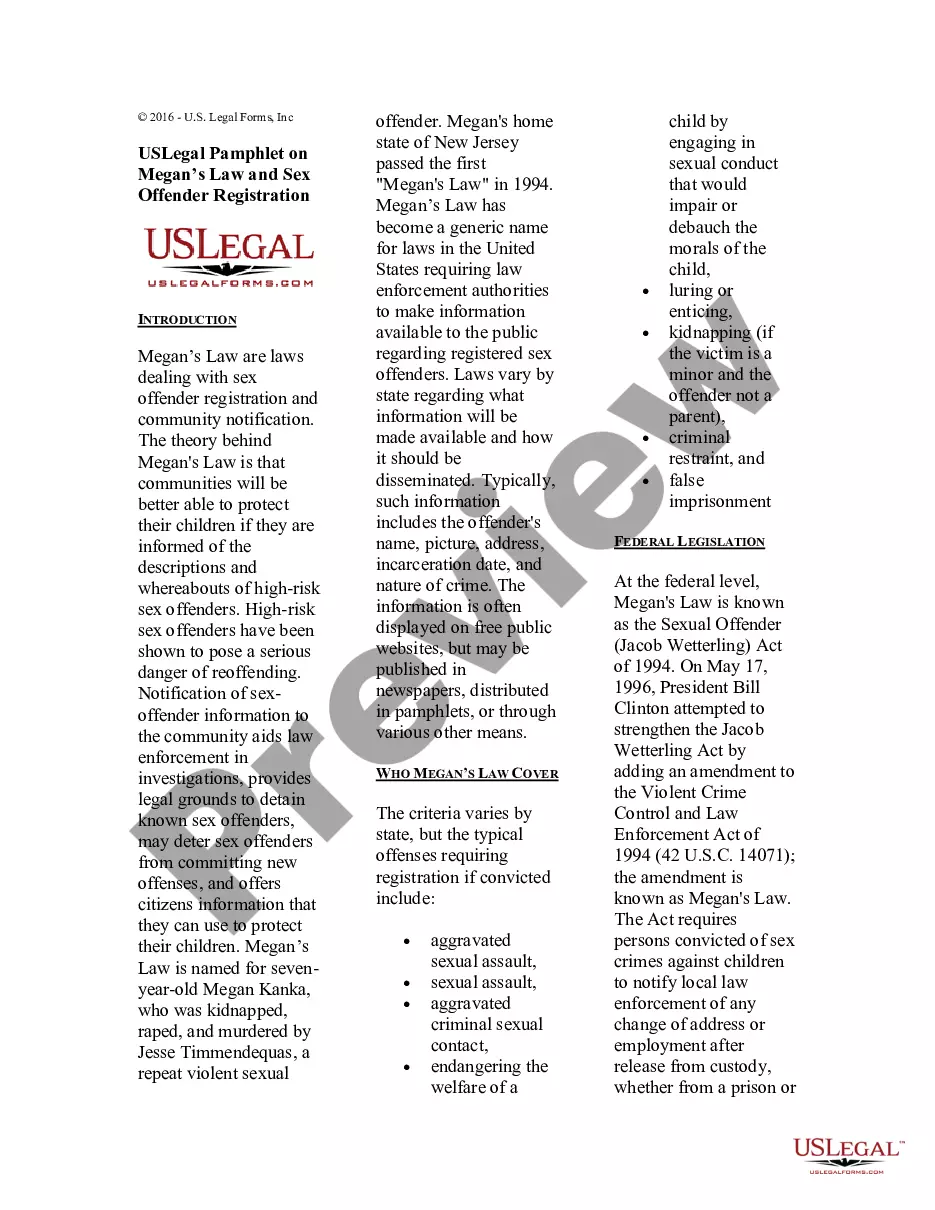
This pamphlet provides an overview on pardons. Topics covered include types of pardons, the effect of a pardon, and presidential pardons for federal crimes.
Massachusetts USLegal Pamphlet on Pardons or Clemency
Instant download
Description
Free preview
Get your form ready online
Our built-in tools help you complete, sign, share, and store your documents in one place.
Built-in online Word editor
Make edits, fill in missing information, and update formatting in US Legal Forms—just like you would in MS Word.
Export easily
Download a copy, print it, send it by email, or mail it via USPS—whatever works best for your next step.
E-sign your document
Sign and collect signatures with our SignNow integration. Send to multiple recipients, set reminders, and more. Go Premium to unlock E-Sign.
Notarize online 24/7
If this form requires notarization, complete it online through a secure video call—no need to meet a notary in person or wait for an appointment.
Store your document securely
We protect your documents and personal data by following strict security and privacy standards.

Make edits, fill in missing information, and update formatting in US Legal Forms—just like you would in MS Word.

Download a copy, print it, send it by email, or mail it via USPS—whatever works best for your next step.

Sign and collect signatures with our SignNow integration. Send to multiple recipients, set reminders, and more. Go Premium to unlock E-Sign.

If this form requires notarization, complete it online through a secure video call—no need to meet a notary in person or wait for an appointment.

We protect your documents and personal data by following strict security and privacy standards.
Looking for another form?


How to fill out USLegal Pamphlet On Pardons Or Clemency?
US Legal Forms - one of many largest libraries of authorized types in the States - provides a wide array of authorized record web templates you may acquire or produce. Using the internet site, you can find a large number of types for company and specific functions, sorted by groups, says, or keywords and phrases.You can find the latest types of types like the Massachusetts USLegal Pamphlet on Pardons or Clemency in seconds.
If you already possess a membership, log in and acquire Massachusetts USLegal Pamphlet on Pardons or Clemency from the US Legal Forms library. The Download button will show up on every develop you view. You have access to all formerly acquired types within the My Forms tab of the account.
If you wish to use US Legal Forms initially, listed here are basic instructions to get you began:
- Ensure you have selected the proper develop for the metropolis/state. Click the Review button to check the form`s content material. Read the develop explanation to ensure that you have selected the appropriate develop.
- In case the develop does not fit your requirements, take advantage of the Search area near the top of the display to obtain the one that does.
- When you are satisfied with the shape, confirm your selection by visiting the Purchase now button. Then, pick the pricing plan you favor and give your accreditations to register on an account.
- Procedure the financial transaction. Utilize your credit card or PayPal account to finish the financial transaction.
- Select the format and acquire the shape in your system.
- Make modifications. Load, revise and produce and sign the acquired Massachusetts USLegal Pamphlet on Pardons or Clemency.
Every web template you added to your bank account does not have an expiration day and is also your own forever. So, if you wish to acquire or produce an additional copy, just proceed to the My Forms section and click on the develop you will need.
Get access to the Massachusetts USLegal Pamphlet on Pardons or Clemency with US Legal Forms, one of the most substantial library of authorized record web templates. Use a large number of professional and status-particular web templates that meet your company or specific needs and requirements.
Form popularity
FAQ
A commutation is generally defined as a lessening of the criminal penalty, whereas a pardon is often defined as the termination of the criminal penalty. The Governor also has the power to issue a reprieve (also called a stay of execution or a "respite") to temporarily delay the imposition of a death sentence.
Clemency is the process by which a governor, president, or administrative board may reduce a defendant's sentence or grant a pardon. Clemencies have been granted in death-penalty cases for a variety of reasons.
If the Board determines that a hearing should be held, they will conduct a hearing and the full Board will then make a recommendation to the Governor. To be granted a pardon, a petitioner must have demonstrated "good citizenship," as well as a specific, verified, and compelling need for a pardon.
If someone is granted clemency, they are punished less severely than they could be. [formal] He avoided a stay in jail after a plea for clemency by his lawyer. Synonyms: mercy, pity, humanity, compassion More Synonyms of clemency.
A pardon and a commutation result in a reduction of punishment, but there is a distinction between the two. The difference between pardon and commutation is that a pardon relieves an individual of all guilt for the crime committed, while a commutation reduces the sentence without exonerating the person.
In the judicial system, the meaning of clemency generally refers to a decision by an authority to reduce the punishment. Clemency can take the form of a pardon, which completely absolves an individual of guilt, or a commutation, which reduces the sentence without forgiving the person convicted.
Regardless, the most common form of clemency is a pardon. A pardon will essentially delete your criminal record if it is granted. This means that you can honestly tell people that you do not have a criminal past. You won't have to tell potential employers that you have been convicted of a crime.
Clemency is a general term used for the act of reducing the penalties of a crime, similar to a commutation. Also, pardons are actually considered a form of clemency. If you receive a pardon, you are always receiving clemency, but if you receive clemency, you are not always receiving a pardon.