Massachusetts Entry of Special Appearance
About this form
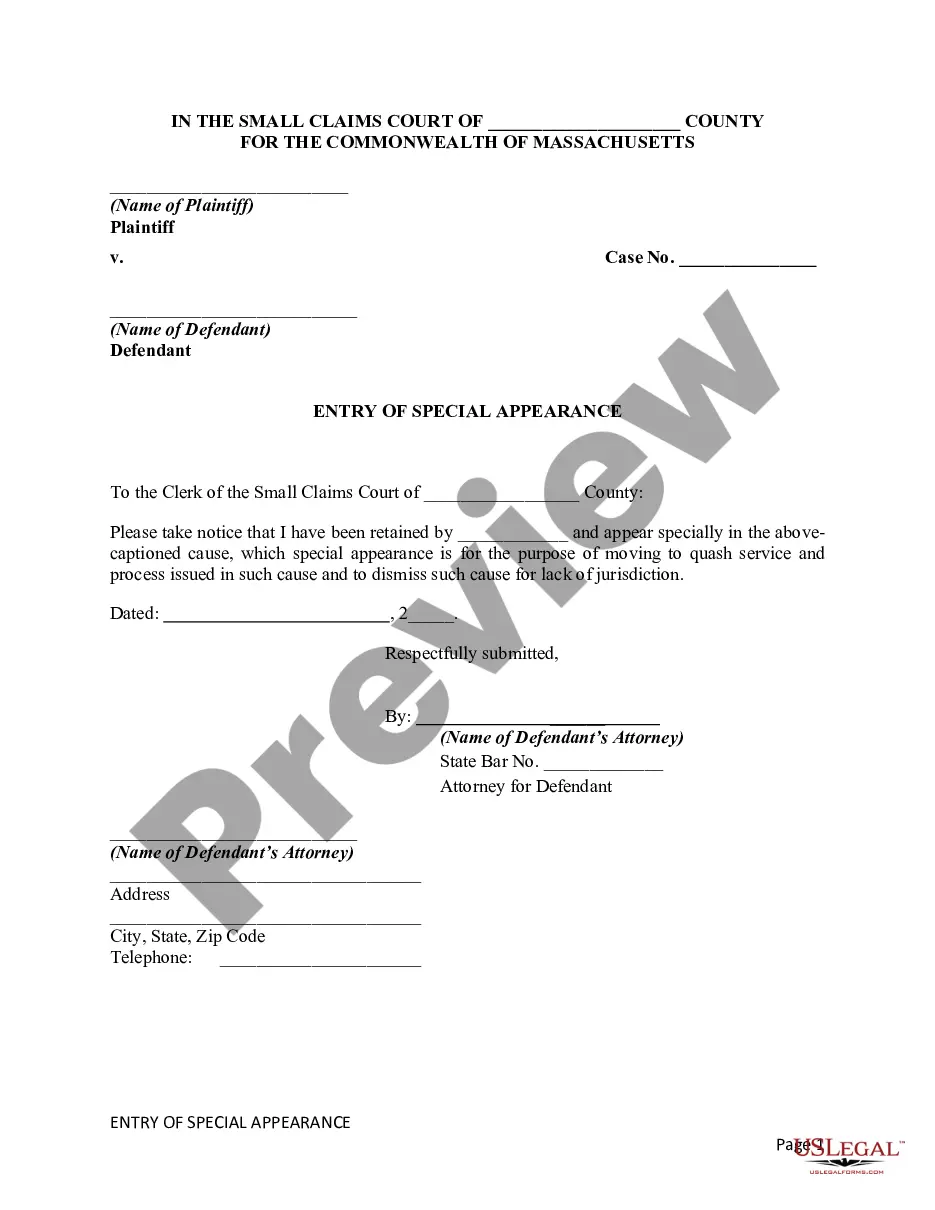
The Entry of Special Appearance form is used by a defendant to officially declare their appearance in court without acknowledging the court's jurisdiction. This form serves to prevent any claims that the defendant has made a general appearance in the case, especially in states where the court may lack personal jurisdiction over them. It is crucial when defendants wish to contest the court's authority before addressing the substance of the case.
Key components of this form
- Name of the plaintiff and defendant.
- Case number for reference.
- Notice of special appearance indicating the intention to challenge jurisdiction.
- Signature and details of the attorney representing the defendant.
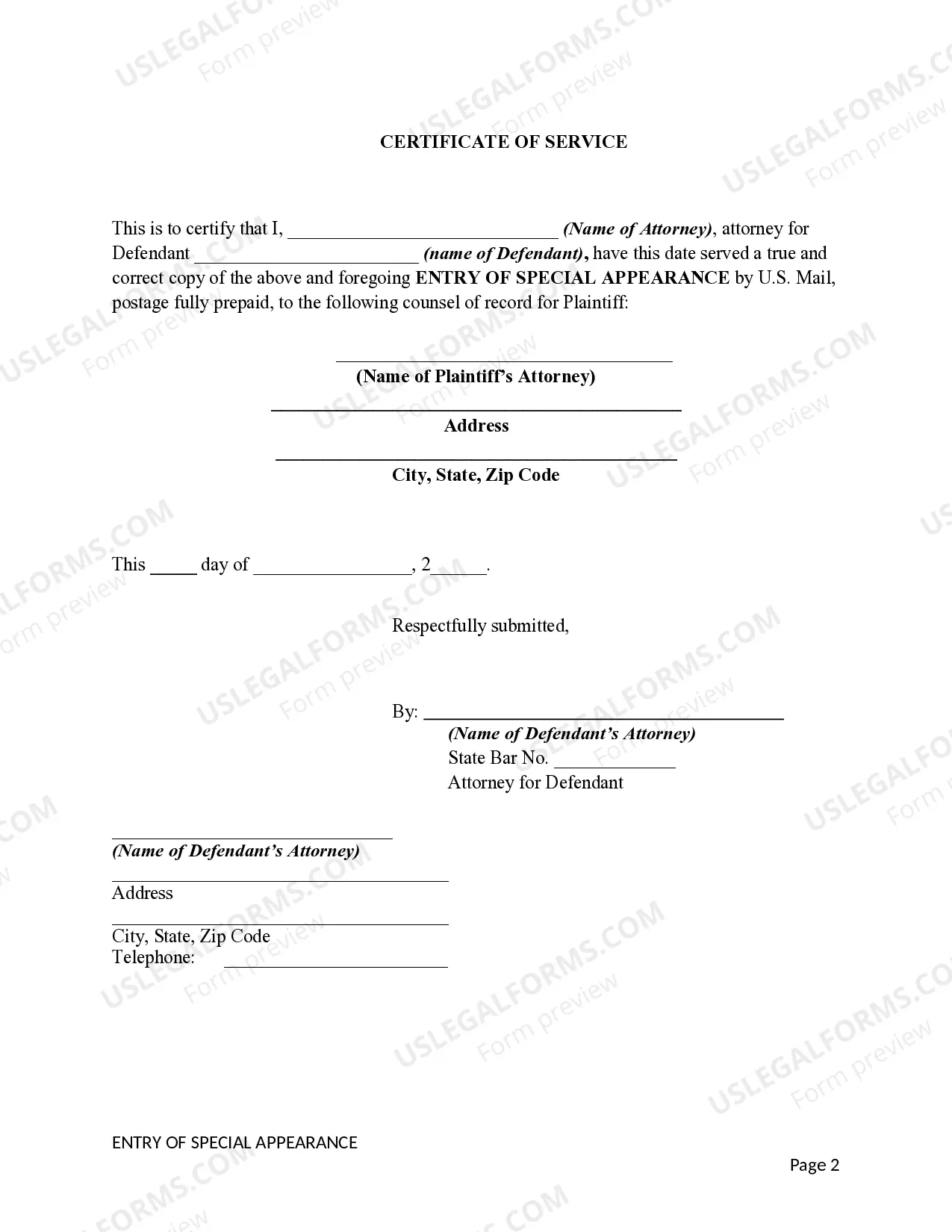
- Certificate of service confirming that the form was sent to the plaintiff's attorney.
Common use cases
This form is commonly used when a defendant is facing a legal action in a state where they believe the court does not have personal jurisdiction over them. It is particularly applicable in small claims or civil cases where defendants wish to contest ongoing legal proceedings before fully engaging in the case.
Who needs this form
- Defendants who have been served with a lawsuit in a jurisdiction where they do not reside.
- Attorneys representing defendants seeking to challenge the courtâs jurisdiction.
- Any party concerned about inadvertently agreeing to the courtâs authority by participating in proceedings.
How to prepare this document
- Identify the parties involved by entering the names of the plaintiff and defendant at the top of the form.
- Fill in the case number assigned to the legal action.
- Clearly state your intention to appear specially and the grounds on which you challenge the jurisdiction.
- Sign the form and include your attorney details, including State Bar number and contact information.
- Complete the certificate of service section, ensuring the plaintiff's attorney receives a copy of the form.
Does this document require notarization?
This form does not typically require notarization unless specified by local law. However, it is wise to check jurisdictional requirements to ensure compliance.
Get your form ready online
Our built-in tools help you complete, sign, share, and store your documents in one place.
Make edits, fill in missing information, and update formatting in US Legal Forms—just like you would in MS Word.
Download a copy, print it, send it by email, or mail it via USPS—whatever works best for your next step.
Sign and collect signatures with our SignNow integration. Send to multiple recipients, set reminders, and more. Go Premium to unlock E-Sign.
If this form requires notarization, complete it online through a secure video call—no need to meet a notary in person or wait for an appointment.
We protect your documents and personal data by following strict security and privacy standards.

Make edits, fill in missing information, and update formatting in US Legal Forms—just like you would in MS Word.

Download a copy, print it, send it by email, or mail it via USPS—whatever works best for your next step.

Sign and collect signatures with our SignNow integration. Send to multiple recipients, set reminders, and more. Go Premium to unlock E-Sign.

If this form requires notarization, complete it online through a secure video call—no need to meet a notary in person or wait for an appointment.

We protect your documents and personal data by following strict security and privacy standards.
Typical mistakes to avoid
- Failing to include the case number or party names accurately.
- Neglecting to sign the form, which may result in it being deemed invalid.
- Not notifying the plaintiffâs attorney properly, which can lead to legal complications.
Why use this form online
- Convenience of immediate access to the form without needing a lawyerâs office visit.
- Ability to edit and customize the form to fit specific case details.
- Reliable templates created by licensed attorneys, ensuring legal compliance.
Legal use & context
- The Entry of Special Appearance is recognized in many jurisdictions as a legitimate means to contest a court's authority.
- Using this form properly can prevent defendants from unintentionally granting jurisdiction to the court.
Quick recap
- The Entry of Special Appearance protects a defendantâs rights regarding jurisdiction.
- It is essential to provide complete and accurate information on this form.
- Filing the form correctly can help a defendant contest the court's authority before addressing the merits of the case.
Looking for another form?
Form popularity
FAQ
Rule 5 addresses the serving and filing of all papers and documents in civil procedures for Massachusetts courts. It explains how to serve documents to parties involved in a case, which is essential when making a Massachusetts Entry of Special Appearance. Proper adherence to Rule 5 guarantees all parties receive necessary documents, ensuring fairness during legal proceedings. For clarity on these rules, consult a legal resource like USLegalForms.
A limited appearance is a term used in the United States law of civil procedure to describe a civil defendant's appearance in a quasi in rem action in the court of another state to dispute liability to the limited extent of the value of the property seized by that court.
A limited appearance is a term used in the United States law of civil procedure to describe a civil defendant's appearance in a quasi in rem action in the court of another state to dispute liability to the limited extent of the value of the property seized by that court.
To sue someone in Massachusetts, you have to file a complaint with the clerk of the court. A complaint is not a specific form. It is a document that contains a short statement of the facts showing your claim and why you are entitled to relief and a demand for judgment granting that relief.
An Entry of Appearance is a legal document that says that an attorney represents one party in a case. It is a representation to the court that an attorney represents one party or the other.It just means they are giving up their right to be served by a sheriff with a copy of the lawsuit.
4 attorney answers A notice of appearance means that the person is appearing on behalf of the listed party, and any pleadings should be sent to the address indicated. However, this does not apply to the initial Summons and Complaint.
1) The personal attendance in court of a party or attorney for the sole purpose of arguing that the court does not have personal jurisdiction over that party.Quite often an attorney will make a "special appearance" to protect the interests of a potential client, but before a fee has been paid or arranged.
An appearance is some OVERT ACT by which the defendant comes before the court to either submit to or challenge the court's jurisdiction. Any party can appear either in person or through an attorney or a duly authorized representative; the party need not be physically present.
An appearance is some OVERT ACT by which the defendant comes before the court to either submit to or challenge the court's jurisdiction. Any party can appear either in person or through an attorney or a duly authorized representative; the party need not be physically present.
An Entry of Appearance is a legal document that says that an attorney represents one party in a case. It is a representation to the court that an attorney represents one party or the other.It just means they are giving up their right to be served by a sheriff with a copy of the lawsuit.