Louisiana Act of Exchange
Understanding this form
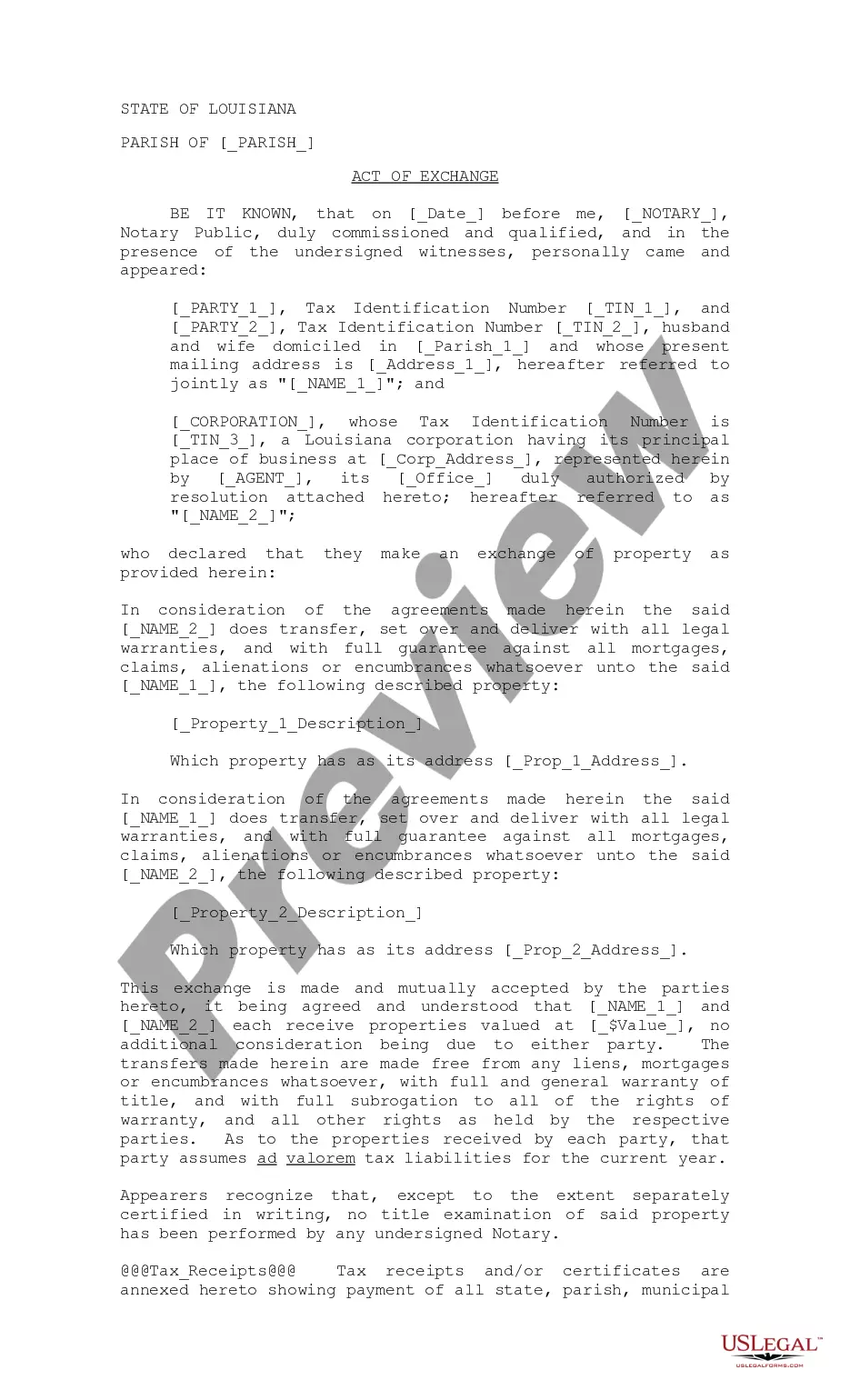
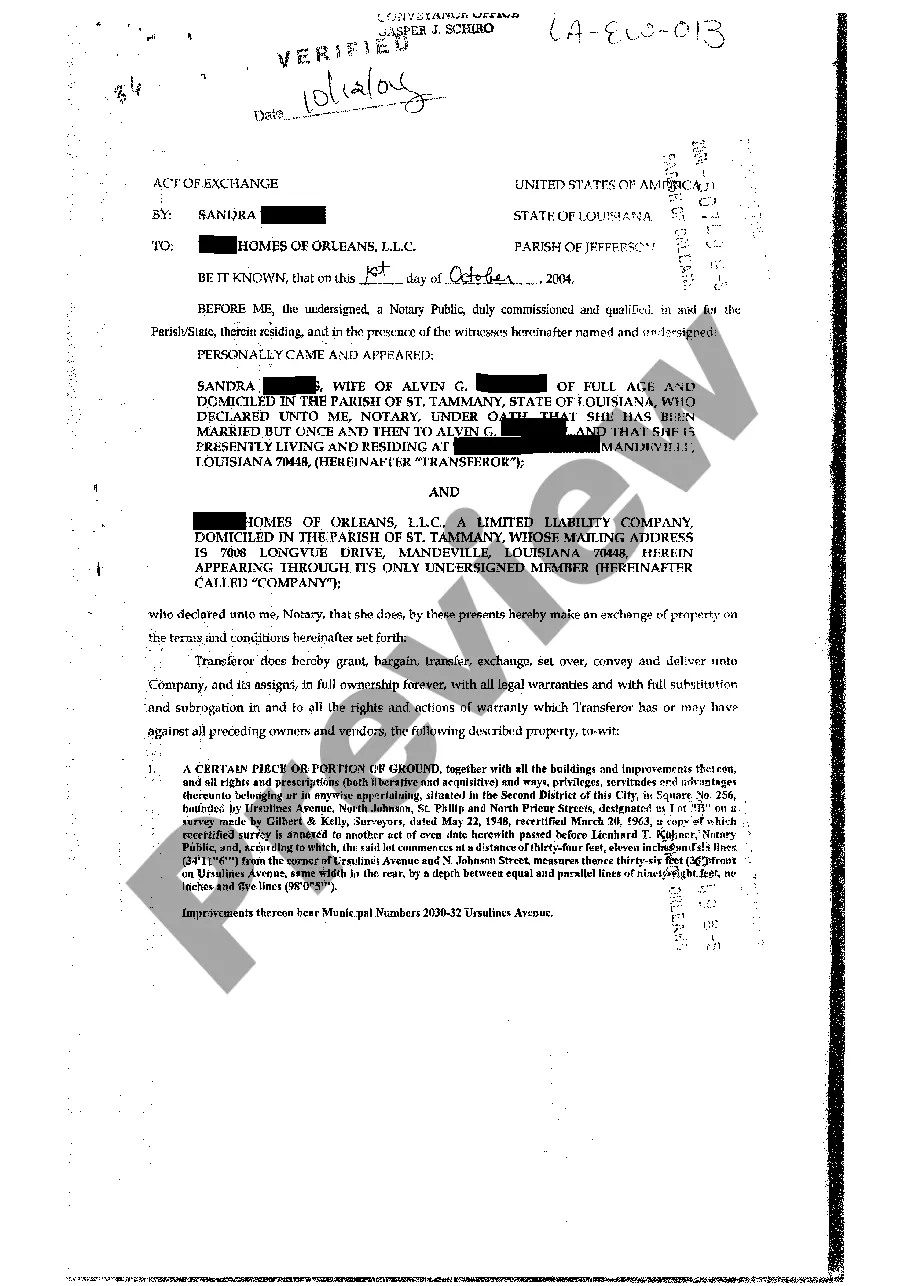
The Act of Exchange is a legal document used to formalize the exchange of immovable property between parties. In this case, it typically involves a married couple and a corporation, with each party receiving properties of equal value without any additional consideration. This form distinguishes itself by outlining the confirmatory nature of property transfers, ensuring all transactions are made free of encumbrances and with full legal warranties.
Key components of this form
- Parties Information: Identifies the individuals and corporation involved in the exchange.
- Property Descriptions: Detailed descriptions of the properties being exchanged, including addresses.
- Legal Warranties: Assurance that the exchanged properties are free from liens or other claims.
- Tax Liabilities: Clarifies that each party assumes tax responsibilities for their received property.
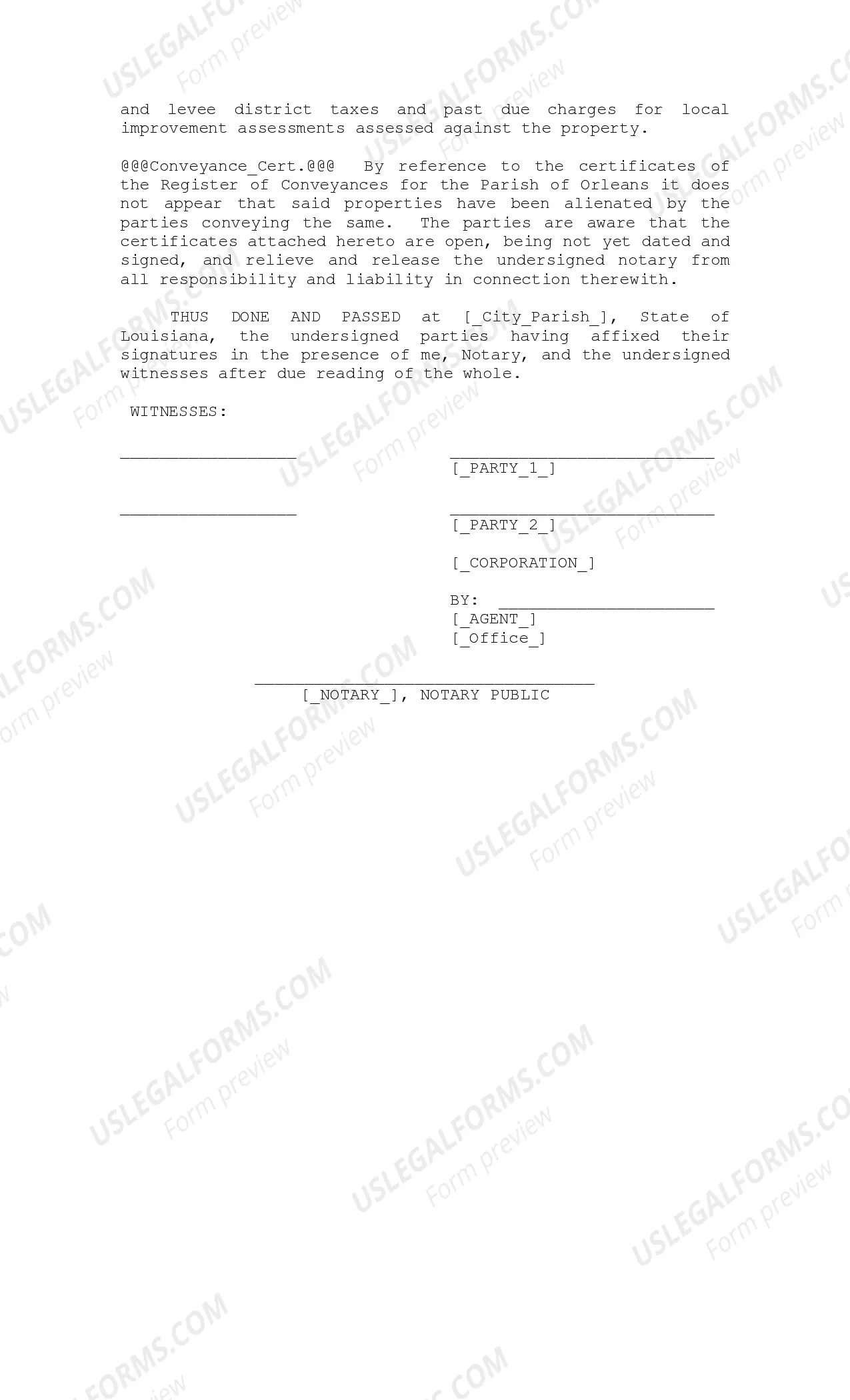
- Notary Certification: Provides a space for notary acknowledgment of the transaction.


When to use this form
You should use the Act of Exchange when two parties, such as a married couple and a corporation, wish to exchange properties of equal value without any additional financial transactions involved. This could be relevant during estate planning or when relocating property ownership among family members or organizations.
Who should use this form
- Married couples looking to exchange property ownership.
- Businesses or corporations that need to transfer real estate assets.
- Individuals involved in a property exchange where no additional compensation is given.
- Real estate professionals facilitating property transactions between parties.
Instructions for completing this form
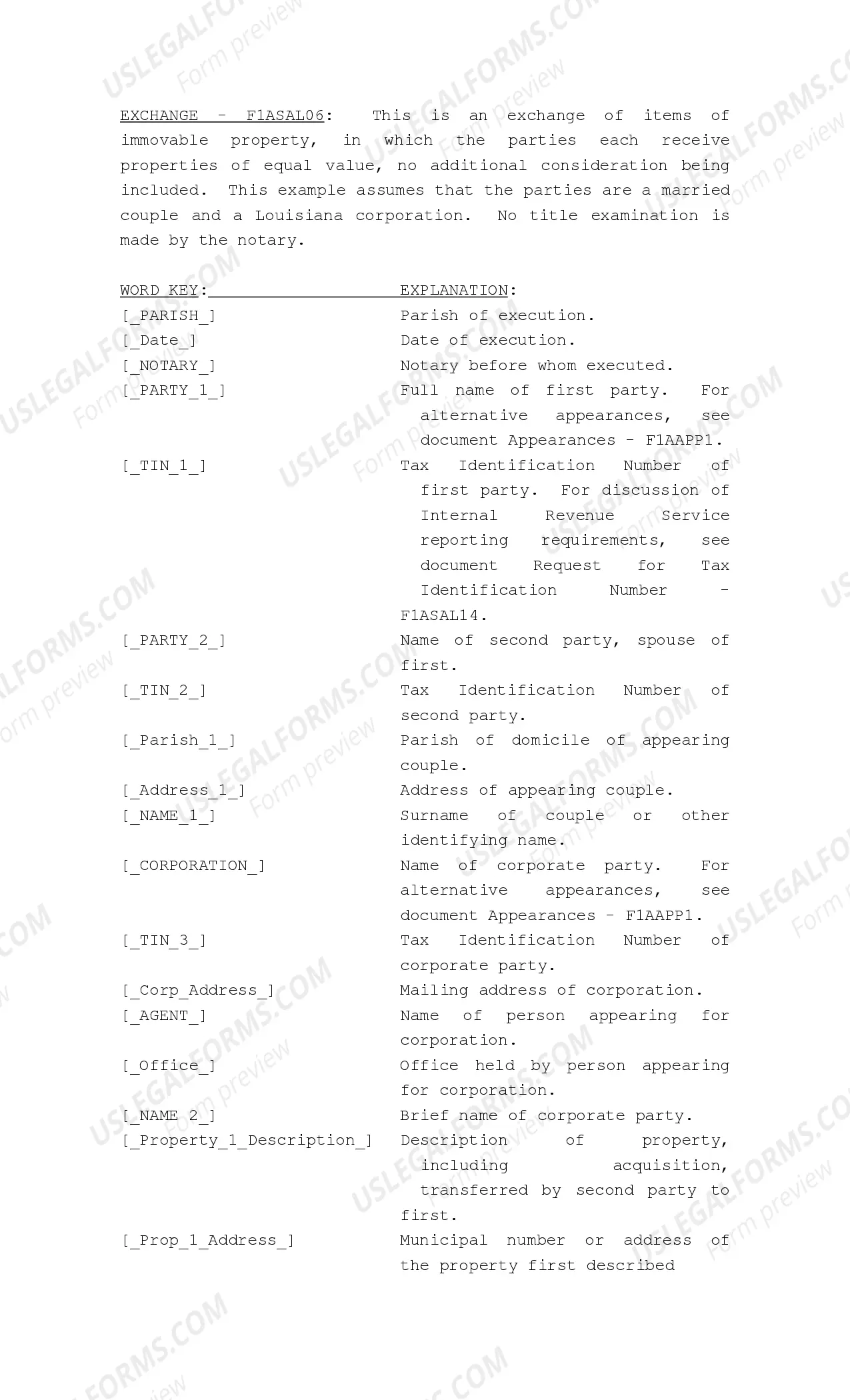
- Identify both parties involved in the exchange, including their full names and Tax Identification Numbers.
- Detail the properties being exchanged, including their descriptions and addresses.
- Include the agreed value of each property, ensuring they are equal.
- Provide the date of the exchange, location (parish and city), and the notary information.
- Ensure all parties sign the document in the presence of witnesses and the notary.
Does this form need to be notarized?
Notarization is required for this form to take effect. Our online notarization service, powered by Notarize, lets you verify and sign documents remotely through an encrypted video session, available 24/7.
Get your form ready online
Our built-in tools help you complete, sign, share, and store your documents in one place.
Make edits, fill in missing information, and update formatting in US Legal Forms—just like you would in MS Word.
Download a copy, print it, send it by email, or mail it via USPS—whatever works best for your next step.
Sign and collect signatures with our SignNow integration. Send to multiple recipients, set reminders, and more. Go Premium to unlock E-Sign.
If this form requires notarization, complete it online through a secure video call—no need to meet a notary in person or wait for an appointment.
We protect your documents and personal data by following strict security and privacy standards.

Make edits, fill in missing information, and update formatting in US Legal Forms—just like you would in MS Word.

Download a copy, print it, send it by email, or mail it via USPS—whatever works best for your next step.

Sign and collect signatures with our SignNow integration. Send to multiple recipients, set reminders, and more. Go Premium to unlock E-Sign.

If this form requires notarization, complete it online through a secure video call—no need to meet a notary in person or wait for an appointment.

We protect your documents and personal data by following strict security and privacy standards.
Typical mistakes to avoid
- Failing to clearly describe the properties being exchanged.
- Not including the correct Tax Identification Numbers for all parties.
- Overlooking signatures from all involved parties and necessary witnesses.
- Not verifying that properties are free from liens or encumbrances.
Benefits of using this form online
- Convenience: Easily download and complete the form from your own device.
- Editability: Customize the form to fit your specific needs quickly and efficiently.
- Legal assurance: Access templates drafted by licensed attorneys to ensure compliance with legal standards.
- Time-saving: Eliminate the need for in-person visits to legal offices or courthouses.
Looking for another form?

Form popularity
FAQ
The actalso known as the "Truth in Securities" law, the 1933 Act, and the Federal Securities Actrequires that investors receive financial information from securities being offered for public sale. This means that prior to going public, companies have to submit information that is readily available to investors.
SEC Form N-1A is the required registration form for establishing open-end management companies. The form can be used for registering both open-end mutual funds and open-end exchange traded funds (ETFs).
SEC Form S-1 is the initial registration form for new securities required by the SEC for public companies that are based in the U.S. Any security that meets the criteria must have an S-1 filing before shares can be listed on a national exchange, such as the New York Stock Exchange.
The Securities and Exchange Commission (SEC) requires public companies, certain company insiders, and broker-dealers to file periodic financial statements and other disclosures. Finance professionals and investors rely on SEC filings to make informed decisions when evaluating whether to invest in a company.
What Is SEC Form N-2? SEC Form N-2 is a filing with the Securities and Exchange Commission (SEC) that must be submitted by closed-end management investment companies to register under the Investment Company Act of 1940 and to offer their shares under the Securities Act of 1933.
SEC Form S-3 is a regulatory filing that provides simplified reporting for issuers of registered securities. An S-3 filing is utilized when a company wishes to raise capital, usually as a secondary offering after an initial public offering has already occurred.
Among the most common SEC filings are: Form 10-K, Form 10-Q, Form 8-K, the proxy statement, Forms 3,4, and 5, Schedule 13, Form 114, and Foreign Investment Disclosures.
SEC Form 3: Initial Statement of Beneficial Ownership of Securities is a document filed by a company insider or major shareholder with the Securities and Exchange Commission (SEC).Filing Form 3 helps disclose who these insiders are and track any suspicious behaviors.
This SEC Form 17-A shall be used for annual reports filed pursuant to Section 17 of the Securities Regulation Code (SRC) and paragraph (1)(A) of SRC Rule 17.1 thereunder.Reports filed on this Form shall be deemed to satisfy Section 141 of the Corporation Code of the Philippines.