Louisiana Letter to Opposing Counsel regarding Continuance
Overview of this form
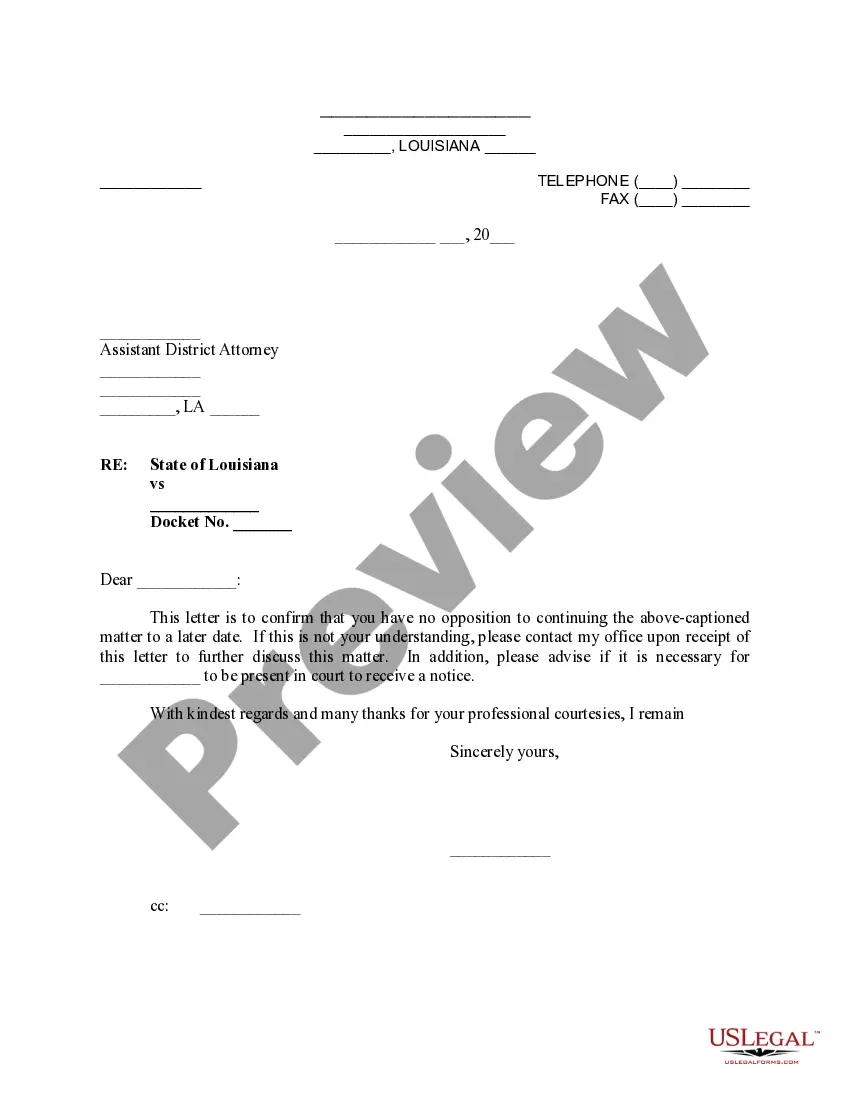
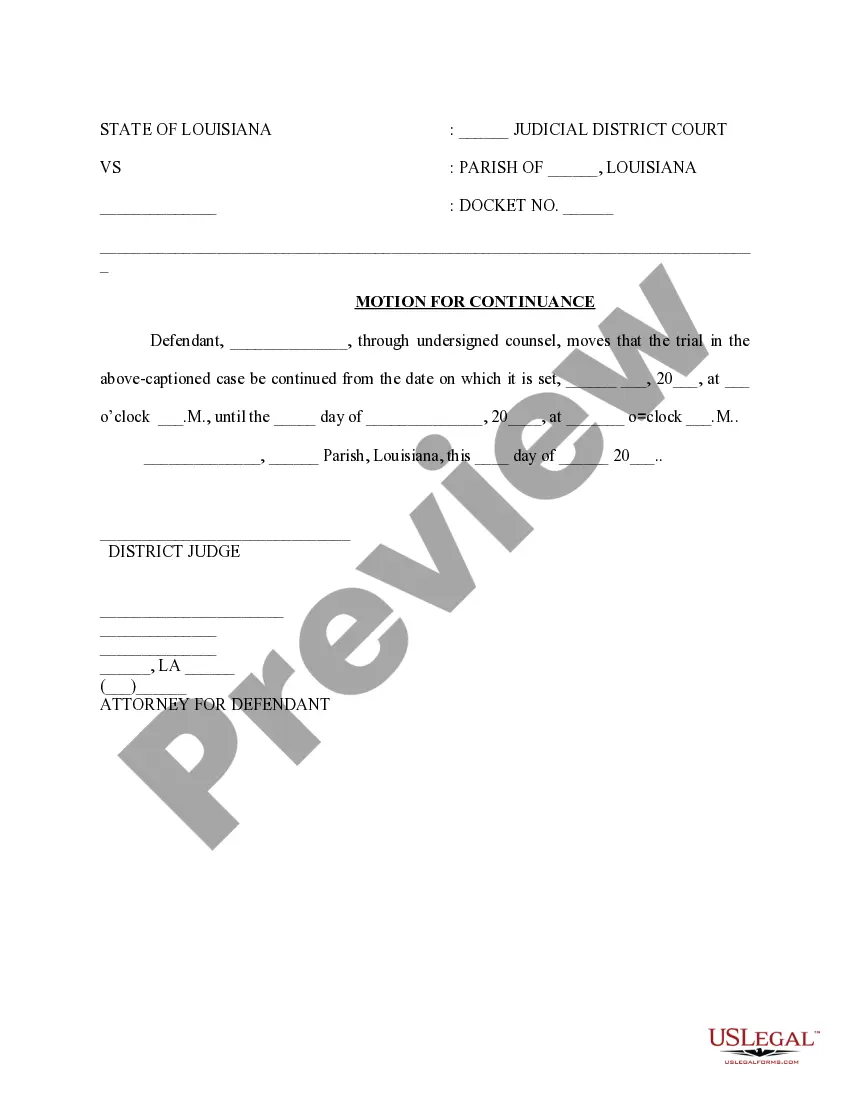
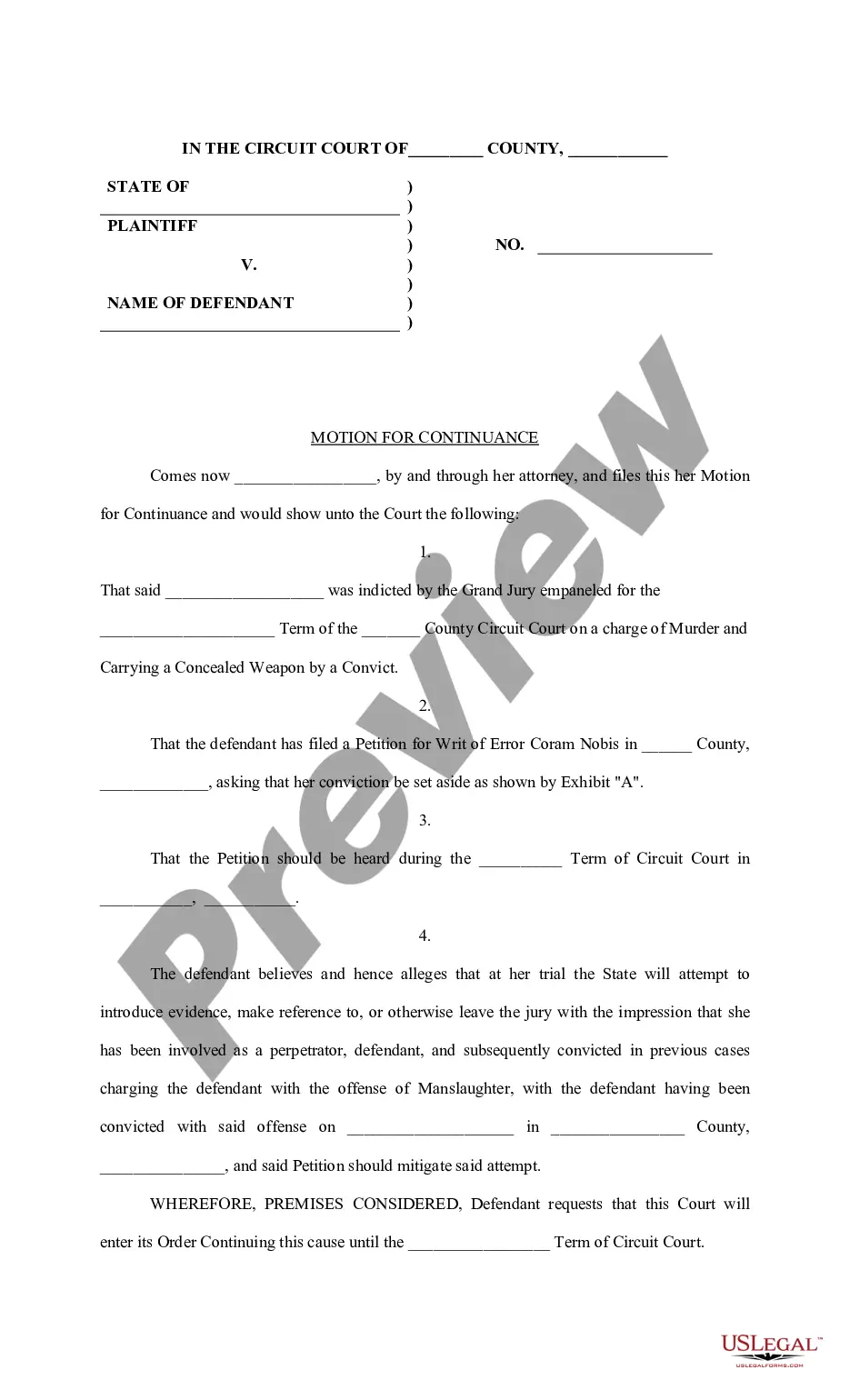
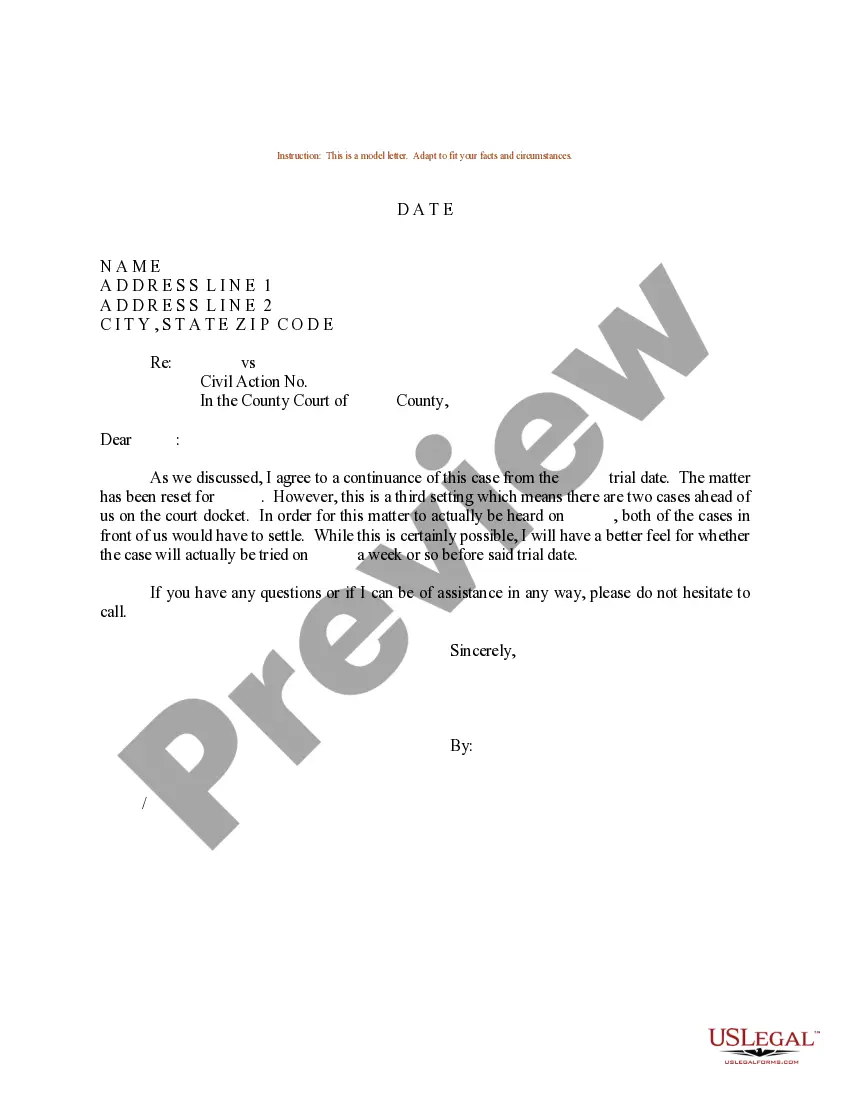
A Letter to Opposing Counsel regarding Continuance is a formal communication from a defense attorney to the Assistant District Attorney (ADA), confirming that there is no objection to postponing a criminal matter. This letter ensures clarity about the continuance and any requirements for the defendantâs presence in court. It helps facilitate communication between the legal representatives involved, making it distinct from other legal correspondence.
Main sections of this form
- Date and sender's information: Includes the attorney's address and contact details.
- Addressee's information: Specifies the name and address of the Assistant District Attorney.
- Subject line: States the case name and docket number.
- Confirmation of continuance: Clearly expresses that there is no opposition to rescheduling the matter.
- Request for clarification: Asks whether the defendant needs to be present in court for notice purposes.
- Closing: Professional sign-off and contact information for further communication.
Common use cases
This letter should be used when an attorney representing a defendant in a criminal case needs to formally confirm that the opposing counsel, typically the ADA, does not object to delaying court proceedings. It is appropriate when scheduling conflicts arise or when additional time is needed to prepare for the case.
Intended users of this form
This letter is intended for:
- Defense attorneys representing clients in criminal matters.
- Assistant District Attorneys handling ongoing cases.
- Legal professionals involved in negotiations about case schedules.
How to complete this form
Follow these steps to complete the letter:
- Identify and fill in the attorneyâs contact information at the top of the letter.
- Insert the date of writing the letter.
- Add the name and address of the Assistant District Attorney as the recipient.
- Clearly state the case name and docket number in the subject line.
- Express the confirmation of continuance and request for clarification regarding the defendant's presence in court.
- Sign the letter and include any necessary ccâs for documentation.
Notarization guidance
This form does not typically require notarization unless specified by local law.
Get your form ready online
Our built-in tools help you complete, sign, share, and store your documents in one place.
Make edits, fill in missing information, and update formatting in US Legal Forms—just like you would in MS Word.
Download a copy, print it, send it by email, or mail it via USPS—whatever works best for your next step.
Sign and collect signatures with our SignNow integration. Send to multiple recipients, set reminders, and more. Go Premium to unlock E-Sign.
If this form requires notarization, complete it online through a secure video call—no need to meet a notary in person or wait for an appointment.
We protect your documents and personal data by following strict security and privacy standards.

Make edits, fill in missing information, and update formatting in US Legal Forms—just like you would in MS Word.

Download a copy, print it, send it by email, or mail it via USPS—whatever works best for your next step.

Sign and collect signatures with our SignNow integration. Send to multiple recipients, set reminders, and more. Go Premium to unlock E-Sign.

If this form requires notarization, complete it online through a secure video call—no need to meet a notary in person or wait for an appointment.

We protect your documents and personal data by following strict security and privacy standards.
Mistakes to watch out for
- Failing to include the case name and docket number, which may lead to confusion.
- Not confirming the ADAâs lack of opposition clearly, leaving room for misinterpretation.
- Forgetting to include contact information for follow-up inquiries.
Benefits of completing this form online
- Convenient access to downloadable templates that save time and ensure professionalism.
- Editable forms allow customization to meet specific case needs.
- Reliability of forms drafted by licensed attorneys, ensuring compliance with local laws.
- The letter serves as a record of communication between legal counsel and the prosecutorâs office.
- It helps ensure transparency in the legal process and maintains an official record of the continuance request.
Quick recap
- A Letter to Opposing Counsel regarding Continuance confirms a delay in criminal proceedings.
- It is crucial for maintaining clear communication between legal parties.
- Ensure all relevant case details are included to avoid confusion.
Looking for another form?
Form popularity
FAQ
It is legal for each party's attorney to talk to the other. This helps with the negotiations and often resolves in a quicker agreement.
Definitions of opposing counsel lawyers representing the other side (the opponents) in a dispute.
A party who is represented by counsel cannot be contacted directly by opposing counsel unless that party and opposing counsel expressly authorized direct contact.
You may notice at some point in your case, your attorney and the opposing counsel seem to be on friendly terms. While this can seem alarming, in most cases it's completely normal.
Point out Common Ground. Don't be Afraid to Ask Why. Separate the Person from the Problem. Focus on your Interests. Don't Fall for your Assumptions. Take a Calculated Approach. Control the Conversation by Reframing. Pick up the Phone.
There is no rule against your talking to the opposing party, or to the opposing party's attorney. There is a rule, however, that applies to attorneys only, that would prevent opposing counsel from responding to your communication, unless he had permission from your attorney.
(A) While representing a client, a member shall not communicate directly or indirectly about the subject of the representation with a party the member knows to be represented by another lawyer in the matter, unless the member has the consent of the other lawyer.
No California legal ethics rule expressly prohibits a non-lawyer client from contacting another party directly, although clients cannot be used as conduits for indirect prohibited contact from lawyers.