Louisiana Motion to Continue and Refix Rule to Show Cause, and Order
Overview of this form
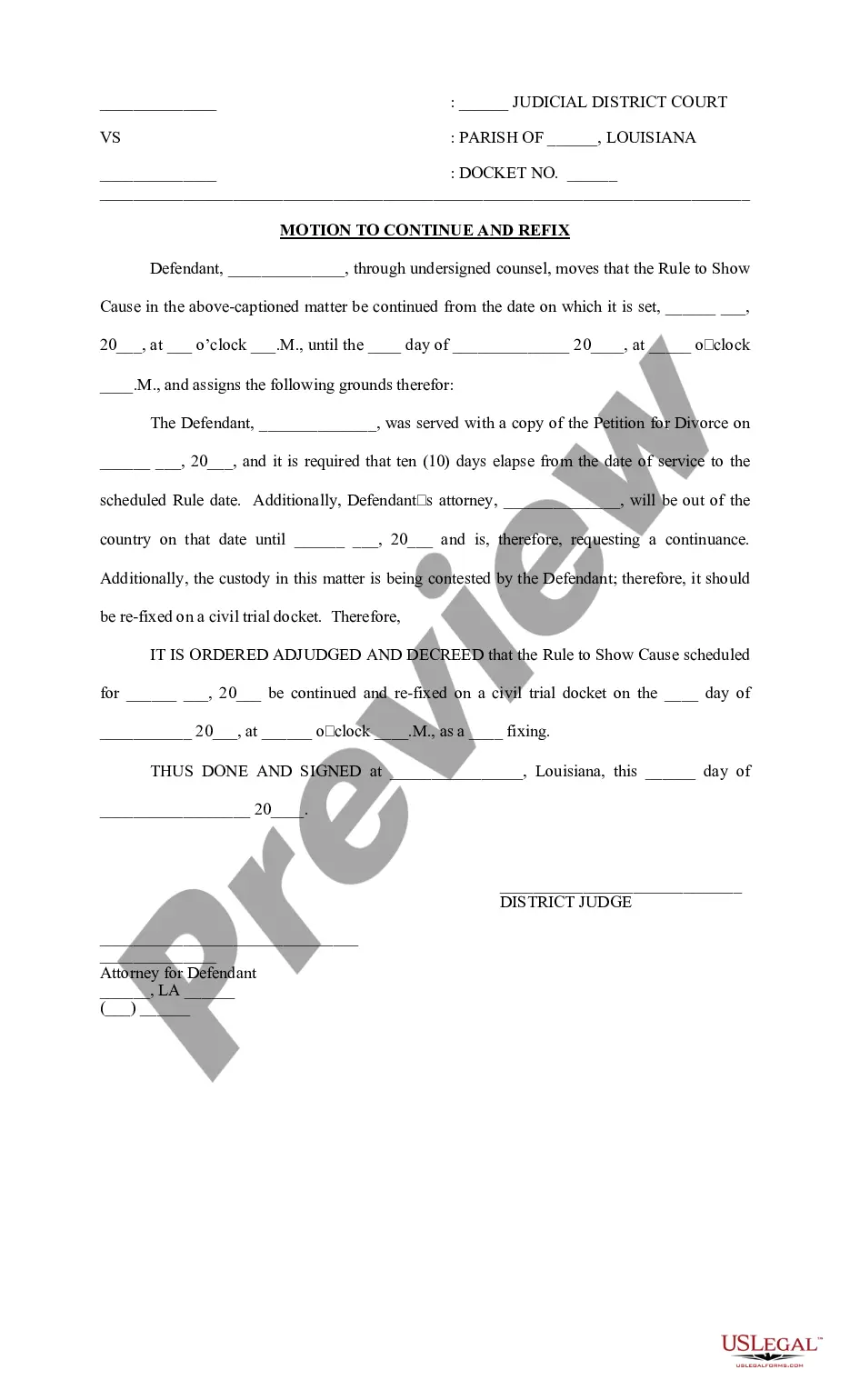
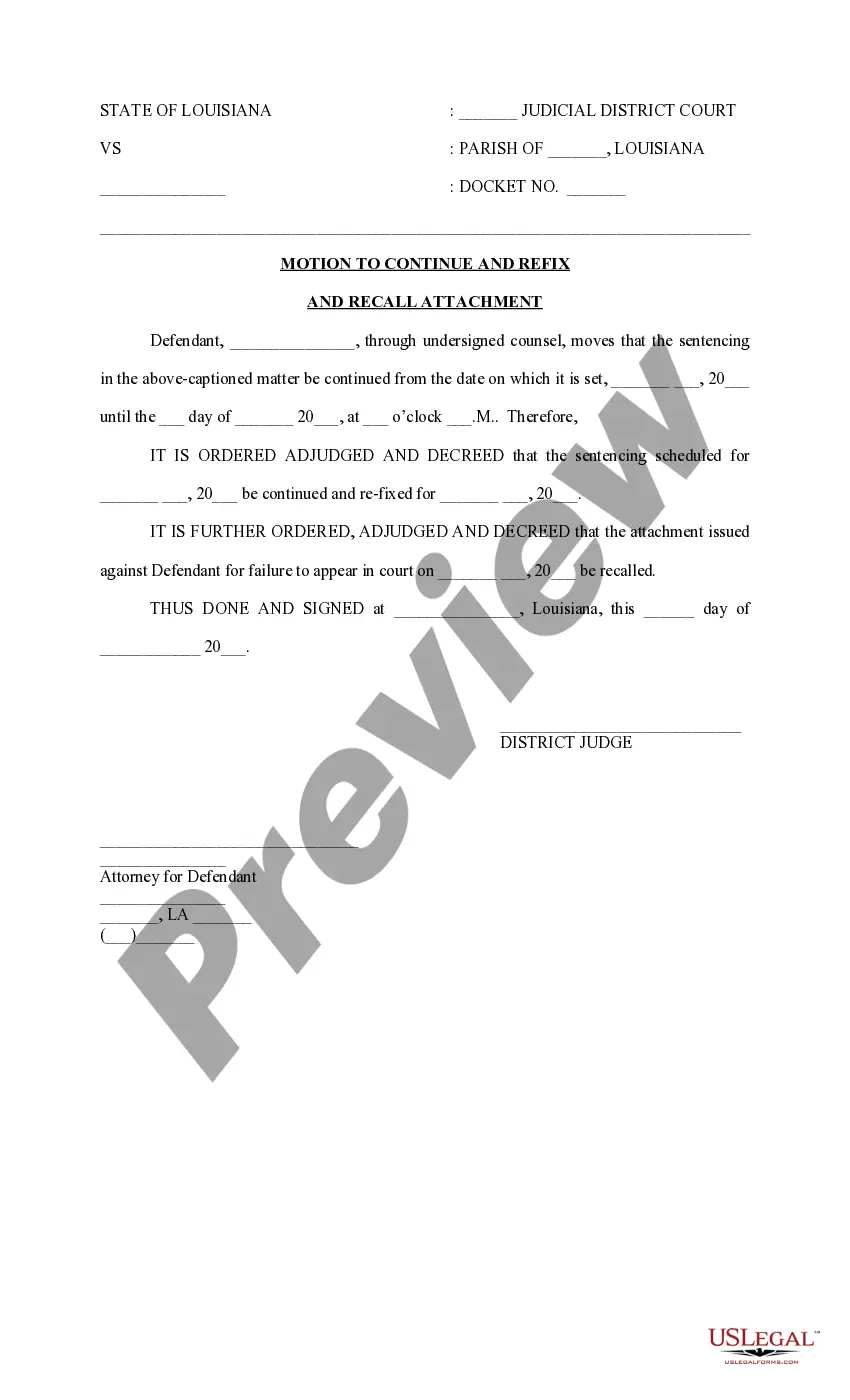
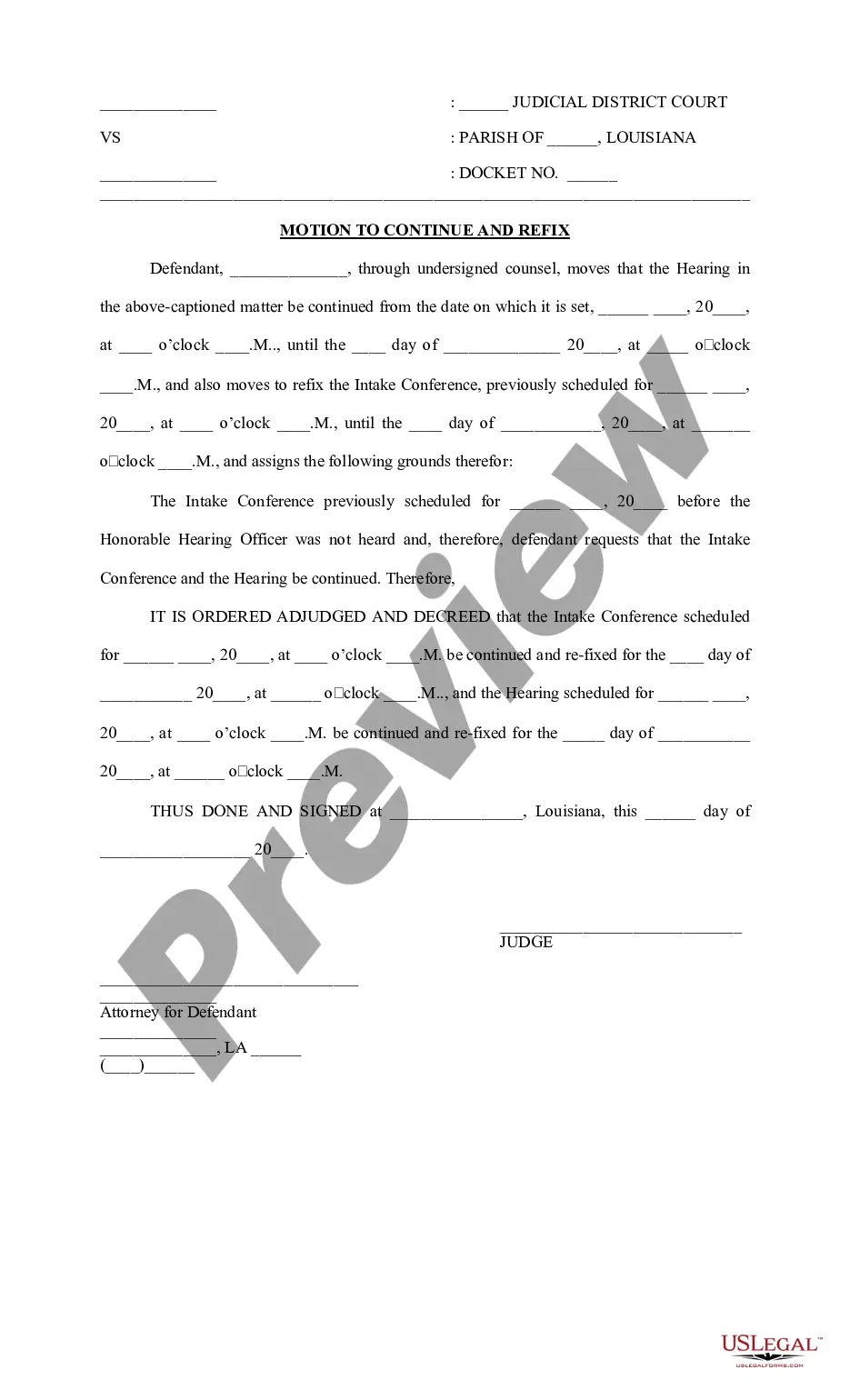
The Motion to Continue and Refix Rule to Show Cause is a legal document used within divorce proceedings to request a delay in a scheduled court date. Specifically, this motion is filed when the current rule date is less than ten days after the defendant has been served with divorce papers, or when the defendant's attorney is unavailable due to being out of the country. By submitting this motion, a party can ensure adequate time to prepare for the case, which may involve contested custody issues. This form also includes an order granting the motion, making it distinct from other motion forms that may not provide such an order.
What’s included in this form
- Caption: Contains court information, such as parish and docket number.
- Defendant's details: Identifies the defendant and their counsel.
- Requested continuance: Specifies the original and new dates for the Rule to Show Cause.
- Grounds for the motion: Lists the reasons for requesting a continuance, including the timeline of the case and attorney unavailability.
- Order section: Formal decree granting the request to continue and re-fix the hearing.
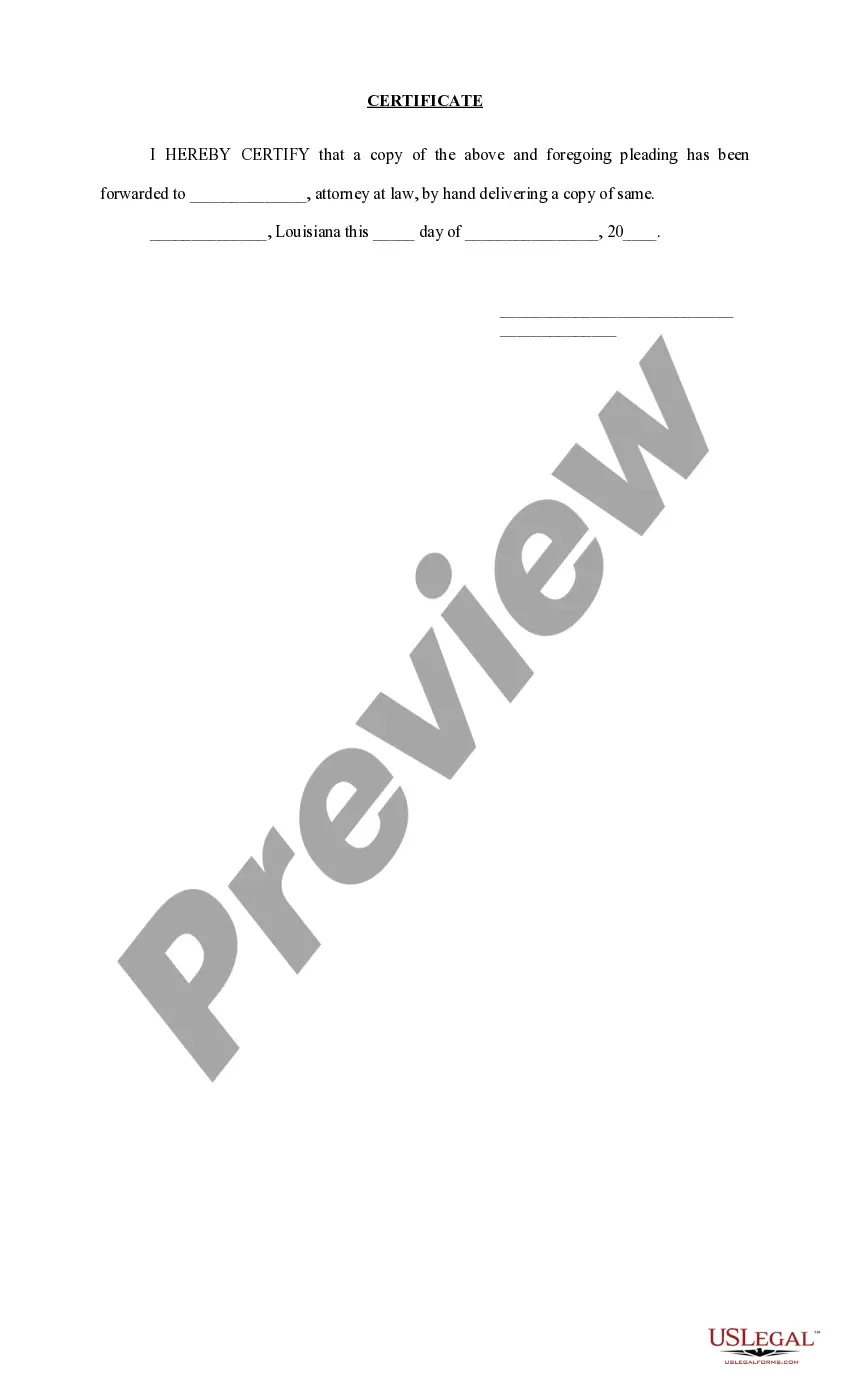
- Certificate of service: Acknowledges the delivery of the motion to the opposing counsel.
Common use cases
This form should be used when a party involved in a divorce proceedings needs to delay the court's Rule to Show Cause hearing. Common scenarios include situations where the service of the divorce petition is less than ten days away from the scheduled hearing, or when the attorney of the defendant has a scheduling conflict, such as being out of the country. It is particularly relevant when custody issues are being contested, warranting additional time for preparation on both sides.
Intended users of this form
This form is intended for:
- Defendants in divorce proceedings
- Attorneys representing defendants in custody disputes
- Parties needing to request a delay in a scheduled court hearing due to valid reasons
Completing this form step by step
- Enter the court's information, including the parish and docket number.
- Identify the defendant's name and the name of their attorney.
- Specify the original date of the Rule to Show Cause and suggest a new date.
- List the reasons for requesting the continuance, including timeline constraints and attorney absence.
- Complete the order section with the new hearing date and time.
- Sign and date the certificate of service to confirm delivery to the opposing attorney.
Does this document require notarization?
In most cases, this form does not require notarization. However, some jurisdictions or signing circumstances might. US Legal Forms offers online notarization powered by Notarize, accessible 24/7 for a quick, remote process.
Get your form ready online
Our built-in tools help you complete, sign, share, and store your documents in one place.
Make edits, fill in missing information, and update formatting in US Legal Forms—just like you would in MS Word.
Download a copy, print it, send it by email, or mail it via USPS—whatever works best for your next step.
Sign and collect signatures with our SignNow integration. Send to multiple recipients, set reminders, and more. Go Premium to unlock E-Sign.
If this form requires notarization, complete it online through a secure video call—no need to meet a notary in person or wait for an appointment.
We protect your documents and personal data by following strict security and privacy standards.

Make edits, fill in missing information, and update formatting in US Legal Forms—just like you would in MS Word.

Download a copy, print it, send it by email, or mail it via USPS—whatever works best for your next step.

Sign and collect signatures with our SignNow integration. Send to multiple recipients, set reminders, and more. Go Premium to unlock E-Sign.

If this form requires notarization, complete it online through a secure video call—no need to meet a notary in person or wait for an appointment.

We protect your documents and personal data by following strict security and privacy standards.
Mistakes to watch out for
- Failing to provide valid reasons for the request, which can lead to rejection.
- Not adhering to the required timeline of ten days after service.
- Incorrectly entering or omitting court dates and details.
- Neglecting to notify the opposing counsel as required.
Why complete this form online
- Immediate access to the form allows for quick submissions to the court.
- Easy editing capabilities ensure accurate completion of all required fields.
- Templates are created by licensed attorneys, enhancing reliability and compliance with legal standards.
Looking for another form?

Form popularity
FAQ
Ask the court for a motion date. Identify and fill out your motion forms. Serve and file your motion forms. Confirm that you will attend the motion. Go to your motion hearing. Receive the judge's decision.
The rule to show cause provided in Civil Code Article 102 shall allege proper service of the initial petition for divorce, that the requisite period of time, in accordance with Article 103.1, or more has elapsed since that service, and that the spouses have lived separate and apart continuously for the requisite period
Fill out the forms. You have to fill out at least 2 forms, maybe more, to file your opposition. File the forms. Turn in your completed forms by mail or efiling. Serve the other party. Get ready for the hearing. Prepare an order.
General format - each motion generally consists of a case caption, a title that briefly identifies the relief sought, a series of numbered paragraphs that explains -- in a logical way -- why you are entitled to that relief, a prayer for relief, a signature block, a certification that a copy of the motion was sent to
The Notice of Motion usually begins with the caption that includes the court of jurisdiction, the docket number, and below the docket number, "Notice of Motion." It is usual to then write, "Please take Notice that the undersigned will bring a motion for (what you are asking the court for or to do)." Read the Local
The motion must include a separate "Notice of Motion" which includes a brief summary of the nature of the motion, the deadline for filing a response, and if there is a hearing, the date, time, and location of the hearing.
Ask the court for a motion date. Identify and fill out your motion forms. Serve and file your motion forms. Confirm that you will attend the motion. Go to your motion hearing. Receive the judge's decision.