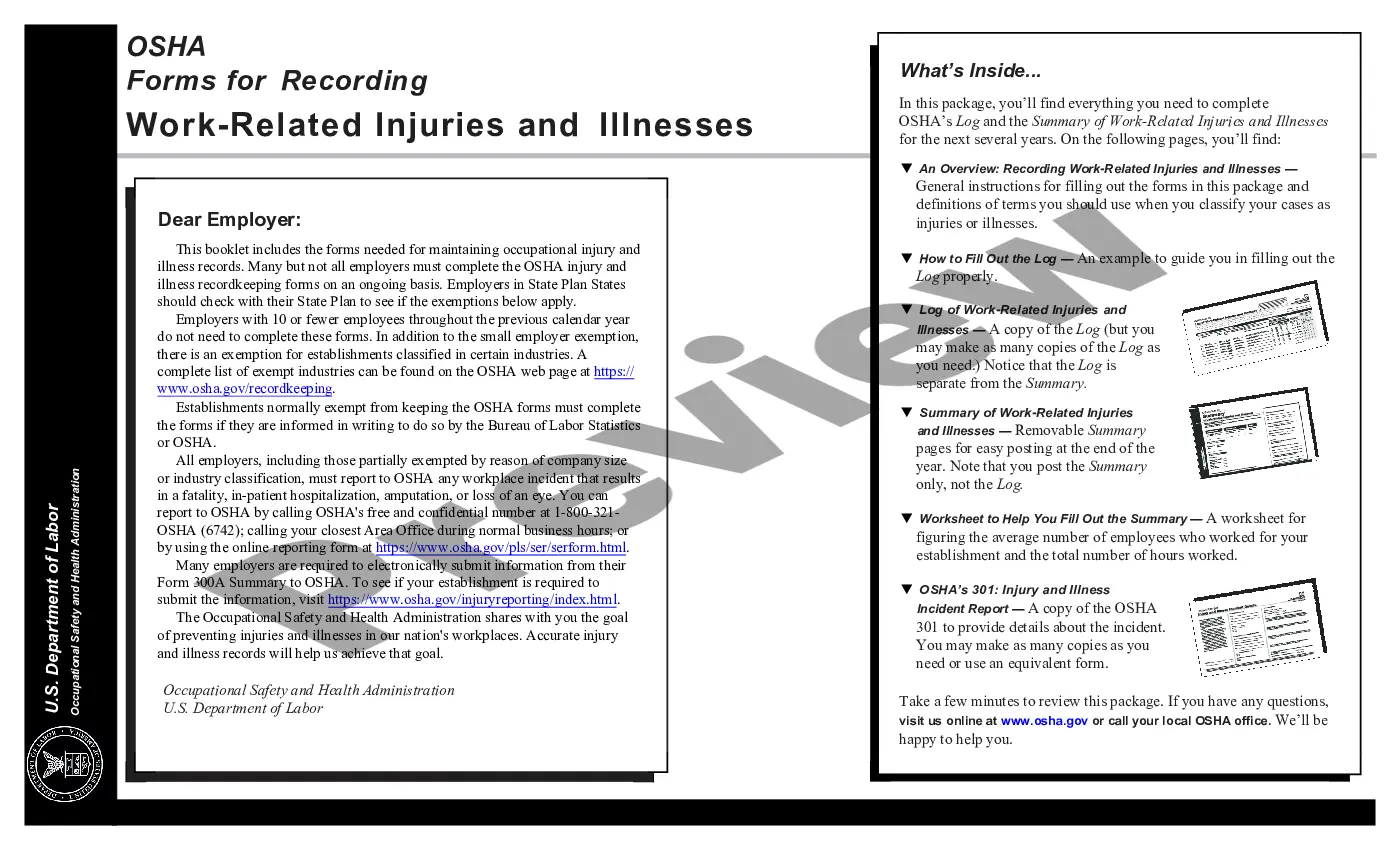
Kentucky Injury and Illness Incident Record (OSHA 301)
Description
Get your form ready online
Our built-in tools help you complete, sign, share, and store your documents in one place.
Make edits, fill in missing information, and update formatting in US Legal Forms—just like you would in MS Word.
Download a copy, print it, send it by email, or mail it via USPS—whatever works best for your next step.
Sign and collect signatures with our SignNow integration. Send to multiple recipients, set reminders, and more. Go Premium to unlock E-Sign.
If this form requires notarization, complete it online through a secure video call—no need to meet a notary in person or wait for an appointment.
We protect your documents and personal data by following strict security and privacy standards.

Make edits, fill in missing information, and update formatting in US Legal Forms—just like you would in MS Word.

Download a copy, print it, send it by email, or mail it via USPS—whatever works best for your next step.

Sign and collect signatures with our SignNow integration. Send to multiple recipients, set reminders, and more. Go Premium to unlock E-Sign.

If this form requires notarization, complete it online through a secure video call—no need to meet a notary in person or wait for an appointment.

We protect your documents and personal data by following strict security and privacy standards.
Looking for another form?



How to fill out Injury And Illness Incident Record (OSHA 301)?
If you wish to accumulate, download, or generate sanctioned document formats, utilize US Legal Forms, the largest collection of legal documents that are available online.
Utilize the site's straightforward and user-friendly search to find the documents you require.
Various templates for business and personal uses are organized by categories and states, or keywords.
Step 4. Once you have found the form you need, click the Buy now button. Select the pricing option you prefer and provide your information to register for an account.
Step 5. Complete the transaction. You can use your Visa or MasterCard or PayPal account to finalize the purchase.
- Employ US Legal Forms to locate the Kentucky Injury and Illness Incident Record (OSHA 301) with just a few clicks.
- If you're already a US Legal Forms customer, sign in to your account and click the Download button to obtain the Kentucky Injury and Illness Incident Record (OSHA 301).
- You can also access forms you previously downloaded in the My documents section of your account.
- If you are using US Legal Forms for the first time, follow the instructions below.
- Step 1. Ensure you have selected the form for the correct city/state.
- Step 2. Utilize the Preview option to review the form's content. Don't forget to read the description.
- Step 3. If you are dissatisfied with the form, use the Search field at the top of the screen to find alternative versions of the legal document format.
Form popularity
FAQ
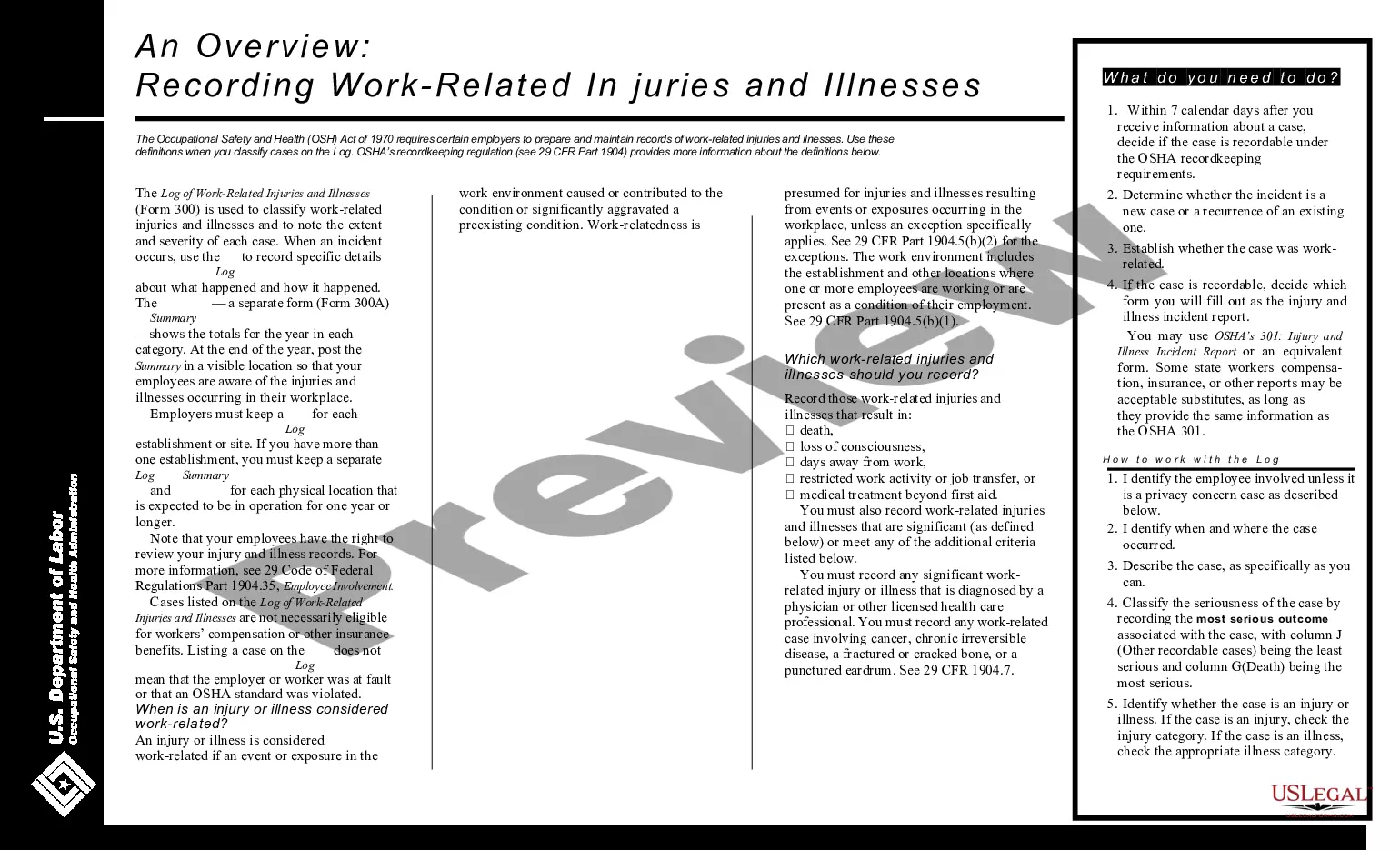
You must consider an injury or illness to meet the general recording criteria, and therefore to be recordable, if it results in any of the following: death, days away from work, restricted work or transfer to another job, medical treatment beyond first aid, or loss of consciousness.
You must record any significant work- related injury or illness that is diagnosed by a physician or other licensed health care professional. You must record any work-related case involving cancer, chronic irreversible disease, a fractured or cracked bone, or a punctured eardrum. See 29 CFR 1904.7.
How does OSHA define a recordable injury or illness? Any work-related fatality. Any work-related injury or illness that results in loss of consciousness, days away from work, restricted work, or transfer to another job. Any work-related injury or illness requiring medical treatment beyond first aid.
How does OSHA define a recordable injury or illness? Any work-related fatality. Any work-related injury or illness that results in loss of consciousness, days away from work, restricted work, or transfer to another job. Any work-related injury or illness requiring medical treatment beyond first aid.
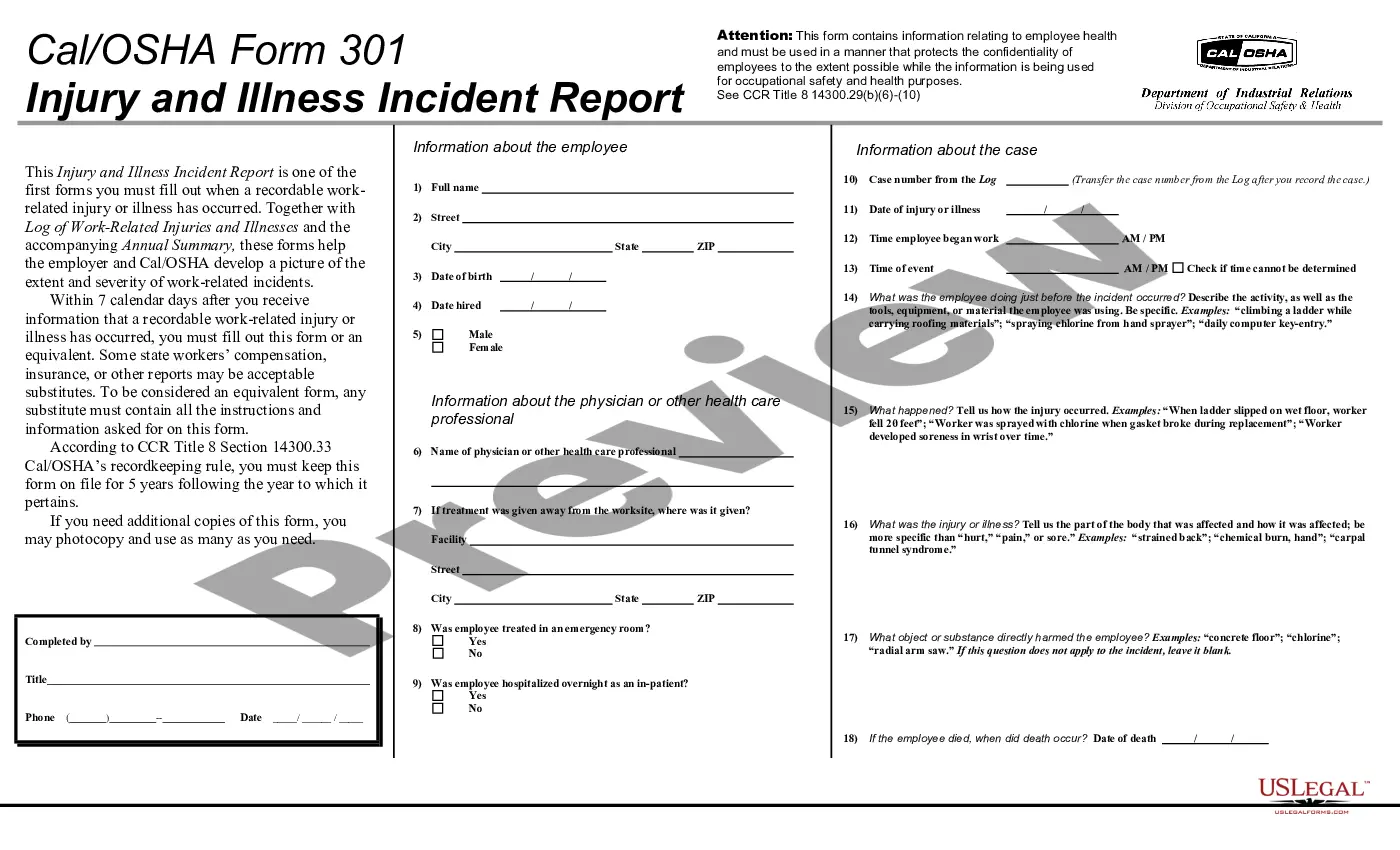
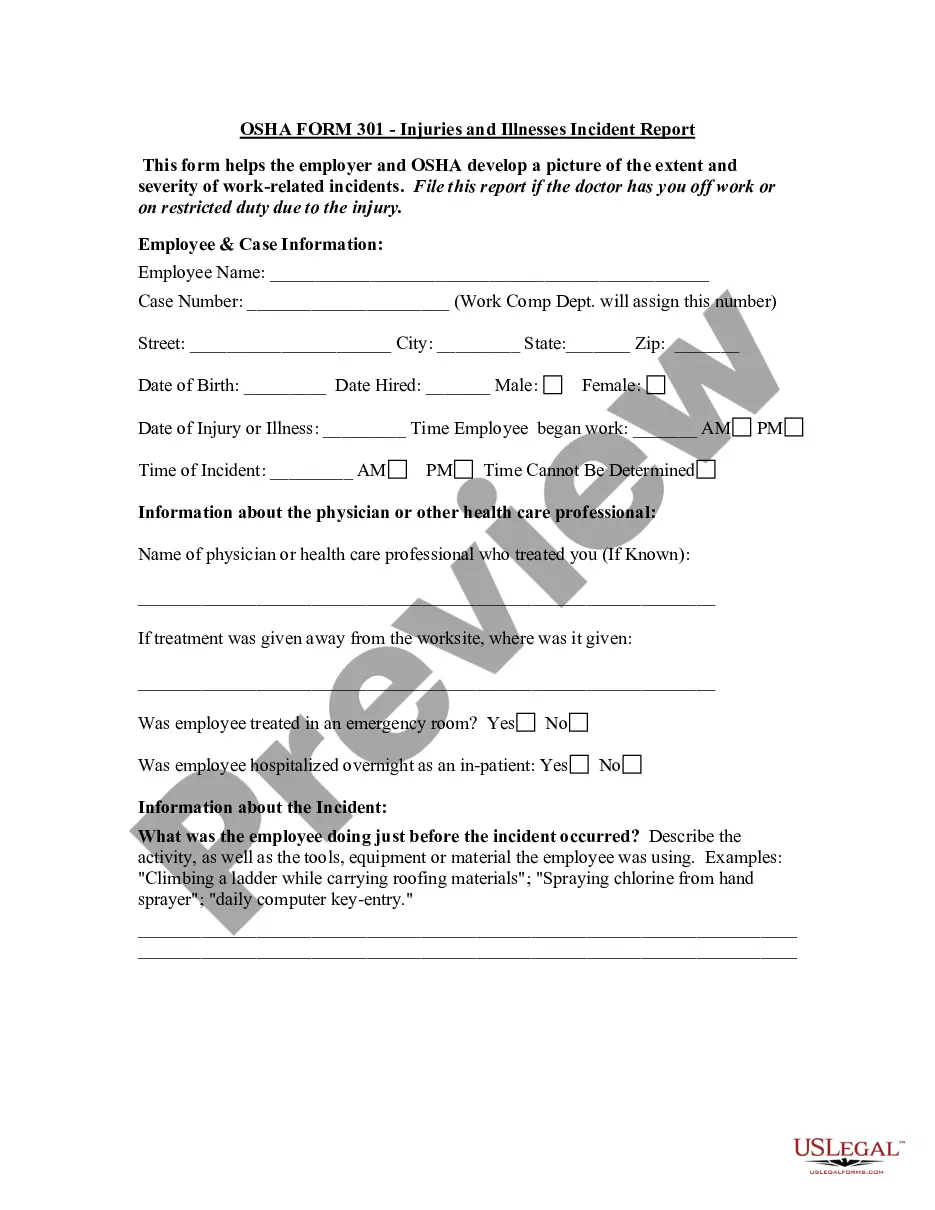
Occupational Safety and Health Administration (OSHA) Form 301, Injury and Illness Incident Report, is used by employers to keep a record of a single injury, illness, or death in a workplace. This form is found within OSHA Form 300, which is used to log and classify all such incidents for a workplace.
All employers are required to notify OSHA when an employee is killed on the job or suffers a work-related hospitalization, amputation, or loss of an eye. A fatality must be reported within 8 hours. An in-patient hospitalization, amputation, or eye loss must be reported within 24 hours.
Recording is simply the act of tracking an on-the-job injury or illness. Multiple forms and logs need to be filled out and maintained by each organization, with different details required of each one. Reporting means notifying OSHA of certain outcomes from occupational incidents, such as a death.
First, the employer must maintain a summary form (OSHA Form 200, commonly referred to as the "OSHA Log," or an equivalent form) that lists each injury and illness that occurred in each establishment during the year.
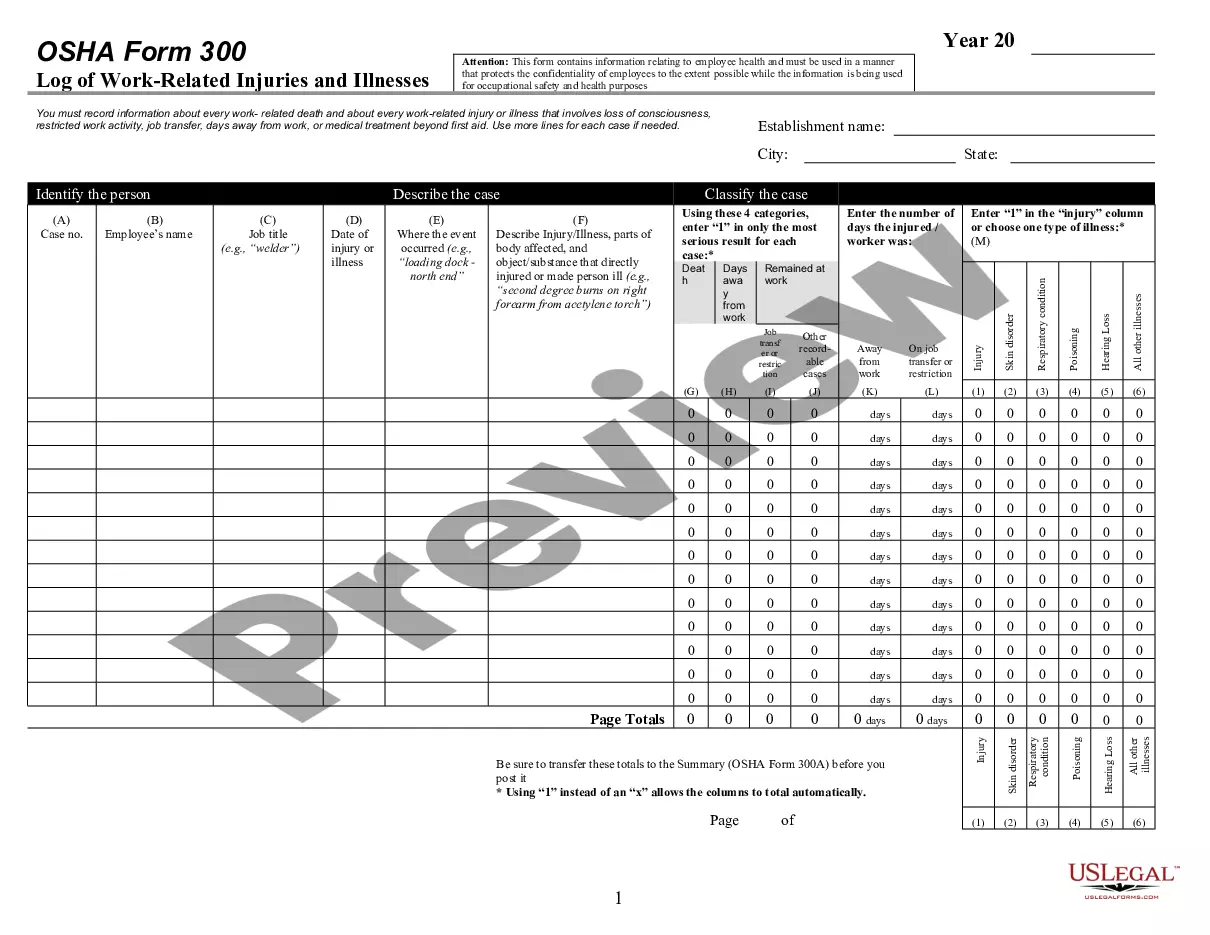
The OSHA 300 Log requires employers to check one of 6 boxes to categorize the injury/illness: (1) injury (2) skin disorder (3) respiratory condition (4) poisoning (5) hearing loss (6) all other illnesses. There are spaces to record days of job transfer or work restriction, as well as days away from work.
Under OSHA's recordkeeping regulation, certain covered employers are required to prepare and maintain records of serious occupational injuries and illnesses using the OSHA 300 Log.