Kentucky Mutual Aid Contract for Emergencies
Description

Get your form ready online
Our built-in tools help you complete, sign, share, and store your documents in one place.
Make edits, fill in missing information, and update formatting in US Legal Forms—just like you would in MS Word.
Download a copy, print it, send it by email, or mail it via USPS—whatever works best for your next step.
Sign and collect signatures with our SignNow integration. Send to multiple recipients, set reminders, and more. Go Premium to unlock E-Sign.
If this form requires notarization, complete it online through a secure video call—no need to meet a notary in person or wait for an appointment.
We protect your documents and personal data by following strict security and privacy standards.

Make edits, fill in missing information, and update formatting in US Legal Forms—just like you would in MS Word.

Download a copy, print it, send it by email, or mail it via USPS—whatever works best for your next step.

Sign and collect signatures with our SignNow integration. Send to multiple recipients, set reminders, and more. Go Premium to unlock E-Sign.

If this form requires notarization, complete it online through a secure video call—no need to meet a notary in person or wait for an appointment.

We protect your documents and personal data by following strict security and privacy standards.
Looking for another form?


How to fill out Mutual Aid Contract For Emergencies?
If you require thorough, download, or print valid document templates, utilize US Legal Forms, the largest collection of legal forms, accessible online.
Employ the website's user-friendly and convenient search to locate the documents you need.
Various templates for business and personal purposes are organized by categories and states, or keywords.
Step 3. If you are not satisfied with the form, use the Lookup section at the top of the screen to find other versions of the legal form format.
Step 4. Once you have found the form you need, click the Acquire now button. Choose the pricing plan you prefer and input your credentials to register for an account.
- Utilize US Legal Forms to obtain the Kentucky Mutual Aid Contract for Emergencies in just a few clicks.
- If you are an existing US Legal Forms user, Log In to your account and click the Acquire button to find the Kentucky Mutual Aid Contract for Emergencies.
- You can also access forms you previously downloaded within the My documents tab of your account.
- If you are using US Legal Forms for the first time, follow the instructions below.
- Step 1. Ensure you have chosen the form for the correct city/state.
- Step 2. Use the Preview option to review the form's details. Remember to check the description.
Form popularity
FAQ
The Logistics Section in the Incident Command System (ICS) is responsible for mutual aid agreements. This section oversees the acquisition and deployment of resources needed during emergencies. Utilizing the Kentucky Mutual Aid Contract for Emergencies helps streamline logistics and resource sharing between jurisdictions, enhancing overall response capabilities.
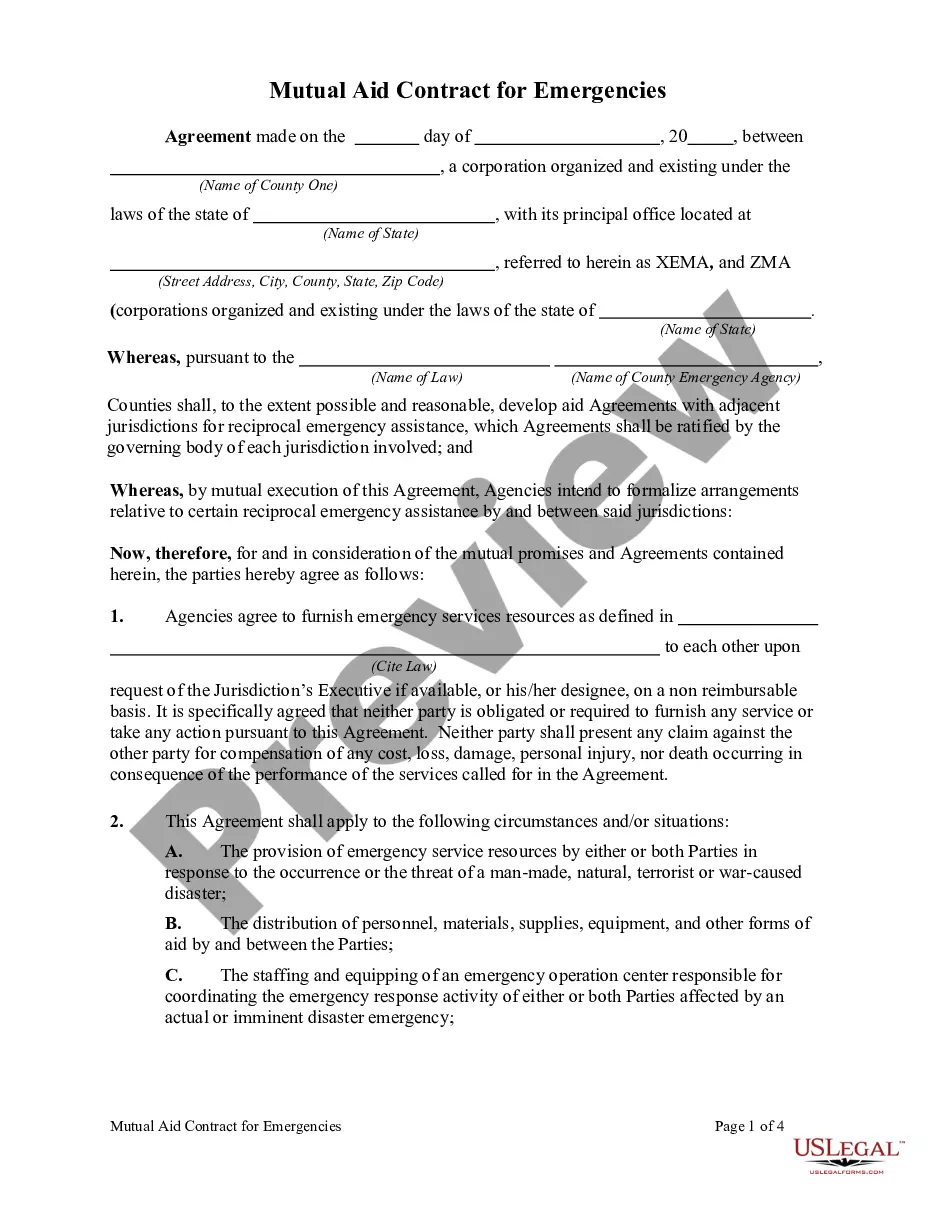
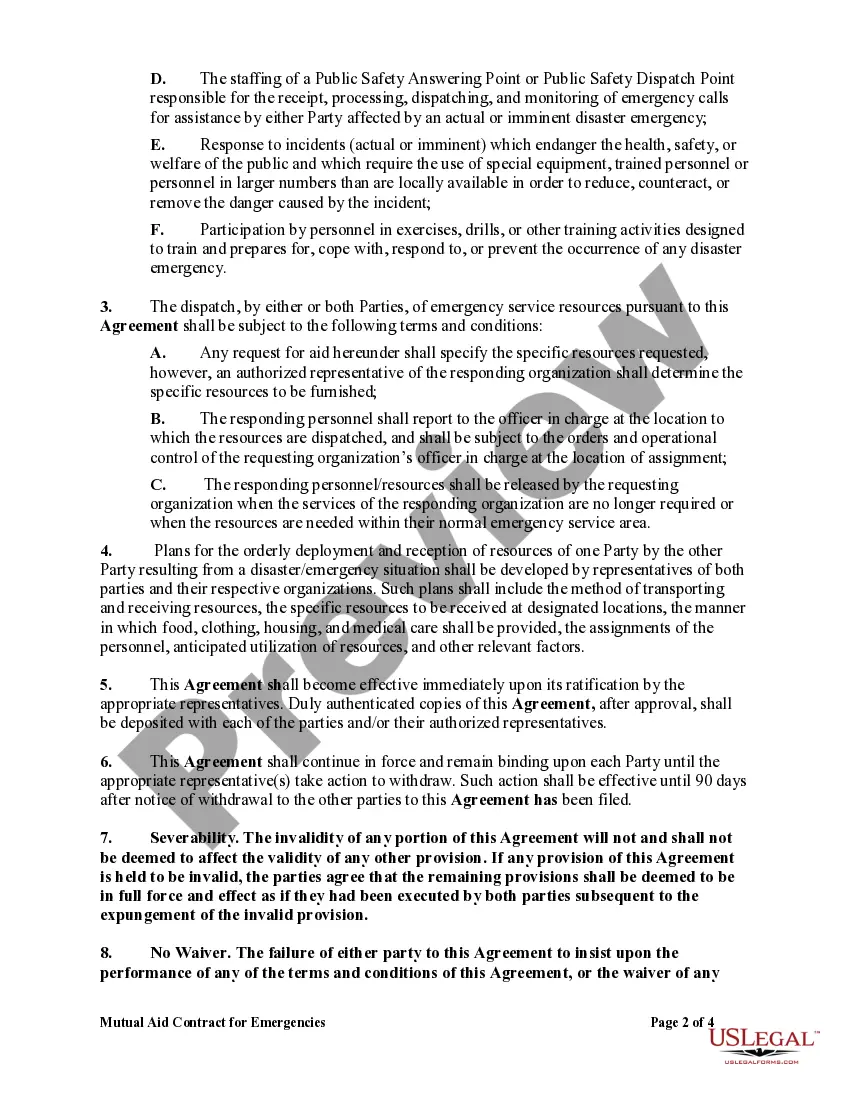
A mutual aid agreement is a formal arrangement between organizations to provide assistance to one another during emergencies. These agreements facilitate the sharing of resources, personnel, and information. The Kentucky Mutual Aid Contract for Emergencies serves as a comprehensive guideline, enabling agencies to collaborate effectively and efficiently in crisis situations.
The concept of mutual aid has origins in numerous historical responses to community needs, particularly in firefighting and disaster situations. It has evolved over time with contributions from various organizations and communities. Today, frameworks like the Kentucky Mutual Aid Contract for Emergencies formalize mutual aid to enhance cooperative responses.
The first step in creating a mutual aid agreement involves assessing the needs and capabilities of all participating organizations. This assessment helps identify resource gaps and strengths. From here, stakeholders can draft a Kentucky Mutual Aid Contract for Emergencies that addresses specific roles, responsibilities, and procedures to follow during an emergency.
Mutual aid agreements are typically established by governing bodies and emergency management organizations at various levels. Local governments, state agencies, and non-profit organizations often collaborate in this effort. The Kentucky Mutual Aid Contract for Emergencies is designed to simplify this process, ensuring that all parties understand their roles and responsibilities during critical situations.
A mutual aid agreement with FEMA outlines the collaborative responsibilities for disaster response and recovery among states or local governments. Such agreements often detail the sharing of resources and personnel during emergencies. By leveraging the Kentucky Mutual Aid Contract for Emergencies, agencies can enhance their preparedness and efficiently respond when disaster strikes.
The process of establishing mutual aid agreements is rooted in resource management planning. This activity involves coordination between different agencies and organizations to ensure a unified approach in emergencies. The Kentucky Mutual Aid Contract for Emergencies is an essential tool that facilitates these agreements, enabling timely resource sharing among jurisdictions.
Creating a mutual aid system involves several key steps, starting with identifying potential partners and their capabilities. For the Kentucky Mutual Aid Contract for Emergencies, agencies should collaboratively draft agreements that establish common goals and procedures. This process also includes training and exercises to prepare all participants for real-life scenarios. Developing strong relationships with other agencies is vital for an effective mutual aid program.
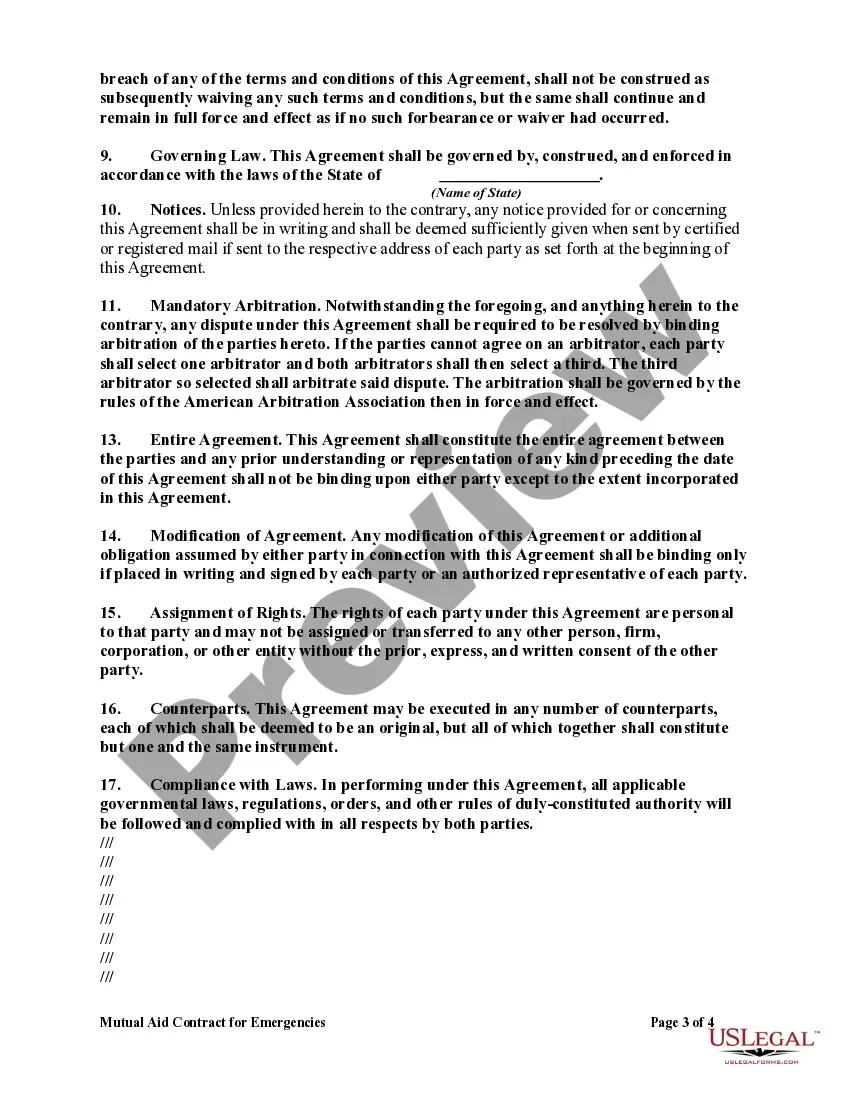
An aid agreement is a formal arrangement that outlines the terms and conditions for cooperation during emergencies. Within the context of the Kentucky Mutual Aid Contract for Emergencies, this agreement serves as a binding document between agencies. It defines responsibilities, procedures, and resource sharing methods to ensure a prompt response. Establishing a clear aid agreement is essential for effective collaboration in times of need.
The components of mutual aid include agreements, coordination mechanisms, resource lists, and communication protocols. The Kentucky Mutual Aid Contract for Emergencies incorporates these elements to ensure a structured response during a crisis. These components facilitate a unified approach to disaster response, allowing agencies to work seamlessly together. Ensuring all parties are on the same page is critical to effective emergency management.