Kansas Revocation of Transfer on Death Deed or TOD - Beneficiary Deed for Individual to Individual
About this form
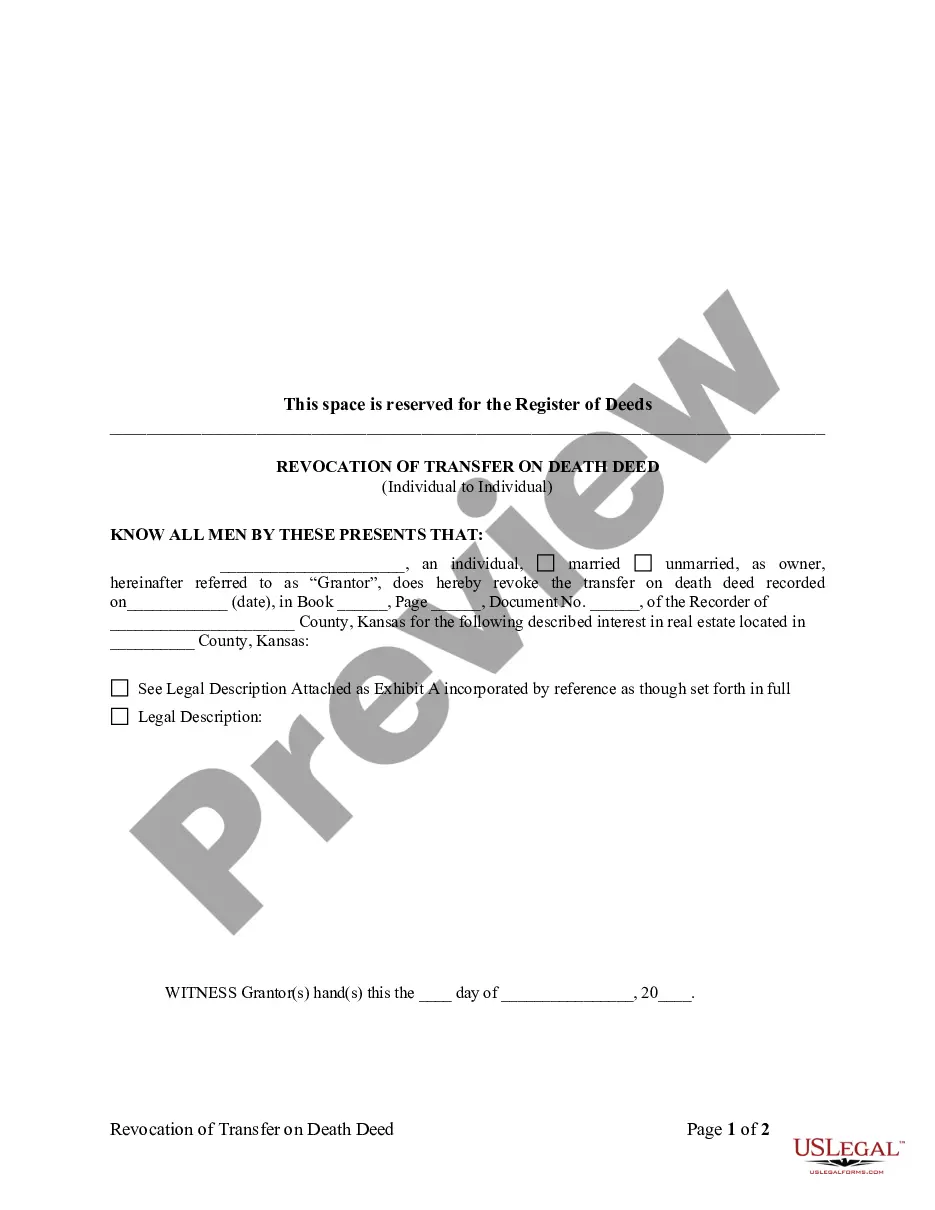
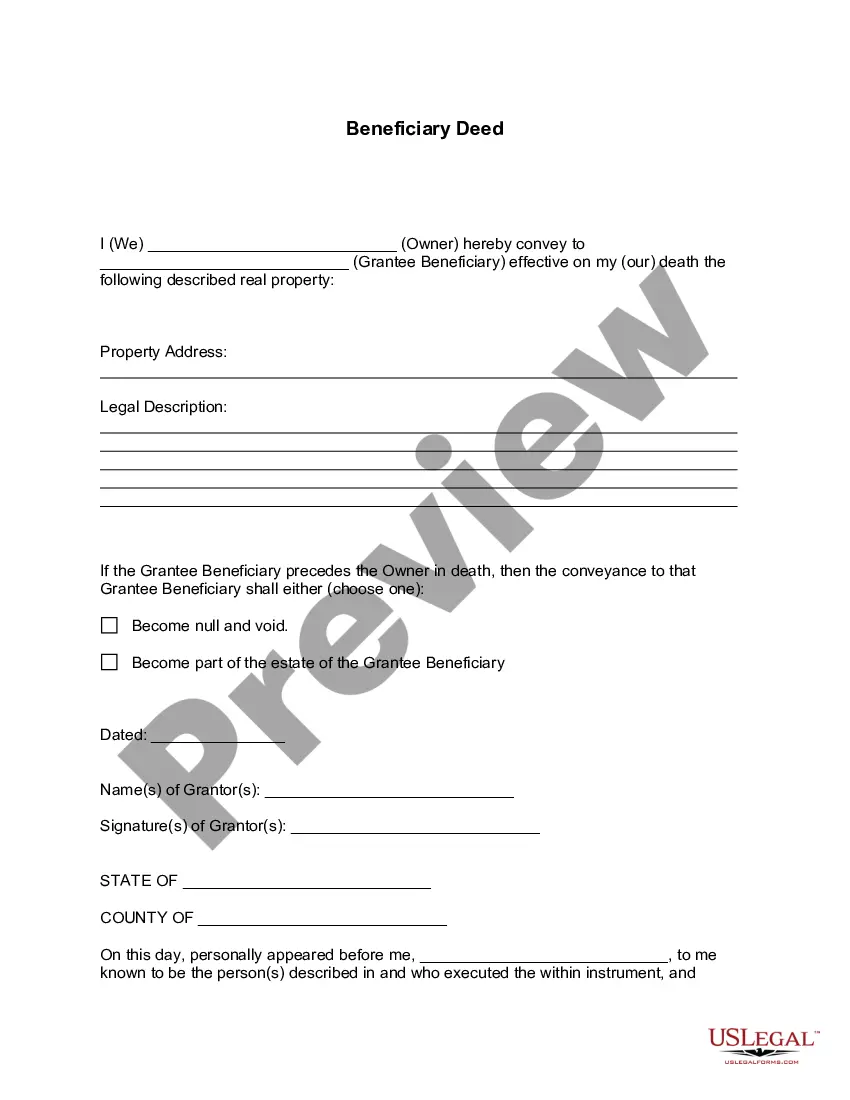
The Revocation of Transfer on Death Deed or TOD - Beneficiary Deed for Individual to Individual is a legal document used to formally cancel a Transfer on Death Deed (TOD) that allows an individual to revoke the transfer of property upon their death. This form is essential for individuals who wish to change their estate planning decisions regarding real estate after previously designating a beneficiary. Unlike other property transfer methods, this form specifically addresses revocation and is crucial for ensuring clarity in property ownership and beneficiary designation.
Main sections of this form
- Grantor's name and marital status.
- Date of the original Transfer on Death Deed being revoked.
- Legal description of the property being transferred.
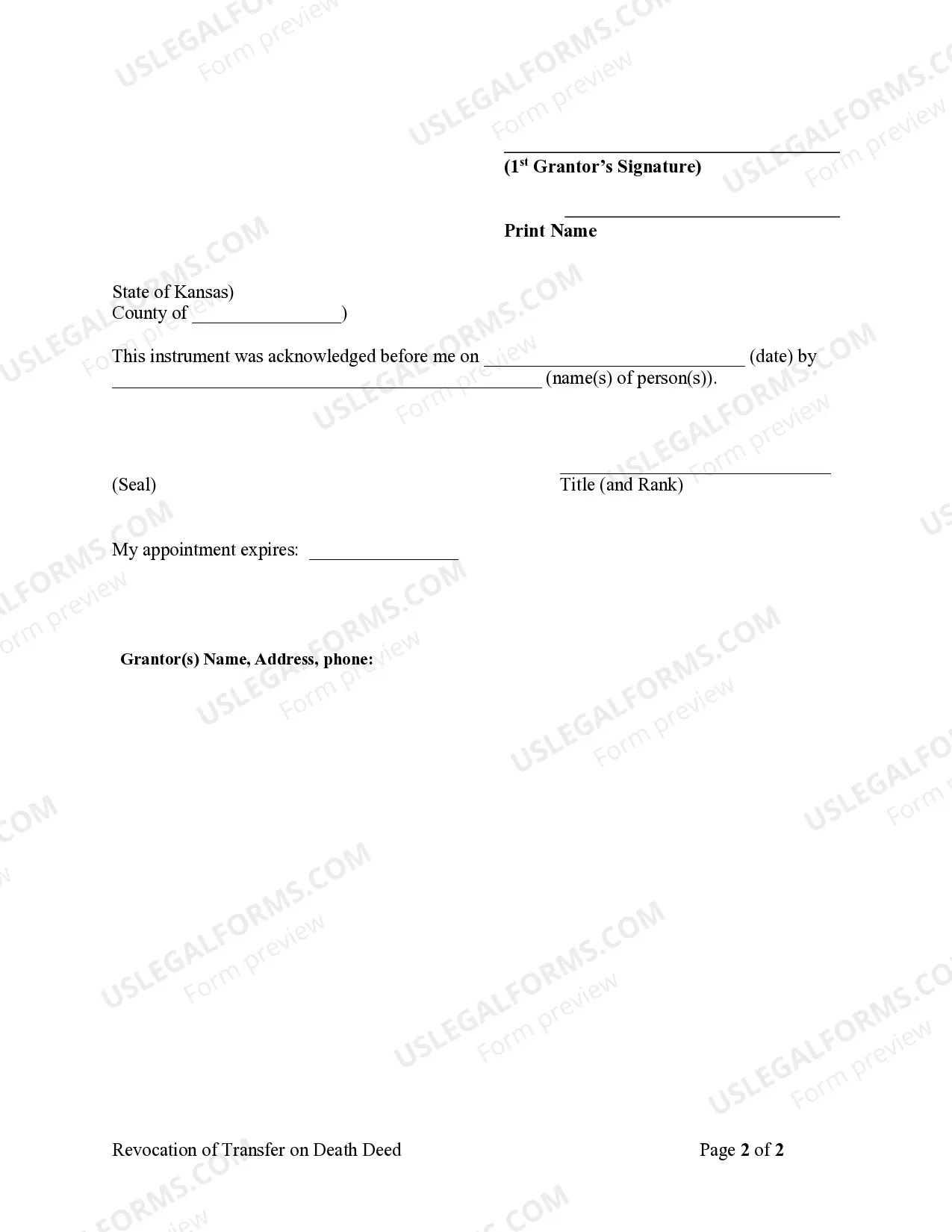
- Notary public acknowledgment section.
- Contact information for the Grantor.





Common use cases
This form should be used when an individual wishes to revoke a previously established Transfer on Death Deed. Common scenarios include changes in personal circumstances, such as divorce, the sale of the property, or the decision to name a different beneficiary. By completing this form, the Grantor can ensure that their wishes regarding property transfer are accurately documented and legally upheld.
Who can use this document
- Individuals who have previously established a Transfer on Death Deed.
- Any person who wishes to modify their estate planning regarding a specific piece of real estate.
- Property owners who need to clarify or cancel prior beneficiary designations.
Steps to complete this form
- Identify the Grantor's name and marital status.
- Specify the date when the original Transfer on Death Deed was recorded.
- Enter the legal description of the property to be affected.
- Have the document acknowledged by a notary public.
- Fill out the Grantor's contact information, including address and phone number.
Does this form need to be notarized?
This form needs to be notarized to ensure legal validity. US Legal Forms provides secure online notarization powered by Notarize, allowing you to complete the process through a verified video call, available anytime.
Get your form ready online
Our built-in tools help you complete, sign, share, and store your documents in one place.
Make edits, fill in missing information, and update formatting in US Legal Forms—just like you would in MS Word.
Download a copy, print it, send it by email, or mail it via USPS—whatever works best for your next step.
Sign and collect signatures with our SignNow integration. Send to multiple recipients, set reminders, and more. Go Premium to unlock E-Sign.
If this form requires notarization, complete it online through a secure video call—no need to meet a notary in person or wait for an appointment.
We protect your documents and personal data by following strict security and privacy standards.

Make edits, fill in missing information, and update formatting in US Legal Forms—just like you would in MS Word.

Download a copy, print it, send it by email, or mail it via USPS—whatever works best for your next step.

Sign and collect signatures with our SignNow integration. Send to multiple recipients, set reminders, and more. Go Premium to unlock E-Sign.

If this form requires notarization, complete it online through a secure video call—no need to meet a notary in person or wait for an appointment.

We protect your documents and personal data by following strict security and privacy standards.
Common mistakes to avoid
- Failing to correctly identify the date of the original TOD being revoked.
- Omitting the legal description of the property.
- Not having the document notarized if required under local law.
Benefits of using this form online
- Convenience of accessing and completing the form from home.
- Editable templates that allow for easy modification to reflect changes in your situation.
- Reliable format that complies with state laws, minimizing the risk of errors.
What to keep in mind
- The form revokes a prior Transfer on Death Deed, clarifying property ownership.
- Proper completion and notarization are essential for legal enforceability.
- Understanding the specific requirements in Kansas can aid in a smooth process.
Looking for another form?
Form popularity
FAQ
Receiving an inheritance can be an unexpected windfall. In fact, transfer on death accounts are exposed to all the same income and capital gains taxes when the account owner is alive, as well as estate and inheritance taxes upon the owner's death.
When a joint owner dies, the process is relatively simple you just need to inform the Land Registry of the death. You should complete a 'Deceased joint proprietor' form on the government's website and then send the form to the Land Registry, with an official copy of the death certificate.
No a will does not override a deed. A will only acts on death. The deed must be signed during the life of the owner. The only assets that pass through the will are assets that are in the name of the decedent only.
A revocable TOD deed does not avoid the owner's creditors. Creditors may seek collection against the designated beneficiaries as to secured and unsecured obligations of the original owner.
If you'd like to avoid having your property going through the probate process, it's a good idea to look into a transfer on death deed. A transfer on death deed allows you to select a beneficiary who will receive your property, but only when you've passed away.
Because transfer-on-death beneficiary deeds do not become effective until you pass away, someone can challenge the validity of the deed after you die.Or, beneficiaries and family members can sue each other to take the property entirely. In this case, a court proceeding may be required to resolve the issue.
In most cases, the surviving owner or heir obtains the title to the home, the former owner's death certificate, a notarized affidavit of death, and a preliminary change of ownership report form. When all these are gathered, the transfer gets recorded, the fees are paid, and the county issues a new title deed.
When a person dies, beneficiaries might learn that the decedent made a deed that conflicts with the specific wording in his will. Generally, a deed will override the will. However, which legal document prevails also depends on state property laws and whether the state has adopted the Uniform Probate Code.
A TOD designation supersedes a will. For bank accounts, you can set up a similar account known as payable-on-death, sometimes referred to as a Totten trust. Your beneficiaries can't touch the account while you're alive, and you're free to change beneficiaries or close the accounts at any time.