Indiana Statutory Funeral Planning Declaration
Understanding this form
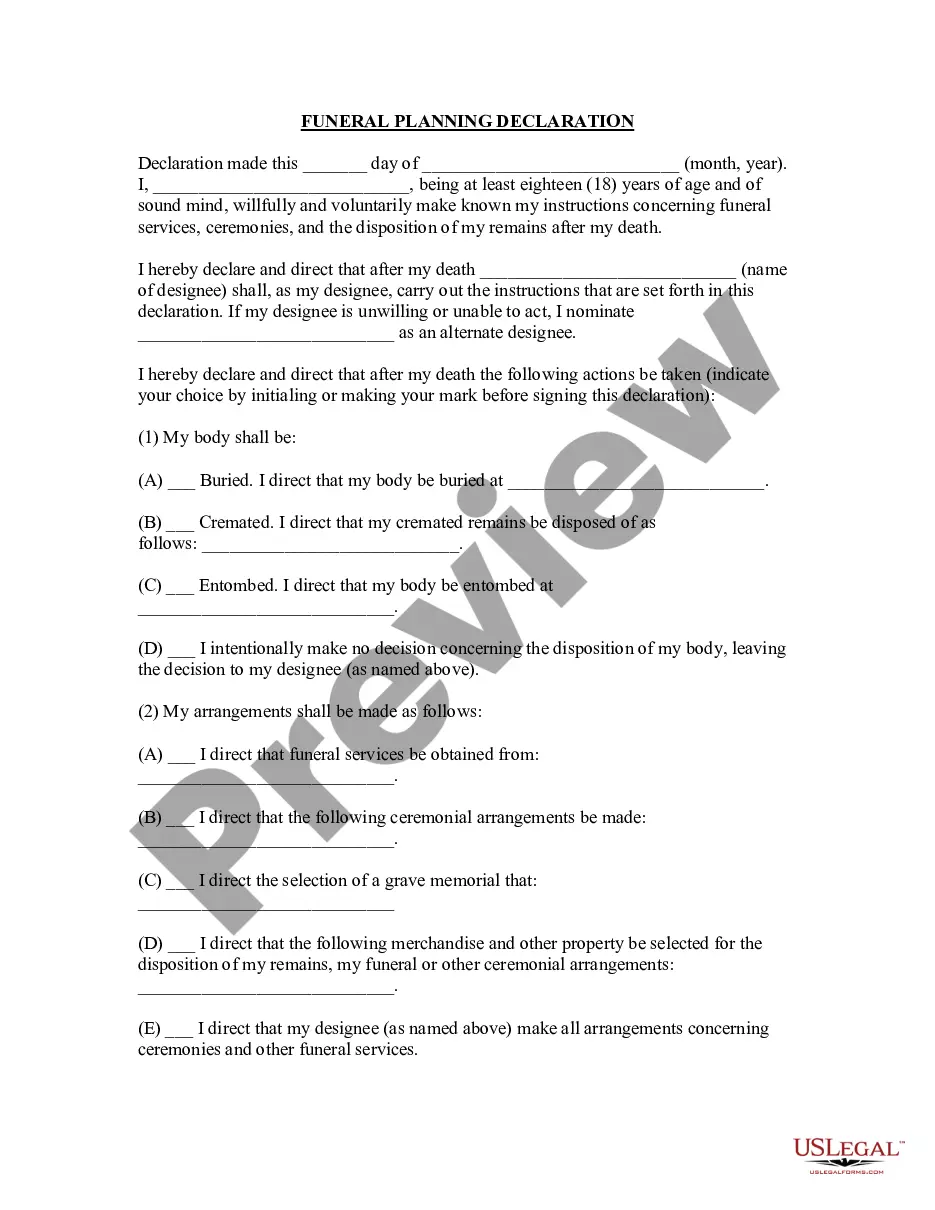
The Statutory Funeral Planning Declaration is a legal document that allows you to specify your wishes regarding funeral arrangements and the disposition of your remains after your death. This form enables you to appoint an individual, referred to as your designee, to ensure that your preferences are honored. A key difference from similar documents is that this declaration is formally recognized and includes specific instructions regarding burial, cremation, and memorial services, making it a reliable expression of your final wishes.
Key parts of this document
- Declaration section: Specifies your name, age, and sound mind.
- Designation of a primary designee and alternate designee.
- Instructions for the disposition of your body: burial, cremation, or entombment options.
- Requests for specific funeral arrangements, including services, ceremonies, and memorial selections.
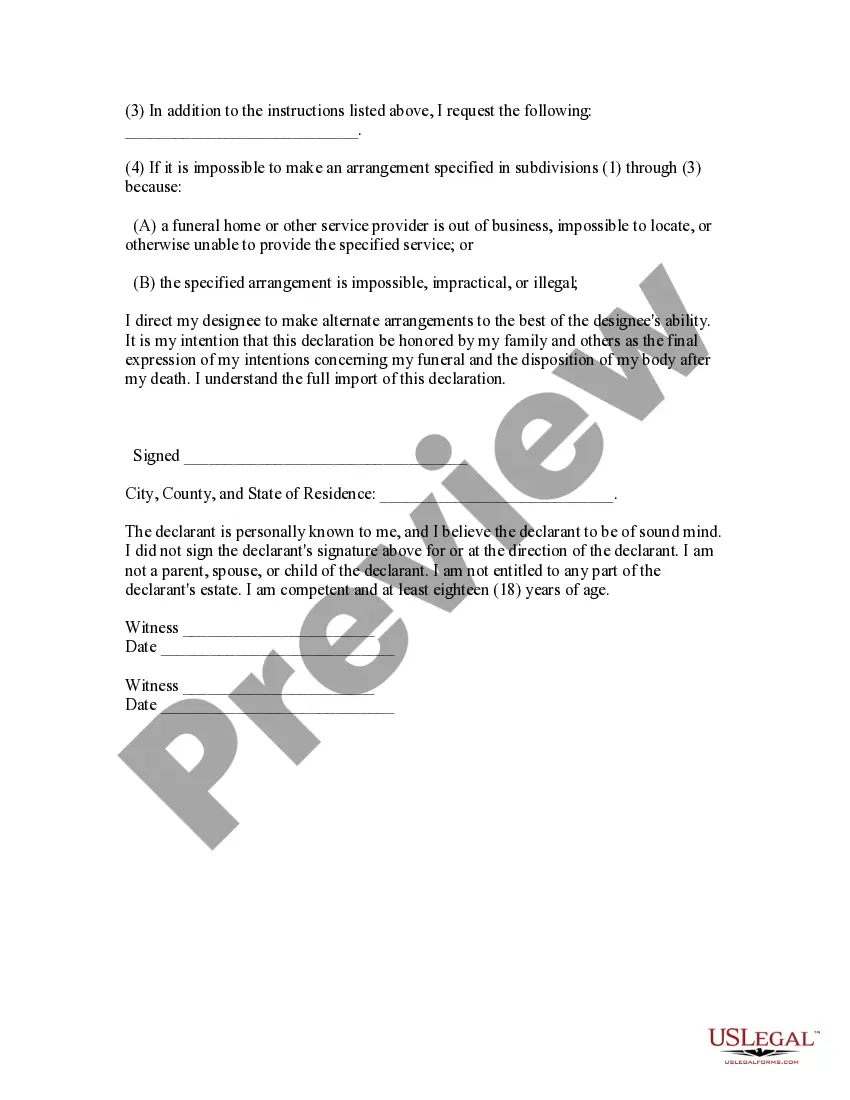
- Provision for alternate arrangements if specified services are impossible.
- Signature and witness requirements to validate the declaration.
Common use cases
You should use the Statutory Funeral Planning Declaration when you want to clearly outline your preferences for funeral services and the final disposition of your body. This form is particularly useful if you desire to prevent potential disputes among family members regarding your wishes or if you have specific instructions that you want to be followed. It is also an essential tool for ensuring peace of mind for you and your family during a difficult time.
Who should use this form
- Individuals aged eighteen (18) and older.
- People who want to make their funeral plans known in advance.
- Those looking to appoint a person they trust to carry out their final wishes.
- Anyone interested in ensuring that their unique preferences regarding funeral services are honored.
How to prepare this document
- Fill in the declaration date at the top of the form.
- Enter your full name and confirm your age and sound mind.
- Appoint your primary designee by writing their name; include an alternate designee if desired.
- Specify your choices regarding burial, cremation, or other disposition methods by initialing the appropriate sections.
- Detail your preferences for funeral services, including any specific memorial or merchandise selections.
- Sign the declaration in front of at least two witnesses who are not related to you.
Notarization requirements for this form
This form does not typically require notarization to be legally valid. However, some jurisdictions or document types may still require it. US Legal Forms provides secure online notarization powered by Notarize, available 24/7 for added convenience.
Get your form ready online
Our built-in tools help you complete, sign, share, and store your documents in one place.
Make edits, fill in missing information, and update formatting in US Legal Forms—just like you would in MS Word.
Download a copy, print it, send it by email, or mail it via USPS—whatever works best for your next step.
Sign and collect signatures with our SignNow integration. Send to multiple recipients, set reminders, and more. Go Premium to unlock E-Sign.
If this form requires notarization, complete it online through a secure video call—no need to meet a notary in person or wait for an appointment.
We protect your documents and personal data by following strict security and privacy standards.

Make edits, fill in missing information, and update formatting in US Legal Forms—just like you would in MS Word.

Download a copy, print it, send it by email, or mail it via USPS—whatever works best for your next step.

Sign and collect signatures with our SignNow integration. Send to multiple recipients, set reminders, and more. Go Premium to unlock E-Sign.

If this form requires notarization, complete it online through a secure video call—no need to meet a notary in person or wait for an appointment.

We protect your documents and personal data by following strict security and privacy standards.
Mistakes to watch out for
- Failing to appoint an alternate designee, which can complicate matters if the primary designee is unavailable.
- Not specifying clear instructions for the disposition of your remains.
- Not having the declaration properly witnessed, which may render it invalid.
- Leaving sections blank, which can lead to confusion about your wishes.
Why use this form online
- Convenience of completing the form from home at any time.
- Editability allows you to customize the declaration to suit your precise wishes.
- Access to reliable legal templates ensures that your document meets necessary legal standards.
- Instant download capability, so you can have the form ready for use immediately.
Legal use & context
- This declaration serves as a legally binding document that communicates the final wishes of an individual regarding their funeral arrangements.
- It is important for families to honor the declarant's wishes as outlined in the declaration.
- Consulting with a legal professional can help clarify any jurisdiction-specific implications.
Summary of main points
- The Statutory Funeral Planning Declaration is essential for clarifying funeral preferences.
- Designating a trusted individual to manage arrangements ensures your wishes are followed.
- Completing the form correctly with signatures and witness is critical for enforceability.
Looking for another form?
Form popularity
FAQ
Under California law, if you write down your funeral instructions before you die, these decisions take precedence. Your health care agent, as named in an advance directive. Your spouse. Your adult child.
Your spouse or registered domestic partner. your adult child, or a majority of your children if you have more than one. your parents. your siblings.
In these cases, the degree of incapacity will have to be determined, usually by the doctor overseeing care for the next of kin. In some states, the next of kin who will be making arrangements will need to fill out a form asserting that they have the legal right to control the disposition of remains.
Cremated remains may only be kept in the dwelling place owned or occupied by the 7100 right holder(s). Contrary to the opinion of some, this privilege can not, in my view, be delegated to other family members.
Are funeral wishes in a will legally binding? In short, no. Under current law, funeral wishes in a will are not legally binding. The executors appointed in a will have ownership of the body and are technically considered the decision-makers with regards to funeral arrangements.
Contact the deceased's legal representative. Select a funeral home. Choose a form of disposition. Choose a service type. Choose a location for the funeral service. Find and schedule a clergy member or officiant. Select a casket. Select a burial container and/or vault.
Most funerals are arranged by the nearest relatives and if not by a close friend. If there is no one, the local or health authority will arrange a simple funeral. The person may have left instructions about the type of funeral and burial they wanted.
Generally, a person's parents, spouse or children have the authority to make funeral and burial arrangements for that person. However, since these people do not exist in your case, you should consider naming an agent to make these arrangements for you.
Most funerals are arranged by the nearest relatives and if not by a close friend. If there is no one, the local or health authority will arrange a simple funeral. The person may have left instructions about the type of funeral and burial they wanted.