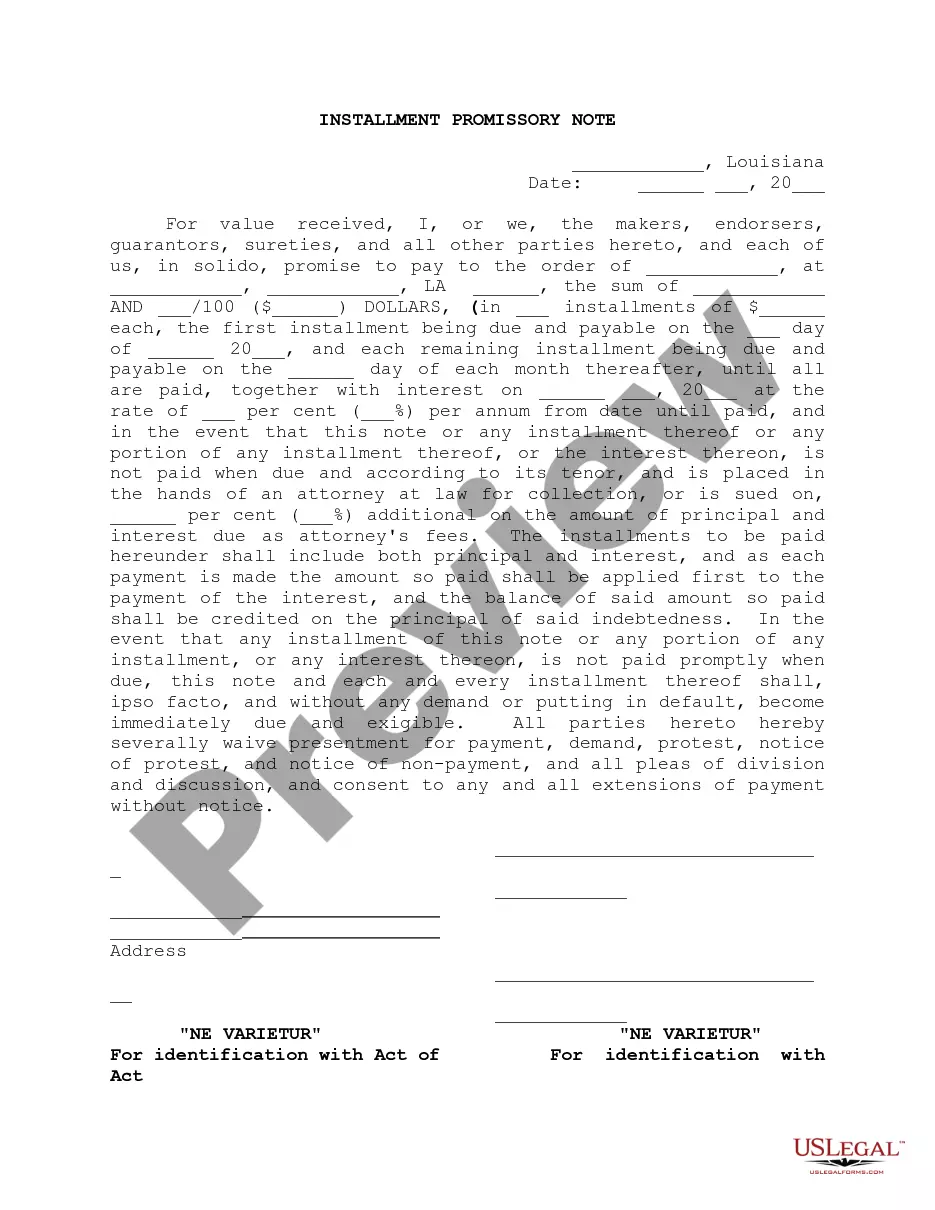
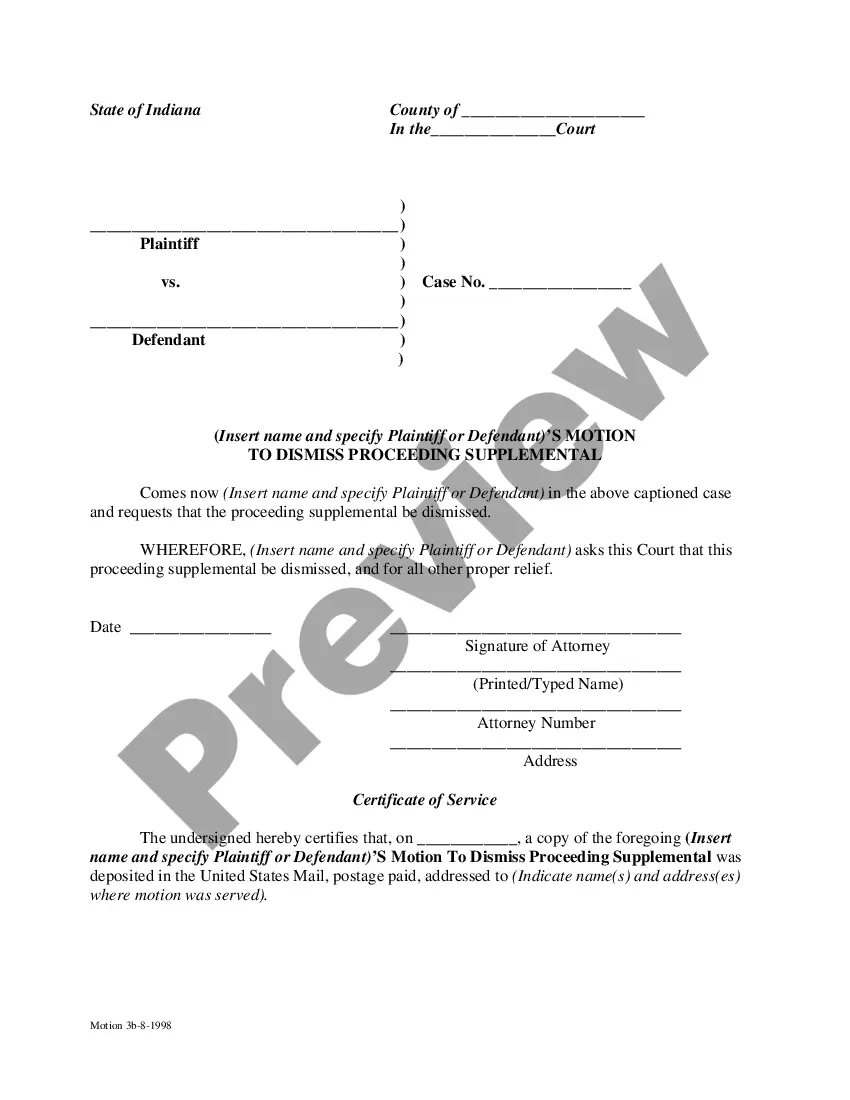
Indiana Motion to Dismiss Proceeding Supplemental Against Less Than All Parties
What this document covers
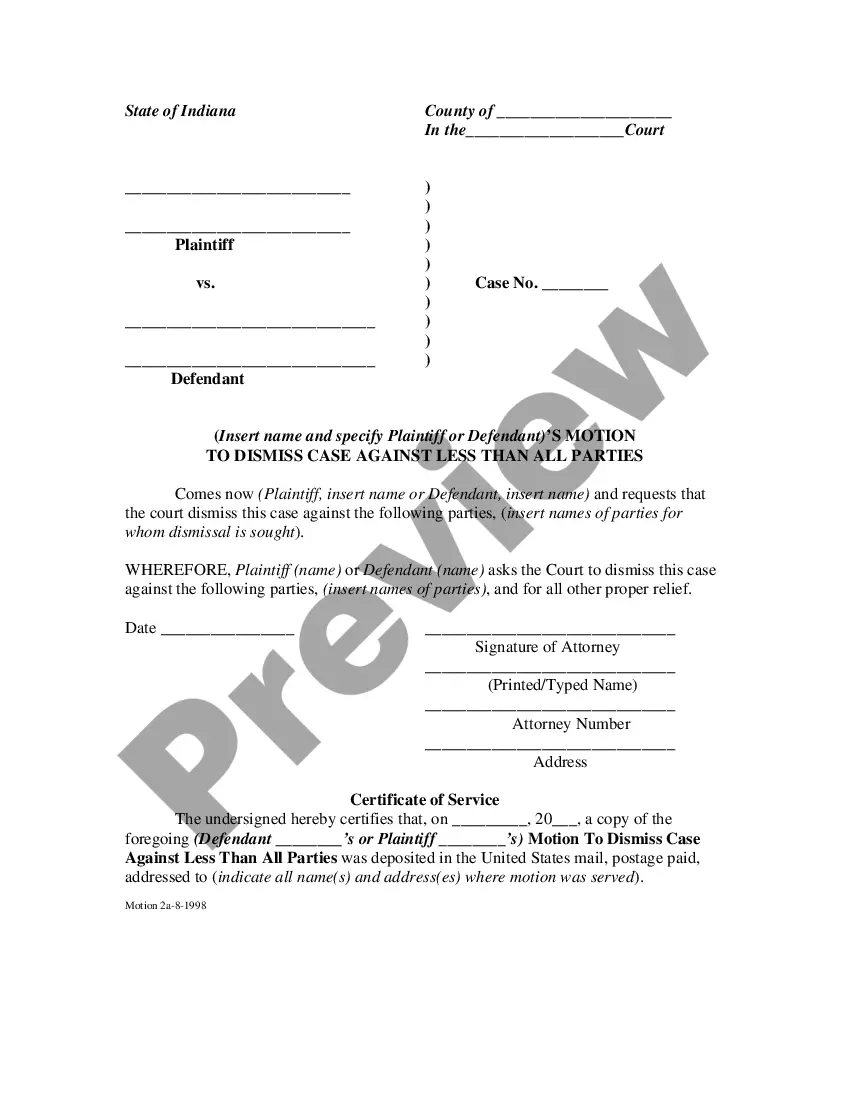
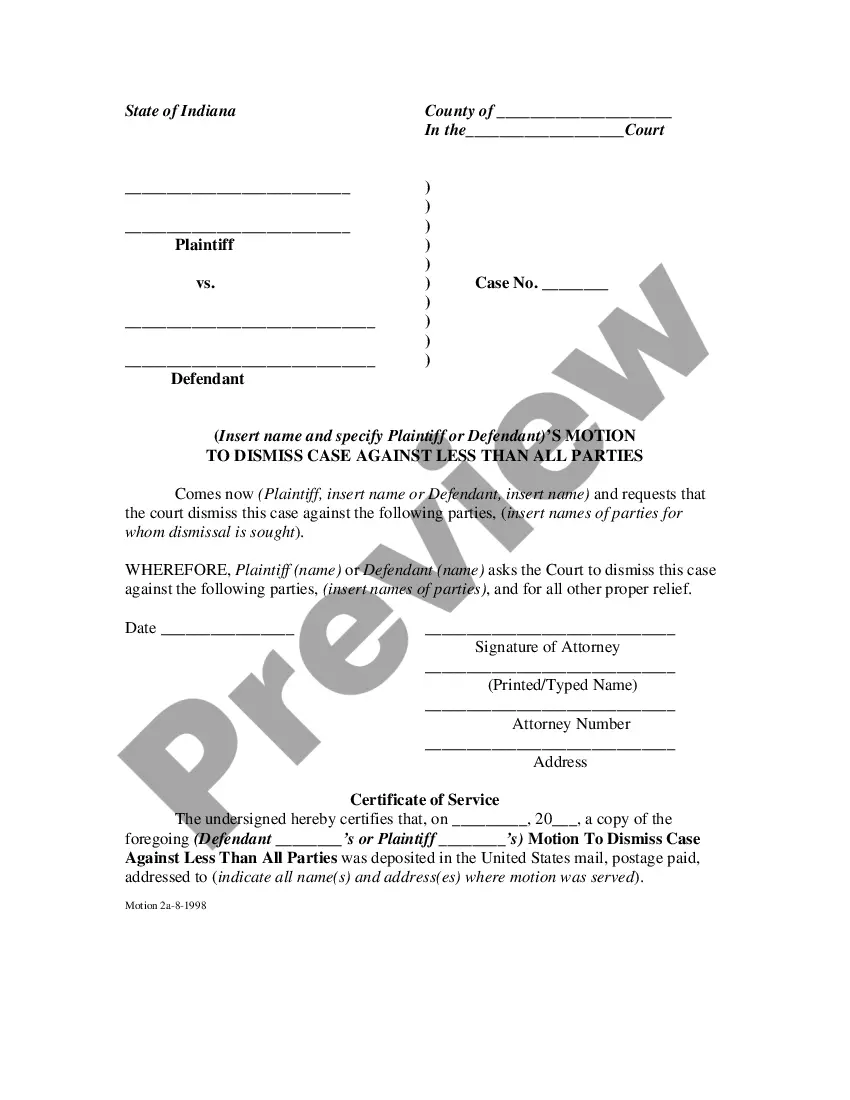
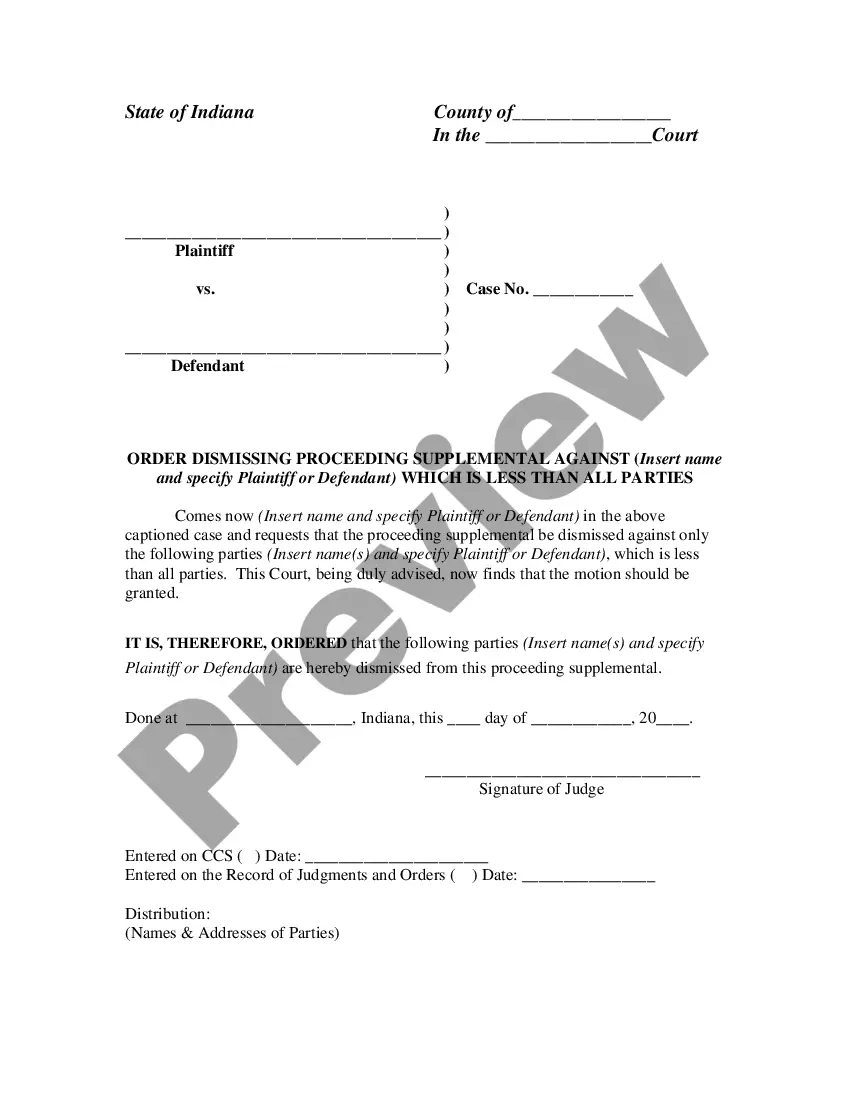
This form is a Motion to Dismiss Proceeding Supplemental Against Less Than All Parties used in Indiana. Its main purpose is to request the court's dismissal of a case against specific defendants, rather than all parties involved in the case. This legal document is essential when a plaintiff or defendant believes that there are valid reasons to dismiss the action against particular parties without affecting the overall case.
What’s included in this form
- Title and case information section to identify the case and the parties involved.
- Motion section where the requesting party indicates who is being dismissed from the case.
- Wherefore clause stating the request to the court for dismissal of specified parties.
- Signature block for the attorney, including printed name and attorney number.
- Certificate of service to confirm that the motion has been properly served to all necessary parties.

When to use this form
This form is applicable when a legal action is pending in court, and one party wishes to request the dismissal of the case against certain defendants only. It is commonly used in scenarios where the plaintiff or defendant believes that those parties do not need to be involved in the proceedings due to lack of merit, jurisdiction, or other legal reasons.
Who can use this document
- Plaintiffs in a civil case who want to dismiss claims against specific defendants.
- Defendants who believe they should not be part of the legal proceedings due to valid reasons.
- Attorneys representing either a plaintiff or defendant seeking to streamline court proceedings.
How to complete this form
- Begin by entering the county and court information at the top of the document.
- Insert the names of the plaintiff and defendant in the designated sections.
- Clearly state the specific parties you are requesting to dismiss in the motion section.
- Fill in the case number and the date of the filing.
- Have the attorney sign the document and include their printed name and attorney number.
- Complete the certificate of service to confirm that all parties have been notified of the motion.
Notarization requirements for this form
This form does not typically require notarization unless specified by local law. It is important to check Indiana statutes to ensure compliance before filing.
Get your form ready online
Our built-in tools help you complete, sign, share, and store your documents in one place.
Make edits, fill in missing information, and update formatting in US Legal Forms—just like you would in MS Word.
Download a copy, print it, send it by email, or mail it via USPS—whatever works best for your next step.
Sign and collect signatures with our SignNow integration. Send to multiple recipients, set reminders, and more. Go Premium to unlock E-Sign.
If this form requires notarization, complete it online through a secure video call—no need to meet a notary in person or wait for an appointment.
We protect your documents and personal data by following strict security and privacy standards.

Make edits, fill in missing information, and update formatting in US Legal Forms—just like you would in MS Word.

Download a copy, print it, send it by email, or mail it via USPS—whatever works best for your next step.

Sign and collect signatures with our SignNow integration. Send to multiple recipients, set reminders, and more. Go Premium to unlock E-Sign.

If this form requires notarization, complete it online through a secure video call—no need to meet a notary in person or wait for an appointment.

We protect your documents and personal data by following strict security and privacy standards.
Common mistakes
- Failing to include all necessary parties in the dismissal request.
- Not providing complete and accurate case information.
- Omitting the attorney's signature or relevant details.
- Neglecting to deliver the certificate of service to all applicable parties.
Advantages of online completion
- Convenient access to the form whenever needed without physical paperwork.
- Editability allows for tailoring the form to specific legal circumstances.
- Reliable updates ensure compliance with current Indiana state law.
Main things to remember
- The Motion to Dismiss Proceeding Supplemental Against Less Than All Parties is crucial for requesting dismissal of certain parties from a case.
- Accuracy in filling out the form is essential to avoid common mistakes.
- This form reflects Indiana-specific legal requirements and should be used accordingly.
Looking for another form?




Form popularity
FAQ
When a judge denies a defendant's motion to dismiss, the case will continue because defendant did not convince the judge to terminate the case.When students read a U.S. court decision where a judge denies a motion to dismiss, it may appear that the judge is ruling that the plaintiff won her case.
Supplemental judgment means a judgment that by law may be rendered after a general judgment has been entered in the action and that affects a substantial right of a party pursuant to a legal authority.
A Proceedings Supplemental is a court-ordered meeting between you and the creditor (the person you owe) to determine what your income, savings and property are. Your bank or employer may also have to give information to the creditor and the court.
What is a Supplemental Proceeding? A creditor (someone you owe money) has a judgment ordered by a court. They want. to collect the money from you. The creditor wants to know if you have property or income they can take.
The most common type of pre-answer motion is the motion to dismiss. A pre-answer motion to dismiss may be made on any of the grounds listed in FRCP 12(b). Courts may also consider other grounds for dismissal raised in a pre-answer motion to dismiss, including immunity or failure to exhaust administrative remedies.
Generally, however, a defendant must file a motion to dismiss before filing an "answer" to the complaint. If the motion to dismiss is denied, the defendant must still file their answer, usually within a shortened amount of time.The motion to dismiss must be filed with the court and served on the other party.
If your wages are being garnished for tax debt, Bankruptcy will stop the garnishment and in some cases you may not have to pay the tax debt. Filing Bankruptcy on tax debt will allow you to receive future tax refunds. If your wages are being garnished for student loans, filing Bankruptcy will stop the garnishment.
You cannot file a second motion dismiss. You have to raise it as an affirmative defense in your answer and present it with evidence at summary judgement or trial...
A proceeding in which a JUDGMENT DEBTOR is summoned into court for questioning by a JUDGMENT CREDITOR who has not received payment. A supplementary proceeding provides the creditor with a chance to discover whether the debtor has any money or property that can be used to satisfy the judgment.