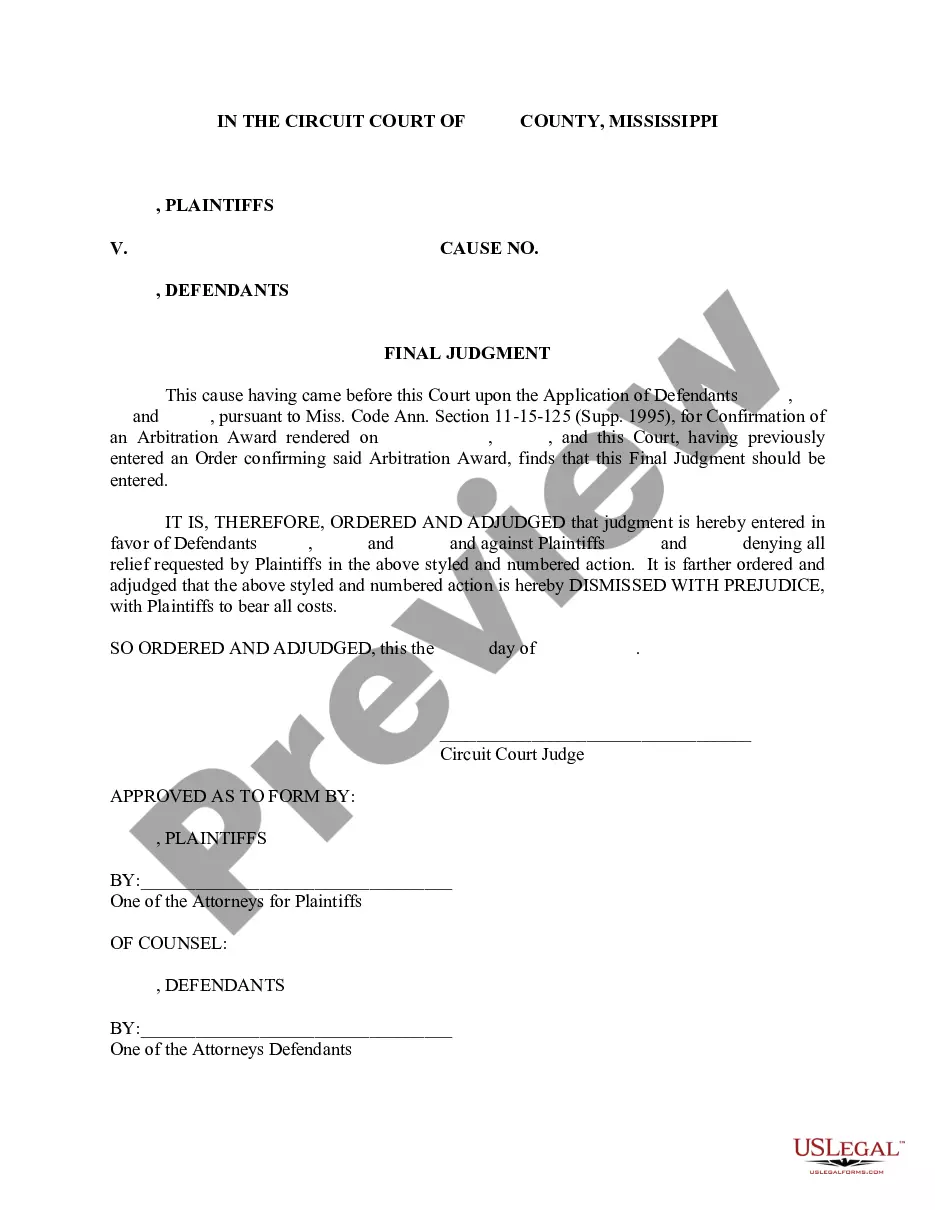
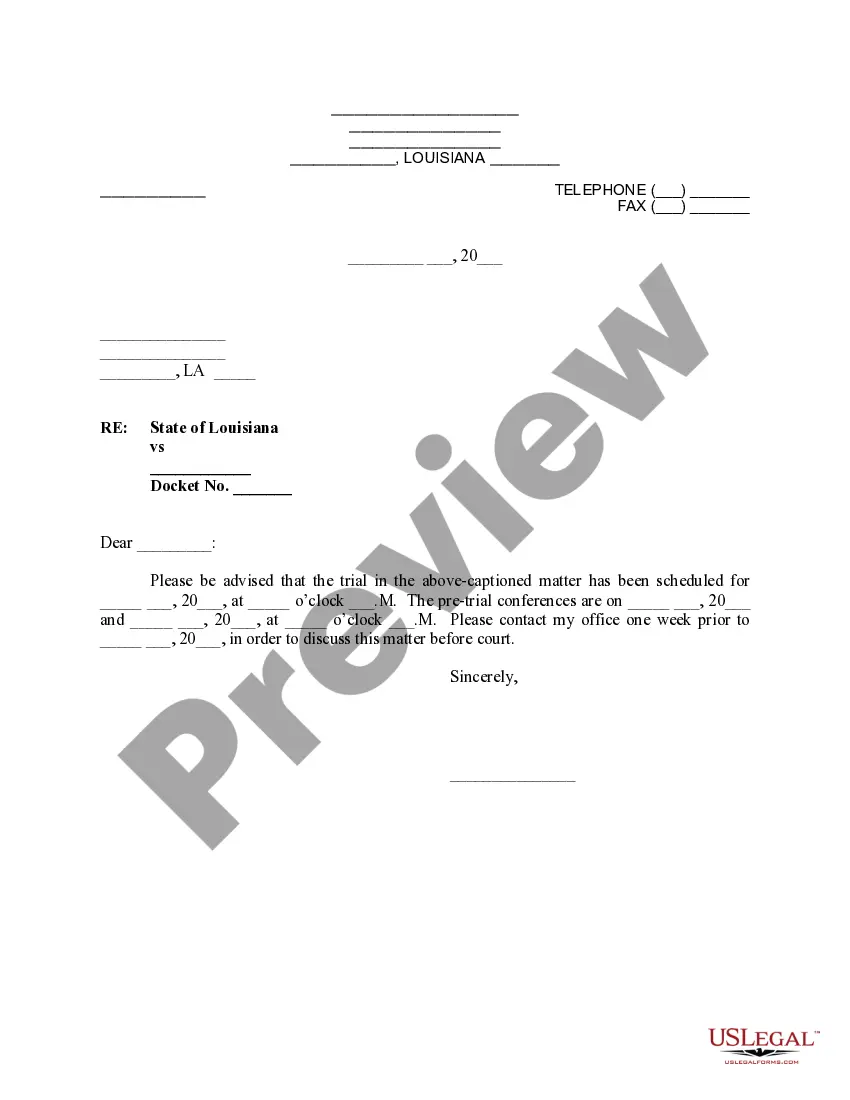
Louisiana Letter to Client regarding Trial Schedule
What this document covers
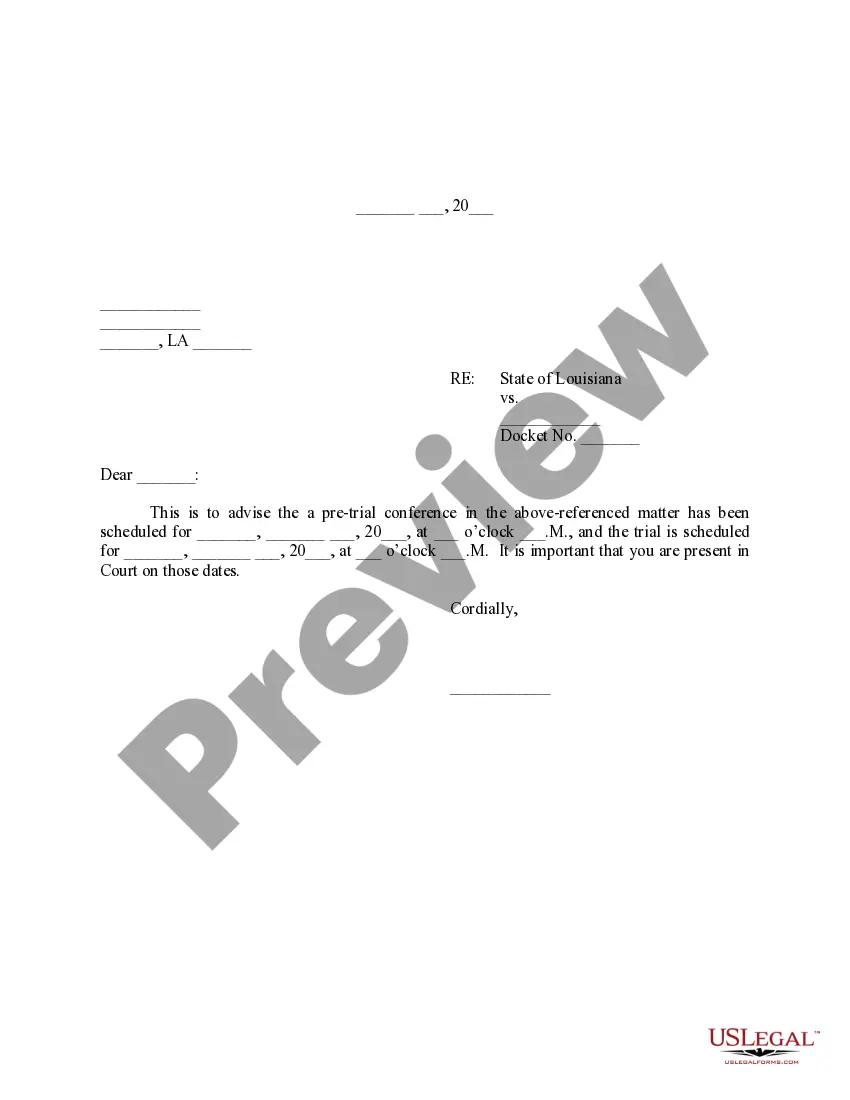
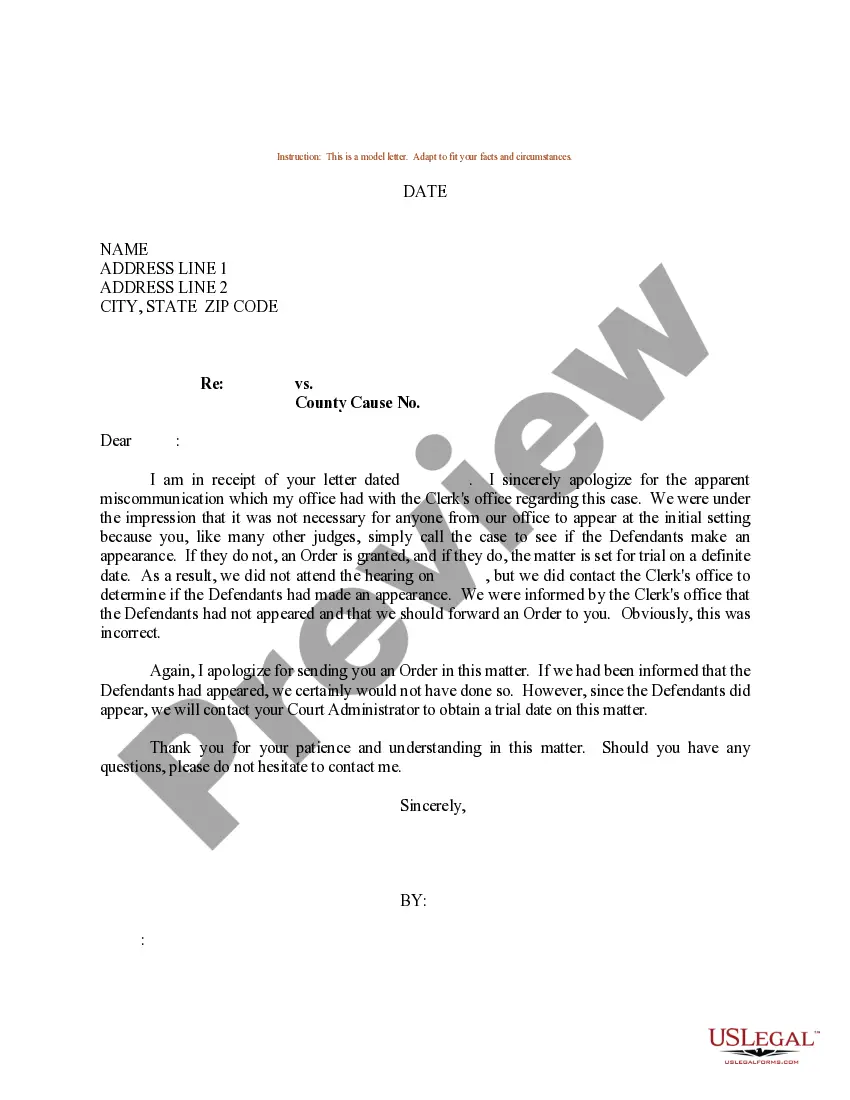
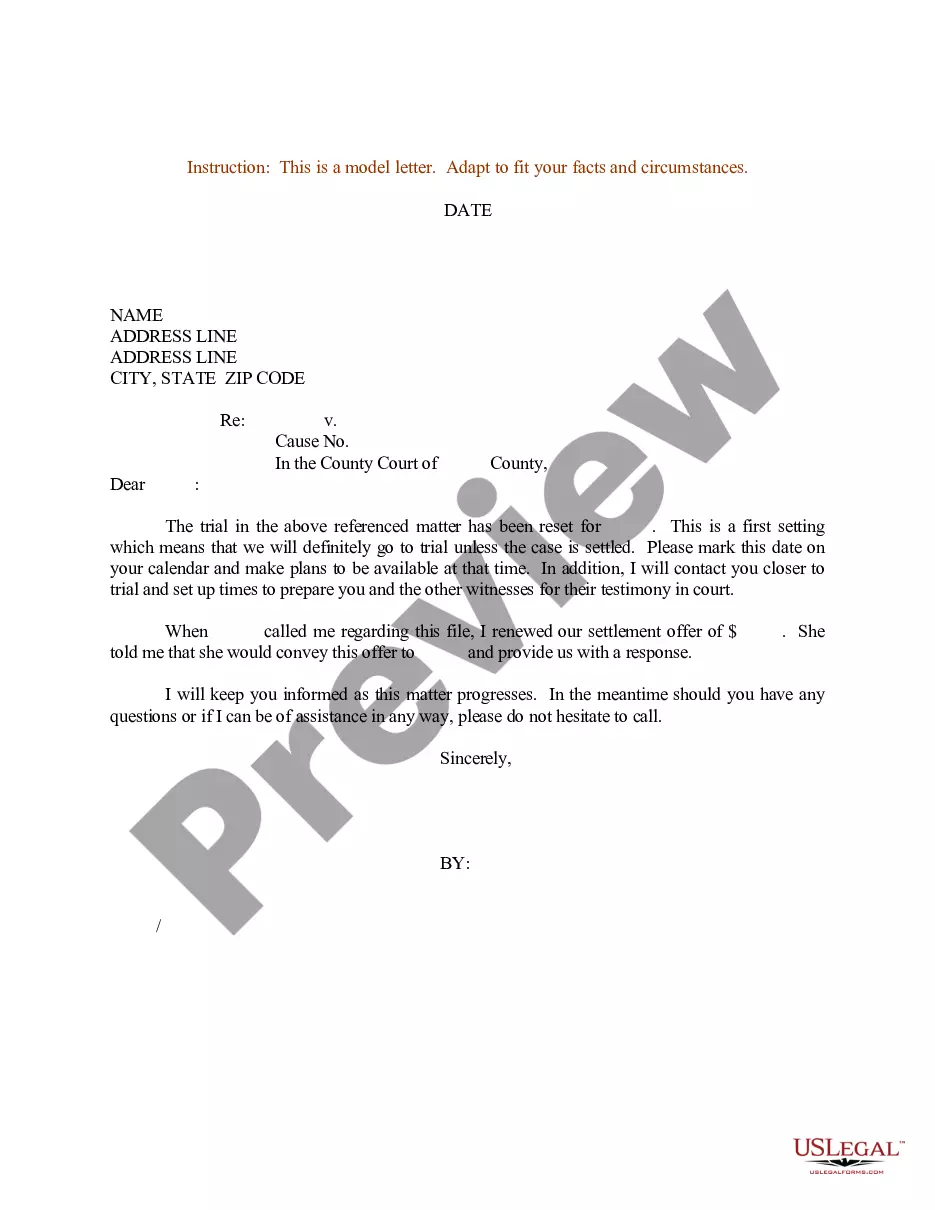
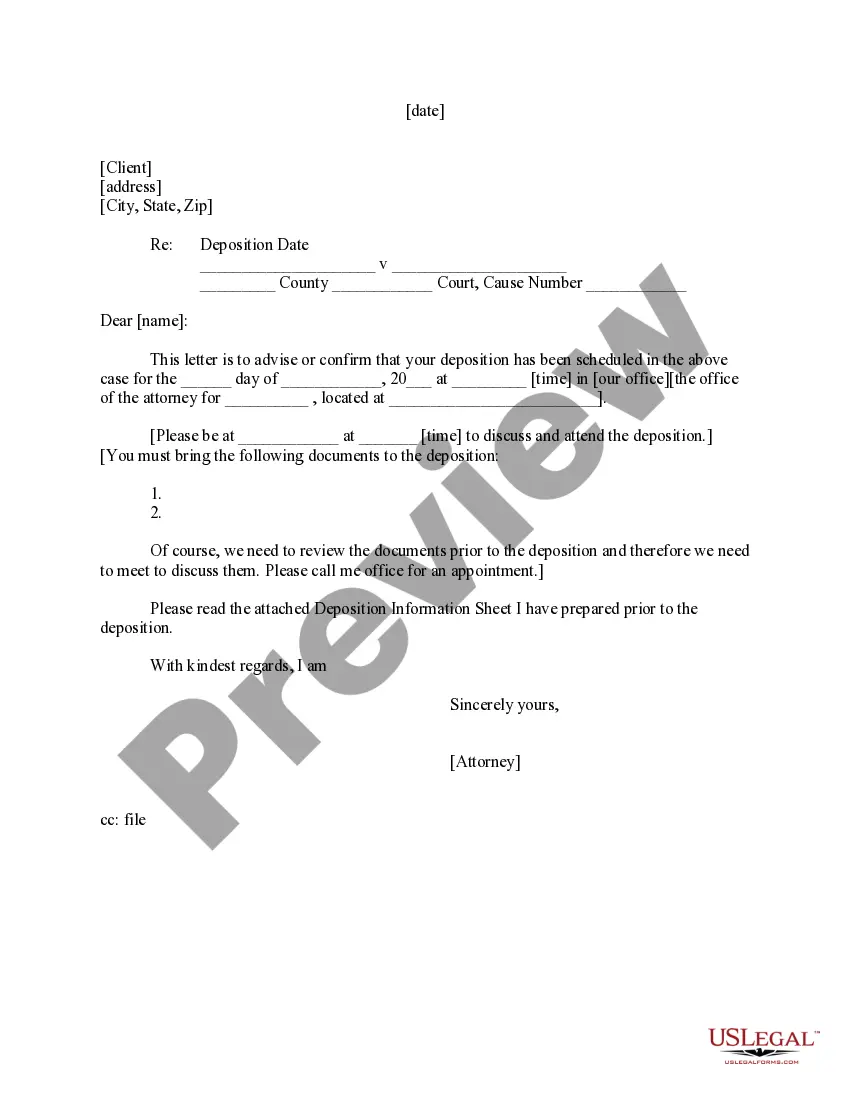
A Letter to Client regarding Trial Schedule is a formal communication from an attorney to their client involved in a criminal matter. This letter provides the client with important dates and times for upcoming pre-trial conferences and the trial itself. Understanding this document is crucial for clients to prepare adequately for their court appearances and to ensure open communication with their attorney.
What’s included in this form
- Attorney's contact information including address and telephone number.
- Details of the case, including the State of Louisiana vs. the clientâs name and docket number.
- Scheduled date and time of the trial.
- Pre-trial conference dates and times.
- A request for the client to contact their attorney a week prior to the court dates.

Common use cases
This form should be used when an attorney needs to inform a client about the trial schedule in a criminal case. It is essential for ensuring that the client understands their obligations and prepares adequately for their court appearances. This letter serves as a reminder for essential dates and encourages communication between the attorney and client.
Who can use this document
- Attorneys representing clients in criminal cases.
- Clients involved in criminal trials who require information about their upcoming court dates.
- Legal offices that need to maintain clear communication regarding trial schedules.
Steps to complete this form
- Enter the attorney's contact information at the top of the letter.
- Fill in the case title, including the State of Louisiana vs. the client's name and the correct docket number.
- Specify the trial date and time clearly.
- List the pre-trial conference dates and times for the clientâs reference.
- Include a reminder for the client to contact the attorney one week before the trial date.
Is notarization required?
This form does not typically require notarization unless specified by local law. It is recommended to confirm any additional legal requirements in your jurisdiction.
Get your form ready online
Our built-in tools help you complete, sign, share, and store your documents in one place.
Make edits, fill in missing information, and update formatting in US Legal Forms—just like you would in MS Word.
Download a copy, print it, send it by email, or mail it via USPS—whatever works best for your next step.
Sign and collect signatures with our SignNow integration. Send to multiple recipients, set reminders, and more. Go Premium to unlock E-Sign.
If this form requires notarization, complete it online through a secure video call—no need to meet a notary in person or wait for an appointment.
We protect your documents and personal data by following strict security and privacy standards.

Make edits, fill in missing information, and update formatting in US Legal Forms—just like you would in MS Word.

Download a copy, print it, send it by email, or mail it via USPS—whatever works best for your next step.

Sign and collect signatures with our SignNow integration. Send to multiple recipients, set reminders, and more. Go Premium to unlock E-Sign.

If this form requires notarization, complete it online through a secure video call—no need to meet a notary in person or wait for an appointment.

We protect your documents and personal data by following strict security and privacy standards.
Common mistakes to avoid
- Failing to fill in the correct docket number, leading to confusion.
- Omitting the pre-trial conference dates, which can disrupt preparation.
- Not providing clear contact information for the attorney, hindering client communication.
Advantages of online completion
- Convenience of downloading the form anytime, from anywhere.
- Editability allows customization to fit specific cases and client needs.
- Reliability of a professionally drafted document created by licensed attorneys.
Looking for another form?
Form popularity
FAQ
Be diligent. First and foremost, you have an obligation to be diligent on behalf of your clients. Exercise attention to detail. Keep a reasonable workload. Take care of yourself. Arrive on time. Listen. Communicate clearly (and often) Manage expectations.
An attorney-client relationship is formed when a lawyer agrees to provide legal assistance to someone seeking the lawyer's services. The scope of the representation depends on the terms of the agreement.
The establishment of the attorney-client relationship involves two elements: a person seeks advice or assistance from an attorney; and the attorney appears to give, agrees to give or gives the advice or assistance.
The lawyer's job is therefore to select the means to complete the client's goals. They are responsible for tasks involving legal procedures, strategies and court tactics. Even still, the lawyer is required to consult with the client about the course of action to be taken according to the law.
As one Massachusetts court put it: an attorney-client relationship may be implied 'when (1) a person seeks advice or assistance from an attorney, (2) the advice or assistance sought pertains to matters within the attorney's professional competence, and (3) the attorney expressly or impliedly agrees to give or actually
An attorney-client relationship can form when any of the following occurs: A formal letter of engagement or contract for legal services is signed by the attorney and client. A client pays a retainer or makes a payment to an attorney in exchange for legal services.
Complaints can be filed in on of two ways: (1) By submitting a completed complaint form to the Office of the Disciplinary Counsel. You can obtain a complaint form in person at the offices of the Disciplinary Counsel, or you can call 800-326-8022 to request that one be mailed to.
Usual manner (express consent) - where the prospective client indicates requests legal advice and the attorney agrees to provide the advice and a contract is signed. By court appointment;