Louisiana Letter to Client regarding Collections Advice
What this document covers
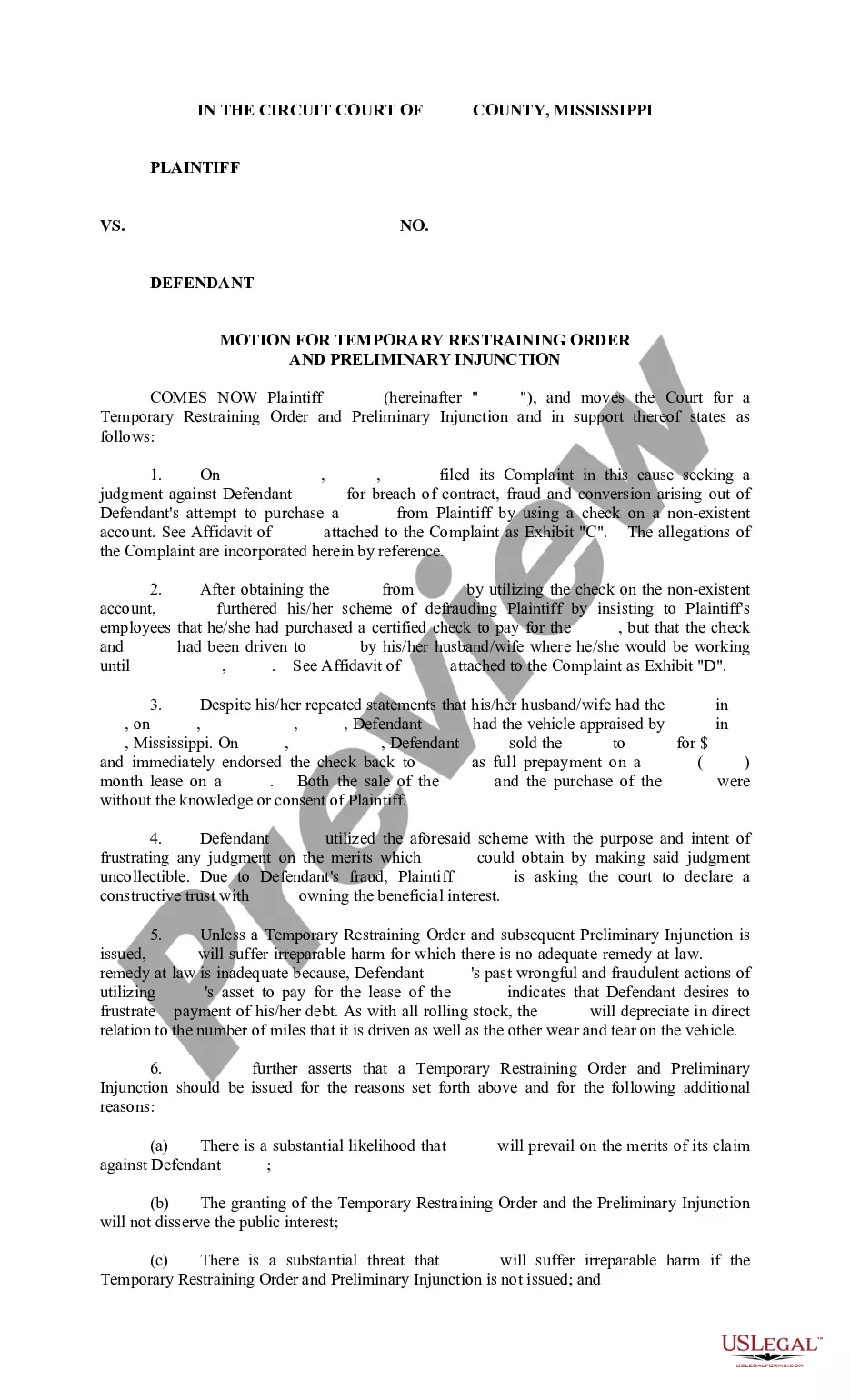
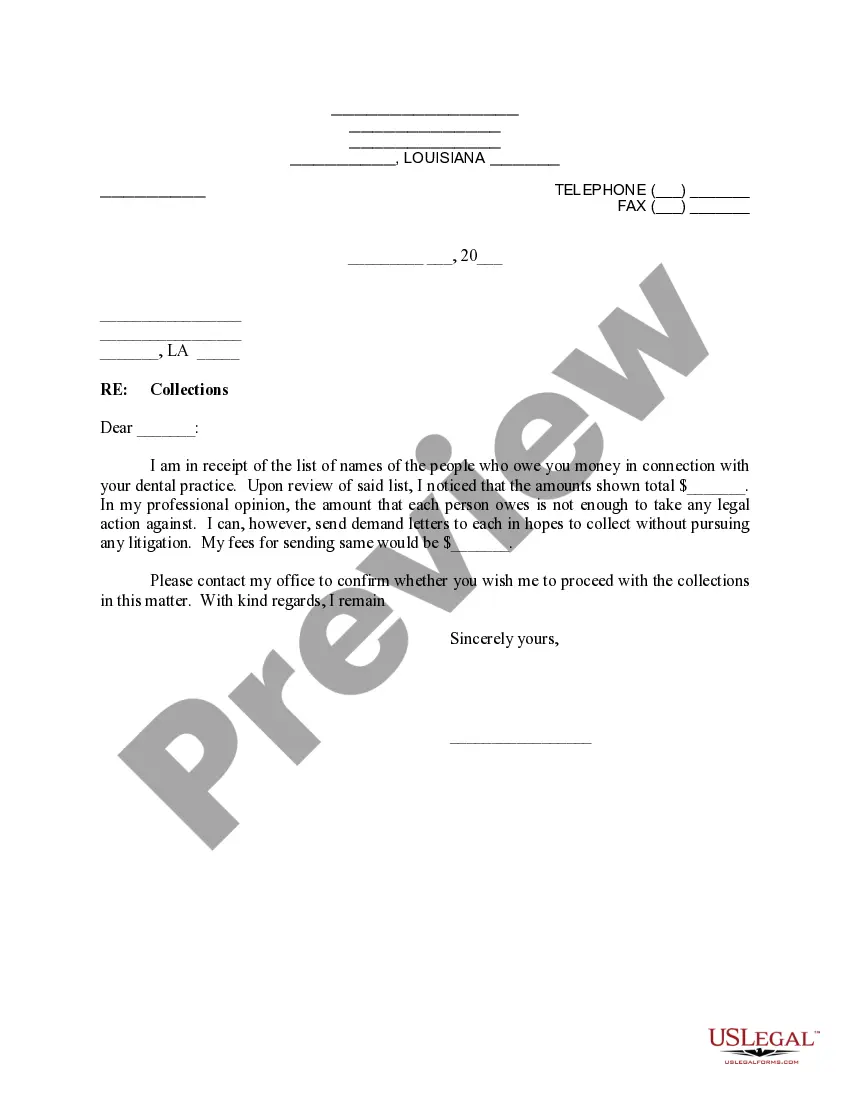
The Letter to Client regarding Collections Advice is a document used by legal professionals to communicate with clients about collecting money owed for unpaid services, specifically in the context of a dental practice. This form provides legal guidance on the feasibility of taking action for debt collection, suggesting alternative options, such as sending demand letters instead of pursuing litigation. By using this form, attorneys ensure clients receive clear, professional advice regarding their collections matters.
Key parts of this document
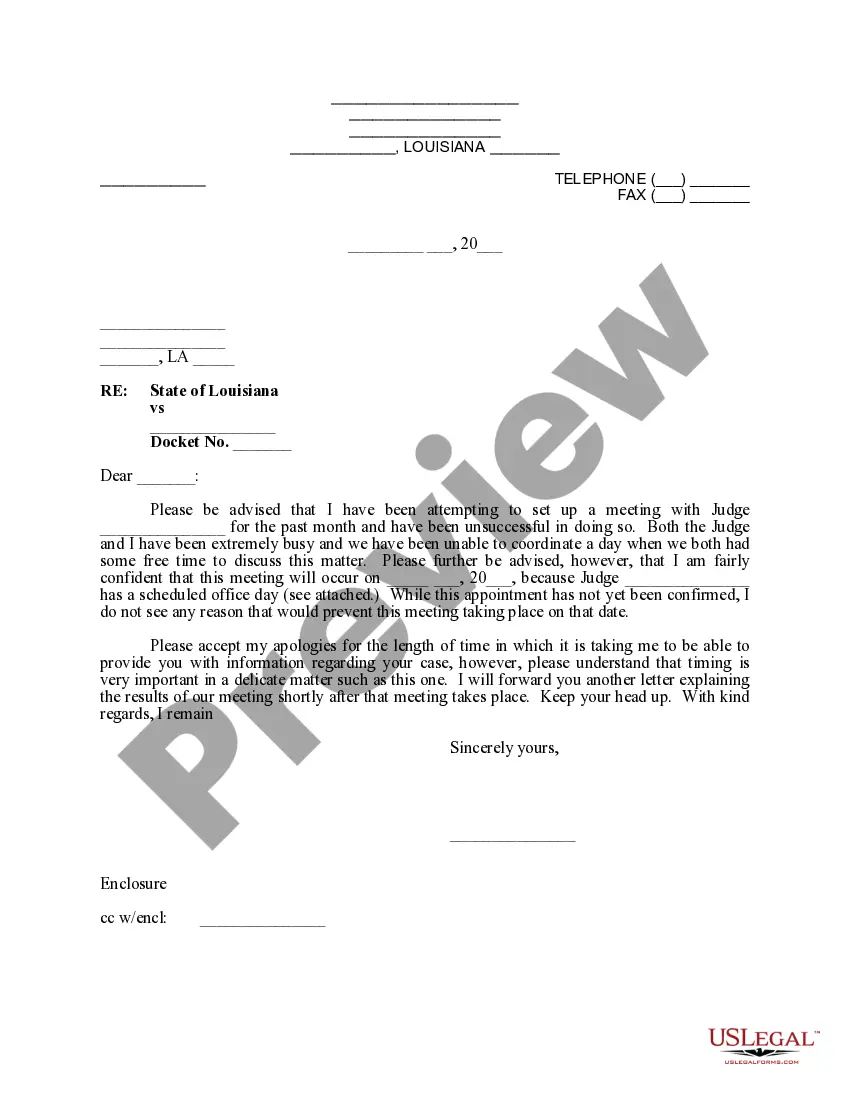
- Attorney's contact information, including name, address, telephone number, and fax number.
- Client's contact details to ensure proper communication.
- A summary of the amounts owed by various individuals.
- Legal opinion on the viability of pursuing legal action based on the amounts owed.
- Offer to send demand letters to debtors for a specified fee.
- Client confirmation request for proceeding with collections.
Situations where this form applies
This form is appropriate to use when a client, particularly a dental practice owner, seeks legal advice about collecting money owed to them. It is particularly useful when the outstanding amounts are not significant enough to warrant full legal proceedings but where the client may wish to pursue more informal collection methods, such as demand letters initiated by an attorney.
Who this form is for
This form is intended for:
- Dentists and dental practice owners dealing with accounts receivable issues.
- Attorneys providing collections advice to clients.
- Individuals or businesses looking to recover minor debts without initiating litigation.
Steps to complete this form
- Fill in the attorney's contact information at the top of the letter.
- Insert the client's name and contact details to personalize the communication.
- List the names and amounts owed by each debtor.
- Provide your professional opinion on the viability of legal action for the stated amounts.
- State your fees for sending demand letters and request confirmation to proceed.
- Sign the letter to finalize the attorney-client communication.
Is notarization required?
This form does not typically require notarization unless specified by local law. As with many legal forms, it's essential to check local regulations to ensure compliance.
Get your form ready online
Our built-in tools help you complete, sign, share, and store your documents in one place.
Make edits, fill in missing information, and update formatting in US Legal Forms—just like you would in MS Word.
Download a copy, print it, send it by email, or mail it via USPS—whatever works best for your next step.
Sign and collect signatures with our SignNow integration. Send to multiple recipients, set reminders, and more. Go Premium to unlock E-Sign.
If this form requires notarization, complete it online through a secure video call—no need to meet a notary in person or wait for an appointment.
We protect your documents and personal data by following strict security and privacy standards.

Make edits, fill in missing information, and update formatting in US Legal Forms—just like you would in MS Word.

Download a copy, print it, send it by email, or mail it via USPS—whatever works best for your next step.

Sign and collect signatures with our SignNow integration. Send to multiple recipients, set reminders, and more. Go Premium to unlock E-Sign.

If this form requires notarization, complete it online through a secure video call—no need to meet a notary in person or wait for an appointment.

We protect your documents and personal data by following strict security and privacy standards.
Common mistakes to avoid
- Failing to include all necessary debtor names and amounts owed.
- Not checking for accurate contact information for clients and debtors.
- Omitting the attorney's fee for sending demand letters, leading to confusion.
- Not obtaining written confirmation from the client before proceeding.
Why complete this form online
- Convenient access to legally vetted templates that save time.
- Editable to tailor the content to your specific situation.
- Reliable format ensuring adherence to legal standards in Louisiana.
Looking for another form?

Form popularity
FAQ
A debt validation letter can be an effective tool for dealing with debt collectors.
Under the Fair Debt collection Practices Act (FDCPA), I have the right to request validation of the debt you say I owe you. I am requesting proof that I am indeed the party you are asking to pay this debt, and there is some contractual obligation that is binding on me to pay this debt.
Verify that it's your debt. Understand your rights. Consider the kind of debt you owe. Consider hardship programs. Offer a lump sum. Mention bankruptcy. Speak calmly and logically. Be mindful of the statute of limitations.
Creditors do not have to respond to every debt verification letter sent to them. Under the FDCPA, if a collector contacts you about a debt, you have 30 days to request validation. If you send a verification request within that time, the creditor is legally obligated to respond to you.
You have the right to force the debt collector to prove you owe the money. Debt validation is your federal right granted under the Fair Debt Collection Practices Act (FDCPA). To request debt validation, you must send a written request to the debt collector within 30 days of being contacted by the collection agency.
The amount of debt owed. The name of the creditor to whom the debt is owed. A statement of notice that the debt will be considered valid by the debt collector unless the consumer disputes it within 30 days of notice.
It is the purpose of this subchapter to eliminate abusive debt collection practices by debt collectors, to insure that those debt collectors who refrain from using abusive debt collection practices are not competitively disadvantaged, and to promote consistent State action to protect consumers against debt collection
Fair Debt Collection Practices Act (FDCPA) Validation Letter The Fair Debt Collection Practices Act (FDCPA) is a federal law that protects consumers from abusive collection practices by debt collectors and collection agencies.
I am responding to your contact about a debt you are attempting to collect. You contacted me by phone/mail, on date. You identified the debt as any information they gave you about the debt. Please stop all communication with me and with this address about this debt.