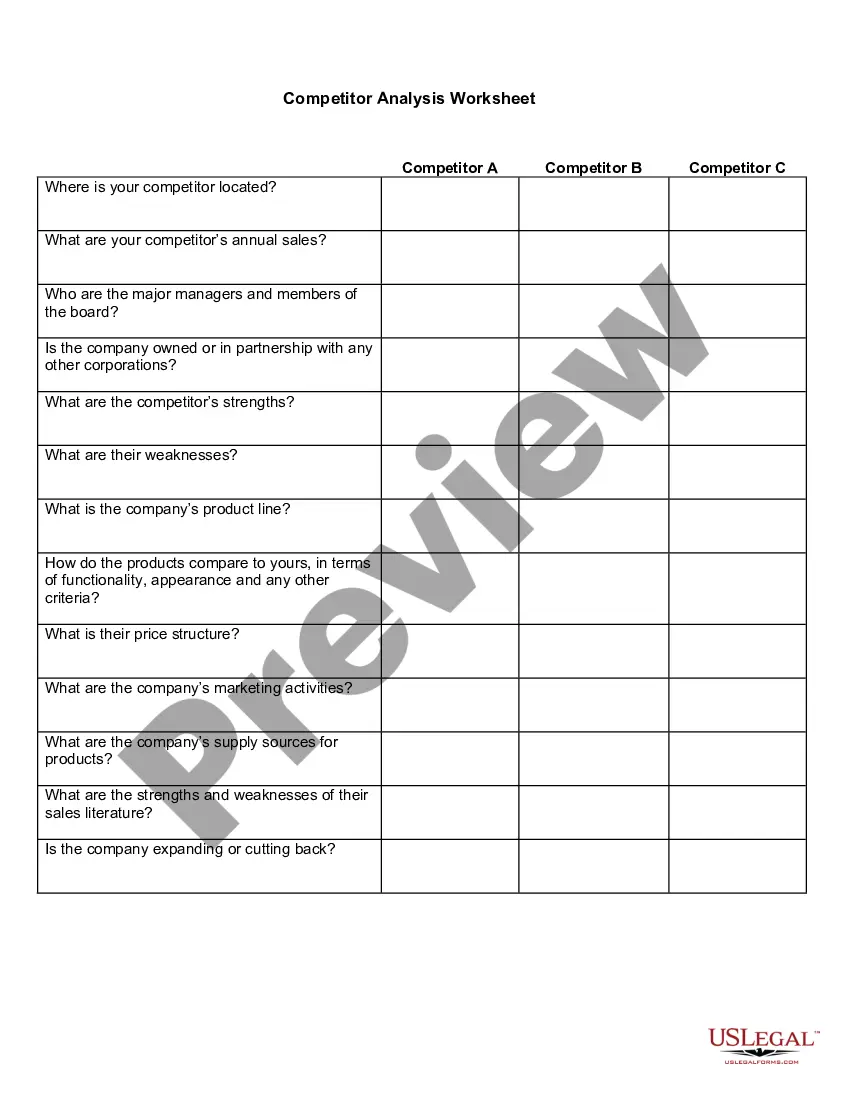
Competitor Analysis Worksheet
Overview of this form
The Competitor Analysis Worksheet is a tool designed to help businesses evaluate and compare their products or services with those of their competitors. This form allows you to systematically analyze various aspects of competing companies, including their strengths, weaknesses, and market strategies. Unlike other market analysis tools, this worksheet focuses specifically on the detailed comparison of competitor offerings, which is essential for crafting effective business strategies.
Form components explained
- Identification of competitors, including location and ownership structure.
- Annual sales figures to gauge market presence.
- Information about key management personnel.
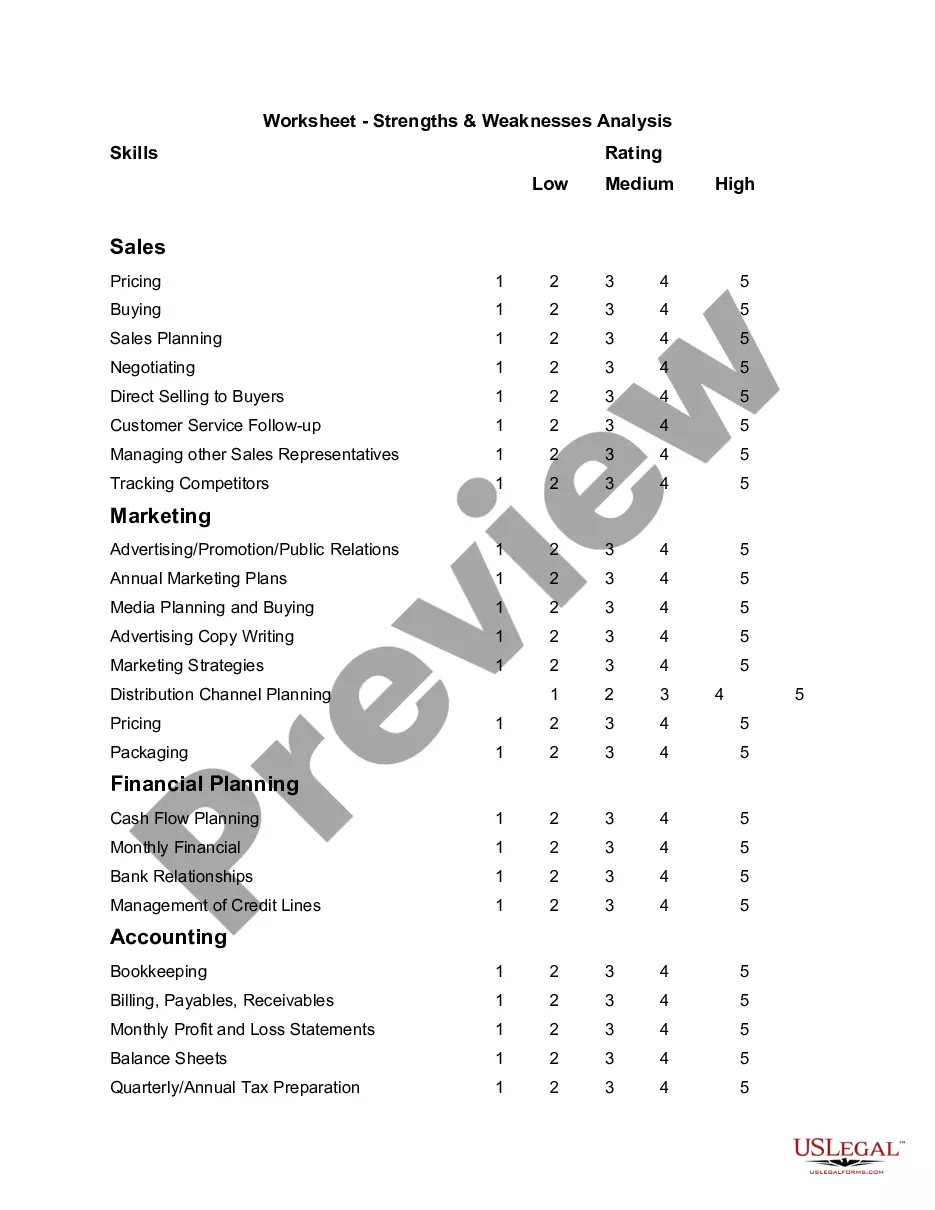
- Analysis of competitors' strengths and weaknesses.
- Comparison of product lines based on functionality and appearance.
- Overview of pricing structures and marketing activities.
- Insights into sales literature and supply sources.
- Current expansion or cutback strategies of competitors.
When this form is needed
This form is used when businesses want to understand their competitive landscape. It is particularly useful during strategic planning, product development, and when entering new markets. Use the Competitor Analysis Worksheet to gather insights before launching new products, adjusting marketing strategies, or when assessing the impact of competitors on your business.
Who can use this document
- Business owners looking to evaluate their market position.
- Marketing professionals engaged in strategic planning.
- Product managers involved in product development and comparison.
- Entrepreneurs entering new markets seeking competitive insights.
- Consultants assisting clients with market analysis.
Completing this form step by step
- Identify your competitors by listing their names and locations.
- Research and note their annual sales figures.
- Gather details about major managers and the board of directors.
- Evaluate the strengths and weaknesses of each competitor.
- Analyze their product lines and how they compare to yours.
- Assess their pricing and marketing strategies.
Does this document require notarization?
This form does not typically require notarization to be legally valid. However, some jurisdictions or document types may still require it. US Legal Forms provides secure online notarization powered by Notarize, available 24/7 for added convenience.
Get your form ready online
Our built-in tools help you complete, sign, share, and store your documents in one place.
Make edits, fill in missing information, and update formatting in US Legal Forms—just like you would in MS Word.
Download a copy, print it, send it by email, or mail it via USPS—whatever works best for your next step.
Sign and collect signatures with our SignNow integration. Send to multiple recipients, set reminders, and more. Go Premium to unlock E-Sign.
If this form requires notarization, complete it online through a secure video call—no need to meet a notary in person or wait for an appointment.
We protect your documents and personal data by following strict security and privacy standards.

Make edits, fill in missing information, and update formatting in US Legal Forms—just like you would in MS Word.

Download a copy, print it, send it by email, or mail it via USPS—whatever works best for your next step.

Sign and collect signatures with our SignNow integration. Send to multiple recipients, set reminders, and more. Go Premium to unlock E-Sign.

If this form requires notarization, complete it online through a secure video call—no need to meet a notary in person or wait for an appointment.

We protect your documents and personal data by following strict security and privacy standards.
Common mistakes to avoid
- Failing to identify all relevant competitors.
- Not updating sales figures regularly, leading to outdated information.
- Neglecting qualitative aspects such as customer service and brand sentiment.
- Overlooking smaller competitors that may disrupt the market.
Why use this form online
- Immediate access to a structured analysis template.
- Easy to download and customize for specific business needs.
- Secure and reliable format ensuring data protection.
- Ability to update and adjust information as market dynamics change.
Legal use & context
- This worksheet is a practical tool for internal assessments and does not typically require legal verifications.
- Using this analysis can enhance strategic planning and provide a competitive edge.
Quick recap
- The Competitor Analysis Worksheet is essential for understanding competition in your market.
- Use this tool to inform business strategies and product development.
- Regular updates and thorough research are critical for effective competitor analysis.
Looking for another form?
Form popularity
FAQ
Start with the Flagship Product. Benchmark Your Own Products. Go Deep on the Website. Watch Videos. Get the Real Story from Customers. Include Marketing, Not Just Product. Track Changes to Identify Product Direction.
Identify your competitors. Examine your competitor's website & customer experience. Identify your competitor's market positioning. Take a peek at pricing. Problem solve for shipping. Take a temperature check with reviews. Review social media.
A Complete List of All Your Competitors. Product Summary of Your Competitors. Strengths and Weaknesses of the Competition. The Outlook of the Market. Direct. Indirect. Potential New Entrants. Discovering All the Comparative Advantages.
Identify Major Competitors. Find out from potential customers how they currently get their needs met. Prepare Competitive Profiles. Next, write a brief profile of each major competitor, summarizing information such as products, markets, facilities, pricing, marketing strategies, and finances. Create Competitive Matrix.
Identifying your competitors. Obtaining information about your competitors. - Brand awareness - the % of your target market that are aware of your competitors. Evaluating their strategies. - Determine their strengths and weaknesses relative to your brand's.
Identify your competitors. Examine your competitor's website & customer experience. Identify your competitor's market positioning. Take a peek at pricing. Problem solve for shipping. Take a temperature check with reviews. Review social media.
Get organized. Competitive landscape analysis example. Identify your competition. Analyze their content. Monitor their social media. Analyze their marketing strategy and offers. Evaluate their offers and pricing. Determine their positioning. Use frameworks: SWOT the PEST.
Competitive analysis Define the industry scope and nature of the industry. Determine who the competitors are. Determine who the customers are and what benefits they expect. Determine the key strengths for example price, service, convenience, inventory, etc.
Identify your competitors. Examine your competitor's website & customer experience. Identify your competitor's market positioning. Take a peek at pricing. Problem solve for shipping. Take a temperature check with reviews. Review social media.