Louisiana Demand Letter to Client regarding Payment of Attorney's Fees and NSF Check
What this document covers
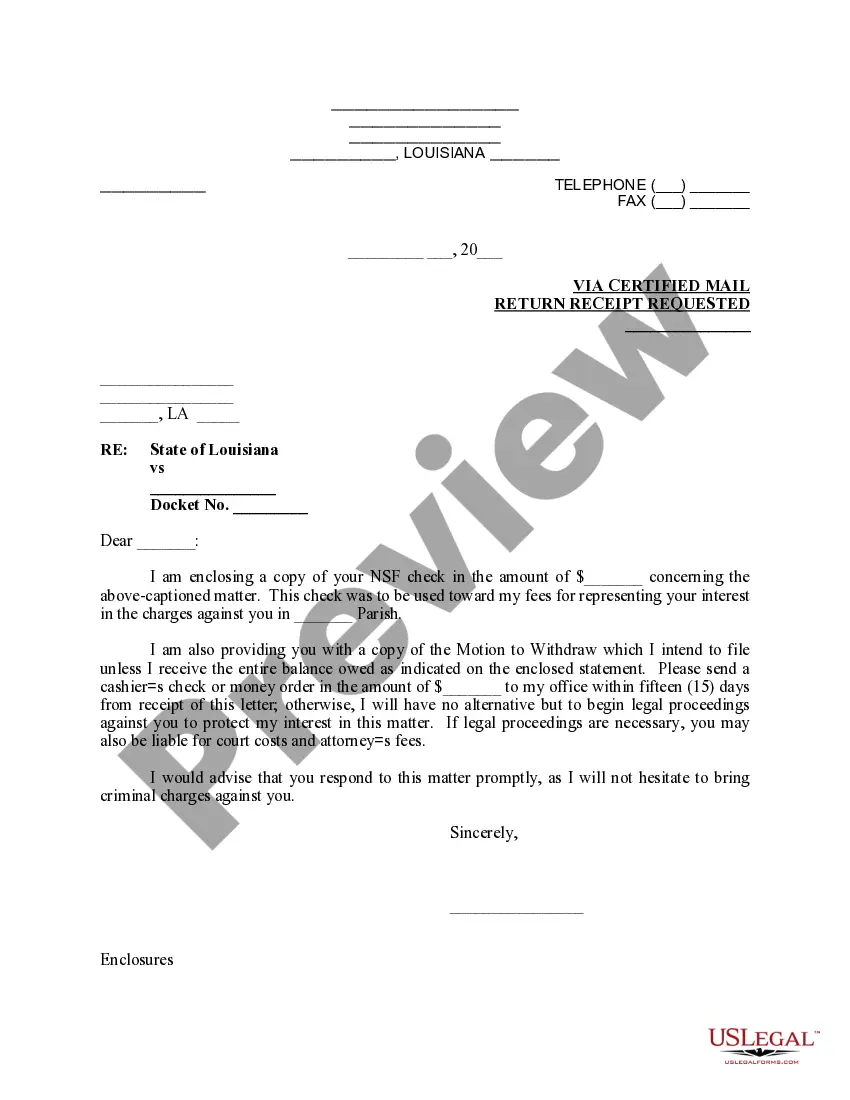
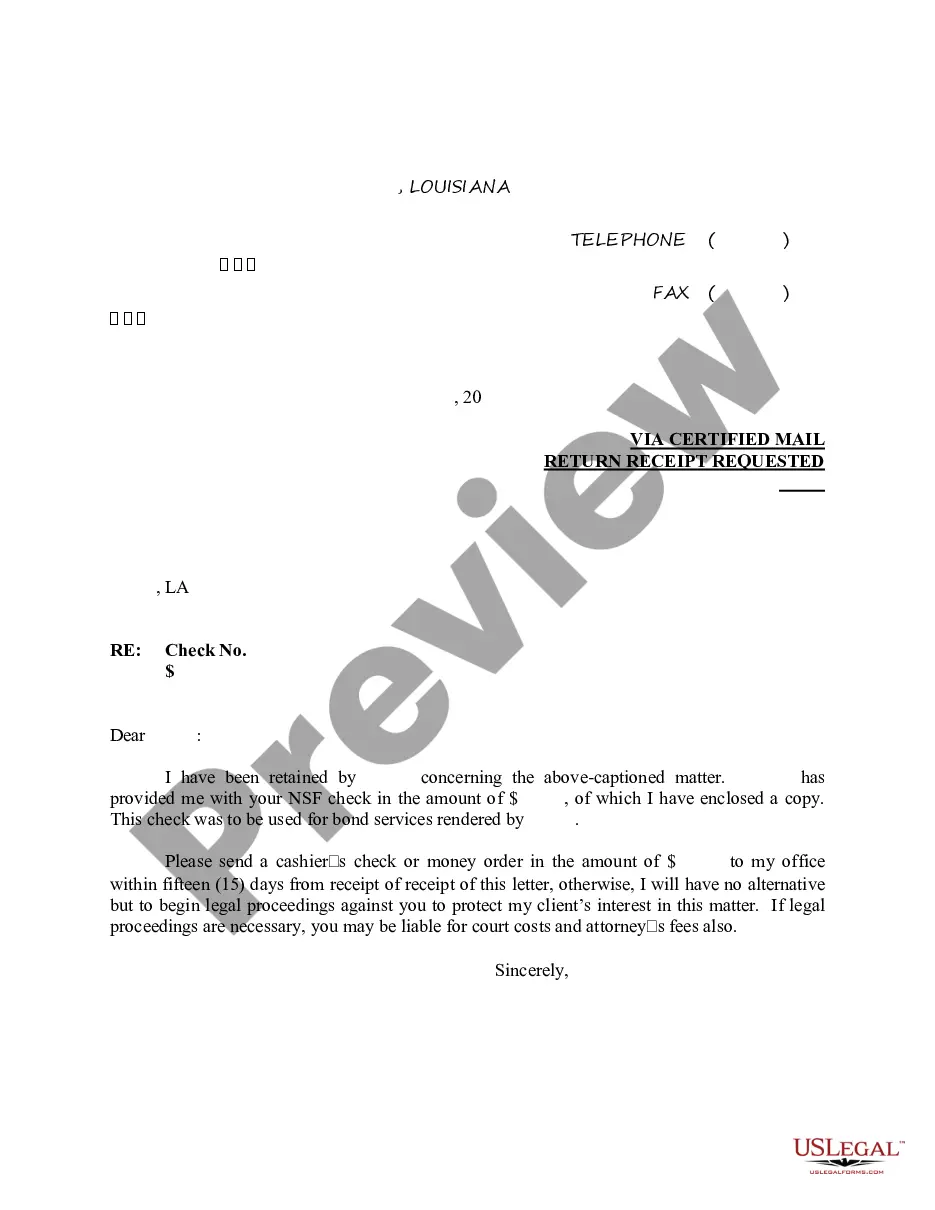
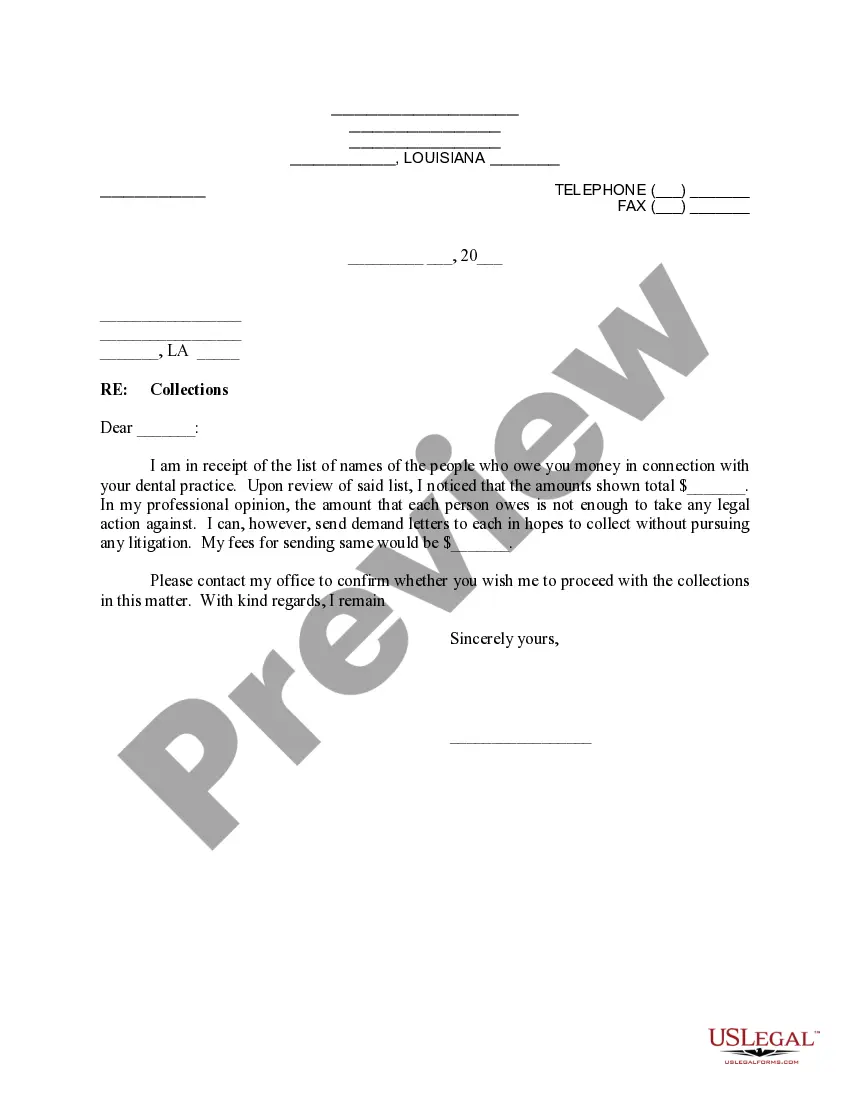
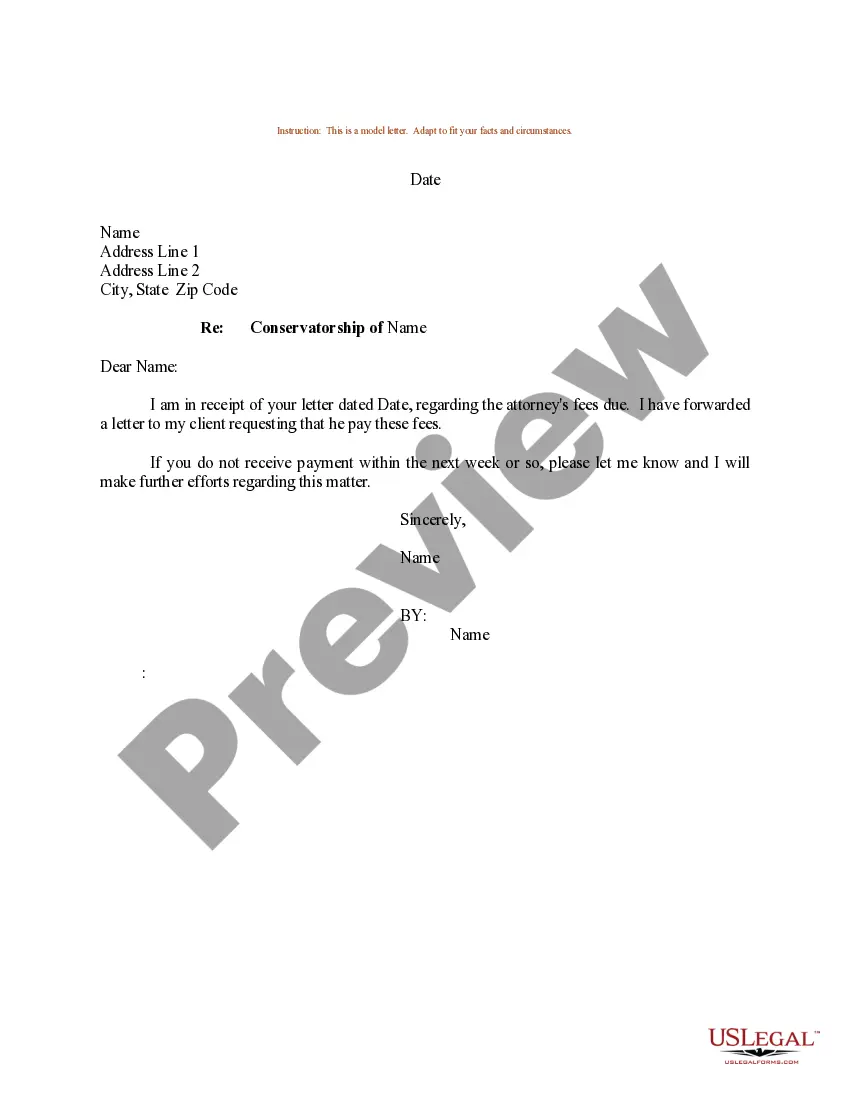
This Demand Letter to Client regarding Payment of Attorney's Fees and NSF Check is a formal communication from an attorney to a client. Its primary purpose is to request payment for fees owed due to a non-sufficient funds (NSF) check issued for legal services. Unlike other standard demand letters, this document specifically addresses the issue of an NSF check and outlines potential legal consequences for non-payment, including the filing of a Motion to Withdraw by the attorney.
Key components of this form
- Identification of the attorney and client, including contact information
- Description of the NSF check and associated fees
- A statement of intent to file a Motion to Withdraw if payment is not received
- Deadline for payment submission in specified formats (cashier's check or money order)
- Warning of potential legal action and additional liabilities
When to use this form
This form should be used when an attorney has received an NSF check from a client and is seeking to recover the owed fees. It applies to situations where the attorney needs to formally notify the client of the outstanding payment and the consequences of non-compliance. This letter serves as a crucial step before escalating the matter to legal proceedings.
Intended users of this form
This form is intended for:
- Attorneys representing clients in various legal matters
- Clients who have issued an NSF check as payment for legal services
- Legal professionals seeking a structured method for requesting unpaid fees from clients
Instructions for completing this form
- Fill in your attorney contact information at the top of the letter.
- Specify the recipient client's name and address.
- Clearly state the details of the NSF check and the amount due.
- Set a clear payment deadline (usually within fifteen days) and acceptable payment methods.
- Include a warning statement regarding the potential legal actions for non-compliance.
Does this document require notarization?
Notarization is generally not required for this form. However, certain states or situations might demand it. You can complete notarization online through US Legal Forms, powered by Notarize, using a verified video call available anytime.
Get your form ready online
Our built-in tools help you complete, sign, share, and store your documents in one place.
Make edits, fill in missing information, and update formatting in US Legal Forms—just like you would in MS Word.
Download a copy, print it, send it by email, or mail it via USPS—whatever works best for your next step.
Sign and collect signatures with our SignNow integration. Send to multiple recipients, set reminders, and more. Go Premium to unlock E-Sign.
If this form requires notarization, complete it online through a secure video call—no need to meet a notary in person or wait for an appointment.
We protect your documents and personal data by following strict security and privacy standards.

Make edits, fill in missing information, and update formatting in US Legal Forms—just like you would in MS Word.

Download a copy, print it, send it by email, or mail it via USPS—whatever works best for your next step.

Sign and collect signatures with our SignNow integration. Send to multiple recipients, set reminders, and more. Go Premium to unlock E-Sign.

If this form requires notarization, complete it online through a secure video call—no need to meet a notary in person or wait for an appointment.

We protect your documents and personal data by following strict security and privacy standards.
Common mistakes
- Failing to specify the correct payment amount owed.
- Not providing a clear deadline for payment.
- Omitting critical client information such as name and address.
- Using informal language instead of a professional tone.
- Neglecting to include the motion for withdrawal and consequences in the letter.
Why use this form online
- Convenience of downloading a legally sound template drafted by licensed attorneys.
- Easy customization options that allow you to fill in personal details quickly.
- Access to reliable legal resources and support through US Legal Forms.
- Time-saving compared to drafting a letter from scratch.
Legal use & context
- This form serves as evidence of a formal demand for payment in case of subsequent legal proceedings.
- It may help in establishing a timeline and detail of attempts made to resolve the payment issue.
- Legal enforceability relies on compliance with local laws regarding demand letters and NSF checks.
Main things to remember
- The Demand Letter is a critical legal tool for recovering unpaid attorney fees.
- It clearly outlines the consequences of non-payment, fostering accountability.
- Using a structured template helps maintain professionalism and legal integrity.
Looking for another form?
Form popularity
FAQ
A flat fee, also referred to as a flat rate or a linear rate refers to a pricing structure that charges a single fixed fee for a service, regardless of usage. Less commonly, the term may refer to a rate that does not vary with usage or time of use.
A good rule of thumb is to charge at least $3,000 per month for your retained clients because this way you'll only need 3 clients to sign retainer agreements in order to earn a six-figure income. Your goal should be to develop high-income skills so that each client is paying a $10,000 per month retainer fee.
Flat fee billing means that, for your particular case, Dickson Davis Law Firm will only charge one rate for services provided for a preset number of hours assigned to your case. With flat fee billing, whether the attorney is efficient is irrelevant.
Generally, the client is entitled to all documents originally provided by the client, and all documents filed, served or sent by the lawyer to others.While virtually every attorney keeps "notes" in his or her files, very few can agree on exactly what specific information constitutes attorney notes.
What is a typical retainer fee attorney? Some lawyers charge retainer fees of $1000, while others charge $5000+. Depending on the lawyer and the complexity of your case, you can usually expect to pay a retainer fee of between $3000 and $5000.
The amount serves as a guarantee by the client to pay the attorney upon completion of the agreed work. The attorney cannot claim the retainer fee until he has completed the work and invoiced the client. Any remaining retainer fee after paying the hourly attorney fees should be returned to the client.
Overview. A retainer fee can be any denomination that the attorney requests. It may be as low as $500 or as high as $5,000 or more. Some attorneys base retainer fees on their hourly rate multiplied by the number of hours that they anticipate your case will take.
According to our database of legal fees, an attorney practicing on their own will charge anywhere between $750 and $1,200 to write and send a demand letter. A smaller law firm will charge anywhere from $1,000 to $1,500 for their services.
While it may not seem like it, fee agreements with attorneys are negotiable.If you do not have a lot of money to pay upfront for the retainer fee, the attorney may be able to offer you a different arrangement.