Indiana Warranty Deed - Business Entity Grantor by Attorney-in-Fact to Individual Grantee
About this form
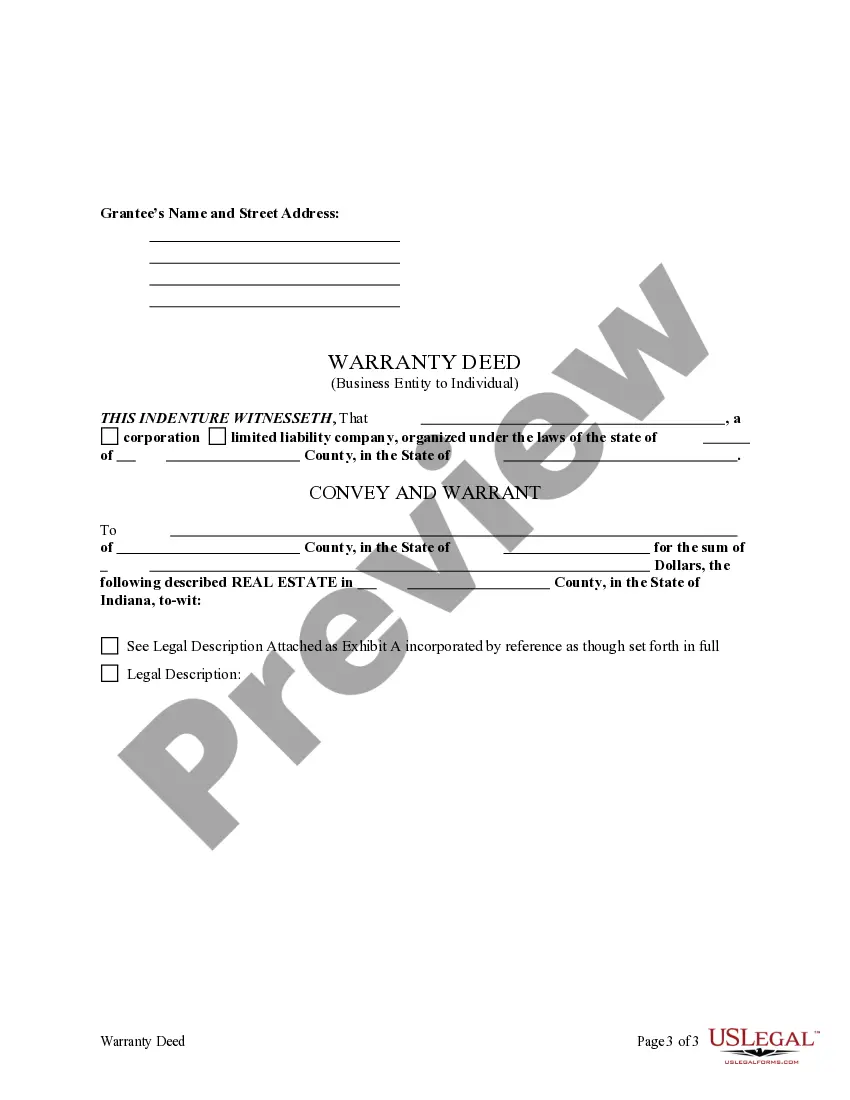
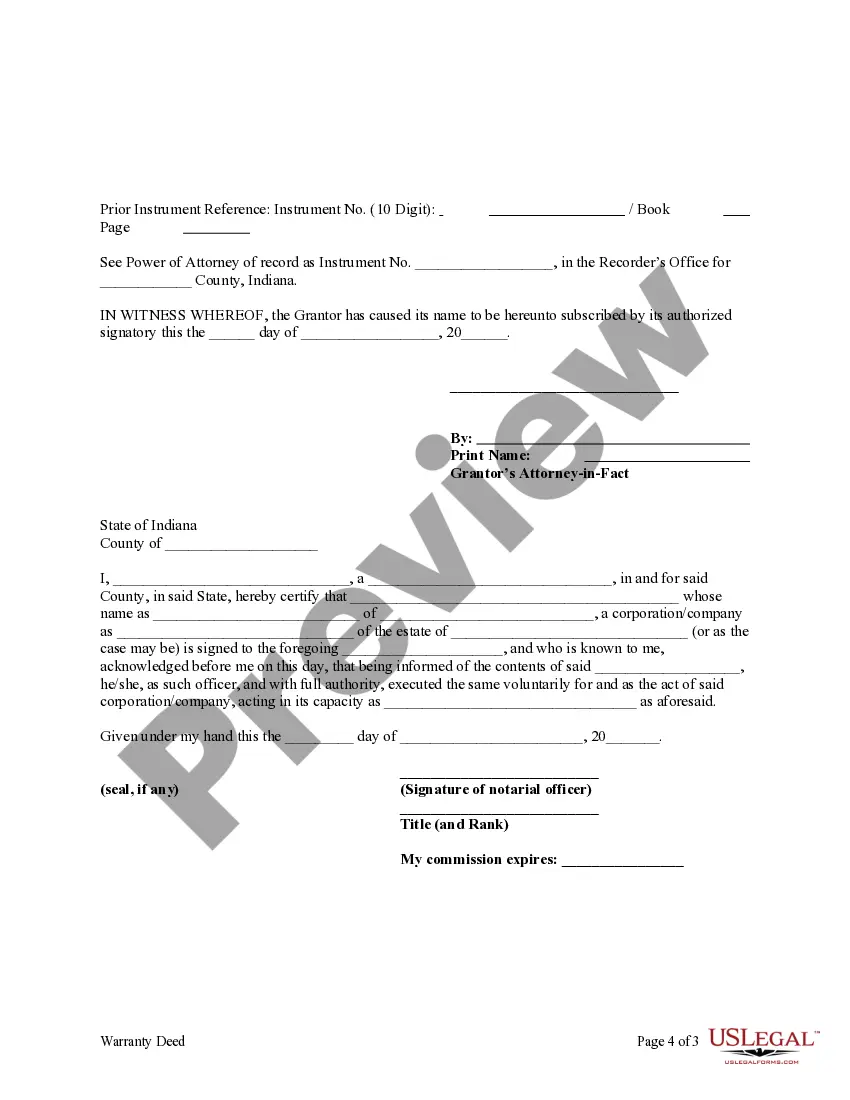
This Warranty Deed is a legal document used when a business entity, such as a corporation or limited liability company, conveys property to an individual. Unlike other deeds, this form explicitly details the Grantor as a business entity and the Grantee as an individual, ensuring that the transaction adheres to state statutory laws. It serves as a formal assurance from the Grantor that they have the right to transfer the property, thus providing the Grantee with a warranty of title.
What’s included in this form
- Identifies the Grantor as a business entity and the Grantee as an individual.
- Contains a legal description of the property being transferred.
- Includes a warranty clause guaranteeing that the Grantor has good title to the property.
- Requires the signature of an authorized representative of the Grantor, along with the date of execution.
- Provides fields for relevant details such as the power of attorney information if applicable.




Common use cases
This form should be used when a business entity wishes to transfer real property to an individual. Common scenarios include the sale of property, gifting of real estate, or transferring property as part of a business dissolution or reorganization.
Who can use this document
- Business entities such as corporations or limited liability companies that want to transfer property.
- Individuals who are receiving property from a business entity.
- Attorneys acting on behalf of either the Grantor or Grantee under a power of attorney.
Completing this form step by step
- Identify the parties involved: the Grantor (business entity) and the Grantee (individual).
- Provide a legal description of the property being conveyed.
- Ensure the authorized representative of the Grantor signs the deed.
- Include details about any powers of attorney if applicable.
- Enter the date of the transfer in the specified fields.
Is notarization required?
To make this form legally binding, it must be notarized. Our online notarization service, powered by Notarize, lets you verify and sign documents remotely through an encrypted video session.
Get your form ready online
Our built-in tools help you complete, sign, share, and store your documents in one place.
Make edits, fill in missing information, and update formatting in US Legal Forms—just like you would in MS Word.
Download a copy, print it, send it by email, or mail it via USPS—whatever works best for your next step.
Sign and collect signatures with our SignNow integration. Send to multiple recipients, set reminders, and more. Go Premium to unlock E-Sign.
If this form requires notarization, complete it online through a secure video call—no need to meet a notary in person or wait for an appointment.
We protect your documents and personal data by following strict security and privacy standards.

Make edits, fill in missing information, and update formatting in US Legal Forms—just like you would in MS Word.

Download a copy, print it, send it by email, or mail it via USPS—whatever works best for your next step.

Sign and collect signatures with our SignNow integration. Send to multiple recipients, set reminders, and more. Go Premium to unlock E-Sign.

If this form requires notarization, complete it online through a secure video call—no need to meet a notary in person or wait for an appointment.

We protect your documents and personal data by following strict security and privacy standards.
Typical mistakes to avoid
- Failing to accurately describe the property being transferred.
- Not obtaining the proper signature from an authorized representative of the Grantor.
- Overlooking the requirement to include power of attorney details if applicable.
Benefits of using this form online
- Access to legally vetted templates drafted by licensed attorneys.
- The ability to complete the form digitally, ensuring ease of editing and accuracy.
- Instant download capability, allowing for quick access and use.
Looking for another form?
Form popularity
FAQ
No, California does not require that the Grantee sign a warranty deed. However, some states and counties require that the deed be signed by the Grantee in addition to the Grantor.
The person represented usually designates someone as their attorney-in-fact by assigning power of attorney. An attorney-in-fact is not necessarily a lawyer. In fact, attorneys-in-fact don't require any special qualifications at all. They can be a family member or close friend.
Grantor's signature: The grantor must sign the deed for it to be valid. Usually, if more than one person owns a property, all the owners must sign. In some states a husband or wife who own property by themselves may have to have the spouse also sign the deed even though the spouse does not have title to the property.
Adding someone to your house deed requires the filing of a legal form known as a quitclaim deed. When executed and notarized, the quitclaim deed legally overrides the current deed to your home. By filing the quitclaim deed, you can add someone to the title of your home, in effect transferring a share of ownership.
Typically, the lender will provide you with a copy of the deed of trust after the closing. The original warranty deeds are often mailed to the grantee after they are recorded. These are your original copies and should be kept in a safe place, such as a fireproof lockbox or a safe deposit box at a financial institution.
A power of attorney enables an agent (also called the attorney-in-fact) to conduct transactions on another person's behalf.If so, a spouse, relative or friend with POA can sign a deed or other real estate documents.
The Power of Attorney is able to do anything which is authorized in the document. If there is language in the POA which allows the transfer of real property, the power of attorney is able to transfer the property to himself.
No, in most states, the Grantee is not required to sign the Quitclaim Deed. However, some counties do require that the Quitclaim Deed be signed by the Grantee in addition to the Grantor.
An agent cannot:Make decisions on behalf of the principal after their death.However, unless the principal named a co-agent or alternate agent in the same POA document or is still competent to appoint someone else to act on their behalf, an agent cannot choose who takes over their duties.