Indiana Quitclaim Deed - Business Entity Grantor by Attorney-in-Fact to Individual Grantee
Understanding this form
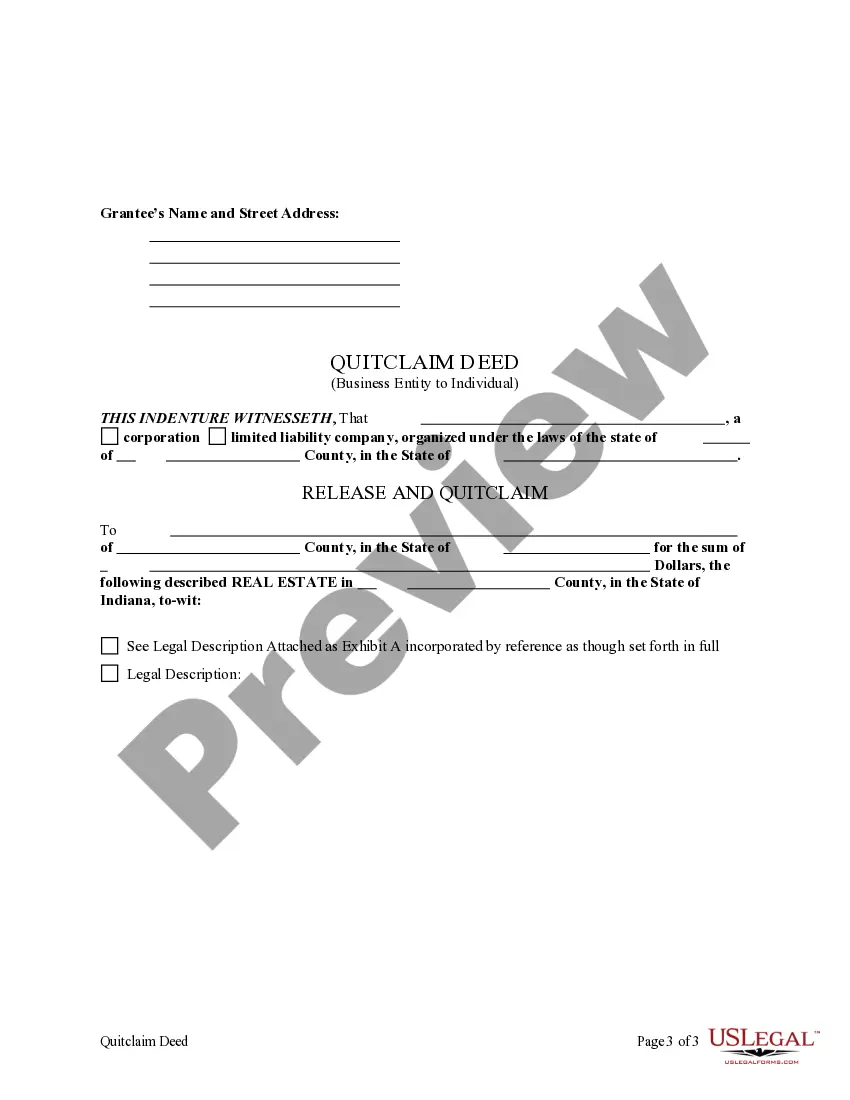
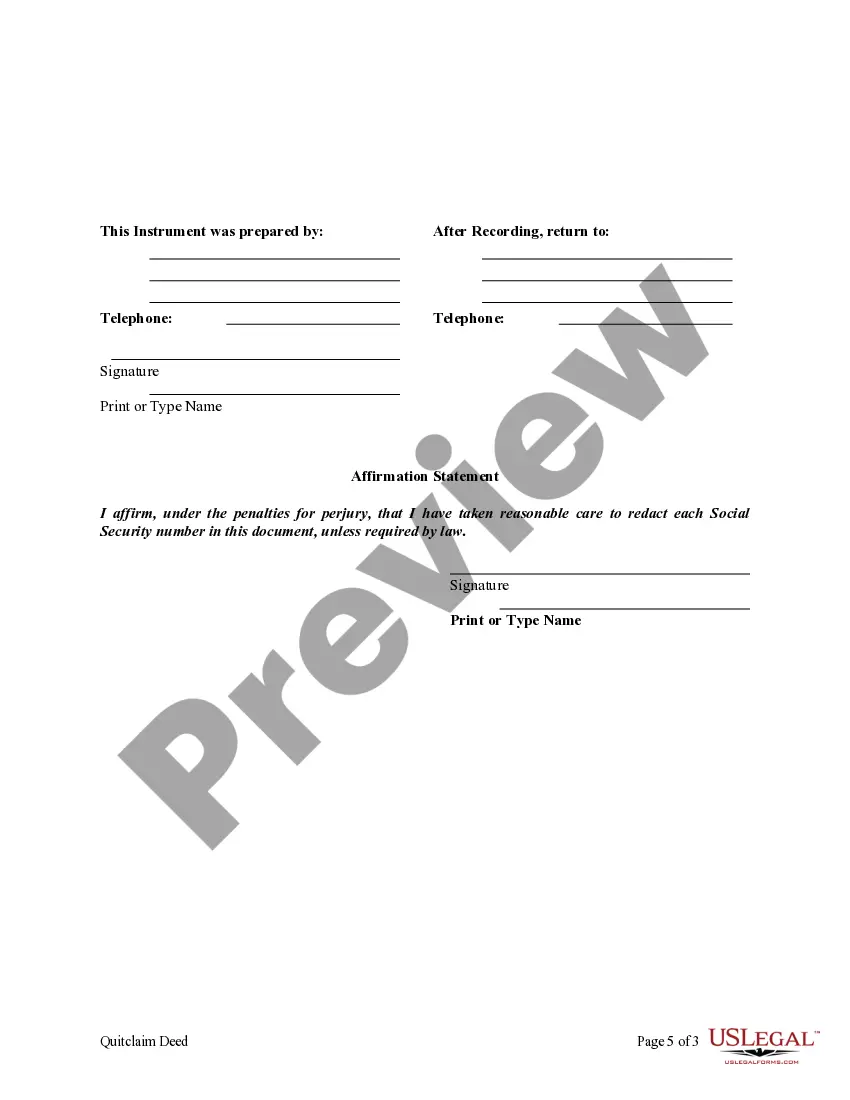
The Quitclaim Deed - Business Entity Grantor by Attorney-in-Fact to Individual Grantee is a legal document used to transfer property ownership from a business entity, such as a corporation or limited liability company, to an individual. Unlike warranty deeds, this form provides no guarantees about the property title, making it essential for situations where the grantor may not be able to provide such assurances. This deed is crucial for ensuring clear property transfers under state laws and is designed to comply with statutory requirements.
Key parts of this document
- Identification of the Grantor (business entity) and Grantee (individual).
- Description of the property being transferred.
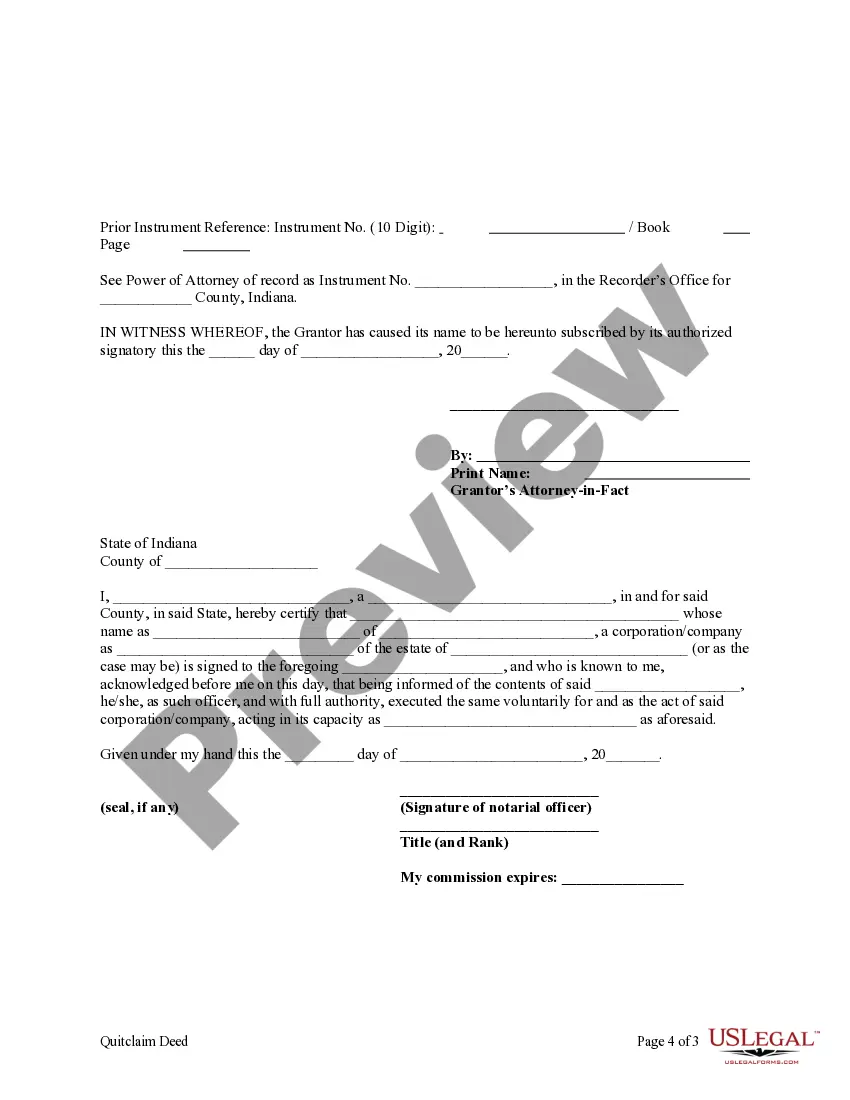
- Signature of the authorized representative from the business entity.
- Notarization section, if required.
- Space for recording details in compliance with local laws.





When to use this form
You should use this quitclaim deed when a business entity, acting through an attorney-in-fact, wishes to convey property to an individual. Common scenarios include the sale of real estate held by a company, transferring ownership for estate planning purposes, or resolving disputes regarding property ownership. This form is particularly useful in simplifying transactions without the complexities associated with other deed types.
Who should use this form
This form is intended for:
- Business entities such as corporations or LLCs that need to transfer property.
- Individuals acquiring property from a business entity.
- Attorneys acting on behalf of a business entity to carry out property transactions.
- Anyone looking to facilitate a property transfer without a warranty of title.
Steps to complete this form
- Identify and enter the name and address of the Grantor and Grantee.
- Provide a full description of the property being transferred.
- Include the date of the transaction.
- Ensure the form is signed by the authorized signatory of the business entity.
- Check local requirements for notarization and recordkeeping.
Does this document require notarization?
This form needs to be notarized to ensure legal validity. US Legal Forms provides secure online notarization powered by Notarize, allowing you to complete the process through a verified video call, available anytime.
Get your form ready online
Our built-in tools help you complete, sign, share, and store your documents in one place.
Make edits, fill in missing information, and update formatting in US Legal Forms—just like you would in MS Word.
Download a copy, print it, send it by email, or mail it via USPS—whatever works best for your next step.
Sign and collect signatures with our SignNow integration. Send to multiple recipients, set reminders, and more. Go Premium to unlock E-Sign.
If this form requires notarization, complete it online through a secure video call—no need to meet a notary in person or wait for an appointment.
We protect your documents and personal data by following strict security and privacy standards.

Make edits, fill in missing information, and update formatting in US Legal Forms—just like you would in MS Word.

Download a copy, print it, send it by email, or mail it via USPS—whatever works best for your next step.

Sign and collect signatures with our SignNow integration. Send to multiple recipients, set reminders, and more. Go Premium to unlock E-Sign.

If this form requires notarization, complete it online through a secure video call—no need to meet a notary in person or wait for an appointment.

We protect your documents and personal data by following strict security and privacy standards.
Avoid these common issues
- Failing to include a complete property description.
- Not obtaining necessary signatures from authorized representatives.
- Forgetting to check local filing requirements for notarization.
- Omitting the date of transfer, which can create ambiguity.
Why use this form online
- Easy access to professionally drafted forms that comply with current laws.
- Editable fields in downloaded formats allow for convenient customization.
- Instant download capabilities save time compared to traditional methods.
- Reliable documentation supported by legal expertise.
Looking for another form?

Form popularity
FAQ
In Indiana, the individual who acts as the Attorney-in-Fact for the business entity must sign the quitclaim deed. This person represents the entity and has the authority to transfer property ownership. It's important to include the name and title of the signer to ensure clarity in the document. For assistance in preparing this deed correctly, you can utilize US Legal Forms, which offers user-friendly templates.
To create an Indiana Quitclaim Deed - Business Entity Grantor by Attorney-in-Fact to Individual Grantee, specific requirements must be met. You need the names of the parties involved, a legal description of the property, and appropriate signatures. Additionally, the deed should be notarized to ensure its validity. Using US Legal Forms can simplify this process and provide the required templates tailored to Indiana law.
A quitclaim deed is quick and easy because it transfers all of one person's interest in the property to another.The deed transfers all claims the seller has to the property, if any. If the seller has no interest in the real estate, no interest is transferred.
A quitclaim deed transfers title but makes no promises at all about the owner's title.A person who signs a quitclaim deed to transfer property they do not own results in no title at all being transferred since there is no actual ownership interest. The quitclaim deed only transfers the type of title you own.
Once the quitclaim deed is signed and notarized, it is a valid legal document. But the grantee must also have the quitclaim deed recorded in the county recorder's office, or with the county clerk -- whoever has the authority to record deeds and property transfers.
Step 1: Find your IN quitclaim deed form. Step 2: Gather the information you need. Step 3: Enter the information about the parties. Step 4: Enter the legal description of the property. Step 5: Have the grantor sign the document in the presence of a Notary Public.
Because quitclaim deeds expose the grantee to certain risks, they are most often used between family members and where there is no exchange of money.In this case, the grantor remains liable for the mortgage even after ownership has transferred through the execution of a quitclaim deed.
A quitclaim deed is dangerous if you don't know anything about the person giving you the property. You should be sure that a person actually has rights to a property before signing it over with a quitclaim deed.
Quitclaim deeds are most often used to transfer property between family members. Examples include when an owner gets married and wants to add a spouse's name to the title or deed, or when the owners get divorced and one spouse's name is removed from the title or deed.
It's usually a very straightforward transaction, but it's possible for a quitclaim deed to be challenged. If a quitclaim deed is challenged in court, the issue becomes whether the property was legally transferred and if the grantor had the legal right to transfer the property.