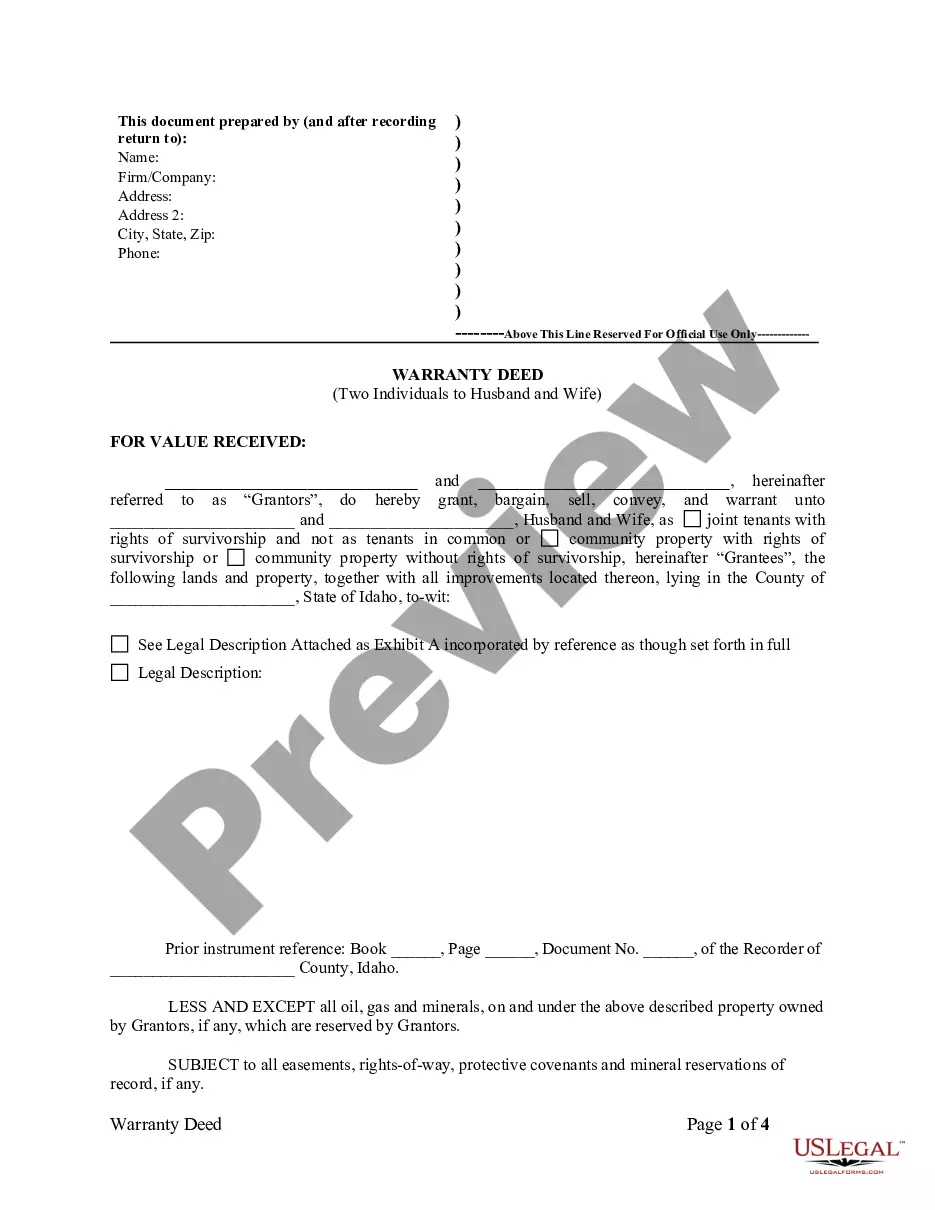
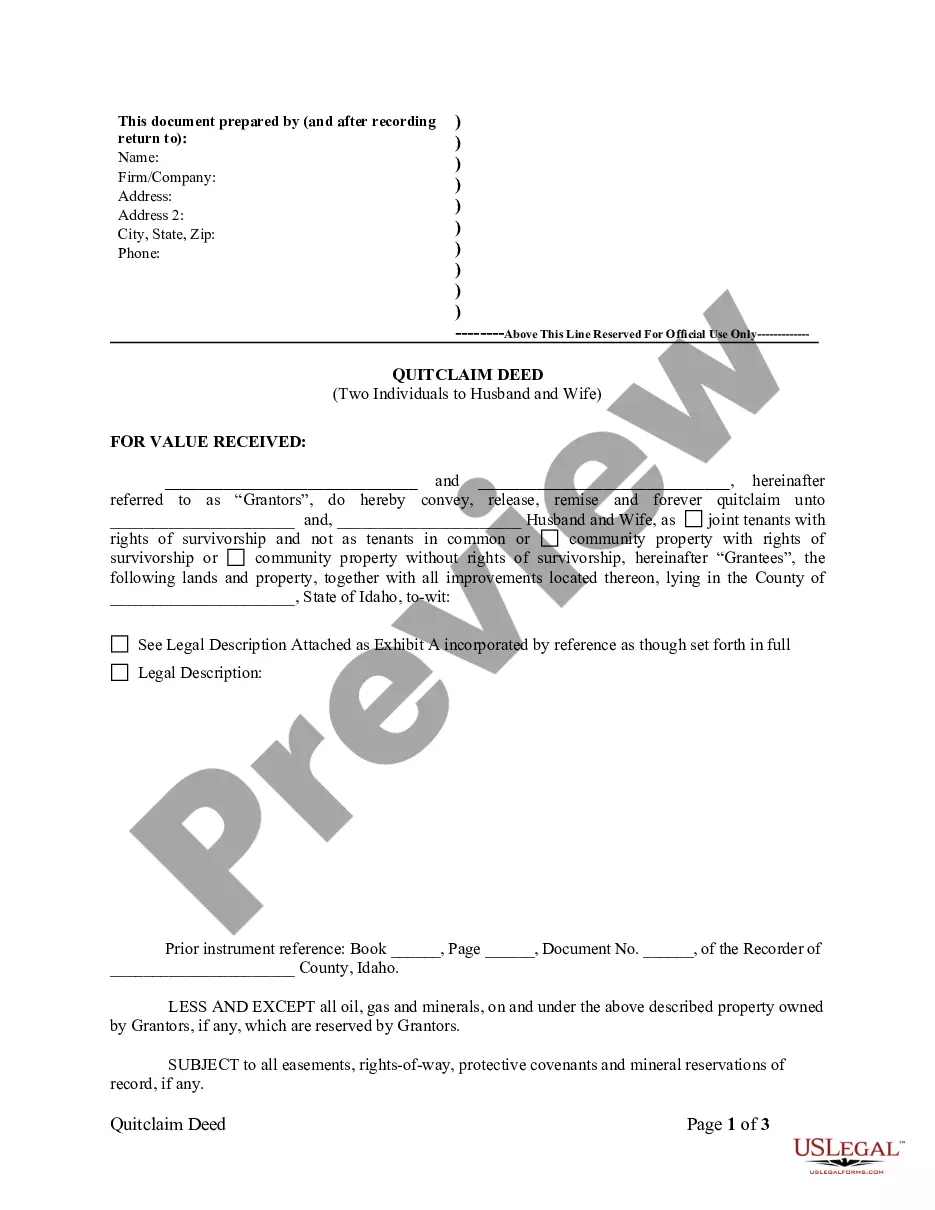
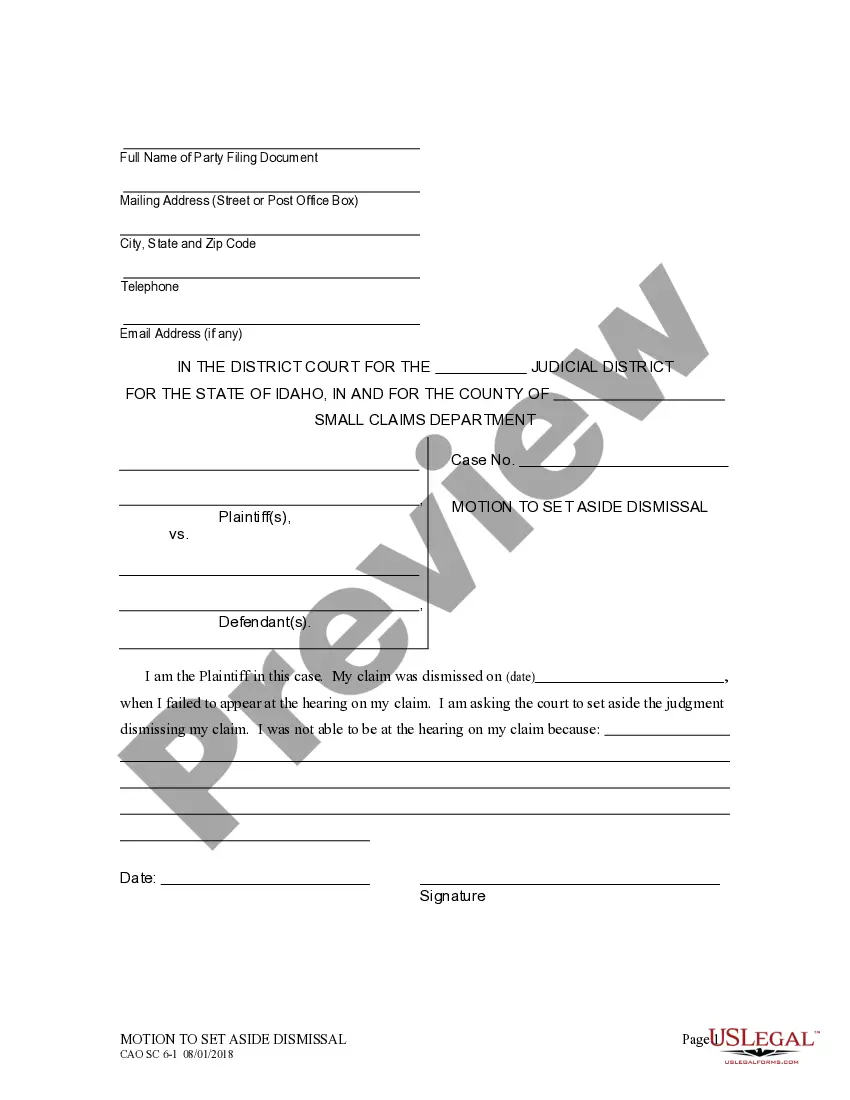
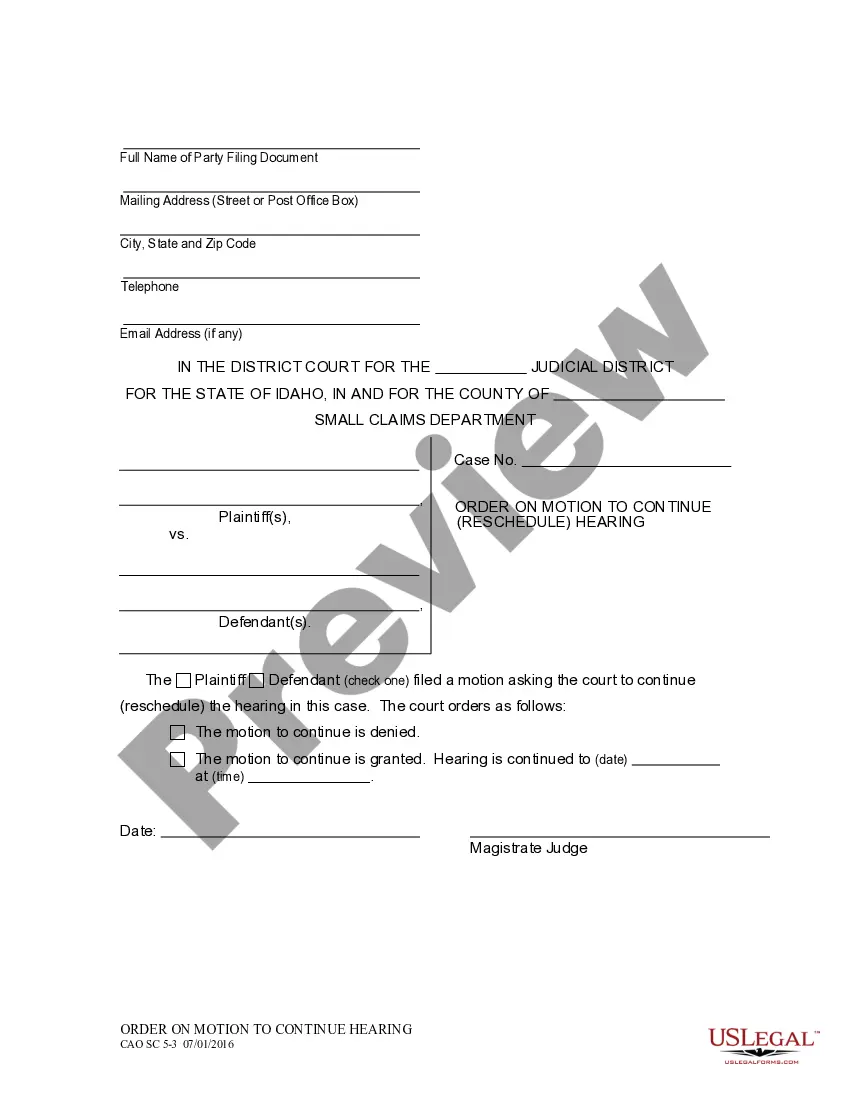
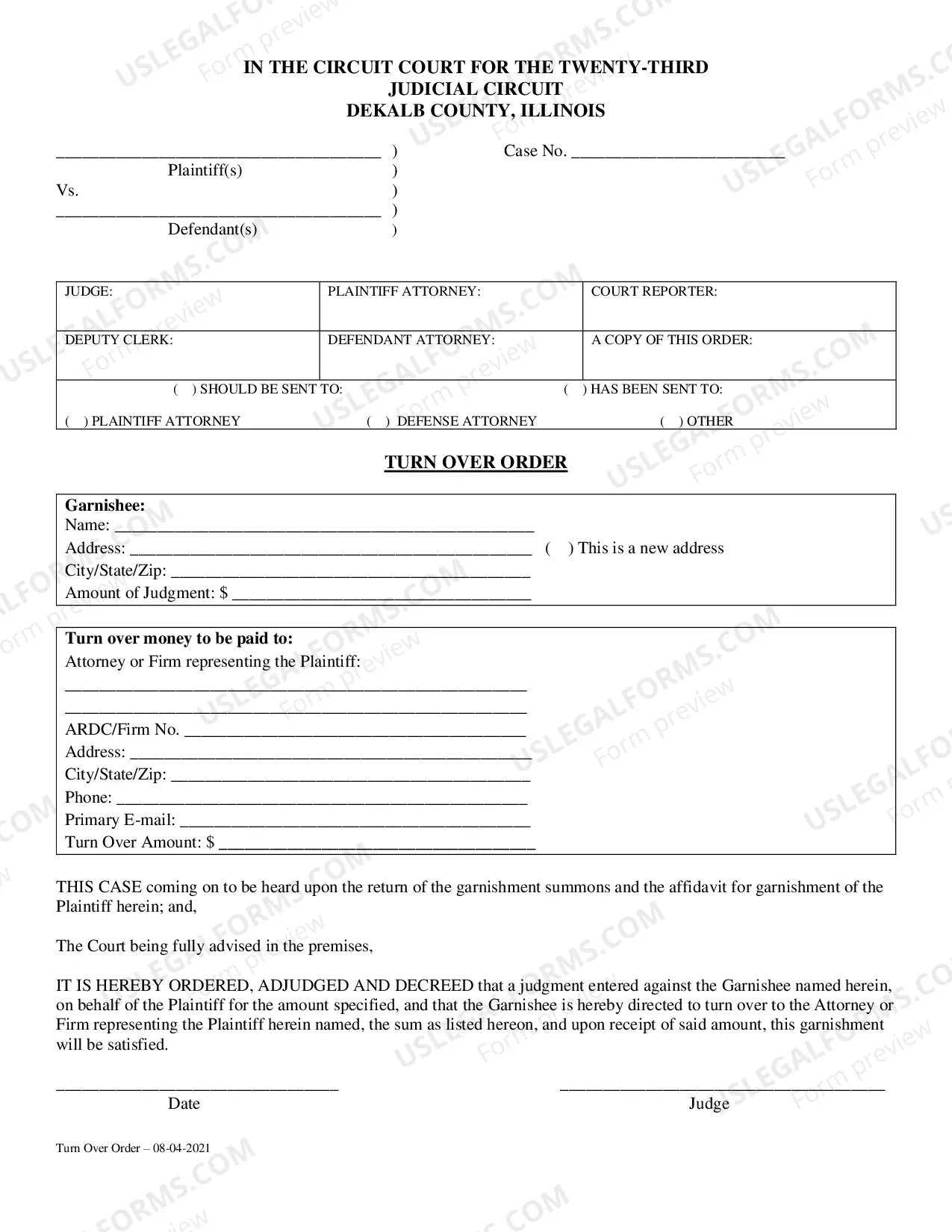
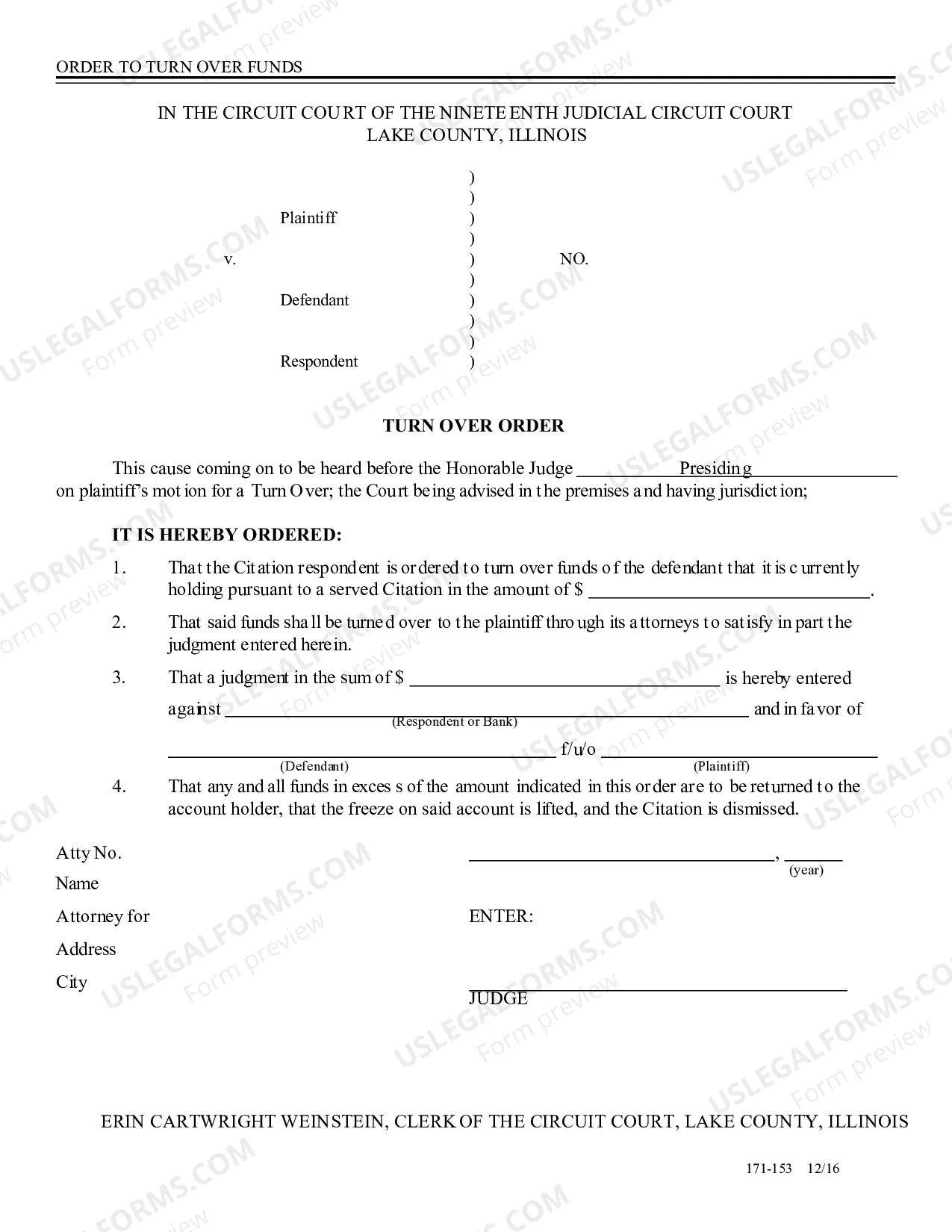
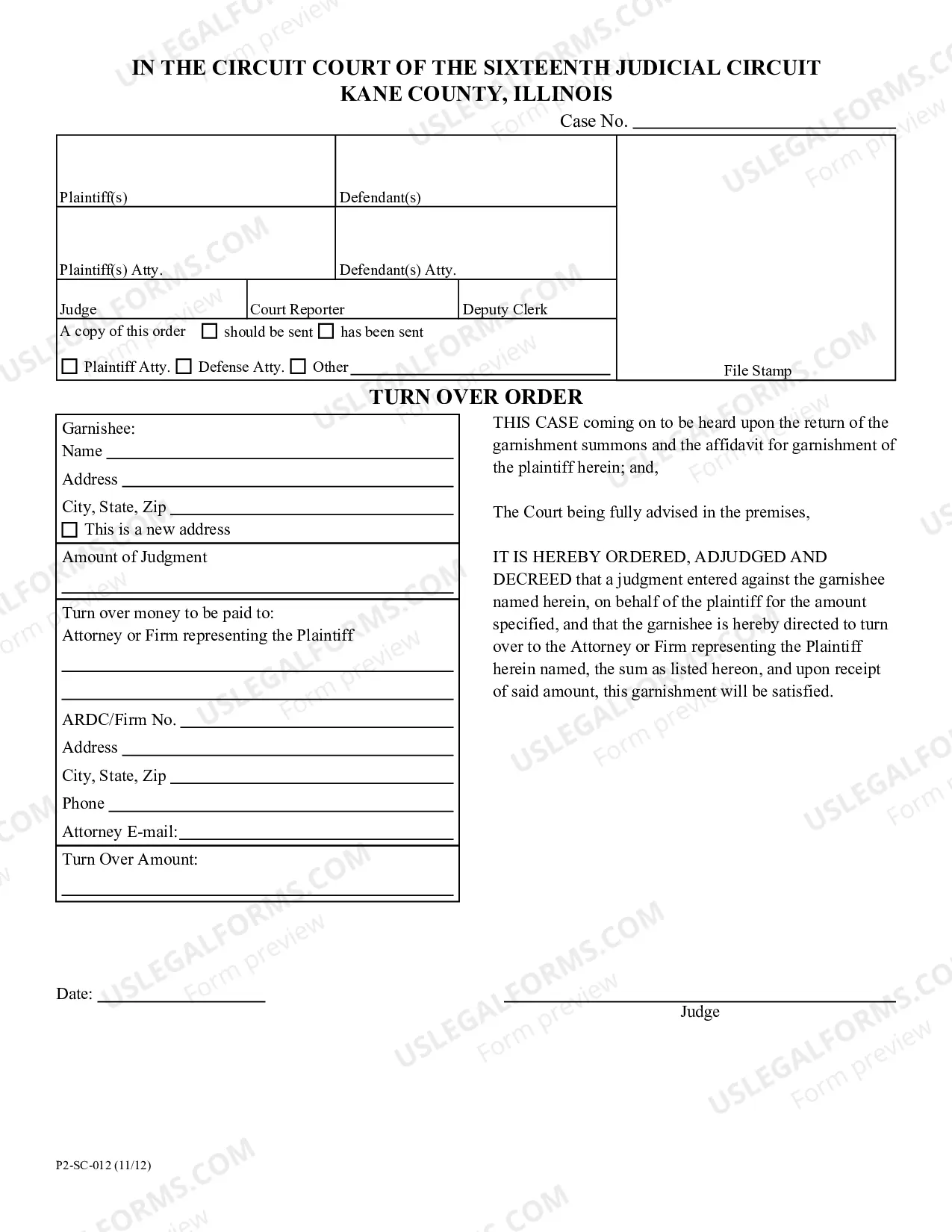
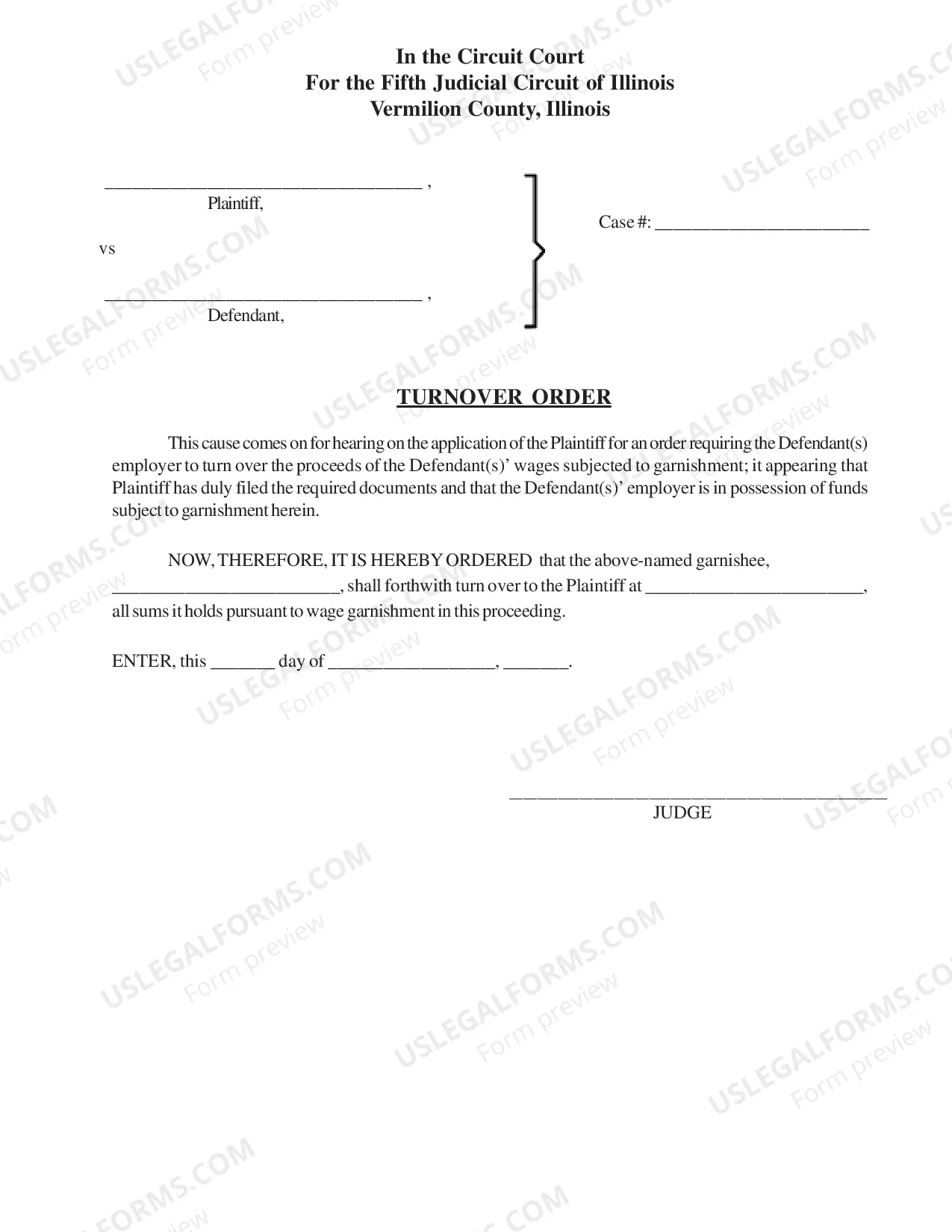
An Illinois Turnover Order is a court-ordered payment of funds from a debtor to a creditor in the state of Illinois. It is also known as a “garnishment” or “levy.” There are two types of Illinois Turnover Orders: a Continuing Order of Withholding and a One-Time Order of Withholding. A Continuing Order of Withholding requires the employer of the debtor to withhold a certain percentage of the debtor's wages or salary and pay that amount to the creditor until the debt is fully paid. A One-Time Order of Withholding requires the employer to immediately pay the full amount of the debt owed to the creditor. Both types of orders are enforceable under Illinois law, and the employer is legally required to comply.
Illinois Turnover Order
Instant download
This website is not affiliated with any governmental entity
Public form
Description
Turnover Order
Get your form ready online
Our built-in tools help you complete, sign, share, and store your documents in one place.
Built-in online Word editor
Make edits, fill in missing information, and update formatting in US Legal Forms—just like you would in MS Word.
Export easily
Download a copy, print it, send it by email, or mail it via USPS—whatever works best for your next step.
E-sign your document
Sign and collect signatures with our SignNow integration. Send to multiple recipients, set reminders, and more. Go Premium to unlock E-Sign.
Notarize online 24/7
If this form requires notarization, complete it online through a secure video call—no need to meet a notary in person or wait for an appointment.
Store your document securely
We protect your documents and personal data by following strict security and privacy standards.

Make edits, fill in missing information, and update formatting in US Legal Forms—just like you would in MS Word.

Download a copy, print it, send it by email, or mail it via USPS—whatever works best for your next step.

Sign and collect signatures with our SignNow integration. Send to multiple recipients, set reminders, and more. Go Premium to unlock E-Sign.

If this form requires notarization, complete it online through a secure video call—no need to meet a notary in person or wait for an appointment.

We protect your documents and personal data by following strict security and privacy standards.
Looking for another form?

How to fill out Illinois Turnover Order?
Handling official paperwork demands focus, accuracy, and utilizing well-structured templates. US Legal Forms has been assisting individuals nationwide with this for 25 years, so when you select your Illinois Turnover Order template from our collection, you can trust it complies with federal and state regulations.
Utilizing our service is straightforward and quick. To access the necessary document, all you require is an account with an active subscription. Here’s a brief guide for you to acquire your Illinois Turnover Order in just minutes.
All documents are designed for multiple uses, such as the Illinois Turnover Order you see here. If you require them again, you can complete them without any additional payment - just access the My documents section in your account and process your document whenever you need it. Experience US Legal Forms and complete your business and personal paperwork swiftly and in full legal compliance!
- Make sure to thoroughly review the document's content and its alignment with general and legal requirements by previewing it or examining its description.
- Search for another official form if the one you opened earlier does not fit your needs or state rules (you can find the tab for that in the top page corner).
- Log in to your account and download the Illinois Turnover Order in your preferred format. If it’s your first visit to our site, click Buy now to continue.
- Create an account, choose your subscription plan, and pay using your credit card or PayPal account.
- Select the format in which you wish to save your document and click Download. Print the form or import it into a professional PDF editor for a paperless submission.
Form popularity
FAQ
Collecting a judgment in Illinois can be straightforward when you understand the steps involved. After obtaining a judgment, you can request an Illinois Turnover Order through the court, which allows you to access the debtor's non-exempt assets. This powerful tool accelerates the collection process and helps you recover what is owed to you. To navigate this process effectively, consider using USLegalForms, which provides all the essential forms and instructions to help you collect your judgment successfully.
Enforcing a judgment in Illinois often begins with obtaining a court order if the debtor does not comply voluntarily. An Illinois Turnover Order can be utilized to compel the debtor to surrender specified assets to satisfy the debt. This process can involve court hearings and legal documentation. It's advisable to work with an attorney to navigate this effectively.
When selling a car in Illinois, accurately filling out the title is key. Write down the buyer's information, the sale date, and any necessary vehicle details on the title. Don’t forget to sign it as the seller. Properly completing the title is essential to ensure the registered ownership aligns with the Illinois Turnover Order requirements.
A wage garnishment is when a part of a person's wages are taken to pay for a debt they owe. This is also called a turnover order. The person who owes the money is called the debtor. The person they owe the money to is called the creditor.
Employment income is usually not exempt under Illinois law, but other kinds of income are exempt from wage deductions. Some examples of exempt income include Social Security and other income from the federal government, workers' compensation benefits, unemployment benefits, and government assistance, to name a few.
The Debt Collection Improvement Act authorizes federal agencies or collection agencies under contract with them to garnish up to 15% of disposable earnings to repay defaulted debts owed to the U.S. government.
In laymen's terms, a turnover order directs the Judgment debtor or third person to transfer (or ?turn over?) personal property to the levying officer.
Wage Garnishment in Illinois In Illinois, if a creditor wins a court judgment against you, the maximum your employer can garnish from your weekly earnings is either 15 percent of your earnings or the amount left over after you deduct 45 hours' worth of Illinois' minimum wage.
Illinois law governs the enforcement and resurrection of judgments. Under Illinois law, judgments have an enforcement time limit of seven years from the date of their entry.