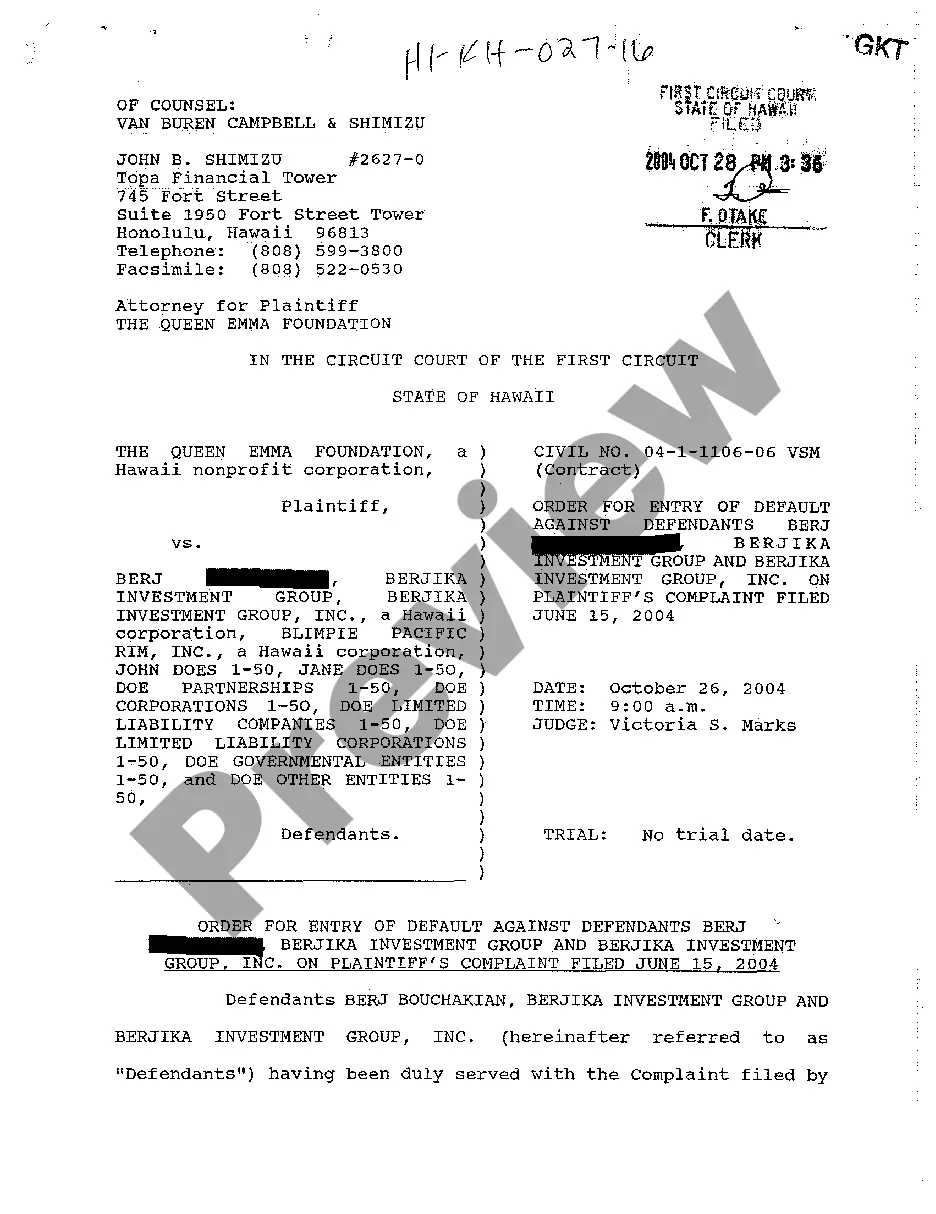
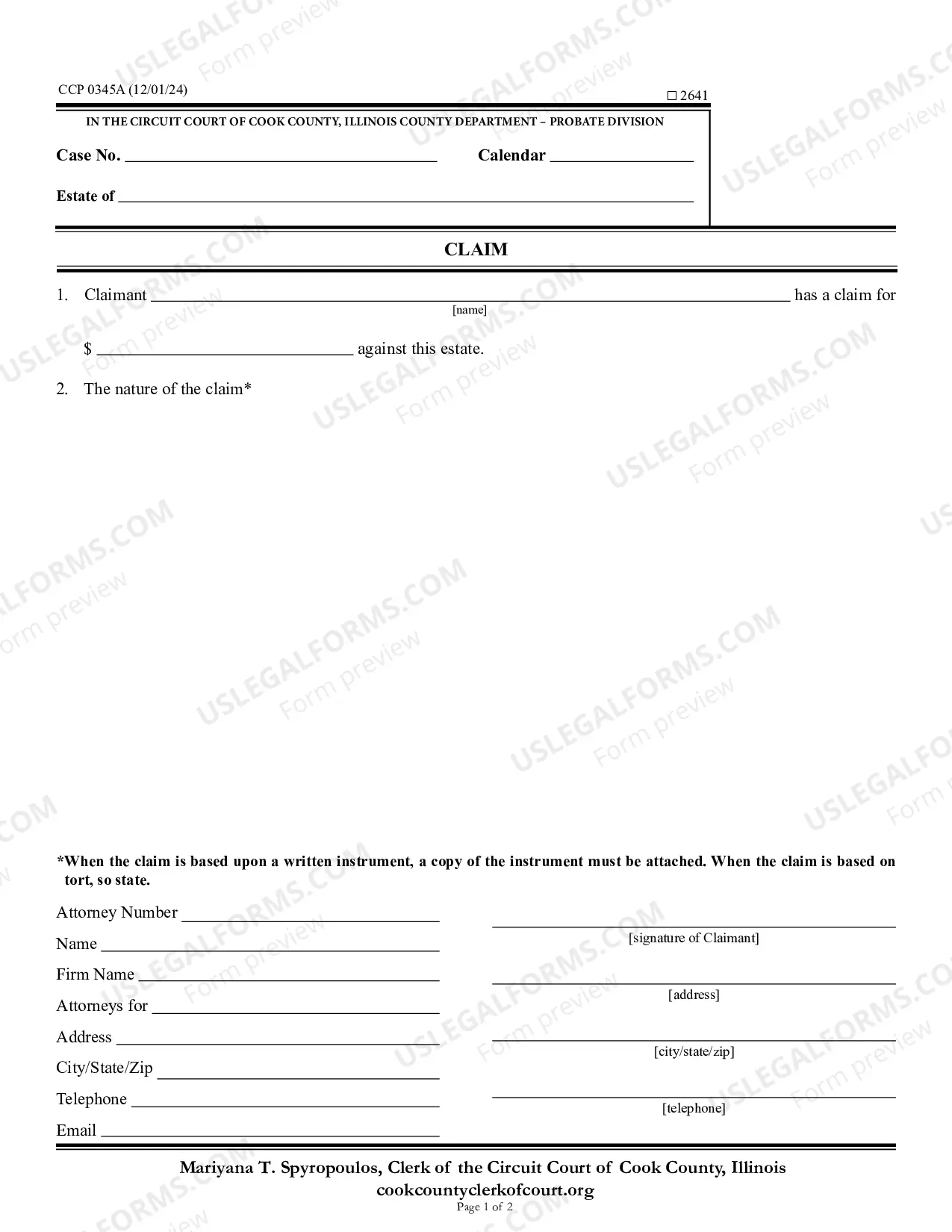
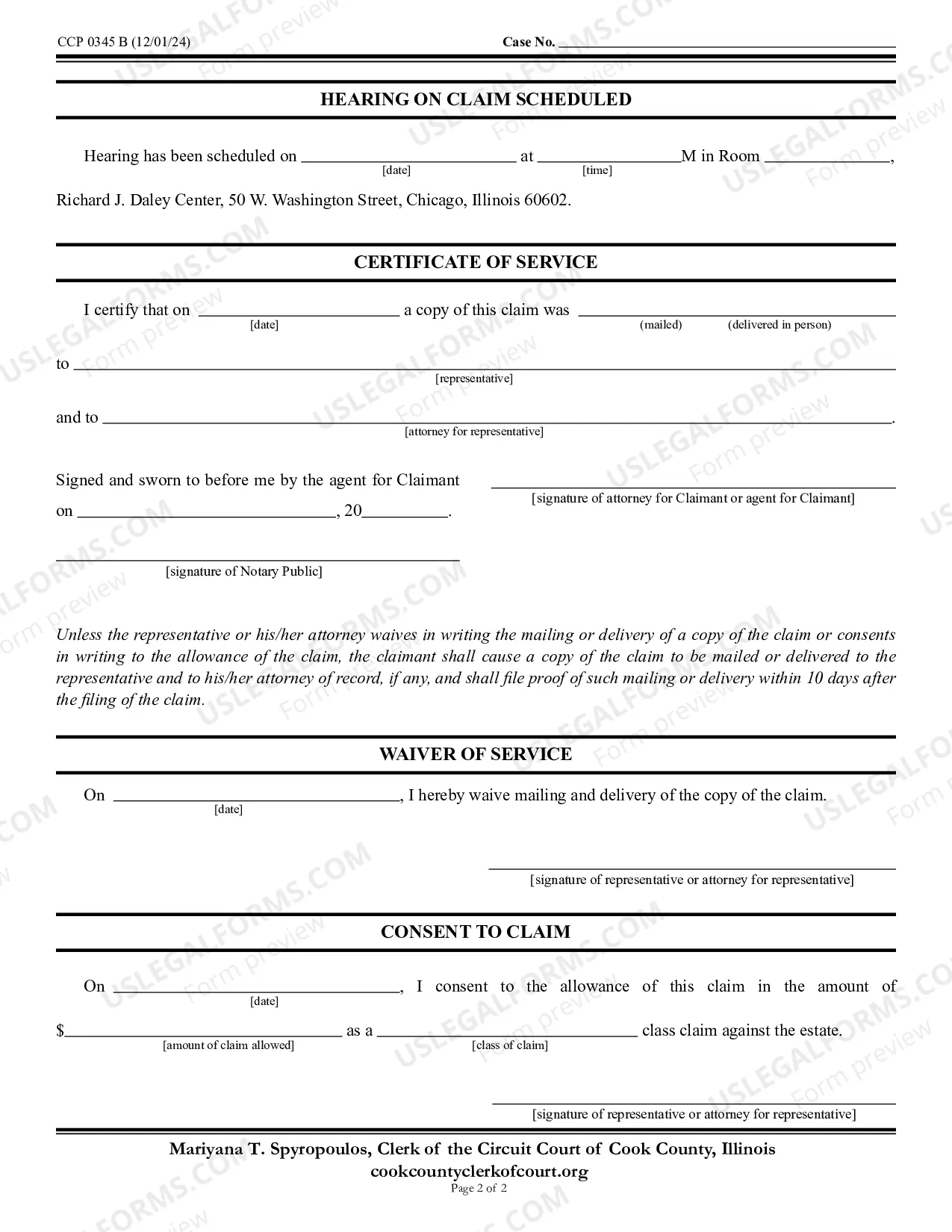
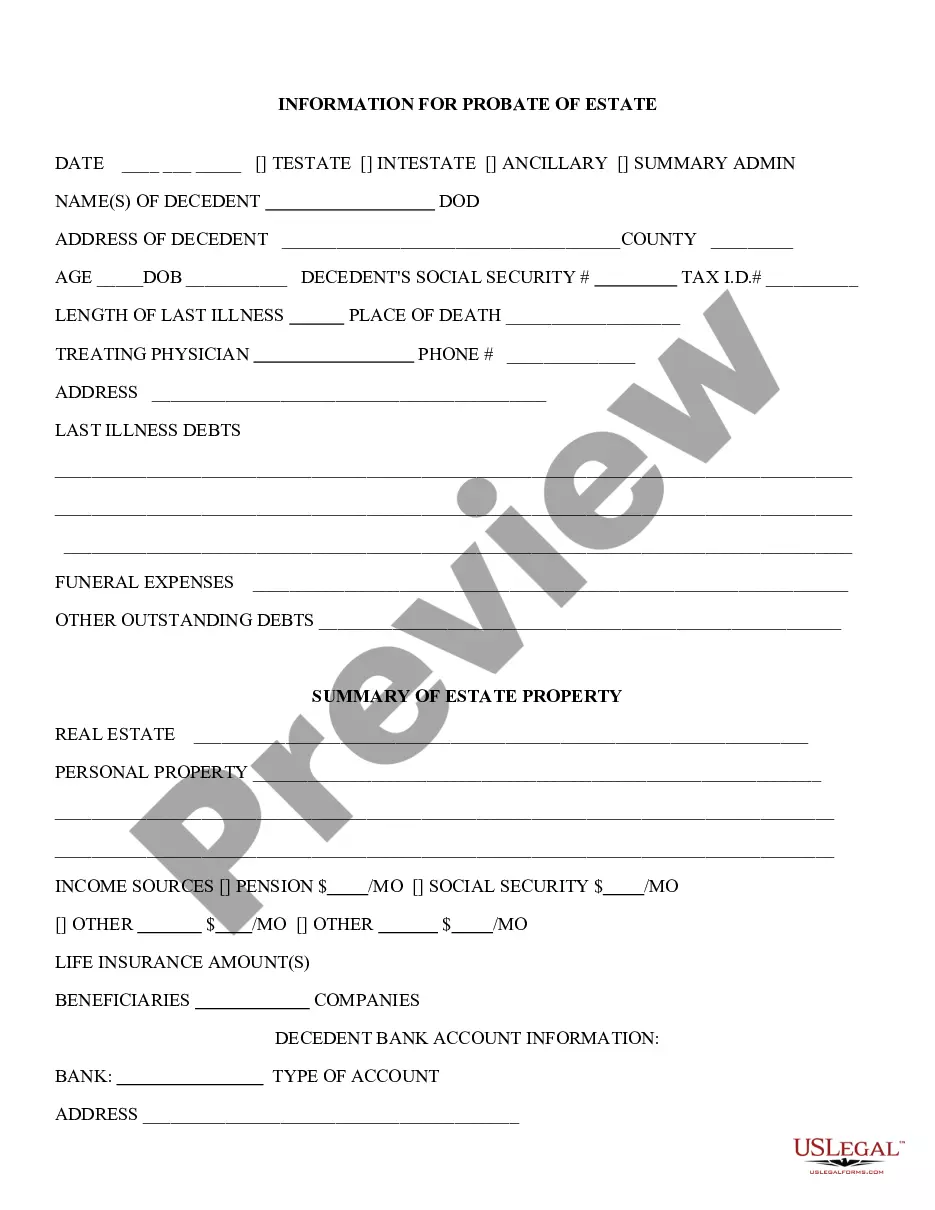
An Illinois Claim against Estate (also known as a “claim against a decedent’s estate”) is a legal claim made by a creditor of the deceased individual (the “decedent”). It is made to secure payment of money owed by the decedent before their death. This is done by filing a claim in the probate court of the county in which the decedent resided. The types of Illinois Claim against Estate are: 1. Funeral Expense Claim: This claim is for payment of funeral expenses incurred by the decedent. 2. Final Medical Expense Claim: This claim is for payment of medical services rendered to the decedent before their death. 3. Wage Claim: This claim is for all wages due to the decedent from their employment prior to their death. 4. Personal Property Claim: This claim is for the recovery of personal property owned by the decedent at the time of their death. 5. Contract Claim: This claim is for payment of money owed by the decedent under a contract. 6. Judgement Claim: This claim is for satisfaction of a judgement debt owed by the decedent. 7. Tax Claim: This claim is for payment of all taxes due from the decedent. 8. Miscellaneous Claim: This claim is for payment of any other money owed by the decedent.
Illinois Claim against Estate
Description
Get your form ready online
Our built-in tools help you complete, sign, share, and store your documents in one place.
Make edits, fill in missing information, and update formatting in US Legal Forms—just like you would in MS Word.
Download a copy, print it, send it by email, or mail it via USPS—whatever works best for your next step.
Sign and collect signatures with our SignNow integration. Send to multiple recipients, set reminders, and more. Go Premium to unlock E-Sign.
If this form requires notarization, complete it online through a secure video call—no need to meet a notary in person or wait for an appointment.
We protect your documents and personal data by following strict security and privacy standards.

Make edits, fill in missing information, and update formatting in US Legal Forms—just like you would in MS Word.

Download a copy, print it, send it by email, or mail it via USPS—whatever works best for your next step.

Sign and collect signatures with our SignNow integration. Send to multiple recipients, set reminders, and more. Go Premium to unlock E-Sign.

If this form requires notarization, complete it online through a secure video call—no need to meet a notary in person or wait for an appointment.

We protect your documents and personal data by following strict security and privacy standards.
Looking for another form?

How to fill out Illinois Claim Against Estate?
How much time and resources do you typically allocate to creating formal documentation.
There’s a superior alternative to obtaining such forms than employing legal professionals or spending hours searching the internet for a suitable template.
Another benefit of our library is that you can retrieve previously purchased documents that you securely store in your profile within the My documents tab. Access them at any time and redo your paperwork as frequently as you need.
Conserve time and effort in preparing formal documents with US Legal Forms, one of the most dependable online solutions. Join us today!
- Browse through the form details to confirm it adheres to your state regulations. To do this, review the form description or utilize the Preview option.
- If your legal template does not satisfy your requirements, search for another one using the search bar at the top of the page.
- If you are already a member of our service, Log In and download the Illinois Claim against Estate. If not, continue to the following steps.
- Click Buy now once you identify the appropriate document. Select the subscription plan that fits you best to gain access to our library’s complete offerings.
- Create an account and pay for your subscription. Payments can be made using your credit card or through PayPal - our service is completely reliable for this.
- Download your Illinois Claim against Estate to your device and complete it on a printed hard copy or electronically.
Form popularity
FAQ
The statute of limitations for probate claims in Illinois provides that creditors have two years from the decedent's death to file a claim against the estate. However, the representative can shorten this period by providing notice to known and unknown creditors.
On average, probate in Illinois takes no less than twelve months. The probate process must allow time for creditors to be notified, filing of required income tax returns, and the resolution of any disputes.
The statute of limitations for probate claims in Illinois provides that creditors have two years from the decedent's death to file a claim against the estate. However, the representative can shorten this period by providing notice to known and unknown creditors.
A claim against the probate estate can either be filed with the court or mailed to the representative of the estate. Once the representative receives notice of the claim, he or she can either allow the claim or send a notice to the claimant informing them that they are ?disallowing? the claim.
The executor immediately must publish a written notice in a newspaper within the county of the Probate Court to notify potential creditors of the existence of the estate and the necessity for their filing of written claims against the estate. The law in Illinois provides such creditors six months to file those claims.
Once the original will has been filed, the executor named in the decedent's will is responsible for filing a petition to probate the will within 30 days, or refusing to accept their position as executor. If they fail to act within 30 days, the court may deny them the right to act as executor.
Generally, the statute of limitations for probate claims in Illinois provides that a collector has up to two years following the death of the person in question to file a claim against the estate.
Things that aren't part of the deceased person's estate don't have to be handled in settling their estate. Probate is just one way to settle an estate when someone dies. And it's not always required. Illinois law allows a different and simplified procedure for handling small estates.