Illinois Acknowledgment by Public Officer
About this form
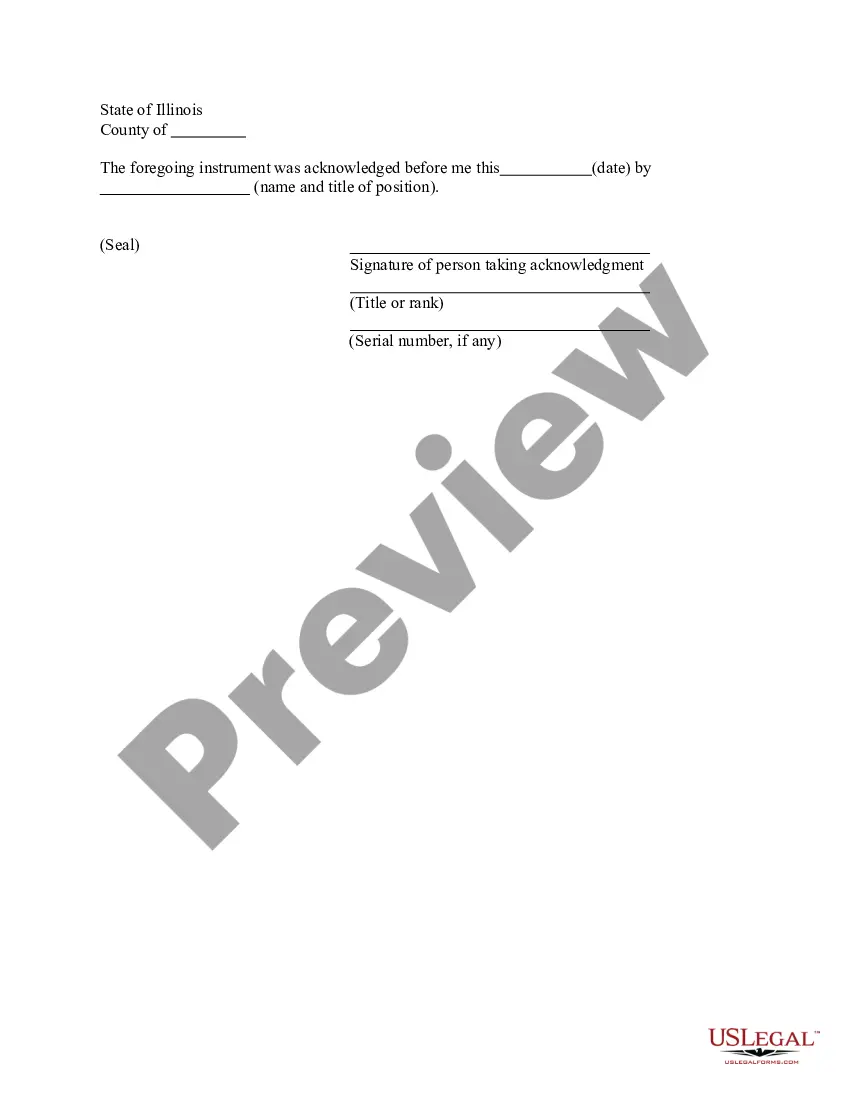
The Acknowledgment by Public Officer is a legal document used to certify the authenticity of a signature or the identity of a person who has executed a particular document. This form is typically required in various legal proceedings, providing assurance that the signatures were obtained in compliance with legal standards. Unlike other acknowledgment forms, this one is specifically designated for use by public officers, ensuring a higher level of credibility and formal recognition in legal contexts.
Key components of this form
- Date of acknowledgment
- Name and title of the public officer
- Signature of the person taking acknowledgment
- Seal of the public officer

Situations where this form applies
This form is needed when a public officer must verify a signature for documents that require formal acknowledgment. Common scenarios include real estate transactions, legal filings, and notarizations where an official confirms the identity of individuals signing important documents. This acknowledgment may be requested by courts, financial institutions, or other entities that require proof of legitimacy.
Intended users of this form
Eligibility and intended audience include:
- Public officers authorized to perform acknowledgments
- Individuals needing to formalize a legal document
- Attorneys or legal representatives facilitating transactions
- Notaries who require a verified acknowledgment for their records
Steps to complete this form
- Identify the date on which the acknowledgment is being made.
- Fill in the name and title of the public officer who is taking the acknowledgment.
- Ensure the person giving the acknowledgment signs the document in the designated area.
- Include the official seal of the public officer to validate the acknowledgment.
- Check that all information is accurate and meets local legal requirements before submission.
Does this document require notarization?
Notarization is required for this form to take effect. Our online notarization service, powered by Notarize, lets you verify and sign documents remotely through an encrypted video session, available 24/7.
Get your form ready online
Our built-in tools help you complete, sign, share, and store your documents in one place.
Make edits, fill in missing information, and update formatting in US Legal Forms—just like you would in MS Word.
Download a copy, print it, send it by email, or mail it via USPS—whatever works best for your next step.
Sign and collect signatures with our SignNow integration. Send to multiple recipients, set reminders, and more. Go Premium to unlock E-Sign.
If this form requires notarization, complete it online through a secure video call—no need to meet a notary in person or wait for an appointment.
We protect your documents and personal data by following strict security and privacy standards.

Make edits, fill in missing information, and update formatting in US Legal Forms—just like you would in MS Word.

Download a copy, print it, send it by email, or mail it via USPS—whatever works best for your next step.

Sign and collect signatures with our SignNow integration. Send to multiple recipients, set reminders, and more. Go Premium to unlock E-Sign.

If this form requires notarization, complete it online through a secure video call—no need to meet a notary in person or wait for an appointment.

We protect your documents and personal data by following strict security and privacy standards.
Common mistakes
- Failing to include the date of acknowledgment.
- Omitting the name or title of the public officer.
- Not securing the official seal of the public officer.
- Having the signer provide a signature outside of the designated area.
Benefits of completing this form online
- Convenience of completing the form at your own pace from anywhere.
- Editability allows users to customize the fields to fit their specific needs.
- Reliable templates drafted by licensed attorneys ensure compliance with legal standards.
- Quick access to forms saves time compared to traditional paperwork methods.
Looking for another form?
Form popularity
FAQ
Notary fees often depend on where you get the document notarizedstates set maximum allowable charges, and notaries can charge any amount up to that maximum. 2feff Standard notary costs range from $0.25 to $20 and are billed on a per-signature or per-person basis depending on the state.
You can notarize something physically or online. In the past, to notarize something, you had to sign it physically in the presence of a notary public.You can now notarize your documents entirely online by connecting with a commissioned eNotary public by live video.
Bring the unsigned document and your photo identification to the notary. Sign the document in the notary's presence. Show the notary your photo identification. Pay the notary fee (usually $1) The notary signs and stamps your document.
Yes. The State of Illinois has enacted the Uniform Real Property Electronic Recording Act (765 ILCS 33/1 through 33/7), which authorizes a notary public to obtain an electronic signature and electronic seal to notarize electronic documents in the physical presence of the individual seeking the notarization.
The law does not require that you charge a fee. However, the maximum fee allowed is $1.
By law, a notary cannot charge more than $1 to simply notarize each signature. Notaries can charge more for immigration application and real estate transactions (see section 3-104 of the Illinois Notary Public Act).
There is no requirement in Illinois that a notary public keep a log book or journal. However, a notary may keep a journal for his or her own record keeping.
Notaries are not required to charge for their Notary services, and they may charge any fee less than the statutory maximum. Confronted with a tricky notarization? Unsure how to proceed? NNA members have unlimited access to our expertly trained NNA Hotline counselors to help you with all of your notarial questions.
Currently, there are 28 states that have enacted some form of permanent remote online notarization (RON) law: Alaska, Arizona, Colorado, Florida, Hawaii, Idaho, Indiana, Iowa, Kentucky, Louisiana, Maryland, Michigan, Minnesota, Missouri, Montana, Nebraska, Nevada, North Dakota, Ohio, Oklahoma, Pennsylvania, Tennessee,