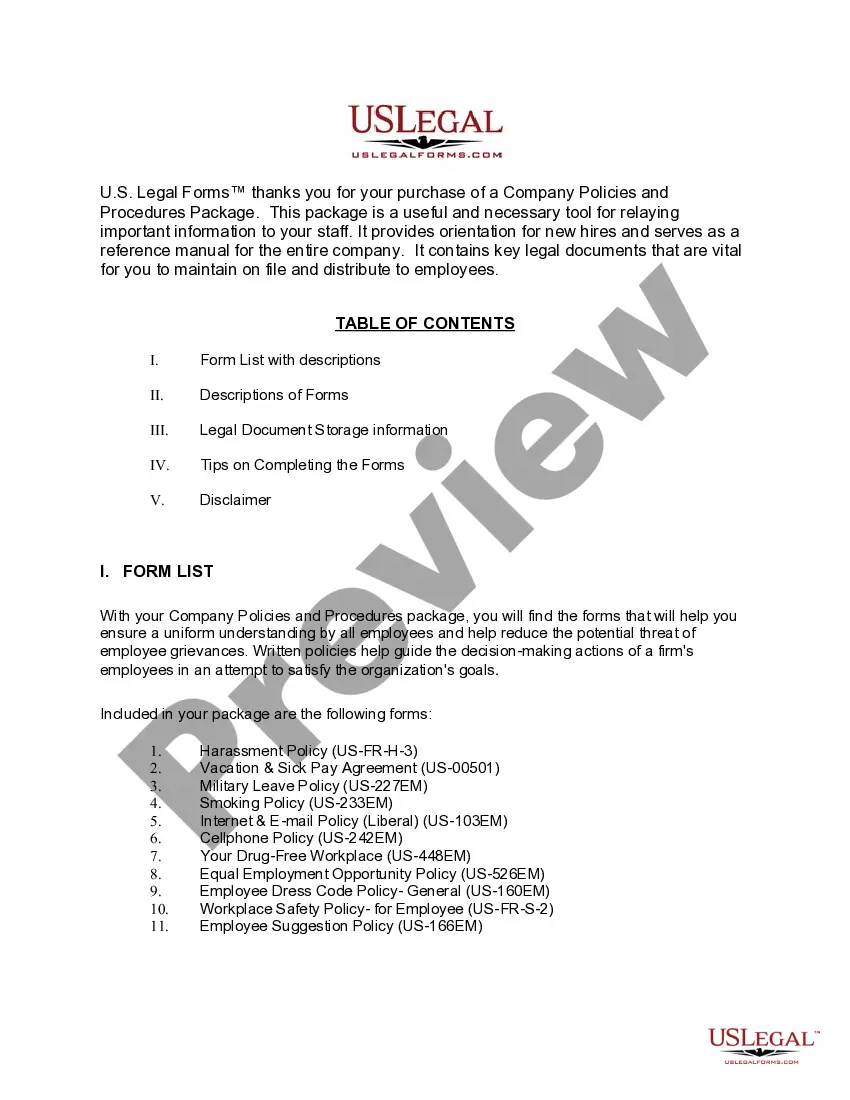
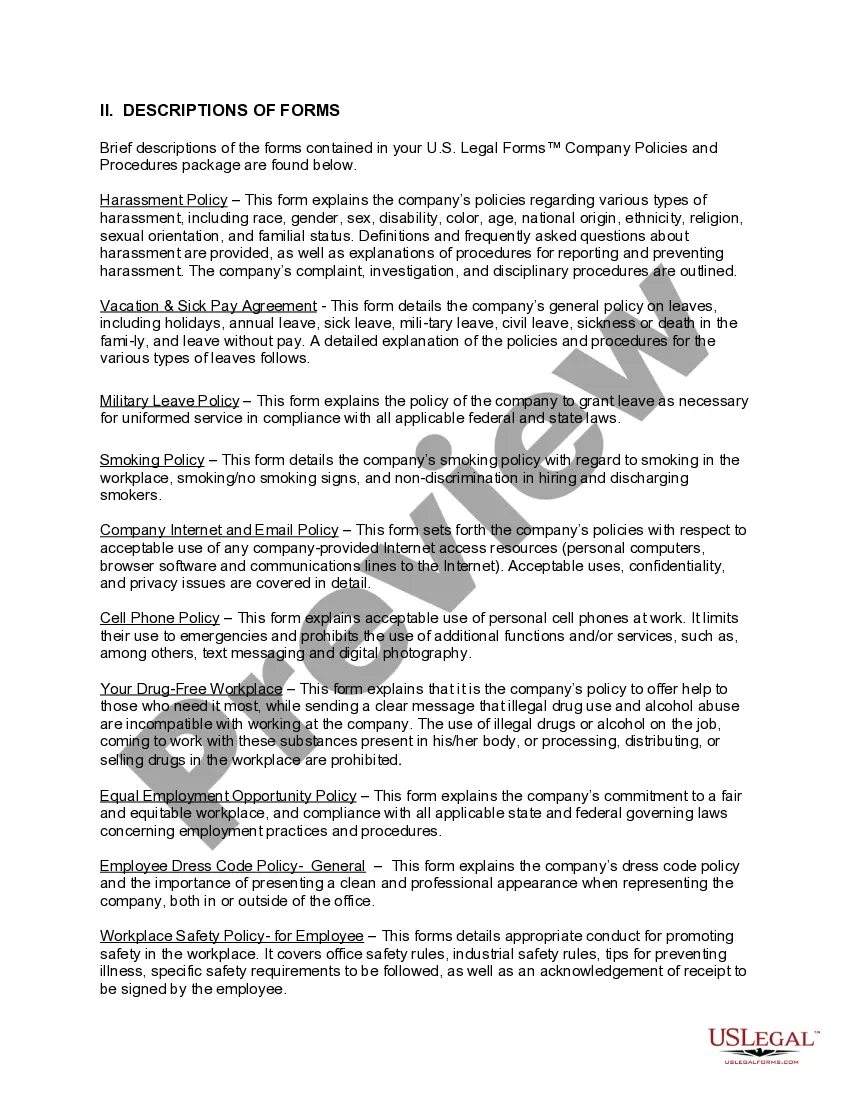
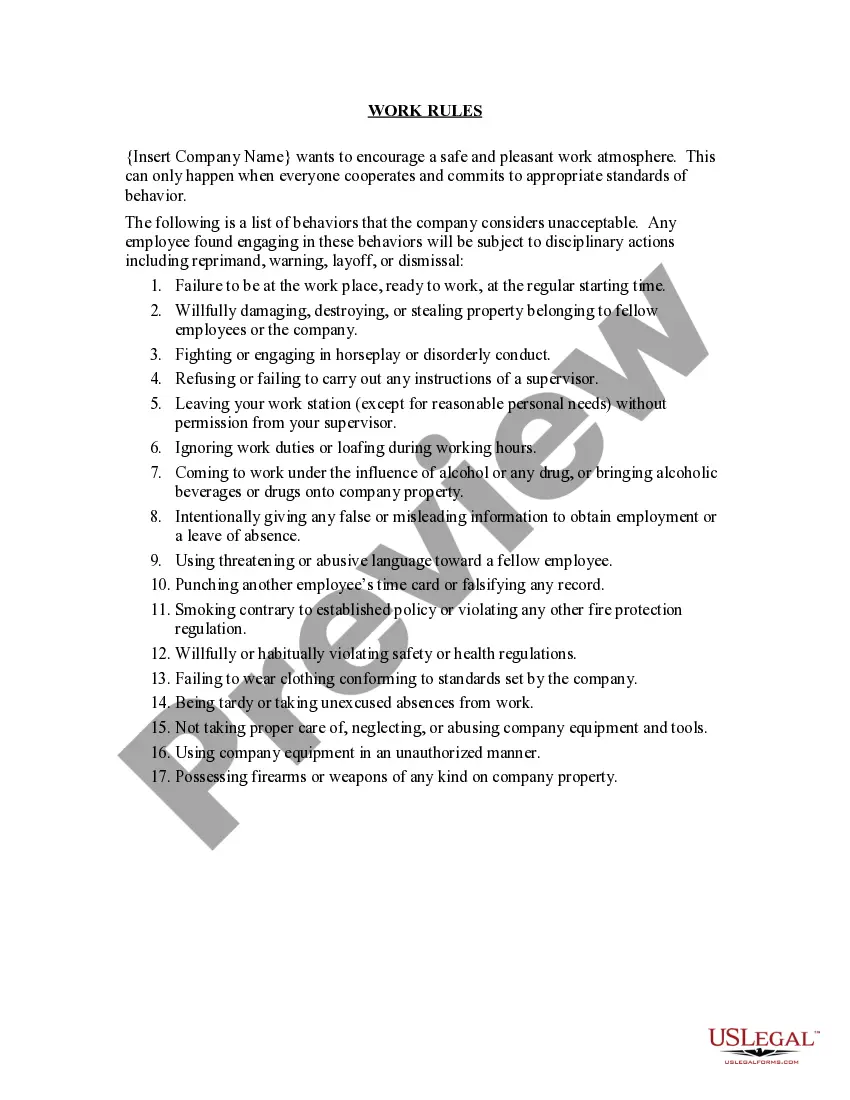
1. Harassment Policy
2. Vacation & Sick Pay Agreement
3. Military Leave Policy
4. Smoking Policy
5. Internet & E-mail Policy (Liberal)
6. Cellphone Policy
7. Your Drug-Free Workplace
8. Equal Employment Opportunity Policy
9. Employee Dress Code Policy- General
10. Workplace Safety Policy- for Employee
11. Employee Suggestion Policy
Illinois Company Employment Policies and Procedures Package
Category:
State:
Illinois
Control #:
IL-P008-PKG
Format:
Word;
Rich Text;
PDF
Instant download
Description
This package contains essential policy and procedures forms to help your company ensure a uniform understanding by all employees and help reduce the potential threat of employee grievances. It provides orientation for new hires and serves as a reference manual for the entire company. The documents in this package include the following:
Free preview



How to fill out Illinois Company Employment Policies And Procedures Package?
Searching for Illinois Business Employment Policies and Procedures Package templates and completing them can be a challenge.
To conserve time, expenses, and effort, utilize US Legal Forms and locate the appropriate template specifically for your state in just a few clicks.
Our legal experts draft each document, so you only need to fill them out. It’s truly that simple.
Select your pricing plan and create your account. Choose to pay by card or PayPal. Download the form in your desired file format. You can print the Illinois Business Employment Policies and Procedures Package form or complete it using any online editor. Don’t fret about errors because your sample can be utilized and submitted as needed, and printed out as often as you wish. Try US Legal Forms and gain access to over 85,000 state-specific legal and tax documents.
- Log in to your account and return to the document's webpage and save the sample.
- All your saved documents are stored in My documents and are accessible at all times for future use.
- If you haven’t signed up yet, you ought to register.
- Review our comprehensive instructions on how to obtain the Illinois Business Employment Policies and Procedures Package sample in a few minutes.
- To receive a qualified example, verify its validity for your state.
- Examine the form using the Preview feature (if it’s available).
- If there's an explanation, read it to understand the specifics.
- Click Buy Now if you found what you're looking for.
Form popularity
FAQ
Disciplinary and Grievance Rules and Procedures; Sickness Absence Policy; Health and Safety Policy; Equal Opportunities Policy; Anti-Harassment and Bullying Policy; and.
Examples include government policies that impact spending for welfare, public education, highways, and public safety, or a professional organization's benefits plan.
California does not require employers to have a handbook.
Company culture, values, and a mission statement. Human resource and legal information as well as rights and obligations related to employment. Realistic expectations; both what the company expects to see from its employees and what employees can expect from the company.
Use clear language. With a major purpose of HR policies being to outline relevant information to your staff and volunteers, it's critical they understand what you're trying to convey. Keep it as brief as possible. Avoid information that may become quickly outdated. Clarify eligibility. Allow for necessary exceptions.
Use the handbook as a communication tool. Employees can be full of legal agreements and notices, which important as they are, can be daunting. Safety and security. Get a legal review. Outline your expectations/Code of conduct. Hours, benefits, and compensation. Don't be redundant. Make it readable. Leave room for change.
Step 1: Determine the Purpose and Intention of the Policy. Step 2: Assemble All Prior Writings and Practices on the Same or Similar Topics. Step 3: Obtain Information and Input from Relevant Stakeholders. Step 4: Conduct Research to Determine Status of the Law and Identify Trends.
Prioritize a policy list. Keep in mind that you can't tackle every policy at once. Conduct thorough research. Take a look at your existing procedures to zone in on how things are currently done. Write an initial draft. After defining what you need to cover, you can begin your first draft. Validate the procedures.
Your company's history, mission, vision and goals. Your company's core values and culture. Human resources and legal information related to employment. Your company's policies. Employee benefits and perks.