Iowa Statutory General Power of Attorney
What this document covers
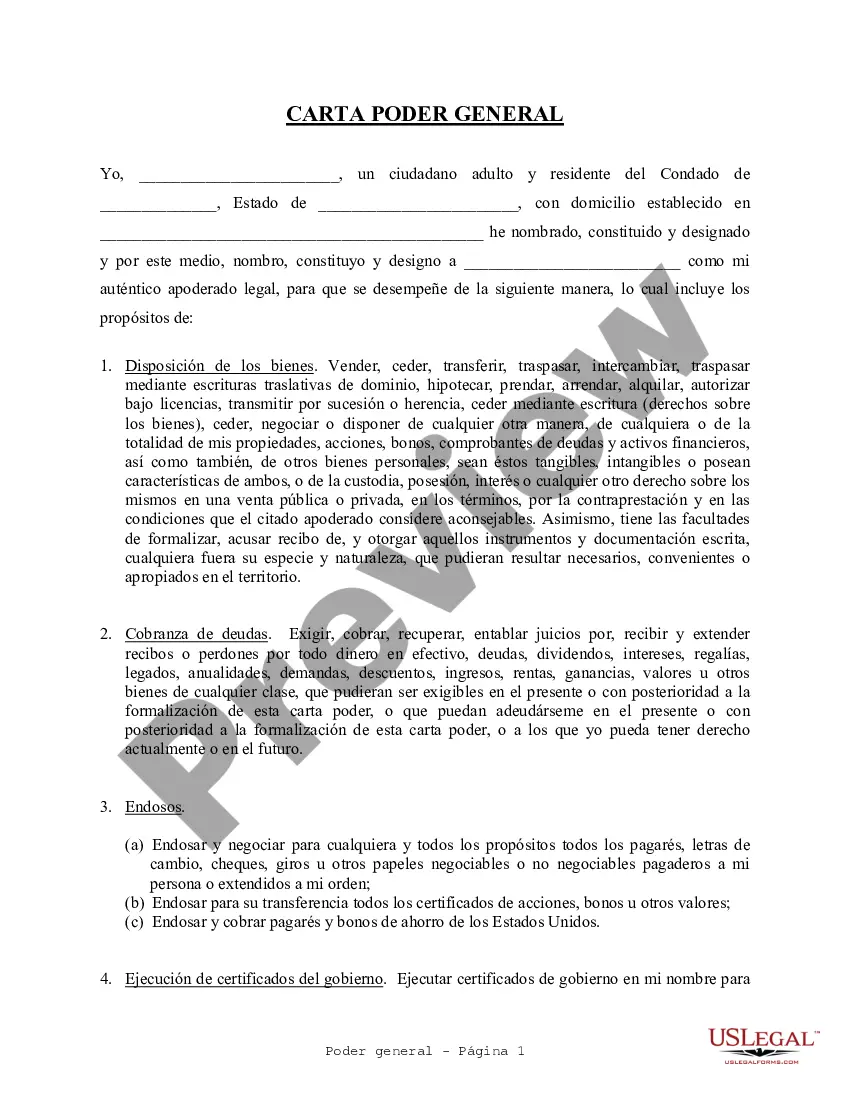
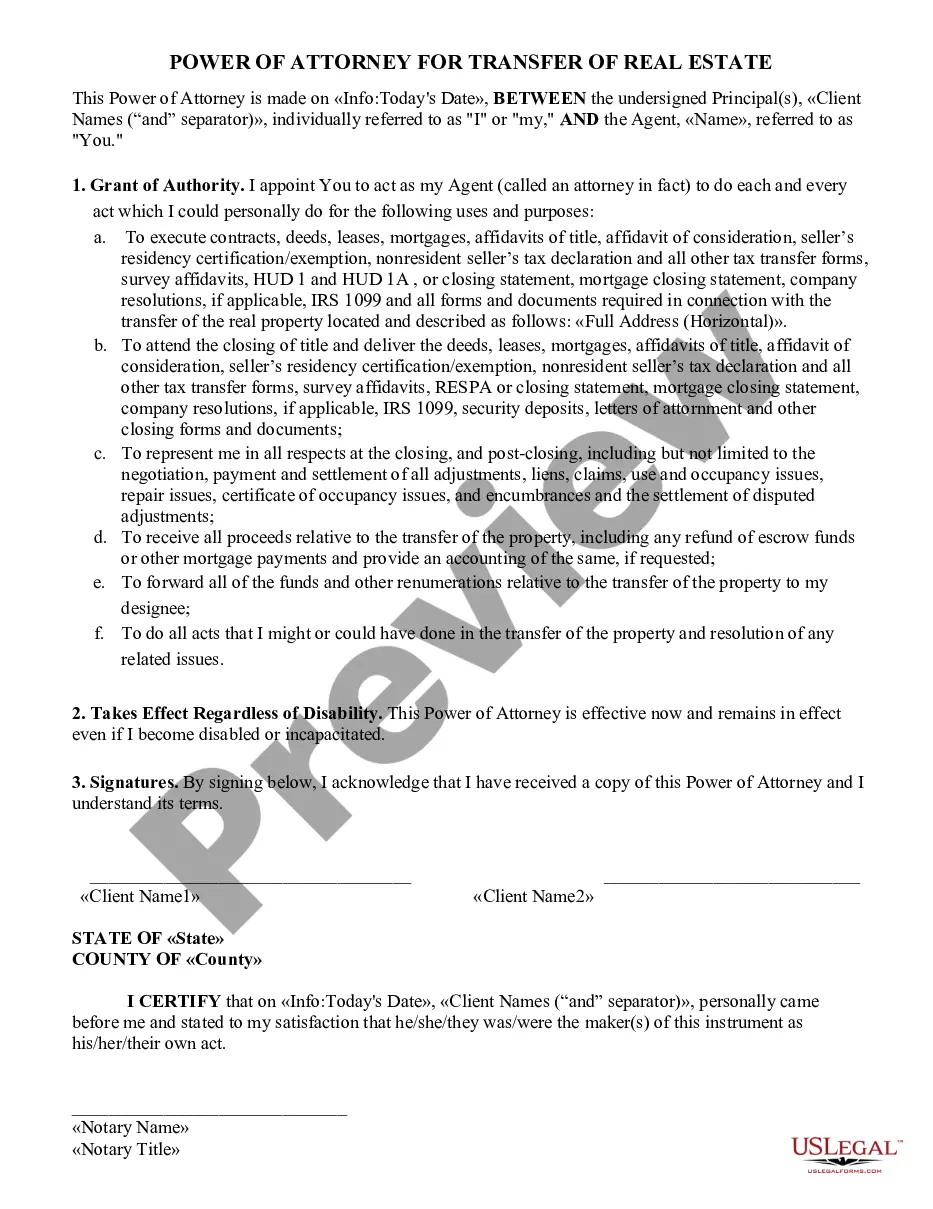
The Statutory General Power of Attorney is a legal document that allows you, the principal, to designate an agent to make decisions about your property and finances on your behalf. This form is statutory, meaning it follows the regulations set by the state legislature, ensuring its validity. Unlike other power of attorney forms, this document does not grant your agent authority over healthcare decisions, focusing solely on financial and property matters.
Key parts of this document
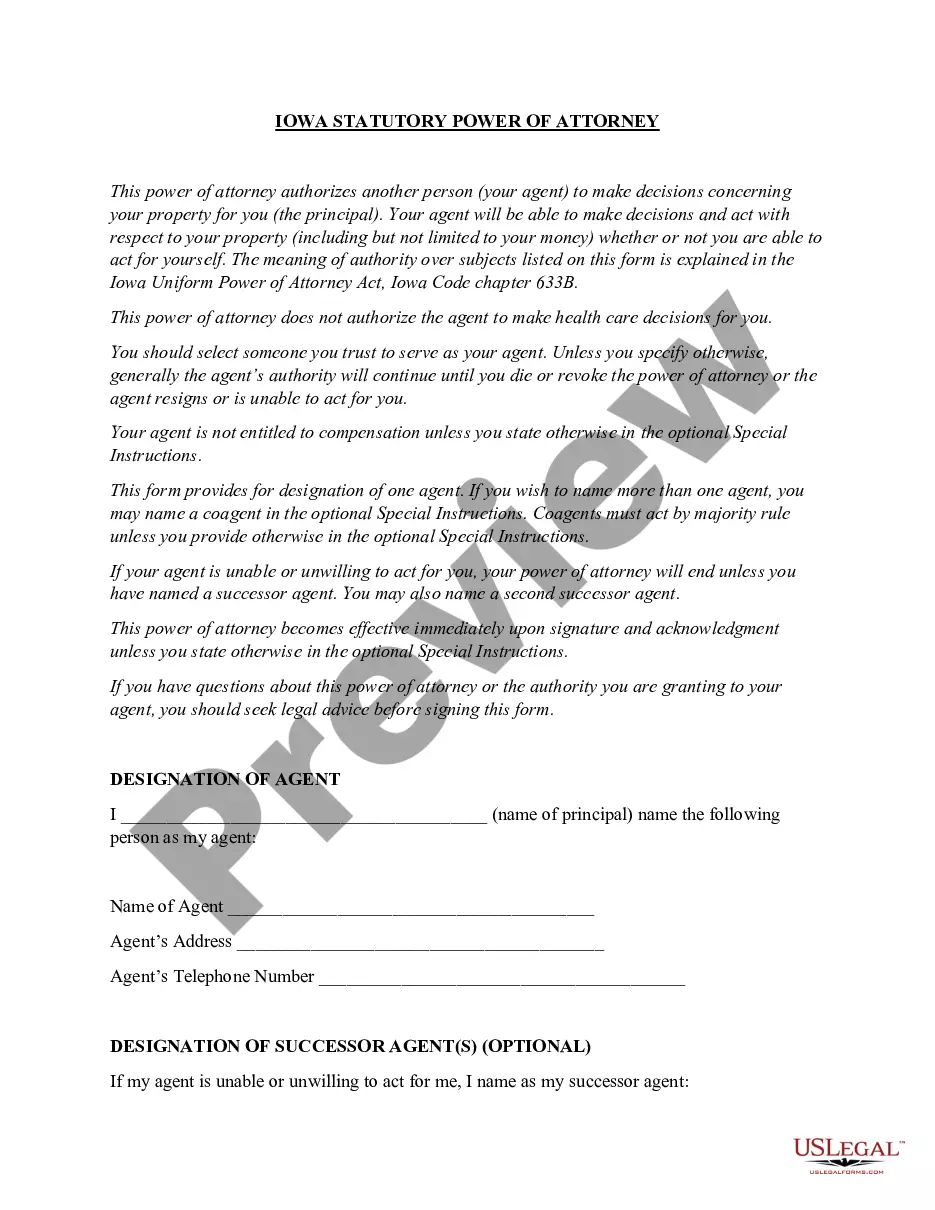
- Designation of Agent: Specify who will act as your agent.
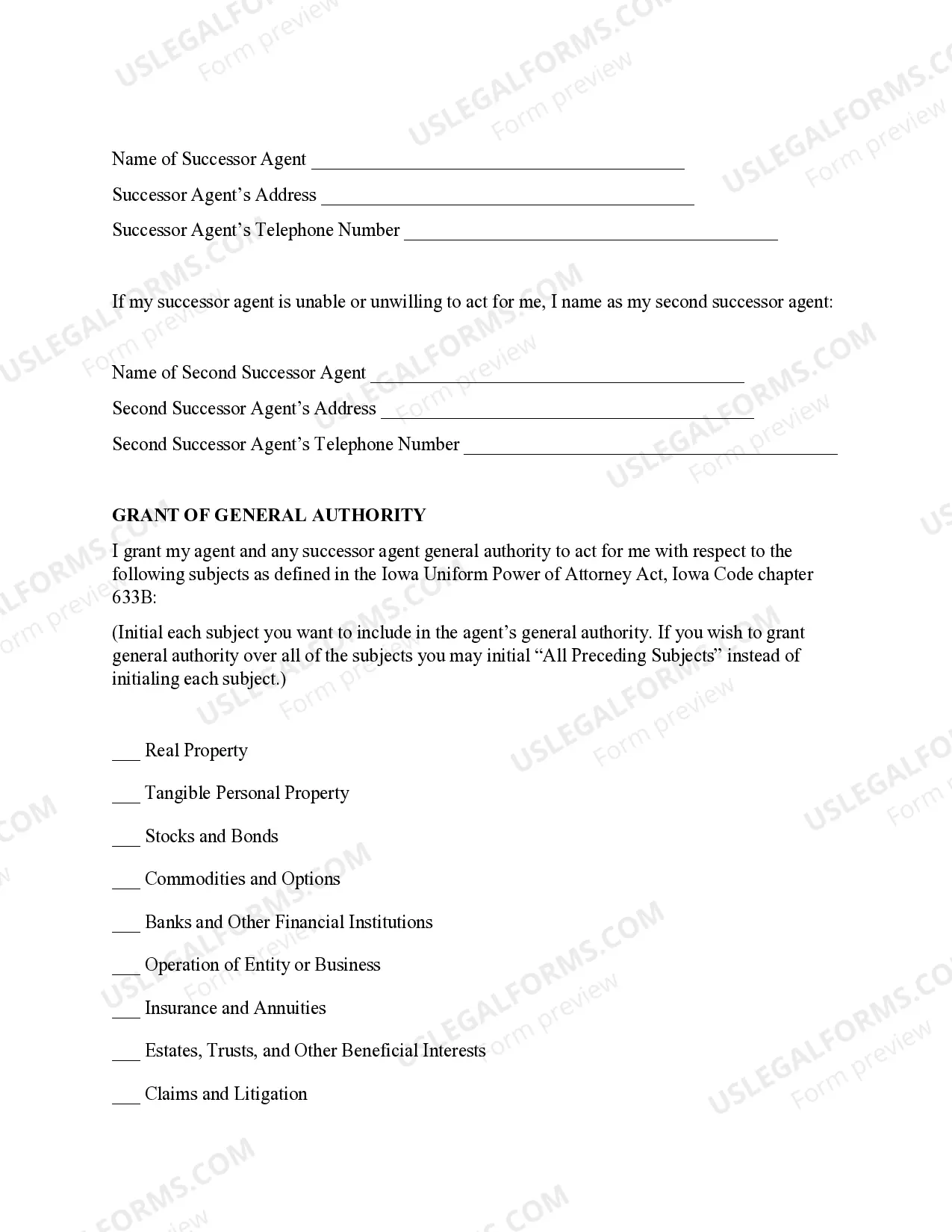
- General Authority: Outline the types of decisions the agent can make regarding property, finances, and other specified areas.
- Successor Agents: Optionally name individuals who may act as your agent in case the primary agent is unable to do so.
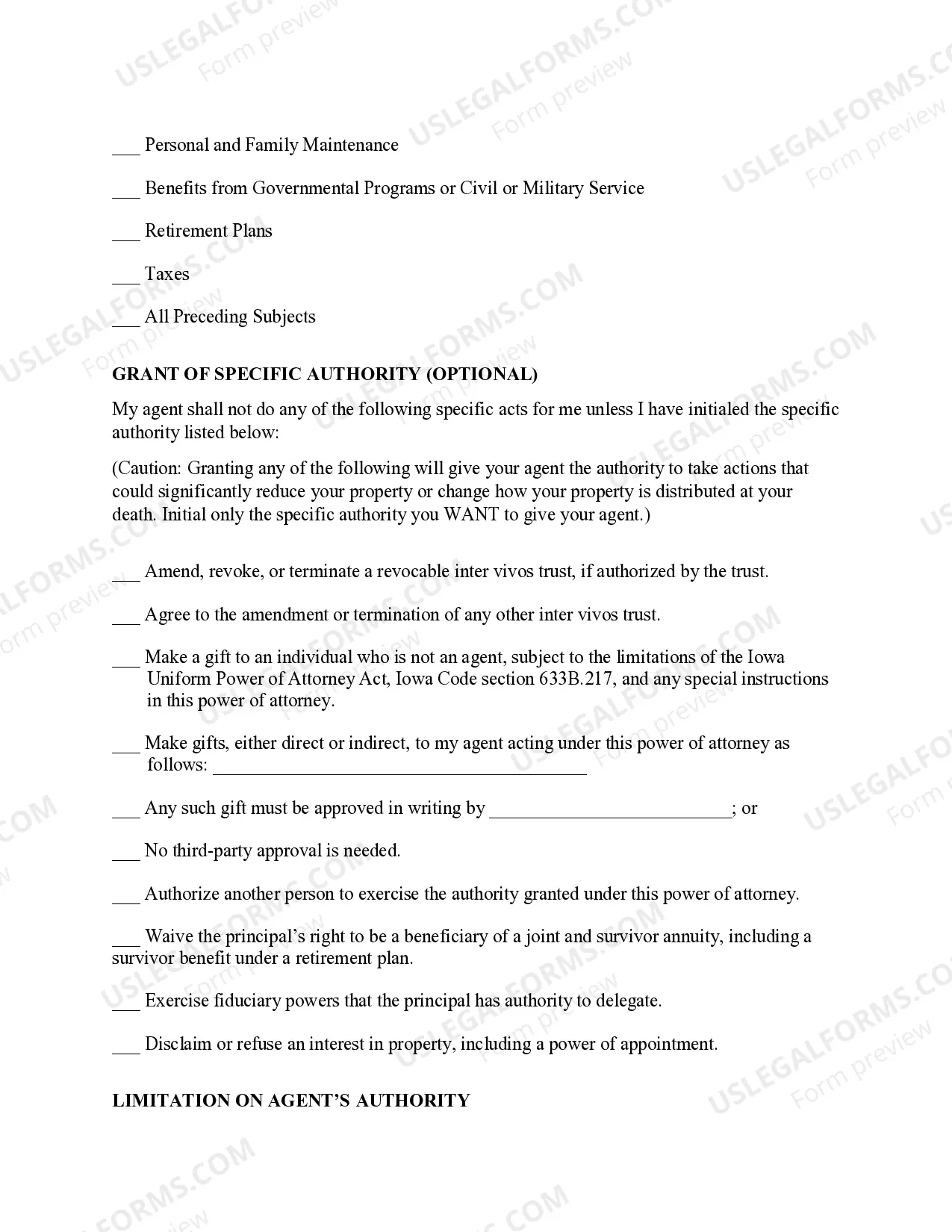
- Specific Authorities: Allow the agent to perform particular acts only if explicitly indicated.
- Special Instructions: Provide additional guidance or limitations regarding the agent's authority.
- Effective Date: Indicates when the power of attorney begins to take effect.


Common use cases
You should consider using the Statutory General Power of Attorney in various situations, such as when you want someone you trust to manage your financial affairs while you are unavailable or incapacitated. It can be particularly useful during long-term travel, illness, or if you need assistance managing your business and property transactions.
Who can use this document
This form is ideal for:
- Individuals needing assistance with financial management.
- Anyone planning for future incapacity due to health issues or absence.
- Persons making arrangements for business dealings.
- Those who want to designate a trusted person to manage their financial affairs.
Instructions for completing this form
- Identify the principal: Enter your name as the principal at the beginning of the form.
- Designate agents: Include the name and contact information for your chosen agent.
- Establish authority: Initial the subjects where you want to grant your agent power, or select "All Preceding Subjects" if applicable.
- Consider successor agents: Optionally provide details for one or two successor agents in case your primary agent cannot serve.
- Review carefully: Ensure you understand all sections and seek legal advice if needed before signing.
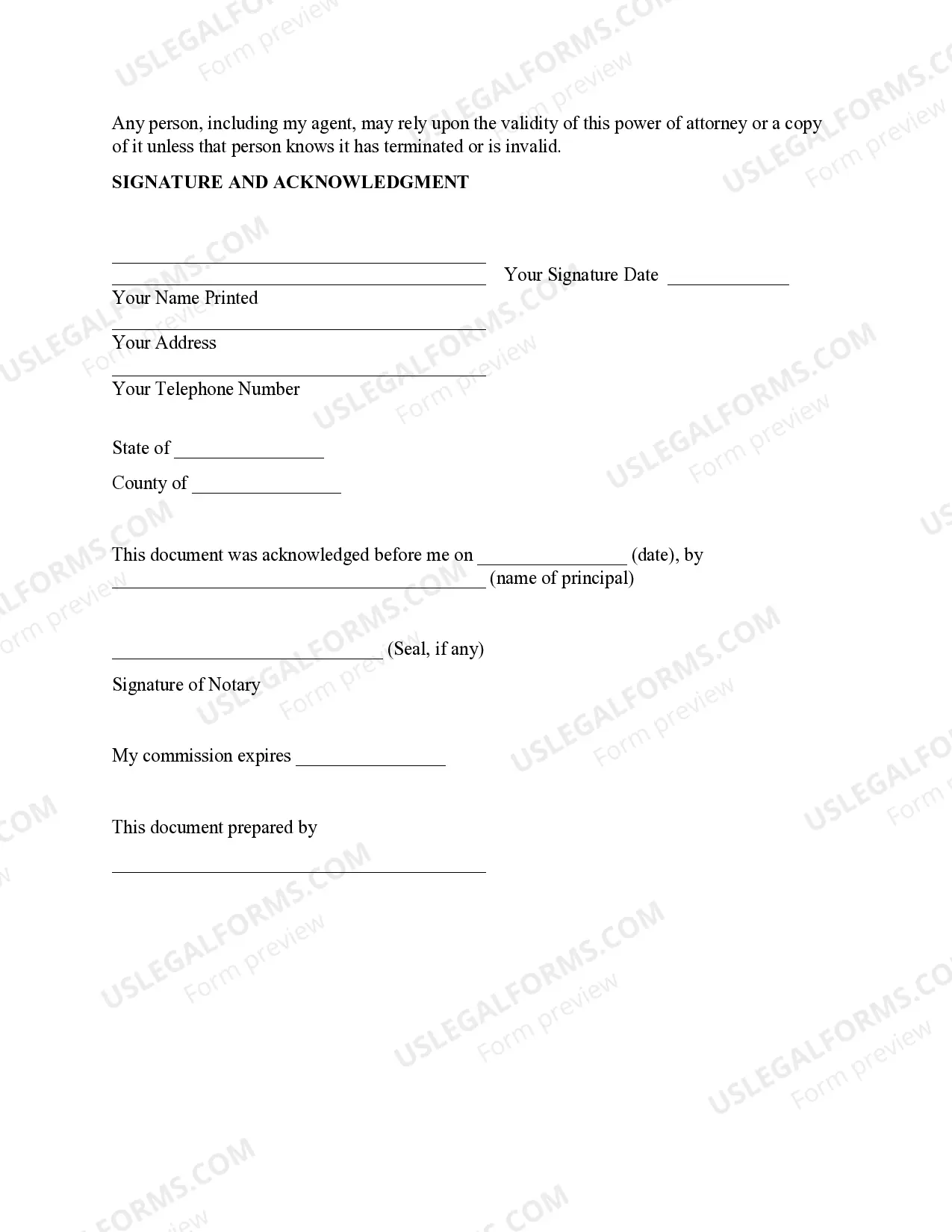
- Sign and date: Complete the signature section, acknowledging the form in front of a notary if required.
Does this form need to be notarized?
This form does not typically require notarization unless specified by local law. However, it's advisable to have the document notarized to enhance its legitimacy and acceptance by third parties.
Get your form ready online
Our built-in tools help you complete, sign, share, and store your documents in one place.
Make edits, fill in missing information, and update formatting in US Legal Forms—just like you would in MS Word.
Download a copy, print it, send it by email, or mail it via USPS—whatever works best for your next step.
Sign and collect signatures with our SignNow integration. Send to multiple recipients, set reminders, and more. Go Premium to unlock E-Sign.
If this form requires notarization, complete it online through a secure video call—no need to meet a notary in person or wait for an appointment.
We protect your documents and personal data by following strict security and privacy standards.

Make edits, fill in missing information, and update formatting in US Legal Forms—just like you would in MS Word.

Download a copy, print it, send it by email, or mail it via USPS—whatever works best for your next step.

Sign and collect signatures with our SignNow integration. Send to multiple recipients, set reminders, and more. Go Premium to unlock E-Sign.

If this form requires notarization, complete it online through a secure video call—no need to meet a notary in person or wait for an appointment.

We protect your documents and personal data by following strict security and privacy standards.
Common mistakes to avoid
- Failure to designate a successor agent, risking the loss of authority if the primary agent cannot serve.
- Not initialing all applicable sections for authority granted to the agent.
- Signing without proper acknowledgment from a notary when required.
- Overlooking the need to specify any restrictions on the agent's authority.
- Neglecting to discuss your decisions with the chosen agent beforehand.
Benefits of using this form online
- Convenient access to legal forms whenever you need them.
- Editable templates allow you to customize the document to your specific needs.
- Reliable legal compliance ensured by documents drafted by licensed attorneys.
- Fast processing: instantly download and complete your form for immediate use.
Looking for another form?

Form popularity
FAQ
A General power of attorney (GPoA) is a legal document authorising one person (called an agent) to act on behalf of another (the principal).A Special power of attorney (SPoA) is a legal document authorising one person (called an agent) to act on behalf of another (the principal).
The power of attorney must be signed by the principal or by another adult in the principal's presence and under the direction of the principal. The power of attorney is signed and acknowledged before a notary public or is signed by two witnesses.
Most states offer simple forms to help you create a power of attorney for finances. Generally, the document must be signed, witnessed and notarized by an adult. If your agent will have to deal with real estate assets, some states require you to put the document on file in the local land records office.
General Power of Attorney. Durable Power of Attorney. Special or Limited Power of Attorney. Springing Durable Power of Attorney.
To create a valid durable power of attorney for health care in Iowa, you must: Explicitly authorize the attorney-in-fact to make health care decisions, you can use the sample form in Section 144B. 5 or one that is substantially similar. Include the date of creating the document.
Generally, a power of attorney allows you to designate an agent to perform specific functions on your behalf. Under the Texas Estates Code, statutory durable power of attorney can be used to appoint an agent to make certain financial decisions for you should you be unable to do so.
A statutory power of attorney is a power of attorney that copies the language in a state statute. The provisions of the Statutory Power of Attorney are provided by the laws of the particular state. It also includes an example of a form that may be used.
A financial power of attorney requires an acknowledged signature by a notary public. Signing a health care power of attorney can be done in one of two ways: It can be signed and dated in the presence of two witnesses; or. It can be signed and dated before a notary public.
In many states, notarization is required by law to make the durable power of attorney valid. But even where law doesn't require it, custom usually does. A durable power of attorney that isn't notarized may not be accepted by people with whom your attorney-in-fact tries to deal.