Vermont Written Revocation of Will
About this form
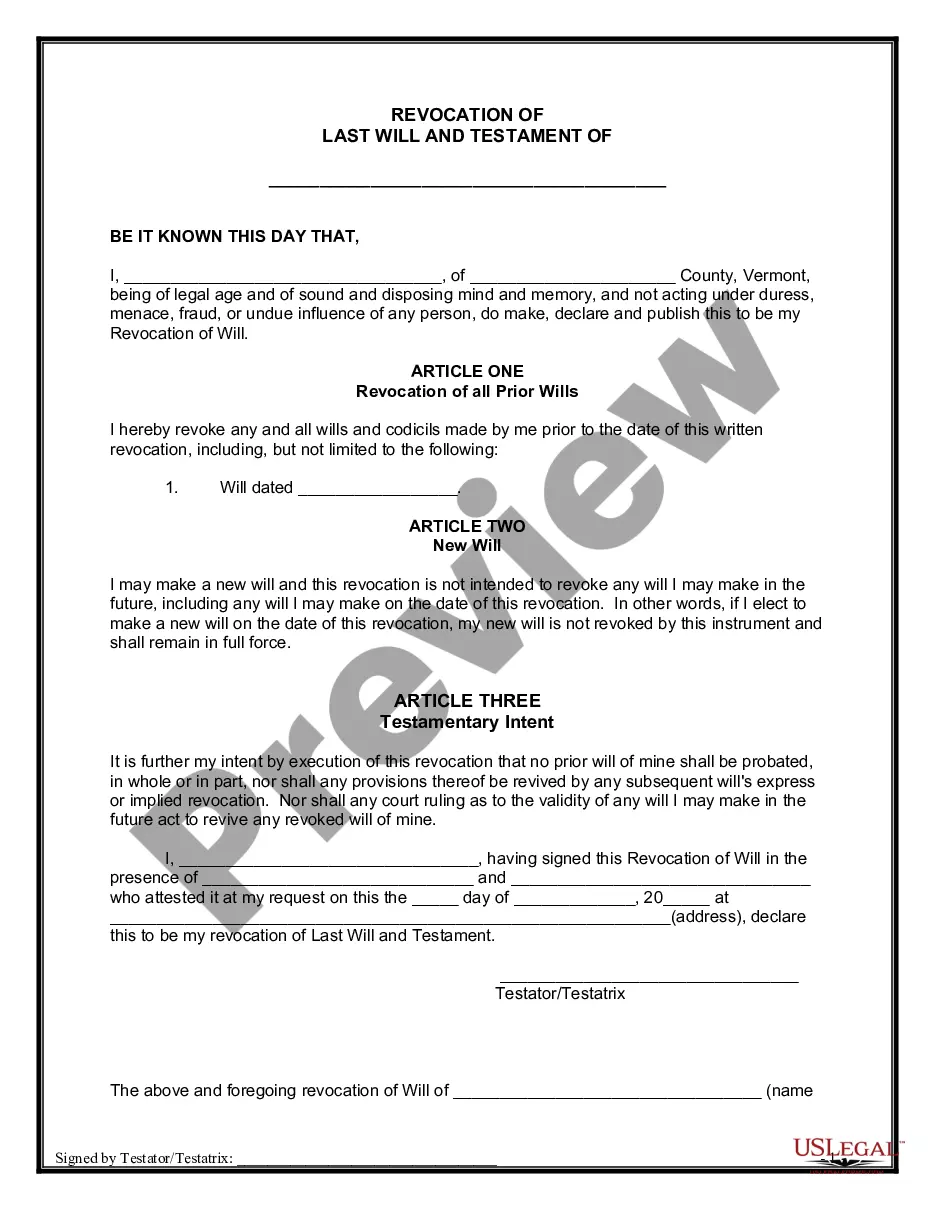
The Written Revocation of Will is a legal document used to formally revoke a previous will. This form ensures that all prior wills are nullified, preventing any confusion that might arise if multiple wills exist. Unlike a new will that commonly contains a revocation clause, this revocation is a standalone instrument that serves to clarify your intent to revoke any earlier wills explicitly.
Key parts of this document
- Testator Declaration: A statement by the testator where they announce their intention to revoke any previous wills.
- Revocation of Prior Wills: A clause stating that all previous wills and codicils are revoked.
- New Will Clause: Clarification that this revocation does not affect any future wills that the testator may create.
- Testamentary Intent: A statement affirming that no previous will should be probated, ensuring clarity of intent.
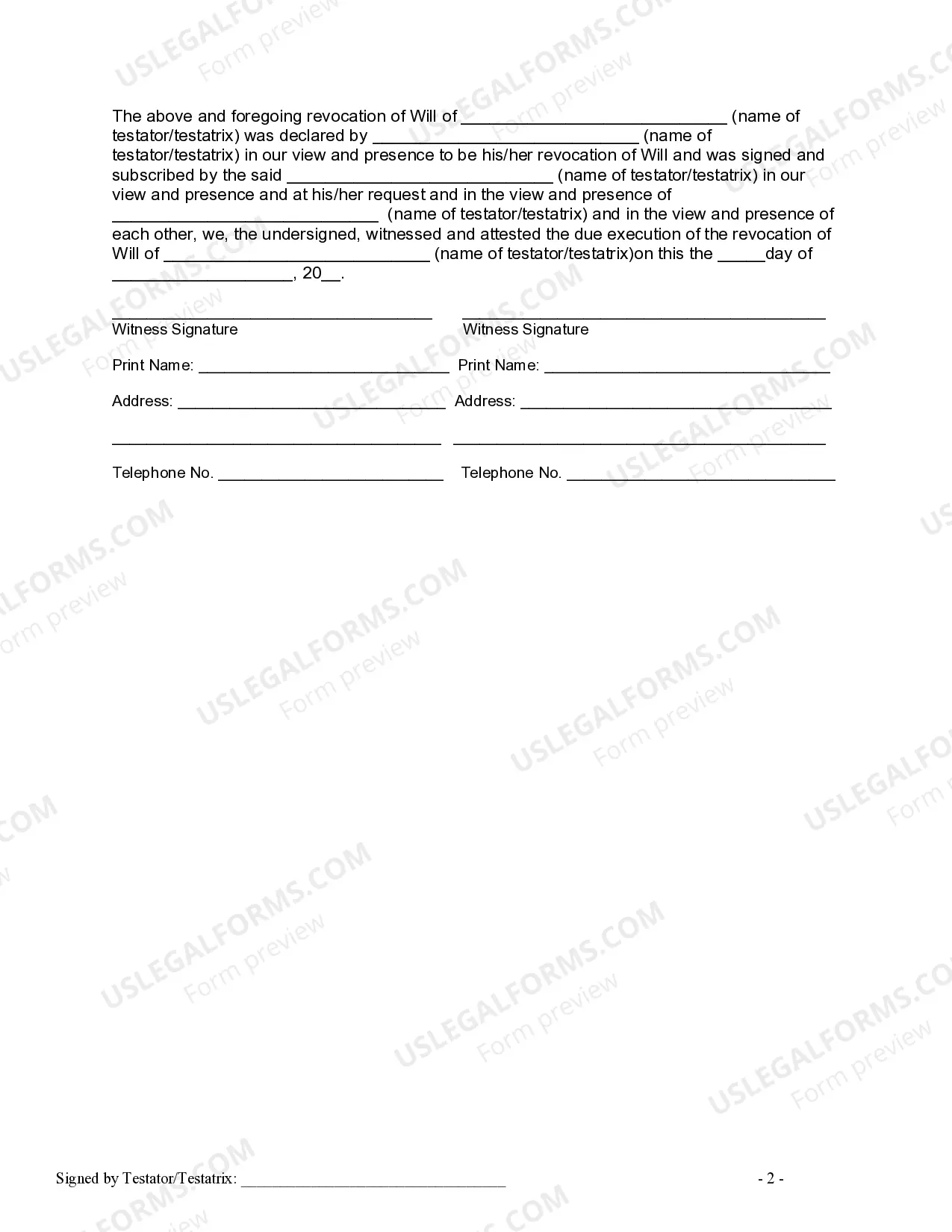
- Witness Signatures: Spaces for the signatures of witnesses, which are required to validate the document.

Common use cases
This form is useful in several scenarios, such as when you wish to change your will or if your circumstances have changed significantly (e.g., divorce, addition of heirs). It can also be utilized when you have created a new will that includes a revocation clause but want to ensure your previous wills are definitively revoked for your heirs.
Who should use this form
- Individuals who have previously created a will that they no longer wish to be considered valid.
- Testators who are changing their estate planning due to life changes.
- People looking for a clear method of revoking previous wills to prevent disputes among heirs.
Steps to complete this form
- Begin by filling in your name and county at the top of the document.
- Clearly state the date of any wills you wish to revoke.
- Sign the document in the presence of at least two witnesses who also need to sign.
- Ensure that all parties understand the intention of this revocation to avoid future disputes.
- Keep a copy of the signed revocation document with your important records.
Notarization requirements for this form
This form usually doesn’t need to be notarized. However, local laws or specific transactions may require it. Our online notarization service, powered by Notarize, lets you complete it remotely through a secure video session, available 24/7.
Get your form ready online
Our built-in tools help you complete, sign, share, and store your documents in one place.
Make edits, fill in missing information, and update formatting in US Legal Forms—just like you would in MS Word.
Download a copy, print it, send it by email, or mail it via USPS—whatever works best for your next step.
Sign and collect signatures with our SignNow integration. Send to multiple recipients, set reminders, and more. Go Premium to unlock E-Sign.
If this form requires notarization, complete it online through a secure video call—no need to meet a notary in person or wait for an appointment.
We protect your documents and personal data by following strict security and privacy standards.

Make edits, fill in missing information, and update formatting in US Legal Forms—just like you would in MS Word.

Download a copy, print it, send it by email, or mail it via USPS—whatever works best for your next step.

Sign and collect signatures with our SignNow integration. Send to multiple recipients, set reminders, and more. Go Premium to unlock E-Sign.

If this form requires notarization, complete it online through a secure video call—no need to meet a notary in person or wait for an appointment.

We protect your documents and personal data by following strict security and privacy standards.
Mistakes to watch out for
- Failing to have the document witnessed appropriately, which may render it invalid.
- Not clearly identifying all previous wills that are being revoked.
- Neglecting to keep a copy of the revocation for personal records and future reference.
Benefits of completing this form online
- Convenient access: Download and complete the form at your own pace.
- Editability: Customize the form to suit your specific needs before printing.
- Reliability: Use a document created by licensed attorneys, ensuring compliance with legal standards.
Looking for another form?
Form popularity
FAQ
If you wish to make major changes to a will, it is advisable to make a new one. The new will should begin with a clause stating that it revokes all previous wills and codicils. The old will should be destroyed. Revoking a will means that the will is no longer legally valid.
Fraud or Undue Influence A nonfamily caregiver forcing the testator to leave them an inheritance. A family member getting the testator to sign a will by pretending it is just a general legal document that needs a signature.
In Vermont, you can make a living trust to avoid probate for virtually any asset you own -- real estate, bank accounts, vehicles, and so on. You need to create a trust document (it's similar to a will), naming someone to take over as trustee after your death (called a successor trustee).
A will can also be declared invalid if someone proves in court that it was procured by undue influence. This usually involves some evil-doer who occupies a position of trust -- for example, a caregiver or adult child -- manipulating a vulnerable person to leave all, or most, of his property to the manipulator instead
In Vermont, a will contest is initially held in probate court and is a full fledged trial in front of the Probate Judge. If the case is appealed, the appeal is to Superior Court, and there is a new trialwith a jury, if a party requests one. The next appeal would be to the Vermont Supreme Court.
Generally, you can revoke a will by (1) destroying the old will, (2) creating a new will or (3) making changes to an existing will. In some circumstances, simply giving away all or your property and assets before you die can have the effect of revoking a will (subject to estate tax penalties).
Generally, you can revoke a will by (1) destroying the old will, (2) creating a new will or (3) making changes to an existing will. In some circumstances, simply giving away all or your property and assets before you die can have the effect of revoking a will (subject to estate tax penalties).
One document that is explicitly written to supersede a will is a codicil, which is a separate document that amends the latest version of a last will and testament. The codicil must control distribution of the assets it references and supersede certain sections of the latest document.
A typical provision in most wills is a provision that all previous will and codicils are revoked with the signing of the new will. Therefore, if your current will has this provision then the old one is revoked and no longer valid.