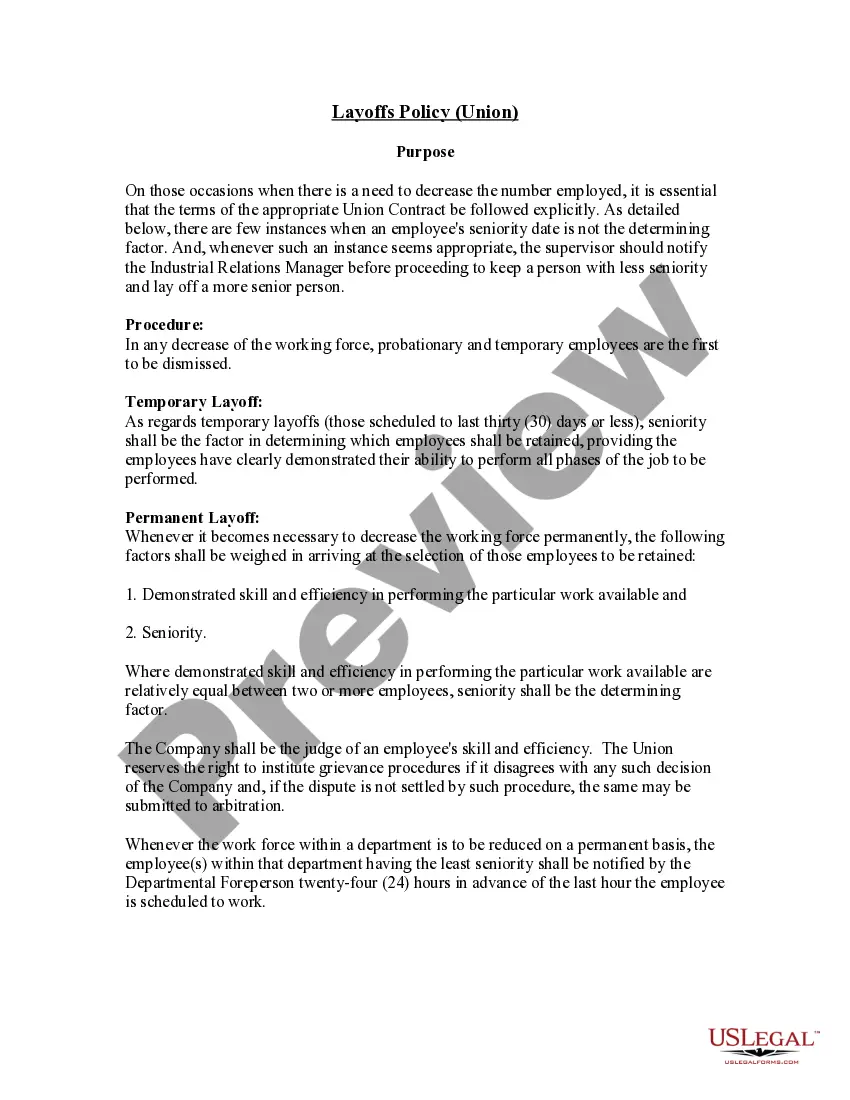
Georgia Layoffs Policy - Union
Description
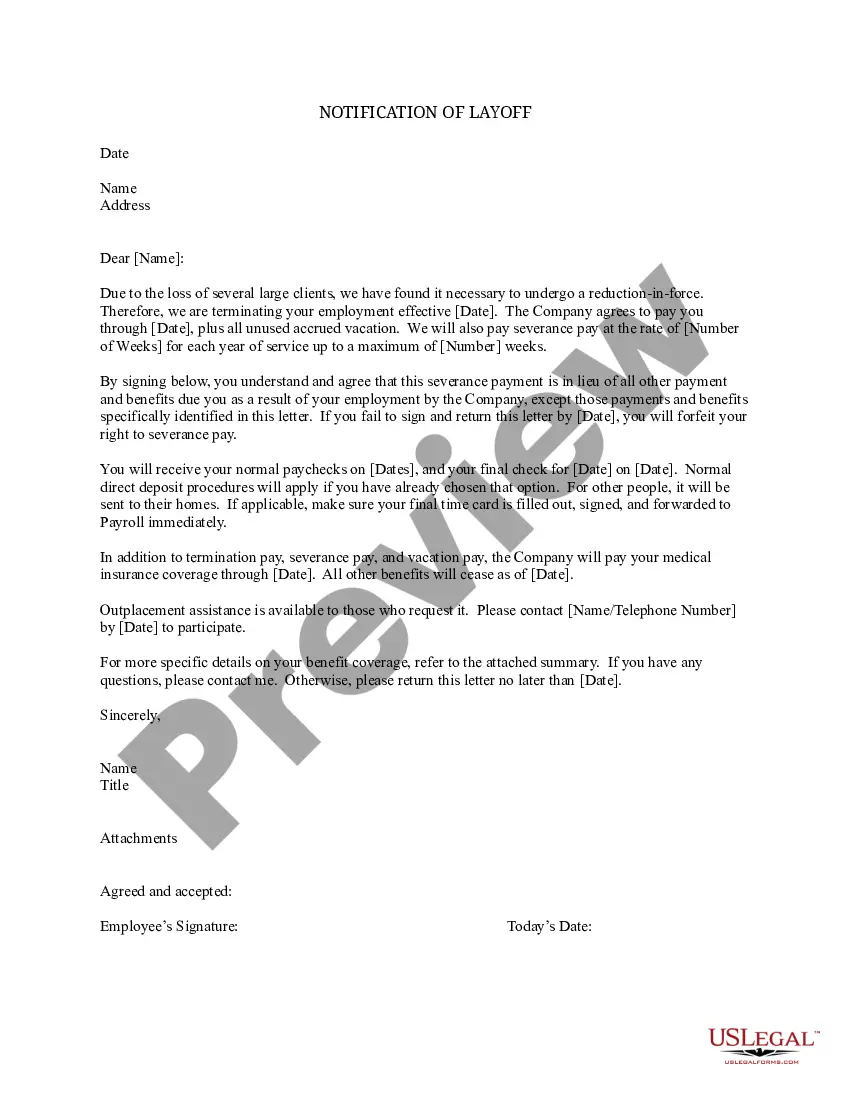
Get your form ready online
Our built-in tools help you complete, sign, share, and store your documents in one place.
Make edits, fill in missing information, and update formatting in US Legal Forms—just like you would in MS Word.
Download a copy, print it, send it by email, or mail it via USPS—whatever works best for your next step.
Sign and collect signatures with our SignNow integration. Send to multiple recipients, set reminders, and more. Go Premium to unlock E-Sign.
If this form requires notarization, complete it online through a secure video call—no need to meet a notary in person or wait for an appointment.
We protect your documents and personal data by following strict security and privacy standards.

Make edits, fill in missing information, and update formatting in US Legal Forms—just like you would in MS Word.

Download a copy, print it, send it by email, or mail it via USPS—whatever works best for your next step.

Sign and collect signatures with our SignNow integration. Send to multiple recipients, set reminders, and more. Go Premium to unlock E-Sign.

If this form requires notarization, complete it online through a secure video call—no need to meet a notary in person or wait for an appointment.

We protect your documents and personal data by following strict security and privacy standards.
Looking for another form?


How to fill out Layoffs Policy - Union?
US Legal Forms - one of the largest collections of legal documents in the United States - offers a variety of legal templates that you can download or print.
By using the website, you will find thousands of forms for business and personal purposes, organized by categories, states, or keywords. You can access the most current versions of forms like the Georgia Layoffs Policy - Union in moments.
If you already hold a monthly subscription, Log In and download the Georgia Layoffs Policy - Union from your US Legal Forms account. The Download button will appear on every document you view. You have access to all previously saved documents within the My documents section of your account.
Process the payment. Use a Visa or Mastercard or PayPal account to complete the transaction.
Choose the format and download the form to your device. Edit. Complete, modify, and print and sign the downloaded Georgia Layoffs Policy - Union. Every template you add to your account has no expiration date and belongs to you permanently. Therefore, if you wish to download or print another copy, simply visit the My documents section and click on the document you need. Access the Georgia Layoffs Policy - Union with US Legal Forms, the most comprehensive collection of legal document templates. Utilize thousands of professional and state-specific templates that fulfill your business or personal needs and requirements.
- Ensure you have selected the correct form for your city/county.
- Click the Preview button to review the content of the form.
- Review the form summary to confirm you have selected the right document.
- If the form does not meet your requirements, use the Search box at the top of the screen to find one that does.
- Once you are satisfied with the form, confirm your choice by clicking the Buy now button.
- Next, choose the pricing plan you prefer and provide your details to register for an account.
Form popularity
FAQ
In Georgia, understanding the Georgia Layoffs Policy - Union can clarify your options for severance and unemployment benefits. Generally, you can receive both, but it depends on your specific circumstances and employer policies. If your employer provides a severance package, it might affect how much you receive in unemployment benefits. To navigate this process smoothly, consider utilizing resources like USLegalForms to understand your rights and to support your application for benefits.
'Warn' in the context of layoffs refers to the requirement to notify employees about potential job losses under the WARN Act. This notification helps employees prepare for the transition and seek alternative employment. Ensuring compliance with the Georgia Layoffs Policy - Union regarding WARN is crucial for employers to avoid legal complications. Clear communication can make a significant difference during layoffs.
Covered EmployersGeorgia has no mini-WARN Act or other notice requirements for group layoffs (see Question 1).
The WARN Act is triggered by: Plant closings. The shutdown of a single employment site, facility or operating unit, that results in a loss of at least 50 full-time employees, during a 30 day period or. Mass layoffs.
There is no requirement for severance under federal or Georgia state law, including the Fair Labor Standards Act (FLSA) the federal law that sets minimum national standards for wages. Some states pass laws that provide employees with more protections.
According to section 25C of Industry and dispute Act 1947, maximum days allowed to Layoff of employee by employer is 45 days, for those days, employee who is laid-off is entitled for compensation equal to 50% of the total of the basic wages and dearness allowance that would have been payable to him, had he not been so
MSS requires you to select who to retrench (not a choice for employees) and negotiate appropriate notice periods and compensation with the soon-to-be ex-employee. VSS gives employees a choice to leave voluntarily with a letter of termination and lay-off benefits.
Georgia is a "Right-to-Work" state. This means that workers may not be required to join a union or make payments to a union as a condition of employment.
In general, employers are covered under WARN if they have 100 or more employees, not counting employees who have worked less than six months in the last 12 months and not counting employees who work an average of less than 20 hours a week.
The act applies to companies with over 100 active full-time employees, private and public companies and all non-profit and for-profit organizations. Employees covered under the act include both salaried and hourly employees. Employees must be employed for at least six months during the last 12 months.