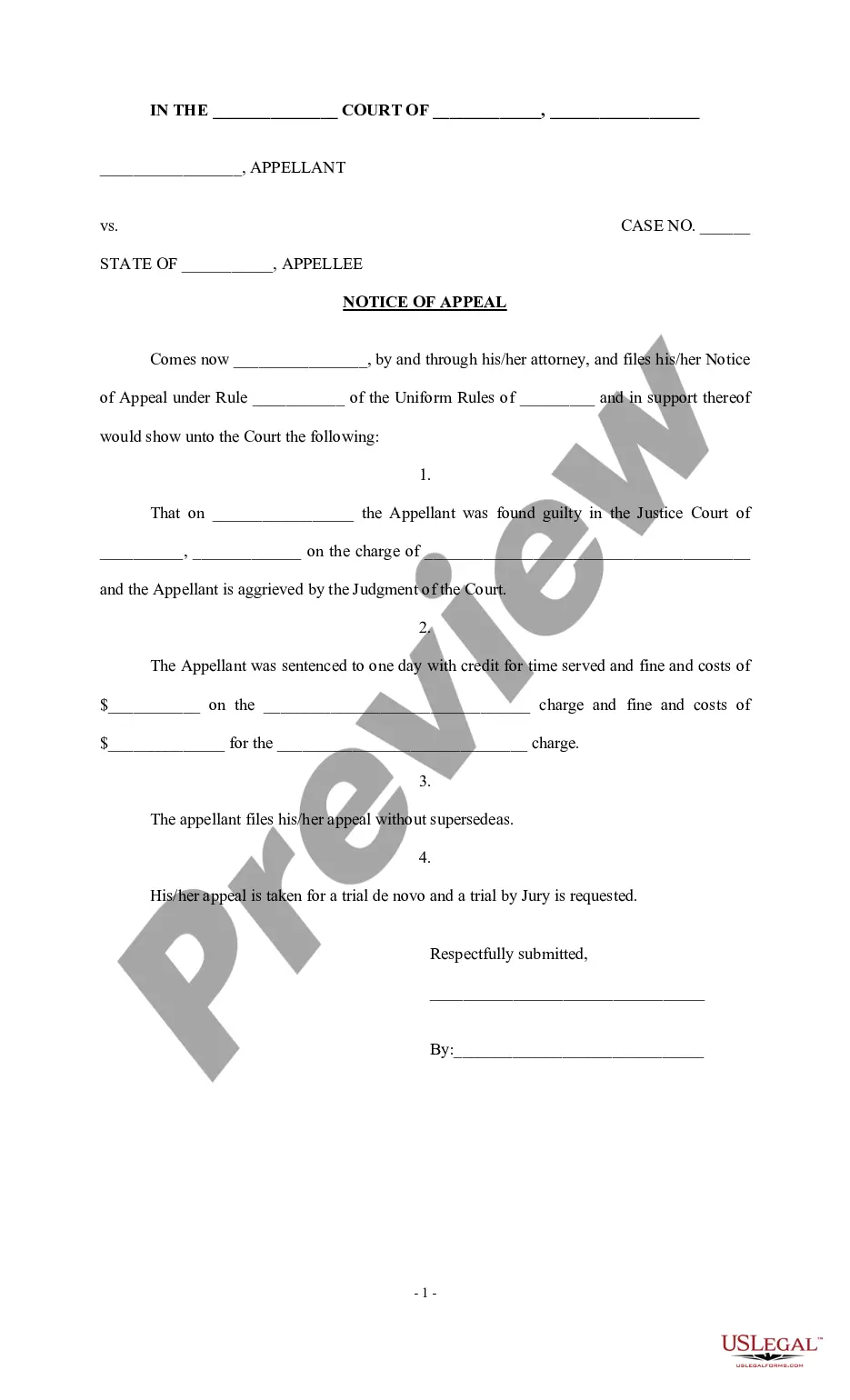
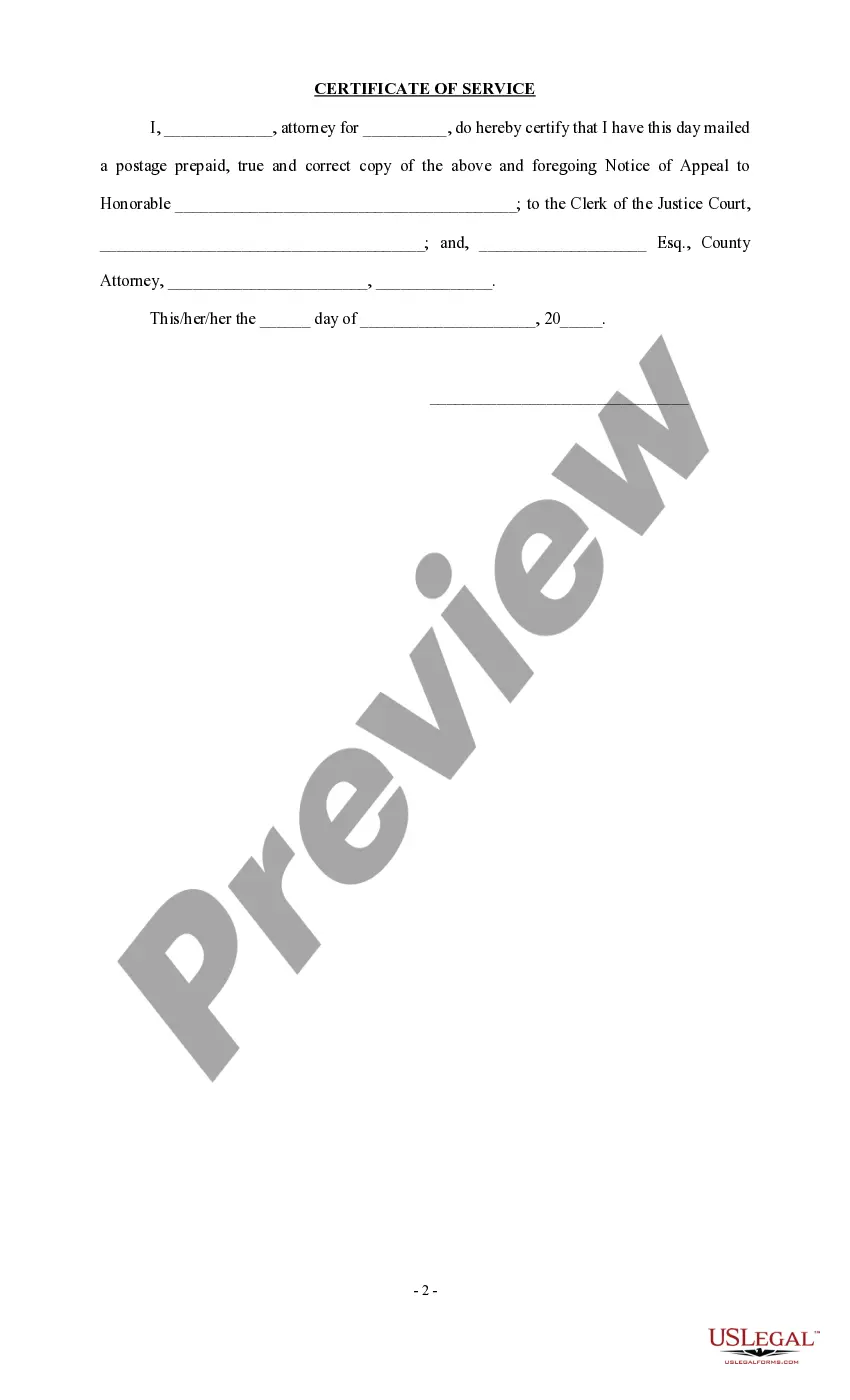
Defendant files a notice of appeal through his/her attorney. The appeal is taken for a trial de novo and a trial by jury is requested.
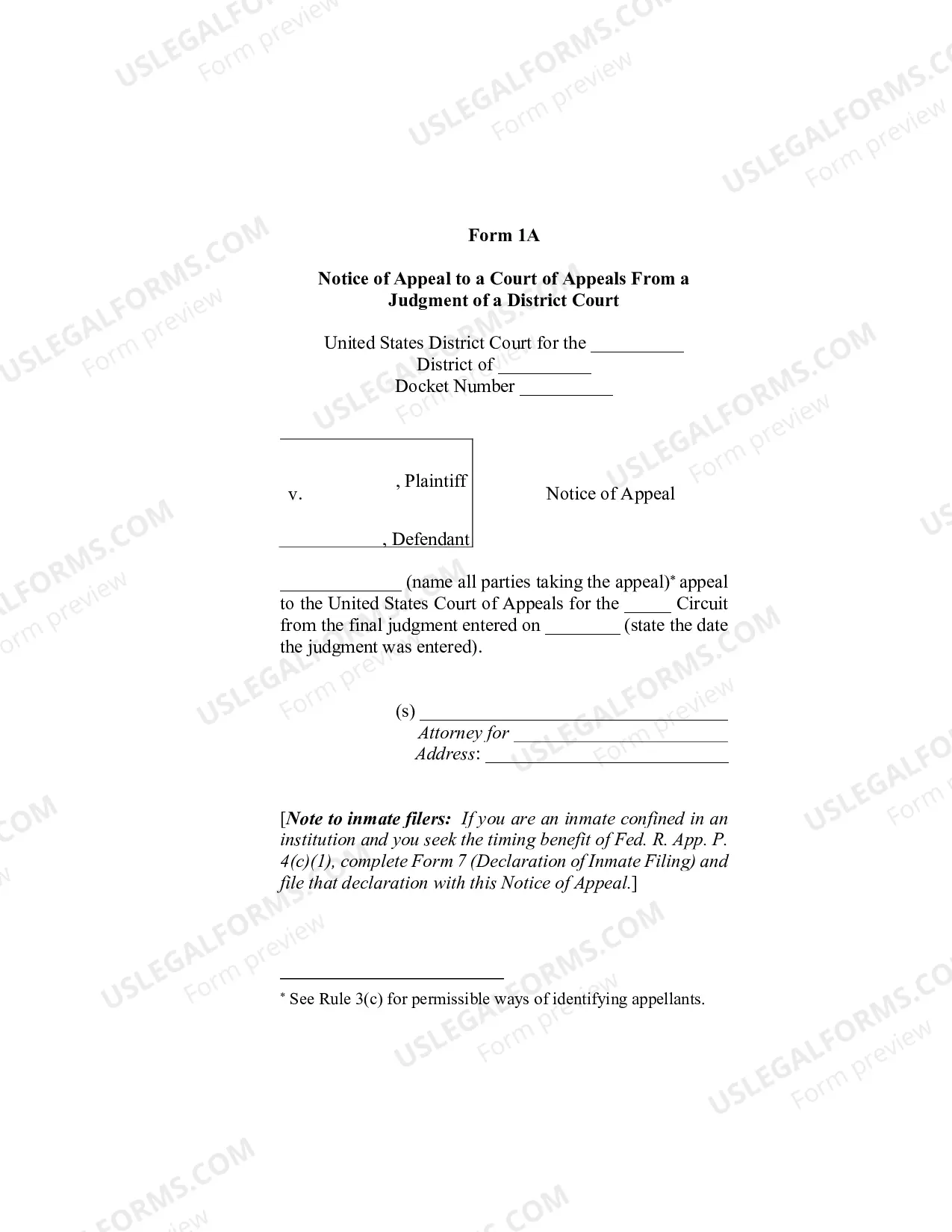
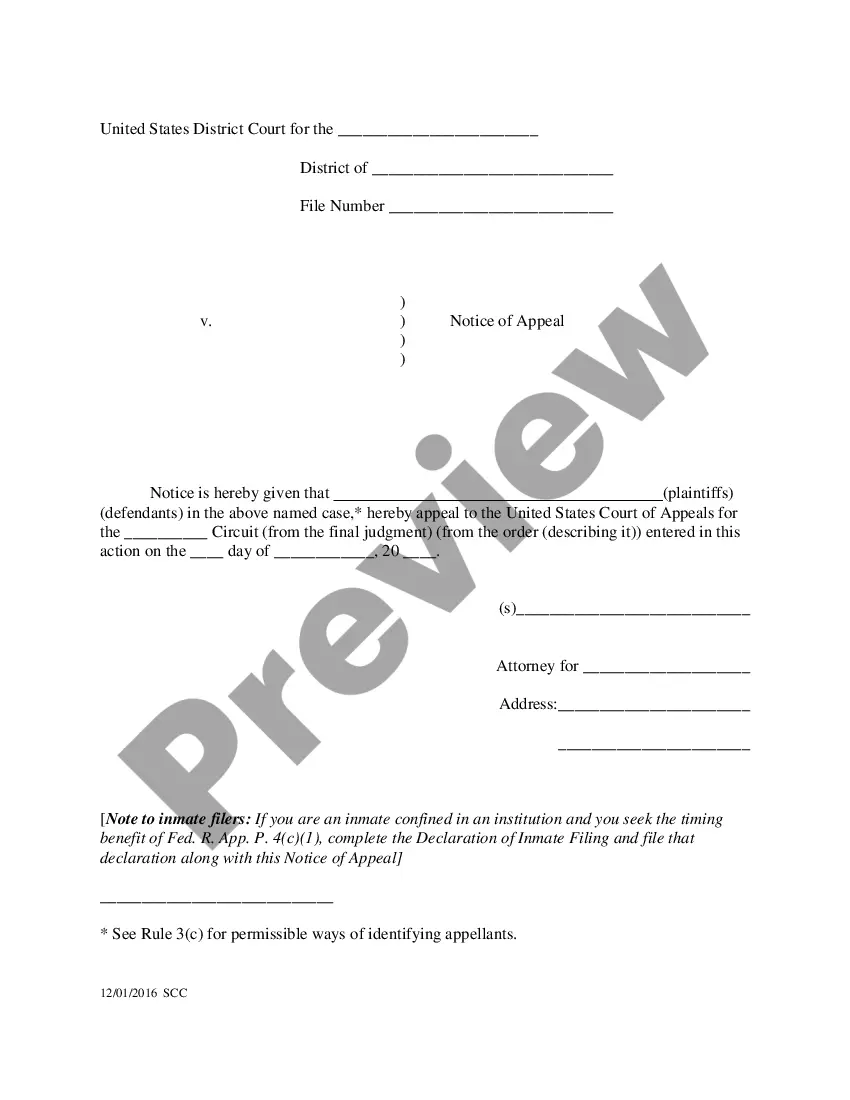
Florida Notice of Appeal in a Criminal Case
262 downloads
Description
Free preview
Get your form ready online
Our built-in tools help you complete, sign, share, and store your documents in one place.
Built-in online Word editor
Make edits, fill in missing information, and update formatting in US Legal Forms—just like you would in MS Word.
Export easily
Download a copy, print it, send it by email, or mail it via USPS—whatever works best for your next step.
E-sign your document
Sign and collect signatures with our SignNow integration. Send to multiple recipients, set reminders, and more. Go Premium to unlock E-Sign.
Notarize online 24/7
If this form requires notarization, complete it online through a secure video call—no need to meet a notary in person or wait for an appointment.
Store your document securely
We protect your documents and personal data by following strict security and privacy standards.

Make edits, fill in missing information, and update formatting in US Legal Forms—just like you would in MS Word.

Download a copy, print it, send it by email, or mail it via USPS—whatever works best for your next step.

Sign and collect signatures with our SignNow integration. Send to multiple recipients, set reminders, and more. Go Premium to unlock E-Sign.

If this form requires notarization, complete it online through a secure video call—no need to meet a notary in person or wait for an appointment.

We protect your documents and personal data by following strict security and privacy standards.
Looking for another form?

How to fill out Notice Of Appeal In A Criminal Case?
Have you found yourself in a situation where you require documents for potential business or particular purposes almost daily.
There are numerous authentic document templates available online, but locating forms you can trust is not simple.
US Legal Forms offers an extensive array of form templates, including the Florida Notice of Appeal in a Criminal Case, which are crafted to comply with federal and state regulations.
Use US Legal Forms, the most comprehensive collection of legitimate forms, to save time and avoid errors.
The service provides professionally crafted legal document templates that can be utilized for various purposes. Create an account on US Legal Forms and start making your life easier.
- If you are already familiar with the US Legal Forms website and possess an account, simply Log In.
- After that, you can download the Florida Notice of Appeal in a Criminal Case template.
- If you do not have an account and wish to start using US Legal Forms, follow these steps.
- Select the form you need and ensure it is for the correct city/state.
- Utilize the Review button to inspect the document.
- Read the description to confirm you have chosen the correct form.
- If the form is not what you are looking for, use the Search box to find the form that meets your needs and requirements.
- Once you have the right form, click Purchase now.
- Choose the pricing plan you want, fill in the necessary information to create your account, and pay for your purchase using PayPal or Visa/Mastercard.
- Select a suitable paper format and download your copy.
- Find all the document templates you have acquired in the My documents section. You can download another copy of the Florida Notice of Appeal in a Criminal Case at any time, if needed. Just select the desired form to download or print the document template.
Form popularity
FAQ
Pursuant to Florida Rule of Appellate Procedure 9.140(b)(2)(i), a ?defendant who pleads guilty or nolo contendere may expressly reserve the right to appeal a prior dispositive[1] order of the lower tribunal, identifying with particularity the point of law being reserved.?
You must prove that the trial court made a legal mistake that caused you harm. The trial court does not have to prove it was right, but you have to prove there was a mistake.
The most common grounds for appeal of a criminal conviction are improper admission or exclusion of evidence, insufficient evidence, ineffective assistance of counsel, prosecutorial misconduct, jury misconduct and/or abuse of discretion by the judge.
After the appropriate paperwork is timely filed (after the oral argument), the appellate court will review the decision of the lower court and make a ruling. Florida's Rules of Court designate the types of appeals that are permitted.
When appealing against a guilty verdict a defendant might say: there was something unfair about the way their trial took place. a mistake was made in their trial. the verdict could not be sustained on the evidence.
If the outcome of your case might have been different if you had had effective counsel, you may have grounds for appeal. The prosecutor acted unethically or made errors. It is up to the court of appeals to decide if these mistakes led to an unfair conviction. The judge made mistakes in pretrial rulings or at trial.
There are many reasons to appeal a criminal conviction, but the three most common reasons for appeal are for ineffective assistance of counsel, evidentiary issues during trial, and plain error committed by the trial court.
Step 1: File the Notice of Appeal. Step 2: Pay the filing fee. Step 3: Determine if/when additional information must be provided to the appeals court as part of opening your case. Step 4: Order the trial transcripts.