Delaware Life Estate Termination
Overview of this form
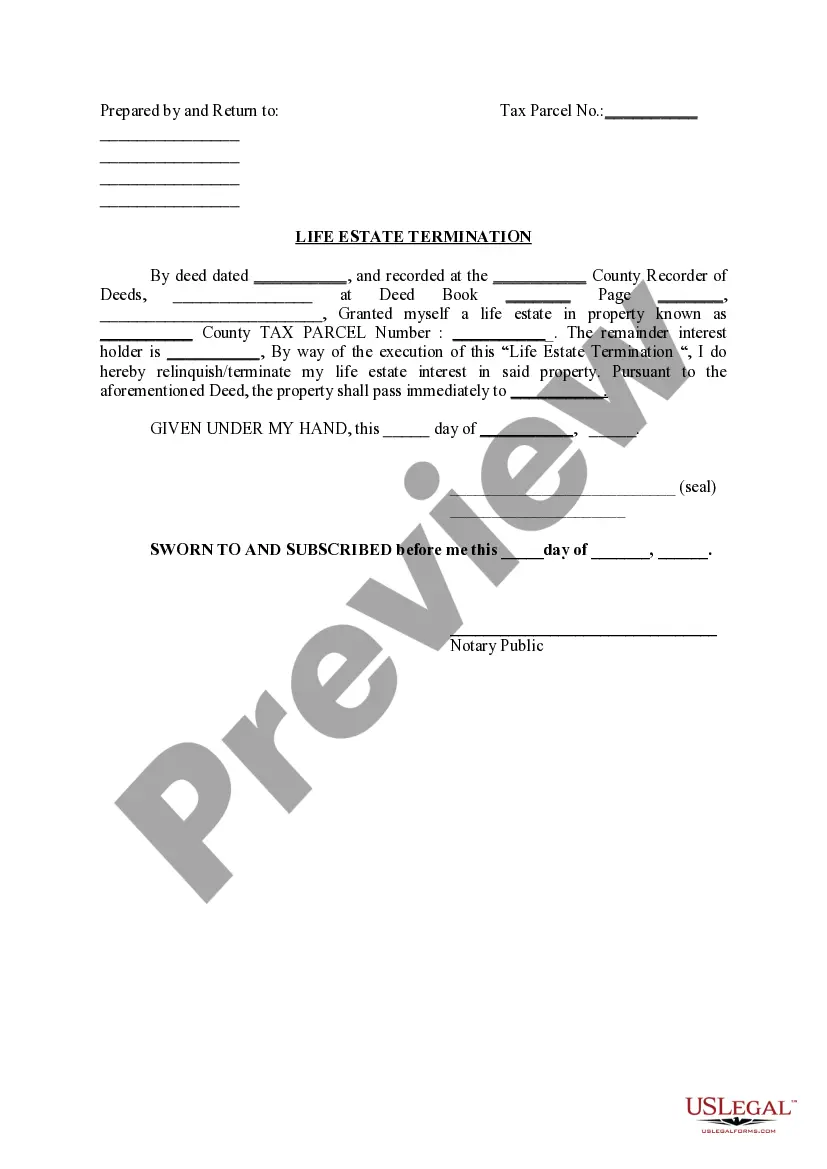
The Life Estate Termination form is a legal document used to officially relinquish a life estate interest in a property. This form is unique as it allows an individual to terminate their rights to a property held under a life estate, enabling the property to pass directly to the remainder interest holder. Unlike general property transfer documents, this form focuses specifically on the termination of a life estate agreement.
Form components explained
- Prepared by and Return to: Indicates where the document should be sent after completion.
- Tax Parcel No.: A field to specify the unique identifier for the property.
- Granting clause: States the original life estate granted through the deed.
- Relinquishment statement: A declaration to terminate the life estate interest.
- Remainder interest holder: Identifies who will receive the property after termination.
- Signatures and notarization: Provides space for signatures and a notary public's acknowledgment.

Situations where this form applies
This form is necessary when the holder of a life estate wishes to terminate their interest in a property before their passing. Common scenarios include when the property owner decides to sell the property, transfer full ownership, or when they no longer wish to retain any rights to the estate. This form ensures a clear legal process for transferring the remainder interest directly to the designated beneficiary.
Who this form is for
- Property owners who currently hold a life estate and wish to terminate their interest.
- Individuals looking to pass their property directly to another party without prolonging the life estate.
- Attorneys assisting clients in estate planning or property transfer matters.
How to complete this form
- Identify the parties involved, including the life estate holder and the remainder interest holder.
- Specify the property by providing the tax parcel number and relevant address.
- Enter the date of the original deed and where it was recorded.
- Clearly state the intent to relinquish the life estate interest in the property.
- Obtain signatures from both the life estate holder and a notary public.
Is notarization required?
Yes, this form must be notarized to be legally valid. This ensures the authenticity of the signatures and the integrity of the document. US Legal Forms offers integrated online notarization, available 24/7 via secure video calls, allowing you to complete the notarization process without needing to travel.
Get your form ready online
Our built-in tools help you complete, sign, share, and store your documents in one place.
Make edits, fill in missing information, and update formatting in US Legal Forms—just like you would in MS Word.
Download a copy, print it, send it by email, or mail it via USPS—whatever works best for your next step.
Sign and collect signatures with our SignNow integration. Send to multiple recipients, set reminders, and more. Go Premium to unlock E-Sign.
If this form requires notarization, complete it online through a secure video call—no need to meet a notary in person or wait for an appointment.
We protect your documents and personal data by following strict security and privacy standards.

Make edits, fill in missing information, and update formatting in US Legal Forms—just like you would in MS Word.

Download a copy, print it, send it by email, or mail it via USPS—whatever works best for your next step.

Sign and collect signatures with our SignNow integration. Send to multiple recipients, set reminders, and more. Go Premium to unlock E-Sign.

If this form requires notarization, complete it online through a secure video call—no need to meet a notary in person or wait for an appointment.

We protect your documents and personal data by following strict security and privacy standards.
Typical mistakes to avoid
- Failing to accurately identify the property using the correct tax parcel number.
- Not including the correct date of the original deed.
- Overlooking the need for signatures and notarization.
- Not specifying the remainder interest holder properly.
Benefits of completing this form online
- Convenience of downloading and completing the form at your own pace.
- Editability allows for easy corrections without needing to start over.
- Reliability of forms prepared by licensed attorneys to ensure compliance with legal standards.
Quick recap
- The Life Estate Termination form is essential for property owners wishing to terminate their life estate rights.
- Accurate details about the property and parties involved are crucial for validity.
- Notarization is necessary for the form to be legally effective.
Looking for another form?


Form popularity
FAQ
Yes, you can remove someone from a life estate deed through a process known as Delaware Life Estate Termination. This procedure involves clear legal steps and typically requires the consent of all parties involved. By following the appropriate legal framework, you can effectively terminate the life estate that may benefit one party while releasing the property for others. Furthermore, using the US Legal Forms platform can provide you with the necessary forms and guidance to navigate this process smoothly.
When someone dies with a life estate in place, the property typically passes to the remainder beneficiary or reverts back to the original owner, depending on the terms of the life estate. This transition should adhere to Delaware laws regarding estate distribution. It is important to understand these implications to ensure proper management of the estate during Delaware Life Estate Termination. UsLegalForms can assist in preparing the necessary documents and providing guidance during this process.
After the termination of a life estate, the right to property is typically referred to as the 'remainder interest' or 'reversionary interest'. This is the legal right that allows the new owner to take possession of the property once the life estate ends. Understanding these terms is crucial when considering Delaware Life Estate Termination, as they define the rights of the parties involved. UsLegalForms can provide clarity in these matters through informative resources and legal forms.
Contesting a life estate involves demonstrating that the life estate was established through improper means or lacks validity. This can require presenting evidence in court to challenge the terms or the holder's rights. If you are facing a disagreement regarding a life estate, seeking assistance from a professional familiar with Delaware Life Estate Termination could be beneficial. UsLegalForms offers resources to assist with contesting life estates effectively.
A life estate can be terminated through several methods, including mutual agreement, expiration of the lifetime interest, or court action. In Delaware, these terminations follow specific legal procedures to ensure compliance with state laws. Consulting an expert in Delaware Life Estate Termination can help navigate this process smoothly. Using resources like UsLegalForms can provide you with the necessary documents and guidance.
Yes, a life estate can be undone, but it involves legal steps and, often, the agreement of the remainder beneficiaries. You may need to create a new deed that clearly states your intention to terminate the life estate. Furthermore, the nuances of the law can vary, so understanding Delaware Life Estate Termination is crucial. Professional resources, like uslegalforms, can provide the necessary templates and guidance to assist in this process.
To terminate a life estate deed, you typically need to execute a legal document, often known as a quitclaim deed, that declares the termination. You may also need permission from the remainder beneficiaries, depending on the arrangement. It is vital to follow the correct procedures to ensure the termination is valid in Delaware. You can find detailed guidance on Delaware Life Estate Termination on platforms like uslegalforms.
One major disadvantage of a life estate is the lack of flexibility. Once you establish a life estate, you generally cannot sell or change the property without the consent of the remainder beneficiaries. Additionally, if you want to terminate the life estate, navigating the legal process can become complex. Knowing the steps for Delaware Life Estate Termination can help you manage these challenges better.
Choosing between a life estate and a will depends on your specific estate planning needs. A life estate allows you to retain some control over your property during your lifetime while ensuring it passes directly to your chosen beneficiaries after your death. This can simplify the transfer process and potentially avoid probate. However, understanding the nuances of Delaware Life Estate Termination is essential for effective planning.
At the end of a life estate, ownership of the property reverts to the designated remainderman without any additional legal processes. This means the remainderman gains full rights to the property, which can be sold, rented, or used as they see fit. Awareness of Delaware Life Estate Termination can help clarify what to expect when a life estate concludes. By using the US Legal Forms platform, you can find comprehensive resources to assist with any related questions or documentation needs.