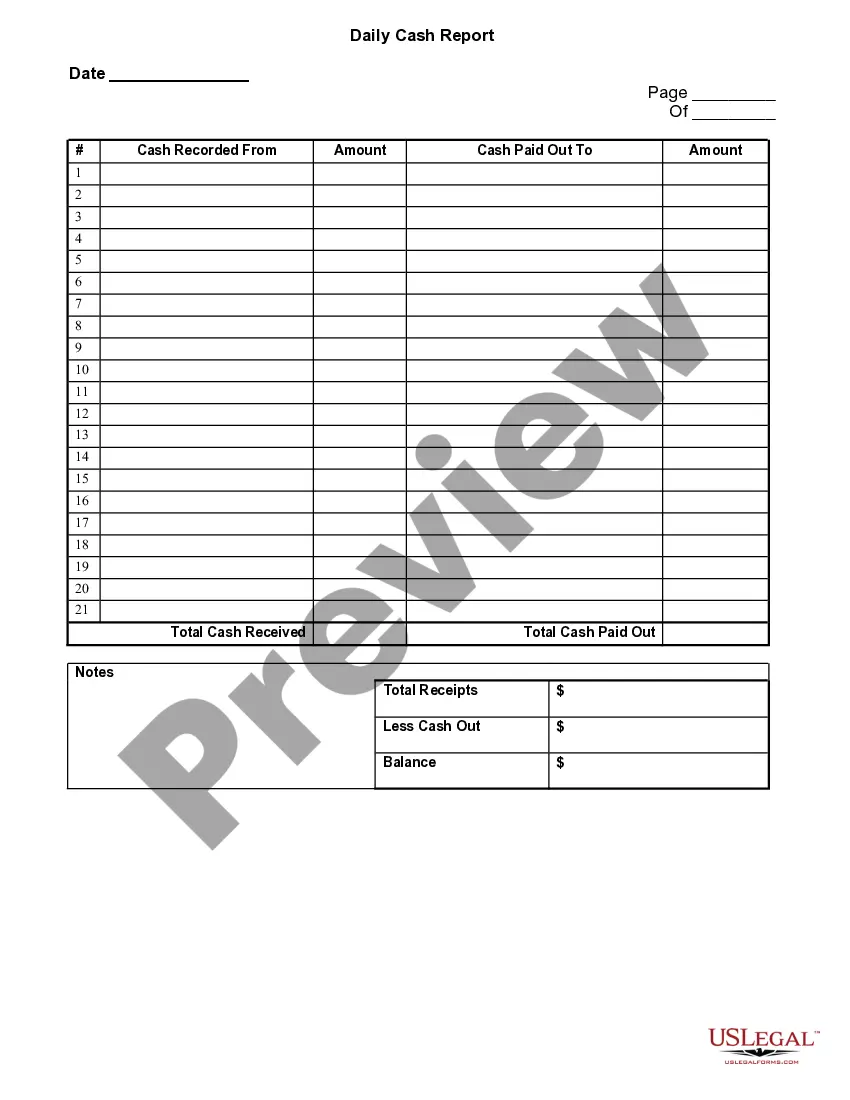
Daily Cash Report
What this document covers
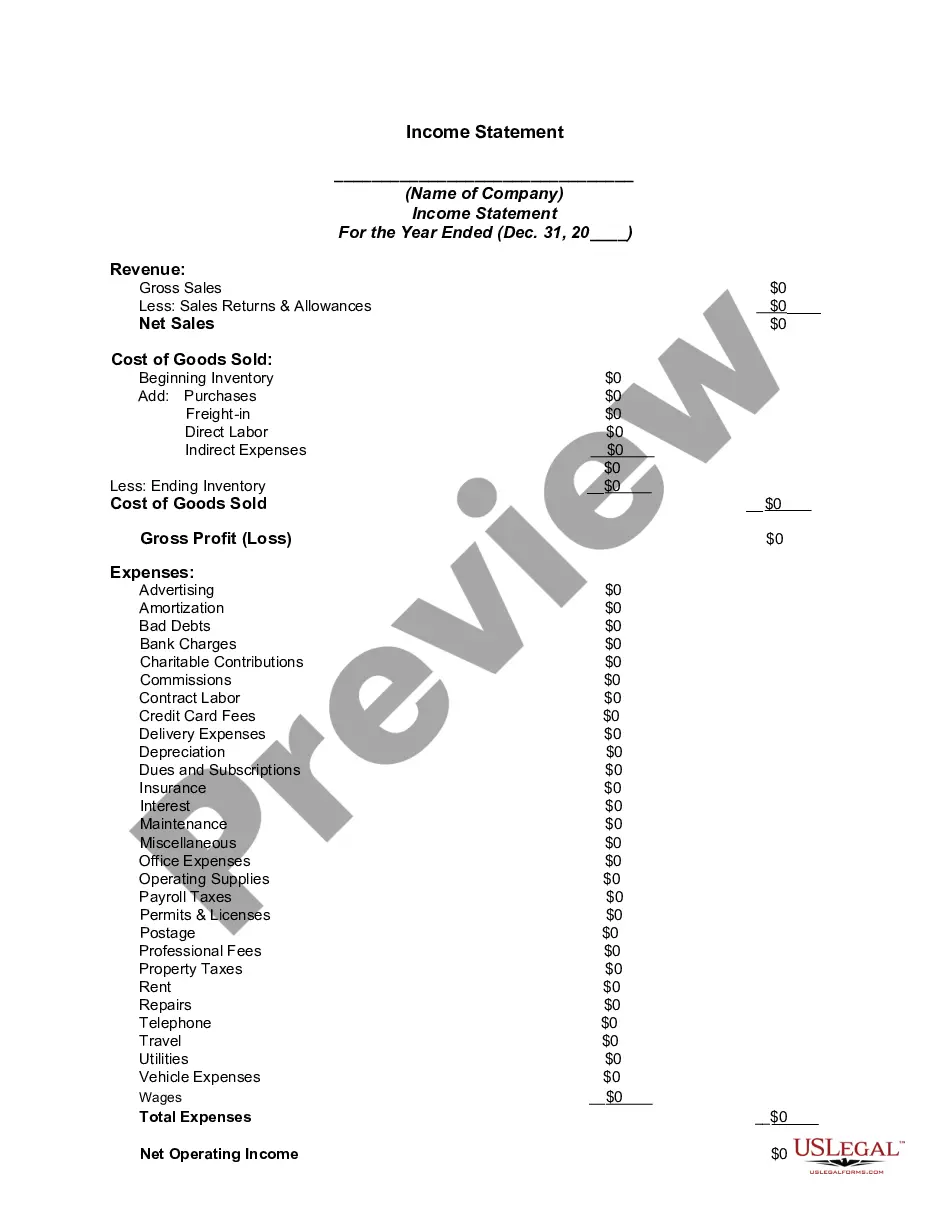
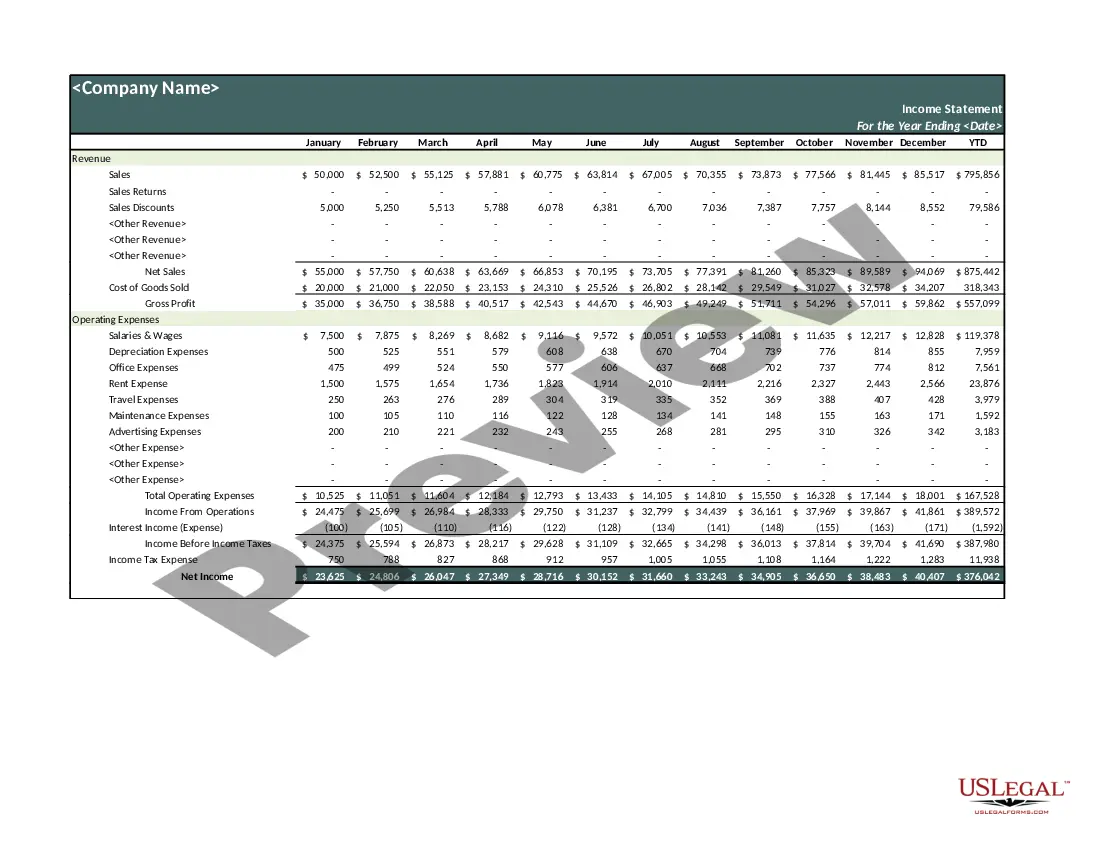
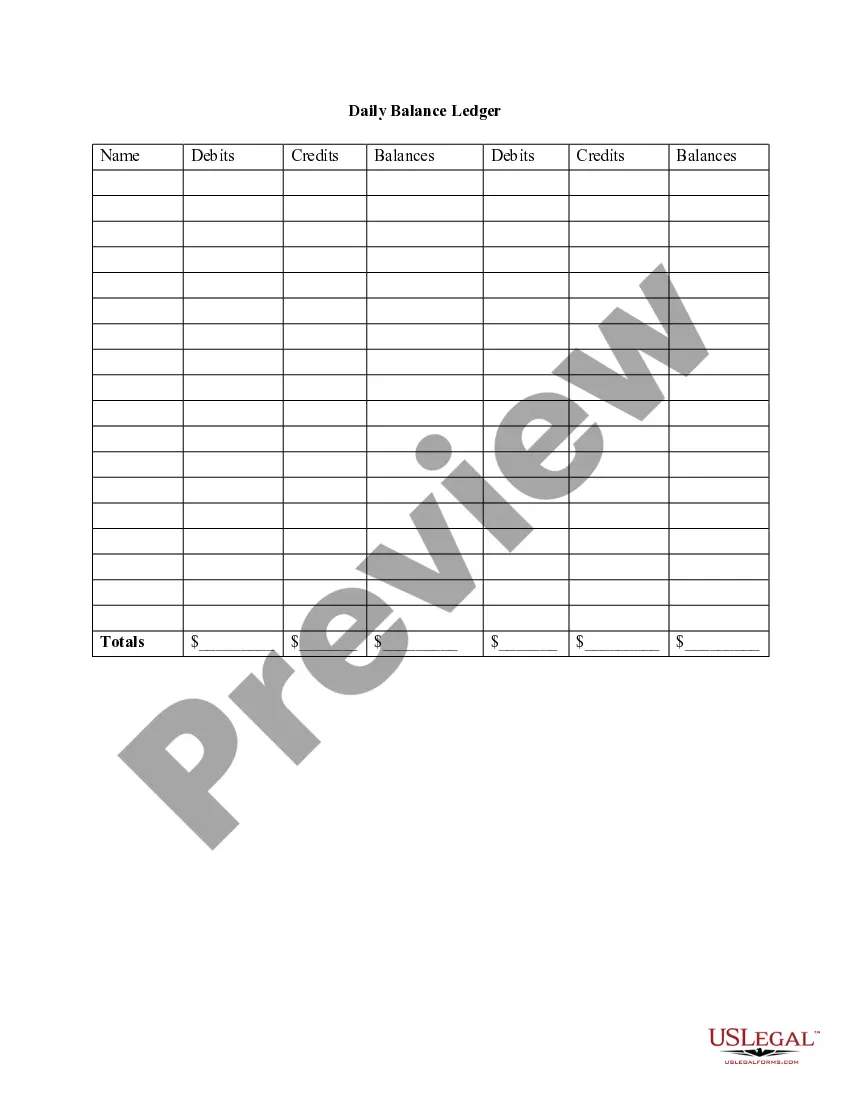
The Daily Cash Report is a financial document used to track cash flow in your business on a daily basis. It outlines daily cash income and expenditures, allowing for effective monitoring of cash management. Unlike other financial statements, this report provides a focused snapshot of daily cash activities, making it essential for daily operations.
Key components of this form
- Date of the report
- Cash recorded from various sources
- Total cash received and paid out
- Notes section for additional remarks
- Balance calculation to assess daily cash flow
When to use this document
This form is useful for businesses that handle cash transactions daily. It is ideal for retail shops, restaurants, and service providers who need to keep a daily record of cash inflow and outflow. Use this report at the end of each business day to ensure accurate cash management and to identify any discrepancies promptly.
Who can use this document
This form is intended for:
- Small business owners
- Retail managers
- Accountants and financial professionals
- Anyone involved in daily cash transactions
How to complete this form
- Enter the date at the top of the report.
- List all cash recorded from different income sources and their respective amounts.
- Document all cash paid out, specifying the recipients and amounts.
- Calculate total cash received and total cash paid out to find the balance.
- Use the notes section for any additional comments or important details about the cash flow.
Does this form need to be notarized?
This form usually doesn’t need to be notarized. However, local laws or specific transactions may require it. Our online notarization service, powered by Notarize, lets you complete it remotely through a secure video session, available 24/7.
Get your form ready online
Our built-in tools help you complete, sign, share, and store your documents in one place.
Make edits, fill in missing information, and update formatting in US Legal Forms—just like you would in MS Word.
Download a copy, print it, send it by email, or mail it via USPS—whatever works best for your next step.
Sign and collect signatures with our SignNow integration. Send to multiple recipients, set reminders, and more. Go Premium to unlock E-Sign.
If this form requires notarization, complete it online through a secure video call—no need to meet a notary in person or wait for an appointment.
We protect your documents and personal data by following strict security and privacy standards.

Make edits, fill in missing information, and update formatting in US Legal Forms—just like you would in MS Word.

Download a copy, print it, send it by email, or mail it via USPS—whatever works best for your next step.

Sign and collect signatures with our SignNow integration. Send to multiple recipients, set reminders, and more. Go Premium to unlock E-Sign.

If this form requires notarization, complete it online through a secure video call—no need to meet a notary in person or wait for an appointment.

We protect your documents and personal data by following strict security and privacy standards.
Typical mistakes to avoid
- Forgetting to enter all cash sales or payments.
- Not double-checking calculations for total cash received and paid out.
- Neglecting to fill in the date, which can lead to confusion over reporting periods.
- Leaving the notes section blank when relevant information could provide context.
Why complete this form online
- Convenient access to download and fill out the form from anywhere.
- Easy to edit and customize according to your business needs.
- Reliable source of professionally drafted templates.
- Fast and efficient processing without the need for physical paperwork.
Quick recap
- The Daily Cash Report is essential for tracking daily cash flow.
- Accurately documenting cash transactions helps maintain financial control.
- It is suitable for all types of businesses that handle cash transactions.
- Using this form online offers convenience and secure access to your financial records.
Looking for another form?
Form popularity
FAQ
Count the cash in each of the cash registers. Make a separate entry on the daily cash position report for each register. Add up and enter the total amount of cash from all the registers on the daily cash report. Add up the amount you received from customers who paid by check.
A cash position can also be found by looking at a company's free cash flow (FCF). This FCF can be found by taking a company's operating cash flow and subtracting its short-term and long-term capital expenditures.
A company's cash flow is calculated by subtracting its total expenses from its total income for a specific period. When calculating daily cash flow needs, subtract daily expenses from daily income. If daily income is not enough to cover daily expenses, the business may have financial difficulty over time.
Enter Your Beginning Balance. For the first month, start your projection with the actual amount of cash your business will have in your bank account. Estimate Cash Coming In. Fill in all amounts you expect to take in during the month. Estimate Cash Going Out. Subtract Outlays From Income.
The cash balance of each fund simply reports the amount of cash held by that fund at quarter end.This differs from the fund balance, in that the fund balance also takes into consideration current assets and current liabilities of that fund.
The Daily Cash Report identifies Receipts posted on accounts that are allocated to Charges posted on the same account. The allocations are reported by General Ledger Account Code and include the total Suspense Receipt movement for allocation against Charges for 7 days following the selected date.
A company's cash flow is calculated by subtracting its total expenses from its total income for a specific period. When calculating daily cash flow needs, subtract daily expenses from daily income.
Gather all cash transaction documentation. Choose a cash report template. Cash at the start of day Calculate incoming cash. Specify credit card sales. List cash expenses. Calculate the end of day cash total. Count the money.