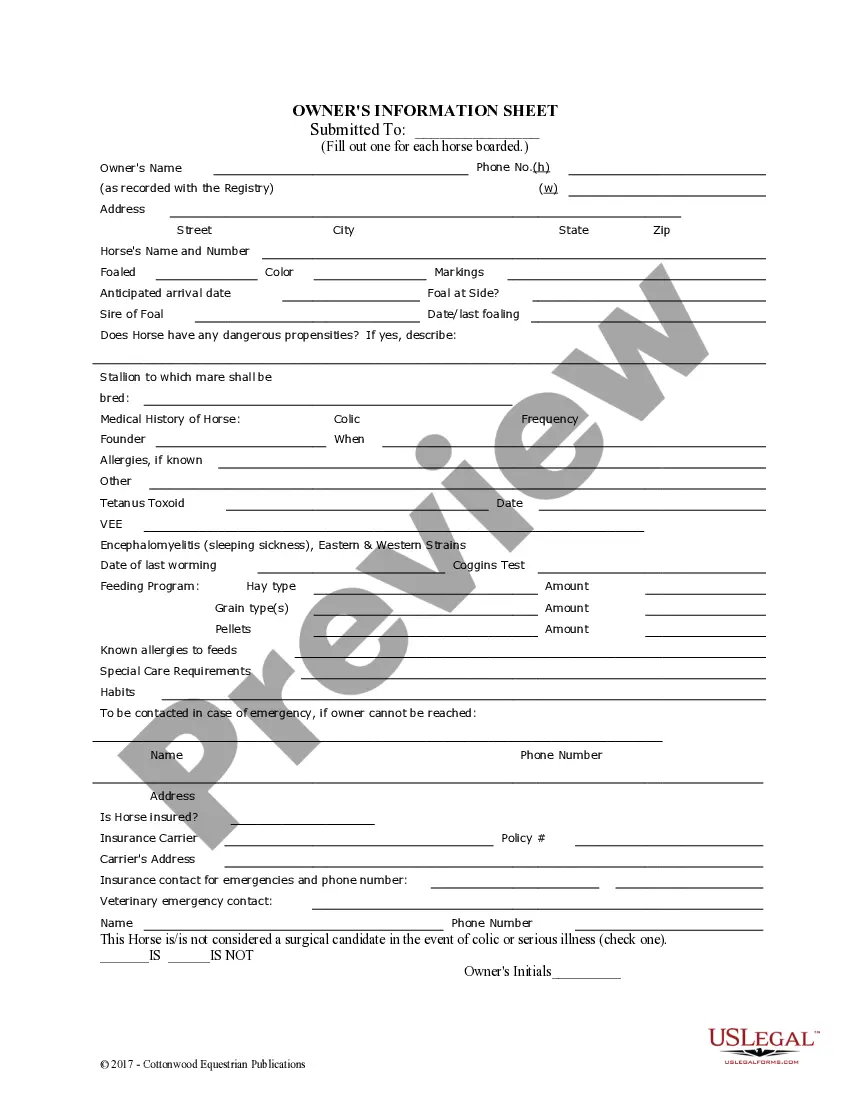
Delaware Owner's Information Sheet - Horse Equine Forms
What is this form?
The Owner's Information Sheet is a crucial document for horse owners who are boarding their horses. This form provides essential details about each horse, including medical history, feeding programs, and emergency contacts. It differs from other equine forms by its specific focus on the administrative requirements surrounding horse boarding and services.
What’s included in this form
- Owner's contact information, including phone number and address.
- Horse specifics, such as name, breed, color, and markings.
- Medical history, including any known allergies and previous illnesses.
- Details about the horse's feeding program and special care requirements.
- Emergency contacts, including veterinary emergency contacts and insurance details.
- Consent regarding the horse's surgical candidacy in case of serious illness.

Common use cases
This form should be completed when boarding a horse at a facility. It is necessary for horse owners to provide relevant information that ensures the proper care and handling of their horses while in the care of another party. It is also useful during veterinary visits where detailed medical and care history is beneficial.
Who can use this document
- Horse owners who plan to board their horses.
- Stable managers or facilities responsible for the care of boarded horses.
- Veterinarians requiring comprehensive horse history for treatment.
- Anyone involved in the breeding process requiring detailed horse information.
Completing this form step by step
- Enter the owner's contact information, including phone numbers and address.
- List the horseâs name, number, breed, color, and any notable markings.
- Provide details on medical history, including any known allergies and the last veterinary visits.
- Outline the feeding program with specifics on hay, grain, and any allergies.
- Fill in contacts for emergencies, including veterinary contact and insurance details.
- Indicate whether the horse is considered a surgical candidate in emergencies.
Does this document require notarization?
This form does not typically require notarization unless specified by local law.
Get your form ready online
Our built-in tools help you complete, sign, share, and store your documents in one place.
Make edits, fill in missing information, and update formatting in US Legal Forms—just like you would in MS Word.
Download a copy, print it, send it by email, or mail it via USPS—whatever works best for your next step.
Sign and collect signatures with our SignNow integration. Send to multiple recipients, set reminders, and more. Go Premium to unlock E-Sign.
If this form requires notarization, complete it online through a secure video call—no need to meet a notary in person or wait for an appointment.
We protect your documents and personal data by following strict security and privacy standards.

Make edits, fill in missing information, and update formatting in US Legal Forms—just like you would in MS Word.

Download a copy, print it, send it by email, or mail it via USPS—whatever works best for your next step.

Sign and collect signatures with our SignNow integration. Send to multiple recipients, set reminders, and more. Go Premium to unlock E-Sign.

If this form requires notarization, complete it online through a secure video call—no need to meet a notary in person or wait for an appointment.

We protect your documents and personal data by following strict security and privacy standards.
Common mistakes to avoid
- Omitting important medical history and care requirements.
- Filling out the form for multiple horses incorrectly.
- Failing to update emergency contact information as it changes.
- Not specifying known allergies, which can affect care.
Why complete this form online
- Instant access to a professionally drafted form tailored for your needs.
- Editability allows for easy updates and personal customization.
- Downloadable format provides a reliable record for boarding facilities and emergencies.
Legal Use & Context:
- This form serves as a record for the care and boarding of horses, which can be important during legal disputes or insurance claims.
- Maintaining accurate records can help protect an owner's rights in case of injury or damage involving the horse.
- It is recommended to keep copies of this document for personal records and future reference.
Key takeaways
- The form is essential for horse boarding and equine service needs.
- It captures important medical and dietary information critical for care.
- Using the form helps ensure smooth communication between owners and providers.
Legal terms and meanings
- Foal: A young horse less than one year old.
- Stallion: An adult male horse that can breed.
- Coggins Test: A blood test to check for equine infectious anemia.
Looking for another form?


Form popularity
FAQ
They are big. They eat. ALL. THE. TIME. They have their own personalities. They can learn things as easily as you can. They recognize people. They have a very long memory. They are very athletic. They are herd animals.
Check on horse's at least twice a day. Make sure grazing is free of danger and poisonous plants. Make sure stables are suitable/safe/kept clean. Always have fresh water available. Feed appropriately for the horse's type and workload. Have regular health checks and farrier care.
Horses are special creatures. They are majestic, strong and can display a broad range of emotions. Whether they're around humans or other horses, they are amazingly communicative and thrive in social settings. These qualities are part of the reason why horses can develop such a strong bond with humans.
Horses can sleep both lying down and standing up. Horses can run shortly after birth. Domestic horses have a lifespan of around 25 years. A 19th century horse named 'Old Billy' is said to have lived 62 years. Horses have around 205 bones in their skeleton. Horses have been domesticated for over 5000 years.