Delaware Disclaimer of Warranties - Horse Equine Forms
What this document covers
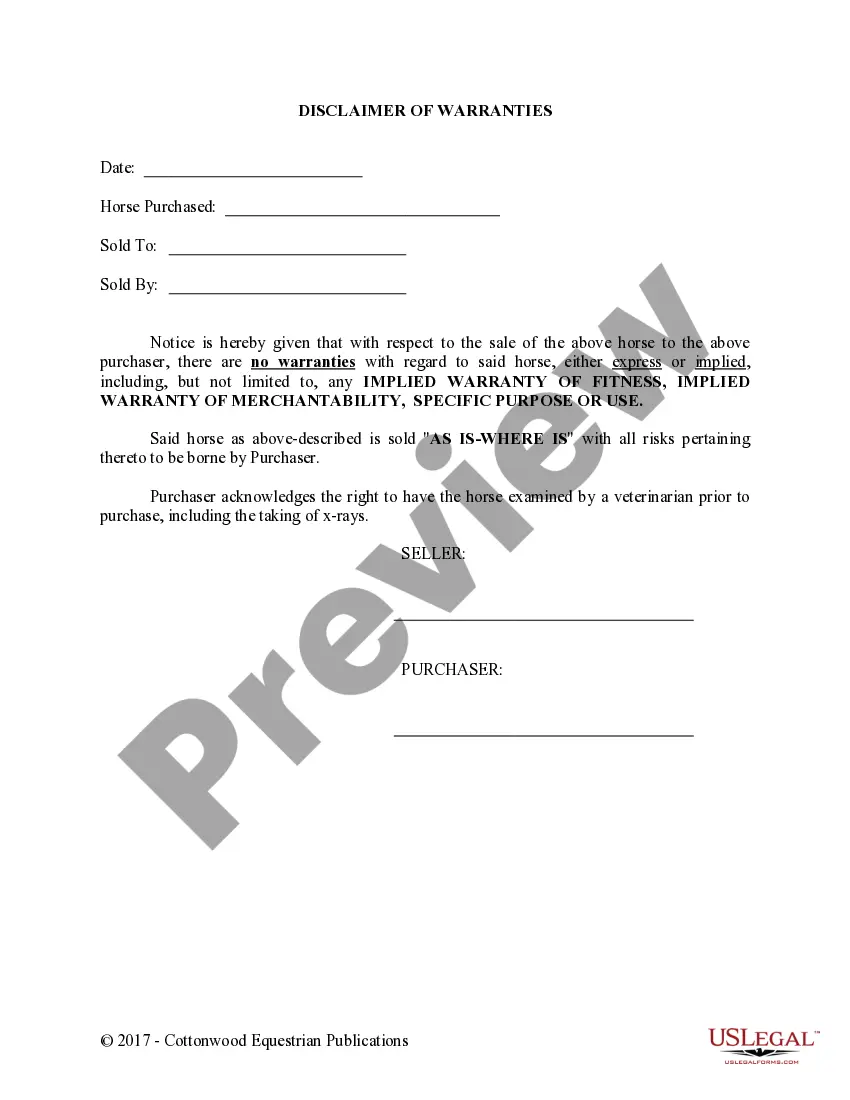
The Disclaimer of Warranties - Horse Equine form is a legal document used in the sale of a horse to protect the seller by stating that there are no warranties, either express or implied, regarding the horse being sold. This form is essential for clarifying that the buyer assumes all risks associated with the horse, differing from other forms that may include warranties or guarantees about the animal's health or fitness for use. This form ensures both parties are clear on the terms of the sale and protects the seller from potential legal claims after the sale is finalized.
What’s included in this form
- Date of horse purchase and sale.
- Details of the horse being sold.
- Identification of the seller and purchaser.
- Disclaimer of any warranties regarding the horse, including fitness and merchantability.
- Statement confirming the horse is sold "AS IS-WHERE IS."
- Acknowledge the purchaser's right to conduct a veterinary examination before purchase.
When to use this document
This form should be used when a seller is offering a horse for sale and wishes to specify that no warranties are provided regarding the horse's condition, performance, or suitability for any specific purpose. It's particularly important in private sales where buyers might assume certain conditions that sellers do not want to guarantee. Additionally, it is useful in situations where the seller is not familiar with the horse's history or health status.
Intended users of this form
- Horse sellers seeking to limit their liability after the sale.
- Buyers who want to understand the conditions under which the horse is being sold.
- Equine professionals involved in horse sales, including trainers and brokers.
- Individuals purchasing horses in private transactions.
How to prepare this document
- Identify the date of the transaction.
- Fill in the details of the horse being sold.
- Enter the names and contact information of both the seller and purchaser.
- Read and understand the disclaimer section before signing.
- Both parties must sign and date the form to ensure it is legally binding.
Is notarization required?
This form usually doesn’t need to be notarized. However, local laws or specific transactions may require it. Our online notarization service, powered by Notarize, lets you complete it remotely through a secure video session, available 24/7.
Get your form ready online
Our built-in tools help you complete, sign, share, and store your documents in one place.
Make edits, fill in missing information, and update formatting in US Legal Forms—just like you would in MS Word.
Download a copy, print it, send it by email, or mail it via USPS—whatever works best for your next step.
Sign and collect signatures with our SignNow integration. Send to multiple recipients, set reminders, and more. Go Premium to unlock E-Sign.
If this form requires notarization, complete it online through a secure video call—no need to meet a notary in person or wait for an appointment.
We protect your documents and personal data by following strict security and privacy standards.

Make edits, fill in missing information, and update formatting in US Legal Forms—just like you would in MS Word.

Download a copy, print it, send it by email, or mail it via USPS—whatever works best for your next step.

Sign and collect signatures with our SignNow integration. Send to multiple recipients, set reminders, and more. Go Premium to unlock E-Sign.

If this form requires notarization, complete it online through a secure video call—no need to meet a notary in person or wait for an appointment.

We protect your documents and personal data by following strict security and privacy standards.
Typical mistakes to avoid
- Failing to properly fill out the details of the horse, leading to potential disputes.
- Not understanding the implications of the "AS IS-WHERE IS" clause.
- Forgetting to get both signatures on the document.
Why use this form online
- Convenient access to the form at any time and from any location.
- Easy editing capabilities to ensure the information is accurately captured.
- Reliable and legally vetted content drafted by licensed attorneys.
Legal use & context
The Disclaimer of Warranties - Horse Equine form is legally binding, ensuring that both parties understand the terms of the sale. It helps prevent future disputes regarding the horse's condition, as buyers acknowledge they are purchasing the horse without any guarantees.
Key takeaways
- This form protects sellers by limiting liability regarding the horse's condition.
- Buyers should be aware they purchase the horse at their own risk.
- Proper completion of the form is essential for legal validity.
Looking for another form?

Form popularity
FAQ
Writing a bill of sale for a horse involves mentioning key details that confirm the sale. Start with a title and include both the seller's and buyer's information, along with a thorough description of the horse. It is wise to reference a Delaware Disclaimer of Warranties - Horse Equine Forms as this ensures both parties understand the limitations of liabilities. Lastly, ensure both parties sign the agreement to complete the transaction.
A horse bill of sale does not typically need to be notarized in most states, including Delaware. However, notarization can add an additional layer of credibility and legitimacy to the transaction. Considering the use of a Delaware Disclaimer of Warranties - Horse Equine Forms can also clarify terms and responsibilities, making it beneficial for both parties. To ensure you meet specific requirements, it’s best to check local regulations.
When selling a horse, you need essential paperwork to ensure a smooth transaction. Most importantly, a Delaware Disclaimer of Warranties - Horse Equine Forms can protect you from future liabilities. Additionally, include a bill of sale that details the sale terms, and consider having health records and registration papers if applicable. These documents provide clear evidence of ownership and help establish trust between you and the buyer.
A qualified disclaimer is a part of the U.S. tax code that allows estate assets to pass to a beneficiary without being subject to income tax. Legally, the disclaimer portrays the transfer of assets as if the intended beneficiary never actually received them.
It must be in writing. It must be made within 9 months of the date of death of the decedent. The disclaimant cannot receive any benefits from the assets.
Disclaimer of interest, in the law of inheritance, wills and trusts, is a term that describes an attempt by a person to renounce their legal right to benefit from an inheritance (either under a will or through intestacy) or through a trust. A disclaimer of interest is irrevocable.
Disclaimer may be revoked if procured by undue influence The disclaimed property passed to the disclaimant's nephew who was the contingent beneficiary of the will and the executor. The disclaimant then filed a document with the court purporting to revoke the disclaimer. The nephew objected and won summary judgment.
A "Disclaimer Will", sometimes referred to as a "Disclaimer Trust", is a flexible estate planning tool that can be implemented to benefit married couples whose combined estates are approaching or exceed the lifetime exemption amount for federal estate tax, resulting in substantial tax savings to the estate of the