District of Columbia Transfer on Death Deed or TOD - Beneficiary Deed for Husband and Wife to Husband and Wife Beneficiaries
What this document covers
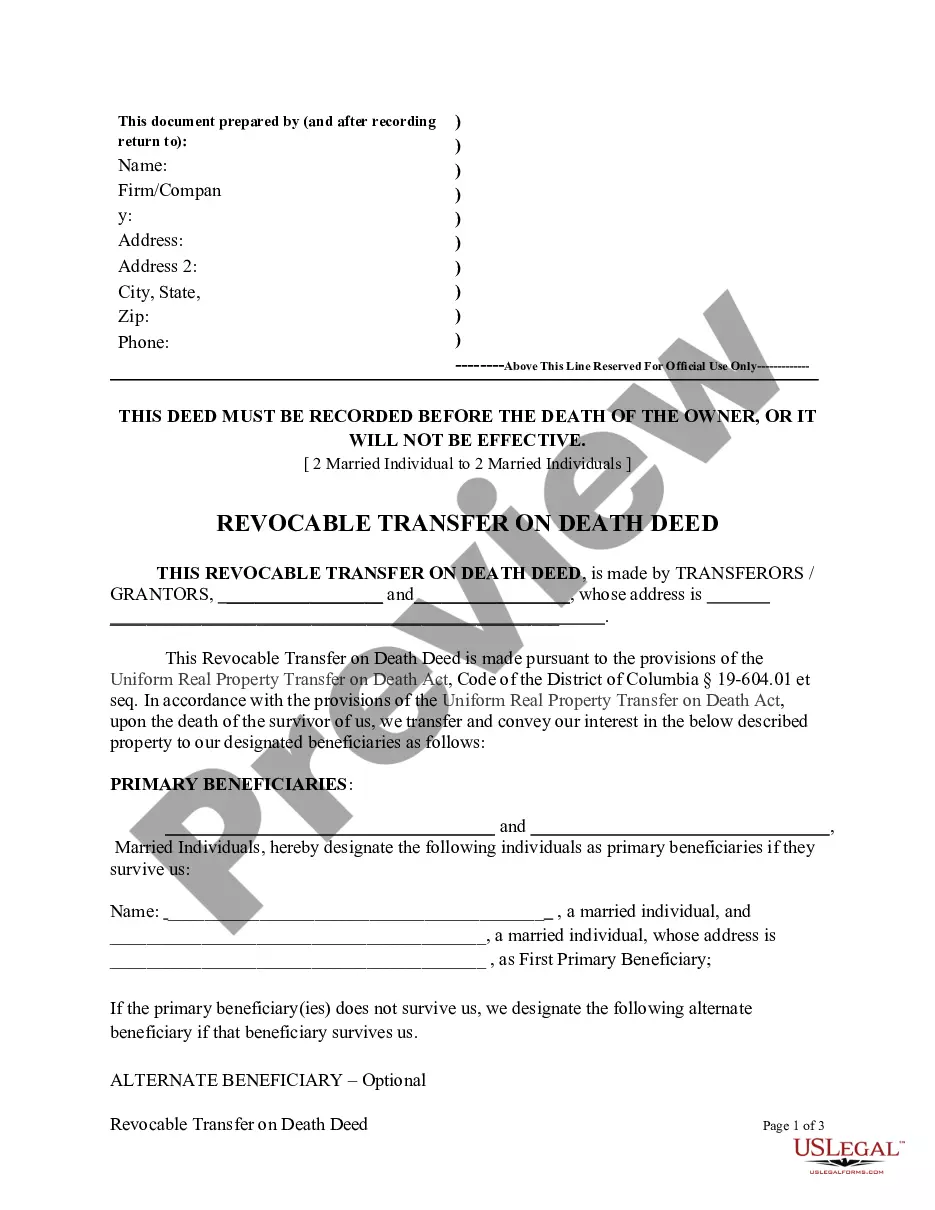
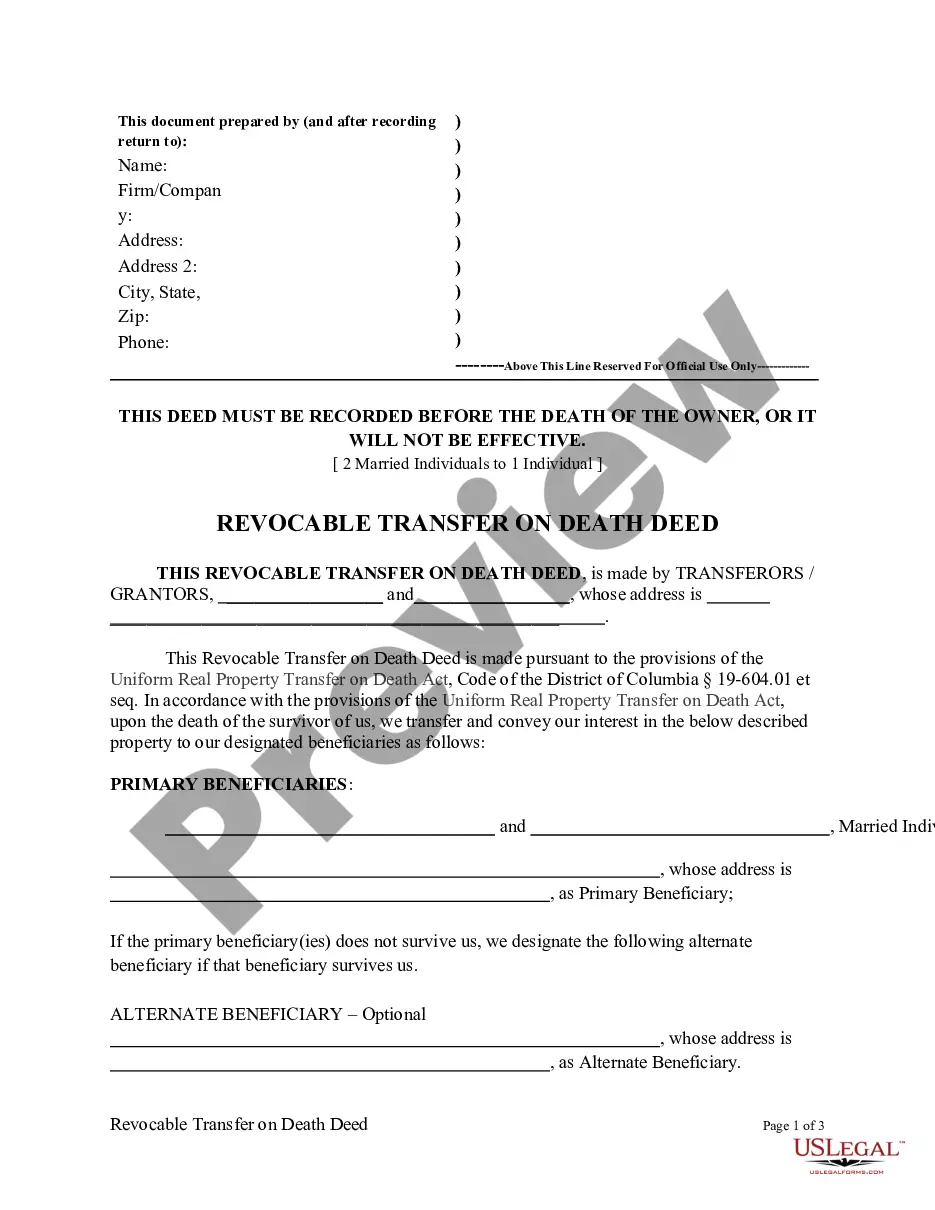
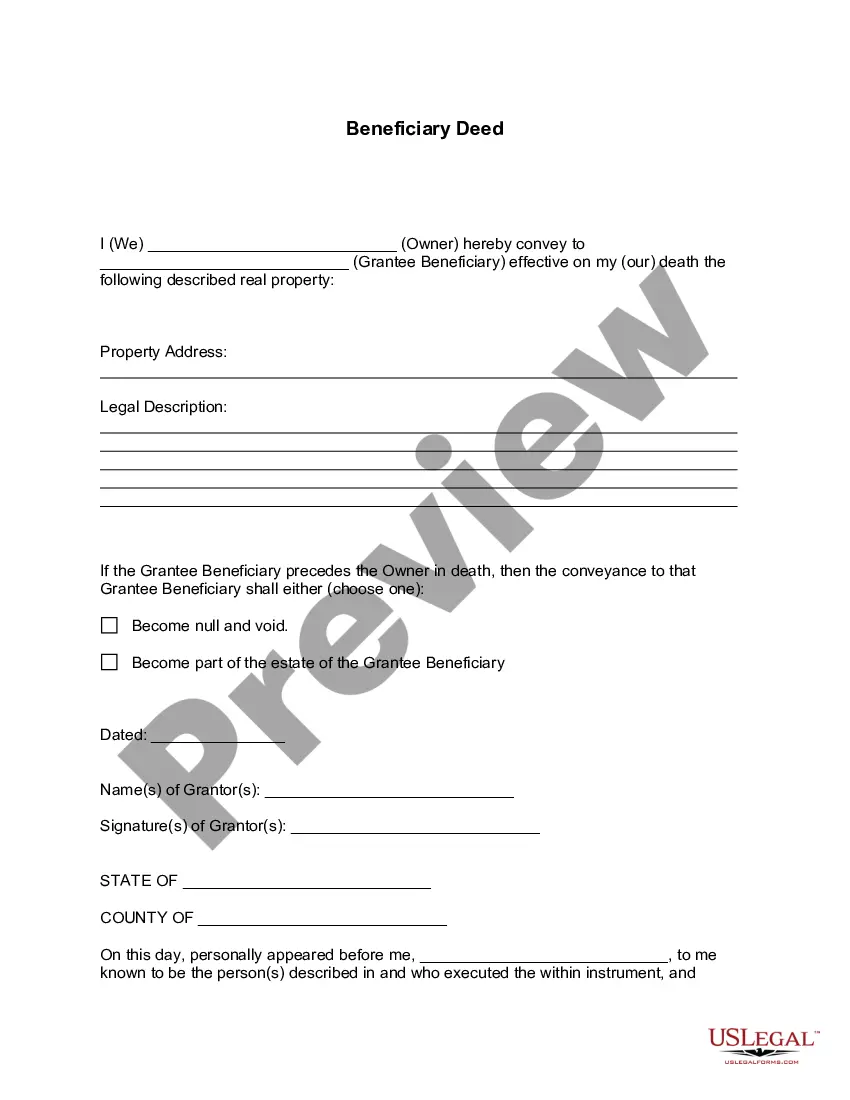
The Transfer on Death Deed (TOD) is a legal document that allows property owners, specifically married couples, to transfer the title of their property to their chosen beneficiaries upon their death. This form ensures that ownership does not change during the owners' lifetime, maintaining their control over the property until they pass away. The TOD is revocable, meaning that the property owners can alter or cancel the deed at any time before their death, making it a flexible option for estate planning.
What’s included in this form
- Transferors/Grantors: Names and addresses of the property owners making the deed.
- Beneficiaries: Designation of primary and optional alternate beneficiaries who will receive the property upon the death of the last surviving owner.
- Property Description: Detailed legal description of the property being transferred.
- Revocation Rights: Statement outlining how the deed can be revoked before the owners' deaths.
- Signatures and Notarization: Required signatures of the transferors and acknowledgment by a notary public to validate the deed.




When this form is needed
This form should be used by married couples who wish to ensure that the property they own together is transferred directly to their chosen beneficiaries following their deaths. It is particularly beneficial in scenarios where couples want to avoid probate, facilitate a smooth transfer of assets, or retain control over property while alive.
Intended users of this form
- Married couples who jointly own real estate and want to designate beneficiaries for their property.
- Individuals looking for a simple method to pass on property without going through probate.
- Those who may want to change beneficiaries later without complex legal processes.
Steps to complete this form
- Identify the parties: Enter the names and addresses of the transferors and beneficiaries.
- Specify the property: Provide a complete legal description of the property to be transferred.
- Fill in the revocation clause: Ensure that the rights to revoke the deed are clearly stated.
- Sign the document: Both transferors must sign the deed in front of a notary public.
- Record the deed: File the completed deed with the appropriate local government office before the death of the grantors.
Notarization requirements for this form
Yes, this form must be notarized to be legally valid. The signatures of the transferors must be acknowledged by a notary public to ensure the authenticity of the document. US Legal Forms provides integrated online notarization services that are available 24/7, allowing you to complete this process securely via video call without needing to travel.
Get your form ready online
Our built-in tools help you complete, sign, share, and store your documents in one place.
Make edits, fill in missing information, and update formatting in US Legal Forms—just like you would in MS Word.
Download a copy, print it, send it by email, or mail it via USPS—whatever works best for your next step.
Sign and collect signatures with our SignNow integration. Send to multiple recipients, set reminders, and more. Go Premium to unlock E-Sign.
If this form requires notarization, complete it online through a secure video call—no need to meet a notary in person or wait for an appointment.
We protect your documents and personal data by following strict security and privacy standards.

Make edits, fill in missing information, and update formatting in US Legal Forms—just like you would in MS Word.

Download a copy, print it, send it by email, or mail it via USPS—whatever works best for your next step.

Sign and collect signatures with our SignNow integration. Send to multiple recipients, set reminders, and more. Go Premium to unlock E-Sign.

If this form requires notarization, complete it online through a secure video call—no need to meet a notary in person or wait for an appointment.

We protect your documents and personal data by following strict security and privacy standards.
Mistakes to watch out for
- Failing to record the deed before the grantors' deaths, which renders it ineffective.
- Not providing a complete legal description of the property, leading to ambiguity in the transfer.
- Overlooking the need for notarization, which can invalidate the deed.
- Not specifying alternate beneficiaries, which can complicate the transfer if primary beneficiaries do not survive.
Main things to remember
- The Transfer on Death Deed allows property owners to transfer real estate to beneficiaries upon their death.
- The deed is flexible and can be revoked or changed during the owners' lifetime.
- It is crucial to record the deed prior to the grantors' death to ensure legal validity.
- Proper notarization is required to prevent legal challenges in the future.
Looking for another form?
Form popularity
FAQ
The choice between a trust and a Transfer on Death deed largely depends on individual circumstances. A trust can provide comprehensive asset management during your life and after death, while the District of Columbia Transfer on Death Deed or TOD - Beneficiary Deed for Husband and Wife to Husband and Wife Beneficiaries directly transfers property upon death. Consult with a legal professional to determine which option best aligns with your estate planning goals.
Several states, including Virginia, Maryland, and California, allow Transfer on Death deeds, alongside Washington, D.C. This feature provides a flexible option for property owners seeking to designate beneficiaries while avoiding probate. If you are looking for guidance on how to navigate this process, the District of Columbia Transfer on Death Deed or TOD - Beneficiary Deed for Husband and Wife to Husband and Wife Beneficiaries can be beneficial.
To avoid probate in Washington, D.C., consider using a Transfer on Death deed. This document allows for the direct transfer of property to beneficiaries without the need for court involvement after death. Furthermore, establishing a revocable living trust can be an effective alternative to ensure that your assets are distributed according to your wishes without going through probate.
While the District of Columbia Transfer on Death Deed or TOD - Beneficiary Deed for Husband and Wife to Husband and Wife Beneficiaries simplifies property transfer, there are potential drawbacks. One concern is that it does not provide asset protection during the property owner's lifetime. Additionally, if the beneficiary predeceases the owner, alternative arrangements must be made to ensure the deed does not fail.
No, you cannot transfer a deed to someone who has already passed away. Once an individual has died, their interests in property are typically handled through probate, unless otherwise specified. If you want to ensure a smooth transition of property to beneficiaries, consider utilizing the District of Columbia Transfer on Death Deed or TOD - Beneficiary Deed for Husband and Wife to Husband and Wife Beneficiaries.
A District of Columbia Transfer on Death Deed or TOD - Beneficiary Deed for Husband and Wife to Husband and Wife Beneficiaries can be a very effective estate planning tool for many individuals. It offers a straightforward method for transferring property without the delays of probate. However, it’s crucial to evaluate your specific circumstances and possibly seek expert advice to determine if it aligns with your long-term estate goals.
A District of Columbia Transfer on Death Deed or TOD - Beneficiary Deed for Husband and Wife to Husband and Wife Beneficiaries does not inherently avoid capital gains tax. However, when the property is passed to beneficiaries, they typically receive a step-up in basis, which can reduce the capital gains tax liability if they sell the property later. It's wise to consult with a tax advisor for personalized guidance.
A notable disadvantage of a District of Columbia Transfer on Death Deed or TOD - Beneficiary Deed for Husband and Wife to Husband and Wife Beneficiaries lies in its limited flexibility. If circumstances change, such as the desire to change beneficiaries or if the property needs to be sold, it may require additional legal steps. It's important to consider these factors carefully before proceeding.
Yes, accounts established under a District of Columbia Transfer on Death Deed or TOD - Beneficiary Deed for Husband and Wife to Husband and Wife Beneficiaries typically avoid probate. This means that upon the death of the account holder, the designated beneficiary can claim the assets directly, allowing for a quicker and more straightforward transfer. This bypass can significantly reduce stress during an already difficult time.
Yes, the District of Columbia does indeed allow for Transfer on Death Deeds or TOD - Beneficiary Deed for Husband and Wife to Husband and Wife Beneficiaries. This efficient method allows property owners to designate beneficiaries who will inherit the property upon the owner's death, bypassing the probate process. This can streamline the transfer, making it easier for loved ones.