District of Columbia 30 Day Notice to Terminate Tenancy at Will for Residential from Tenant to Landlord
Understanding this form
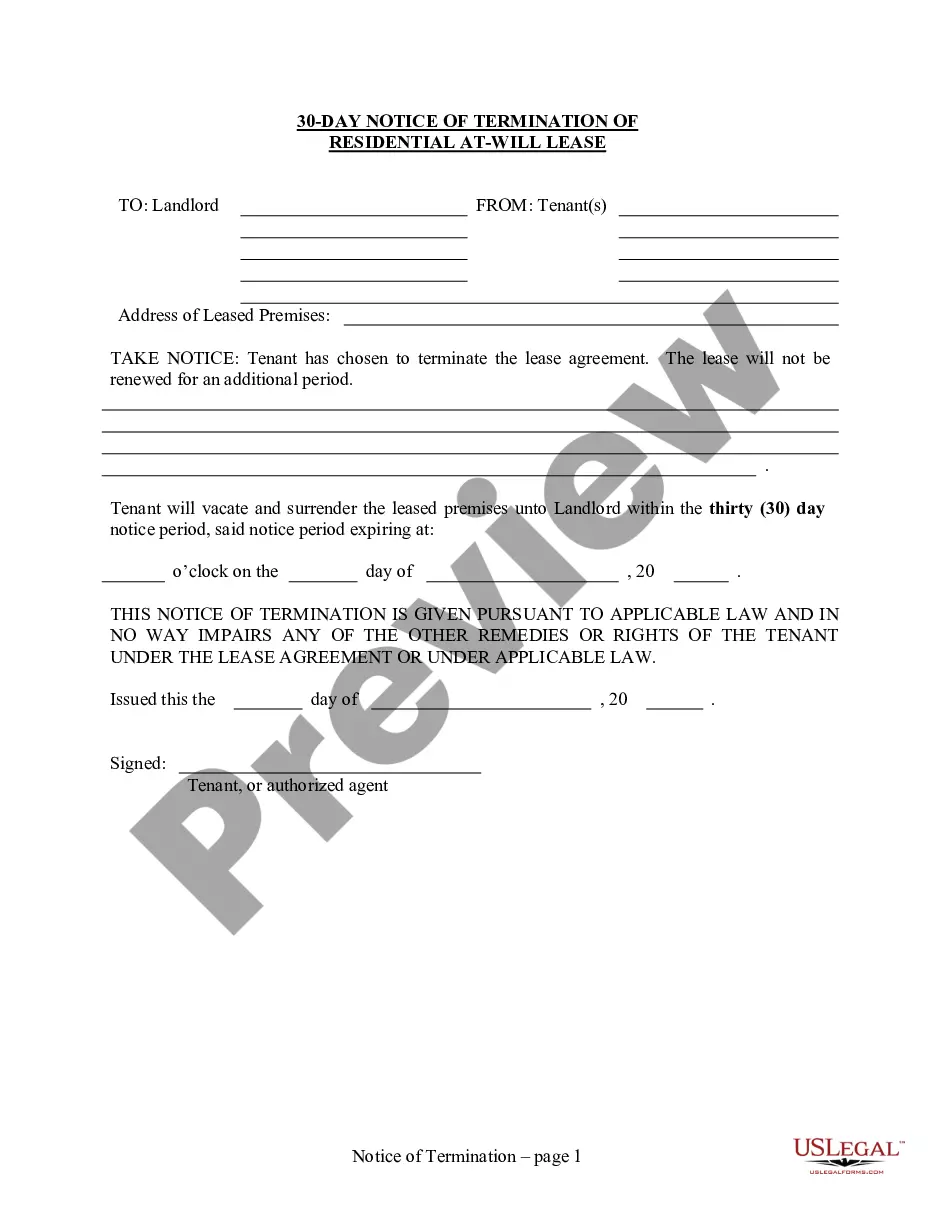
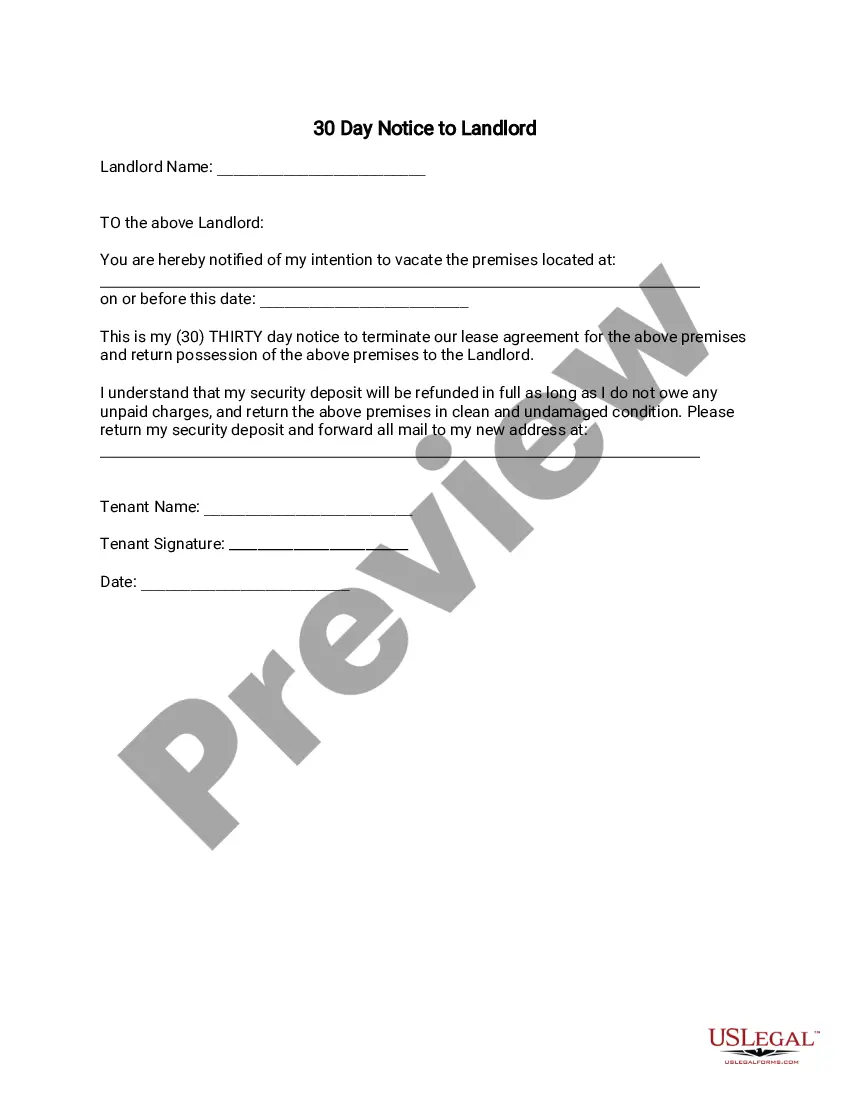
This 30 Day Notice to Terminate Tenancy at Will for Residential from Tenant to Landlord is a legal document used by tenants who wish to end a month-to-month rental agreement. This form is crucial as it formally notifies the landlord of the tenant's intent to vacate the property, ensuring compliance with the legal requirement to provide a minimum of thirty days' notice. Unlike other lease termination forms, this notice specifically addresses tenancy that does not have a fixed term, giving both parties clarity on the termination process.
Main sections of this form
- Identification of parties: Names of the tenant and landlord.
- Leased premises address: Clear details of the rental property being vacated.
- Notice period: Specifically states the thirty-day notice requirement.
- Termination declaration: Formal acknowledgment of intent not to renew the lease.
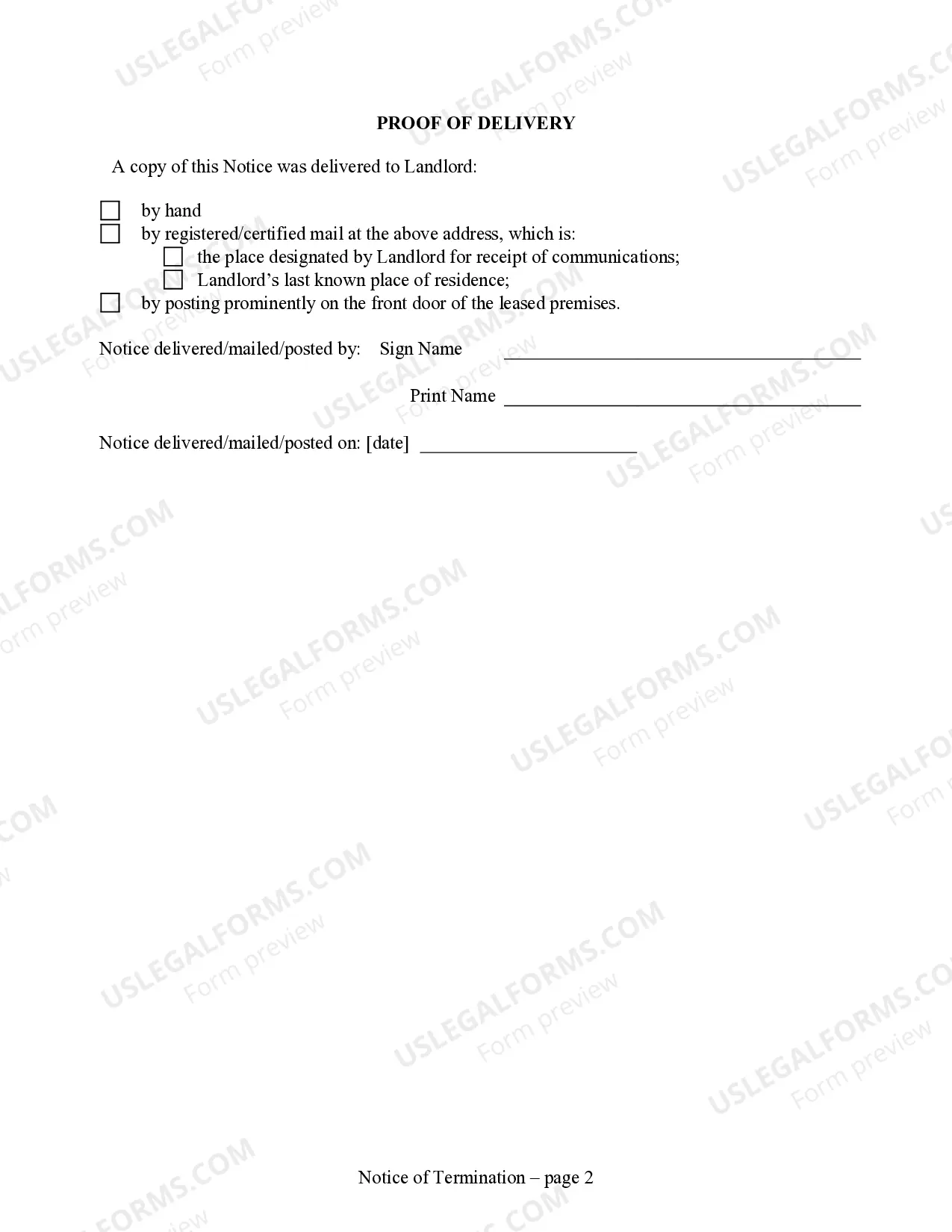
- Proof of delivery: Method used to deliver the notice to the landlord.

When to use this form
This form should be used when a tenant living in a rental property under a tenancy at will arrangement decides to terminate their lease. It is most commonly employed when tenants need to relocate for personal reasons, such as a job change, a family situation, or simply seeking a different living environment. The form is vital for ensuring that the proper notice is given to the landlord, adhering to state laws regarding lease terminations.
Who should use this form
- Tenants in residential properties on a month-to-month basis.
- Individuals wishing to formally communicate their intention to vacate a rental unit.
- Those who need to ensure compliance with specific notice periods as required by law.
How to complete this form
- Identify the parties: Enter the names of the tenant and landlord.
- Specify the property: Provide the complete address of the leased premises.
- Enter the notice date: Clearly state the date on which the notice is being issued.
- Fill in the termination date: Include the date that marks the end of the notice period.
- Sign the form: The tenant or authorized agent should sign and date the form.
- Deliver the notice: Indicate how and when the notice was delivered to the landlord.
Notarization requirements for this form
This form does not typically require notarization unless specified by local law. Tenants should check their state regulations to ensure compliance.
Get your form ready online
Our built-in tools help you complete, sign, share, and store your documents in one place.
Make edits, fill in missing information, and update formatting in US Legal Forms—just like you would in MS Word.
Download a copy, print it, send it by email, or mail it via USPS—whatever works best for your next step.
Sign and collect signatures with our SignNow integration. Send to multiple recipients, set reminders, and more. Go Premium to unlock E-Sign.
If this form requires notarization, complete it online through a secure video call—no need to meet a notary in person or wait for an appointment.
We protect your documents and personal data by following strict security and privacy standards.

Make edits, fill in missing information, and update formatting in US Legal Forms—just like you would in MS Word.

Download a copy, print it, send it by email, or mail it via USPS—whatever works best for your next step.

Sign and collect signatures with our SignNow integration. Send to multiple recipients, set reminders, and more. Go Premium to unlock E-Sign.

If this form requires notarization, complete it online through a secure video call—no need to meet a notary in person or wait for an appointment.

We protect your documents and personal data by following strict security and privacy standards.
Typical mistakes to avoid
- Failing to provide the full thirty days' notice.
- Not properly identifying the leased premises.
- Omitting the signature or date from the notice.
- Not delivering the notice according to legal requirements.
Benefits of completing this form online
- Convenient access from anywhere at any time.
- Easy to fill out and customize for your specific situation.
- Reduces the risk of errors by providing a structured format.
- Legal forms drafted by licensed attorneys ensure compliance with relevant laws.
Summary of main points
- This form is essential for tenants wanting to terminate a tenancy at will legally.
- It must be served at least 30 days prior to the intended move out date.
- Proper delivery of the notice is crucial to ensure legal effectiveness.
Looking for another form?
Form popularity
FAQ
Before selling their property, a DC landlord must provide tenants with notice about the sale and inform them of their rights, including any obligations under the TOPA. This information ensures tenants are aware of their options and can respond appropriately. When facing such situations, understanding the District of Columbia 30 Day Notice to Terminate Tenancy at Will for Residential from Tenant to Landlord can be vital for both landlords and tenants.
If your landlord sells the property, breaking your lease is not automatically permitted unless specified in your lease agreement. Typically, the new owner must honor the existing lease terms. However, it is wise to review your lease and consider sending a District of Columbia 30 Day Notice to Terminate Tenancy at Will for Residential from Tenant to Landlord if you choose to leave.
To handwrite a 30-day notice, start by clearly stating your intent to terminate the tenancy. Include your name, address, the landlord's name, and property address. Be sure to specify the date the notice is served and the date the tenancy will terminate, typically 30 days from the notice date. Using a template can help you format this correctly to comply with the District of Columbia 30 Day Notice to Terminate Tenancy at Will for Residential from Tenant to Landlord.
A tenancy at will may pose several disadvantages, particularly concerning stability and security. Since this type of agreement allows either party to terminate the arrangement with little notice, tenants can face abrupt changes. Additionally, the absence of a formal lease may lead to misunderstandings over rent payments or property conditions. For anyone considering this arrangement, being aware of the District of Columbia 30 Day Notice to Terminate Tenancy at Will for Residential from Tenant to Landlord is essential to navigate potential challenges effectively.
The D.C. code 42 3505.01 A establishes the legal framework for the District of Columbia 30 Day Notice to Terminate Tenancy at Will for Residential from Tenant to Landlord. This law outlines the process that tenants must follow when they wish to terminate their tenancy under specific conditions. Following this code helps ensure proper communication and adherence to legal obligations, protecting both tenants and landlords involved. Understanding this code is vital for tenants aiming to end their residence legally and efficiently.
Yes, an estate at will is the same as a tenancy at will. Both terms describe a rental arrangement without a fixed duration, where either party can terminate the agreement at any time. In the context of the District of Columbia 30 Day Notice to Terminate Tenancy at Will for Residential from Tenant to Landlord, it is essential to provide notice to ensure compliance with local laws. Understanding this concept can enhance tenant rights and make transitions more manageable.
The terms estate and tenancy refer to different aspects of the rental relationship. An estate generally pertains to the interest in property, while tenancy focuses on the rights of the tenant under a rental agreement. Understanding this distinction can help clarify the implications of the District of Columbia 30 Day Notice to Terminate Tenancy at Will for Residential from Tenant to Landlord, ensuring that both parties adhere to their legal obligations.
Tenancy at will is also called a lease at will. This agreement allows for more flexibility in the rental relationship, where either party can end the rental with proper notice, such as the District of Columbia 30 Day Notice to Terminate Tenancy at Will for Residential from Tenant to Landlord. However, it’s important to maintain clear communication to ensure a smooth process.
Another name for an estate at will is a tenancy without a fixed term. In this arrangement, the landlord and tenant agree that the tenant may remain at the property for an indefinite period, subject to termination through a proper notice like the District of Columbia 30 Day Notice to Terminate Tenancy at Will for Residential from Tenant to Landlord. This is often utilized when no formal lease exists.
An estate at will is often referred to as a tenancy at will. This arrangement allows either the tenant or landlord to terminate the tenancy at any time, given proper notice, such as the District of Columbia 30 Day Notice to Terminate Tenancy at Will for Residential from Tenant to Landlord. This flexibility can be beneficial in various living situations, but it’s crucial to understand your rights and responsibilities in this type of agreement.