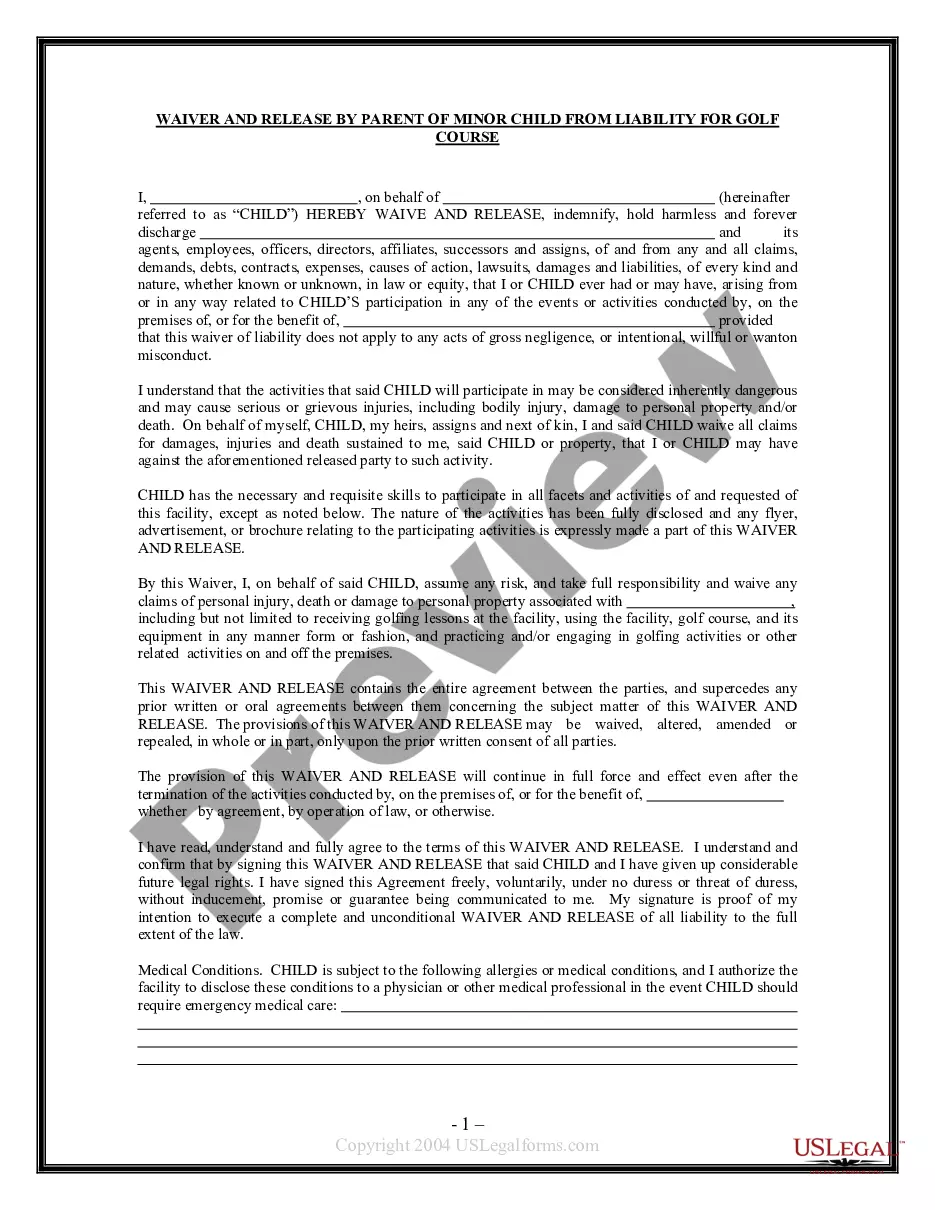
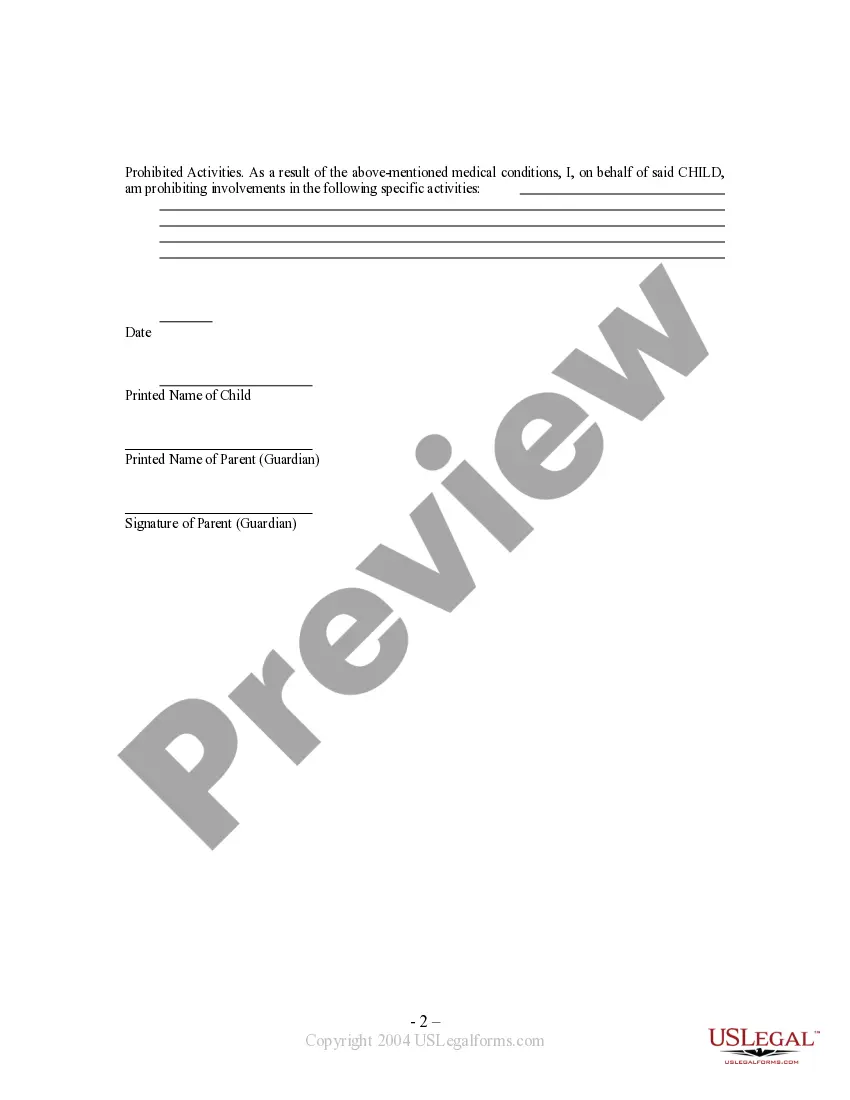
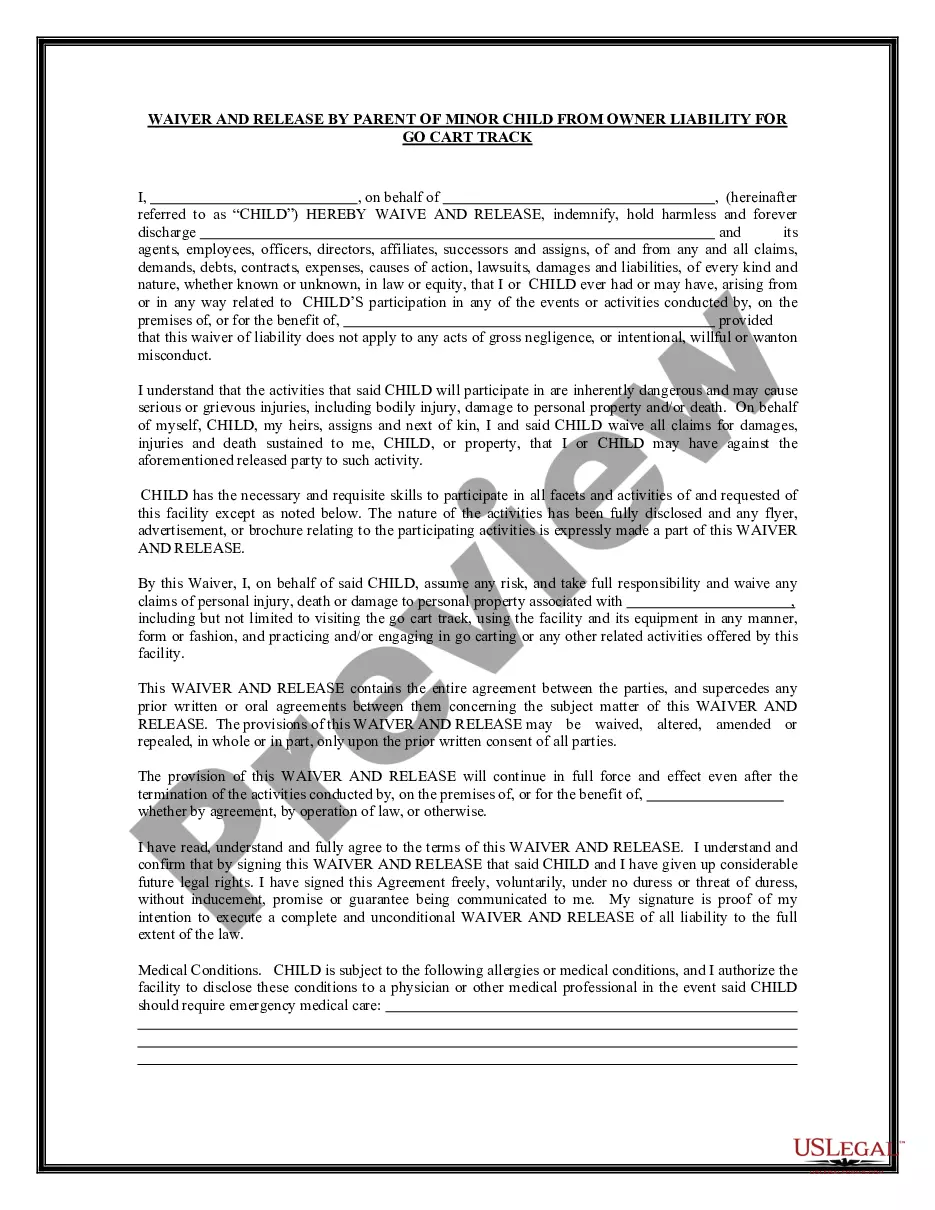
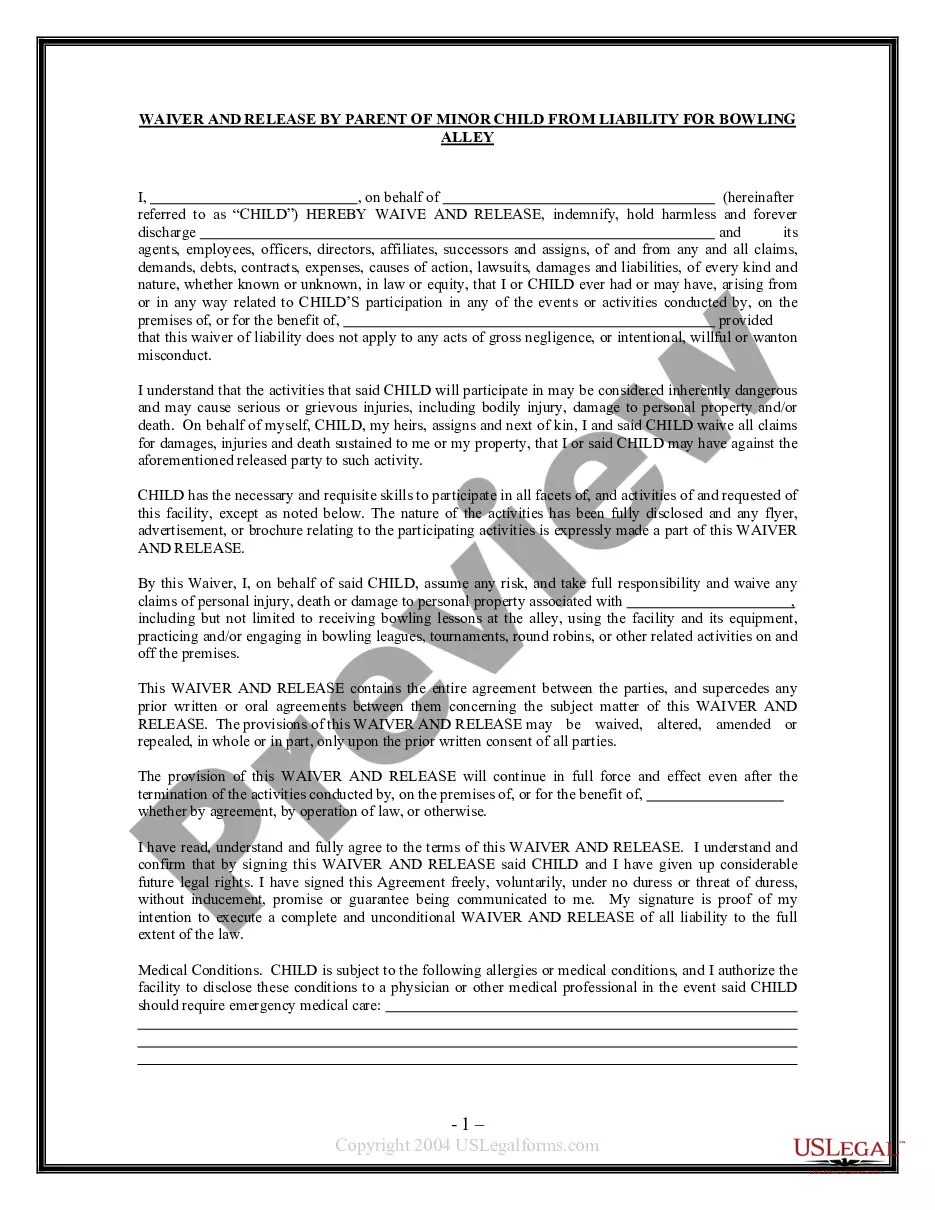
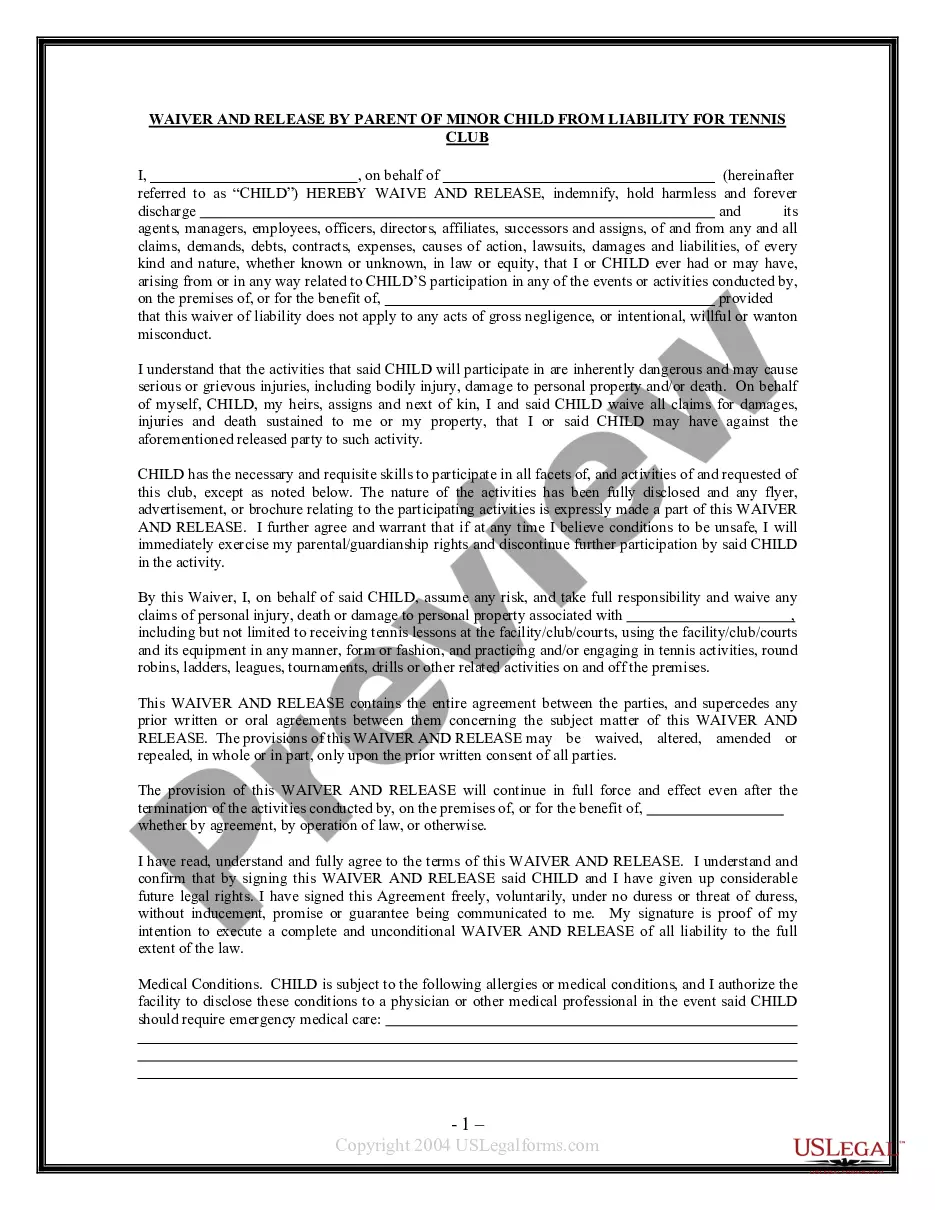
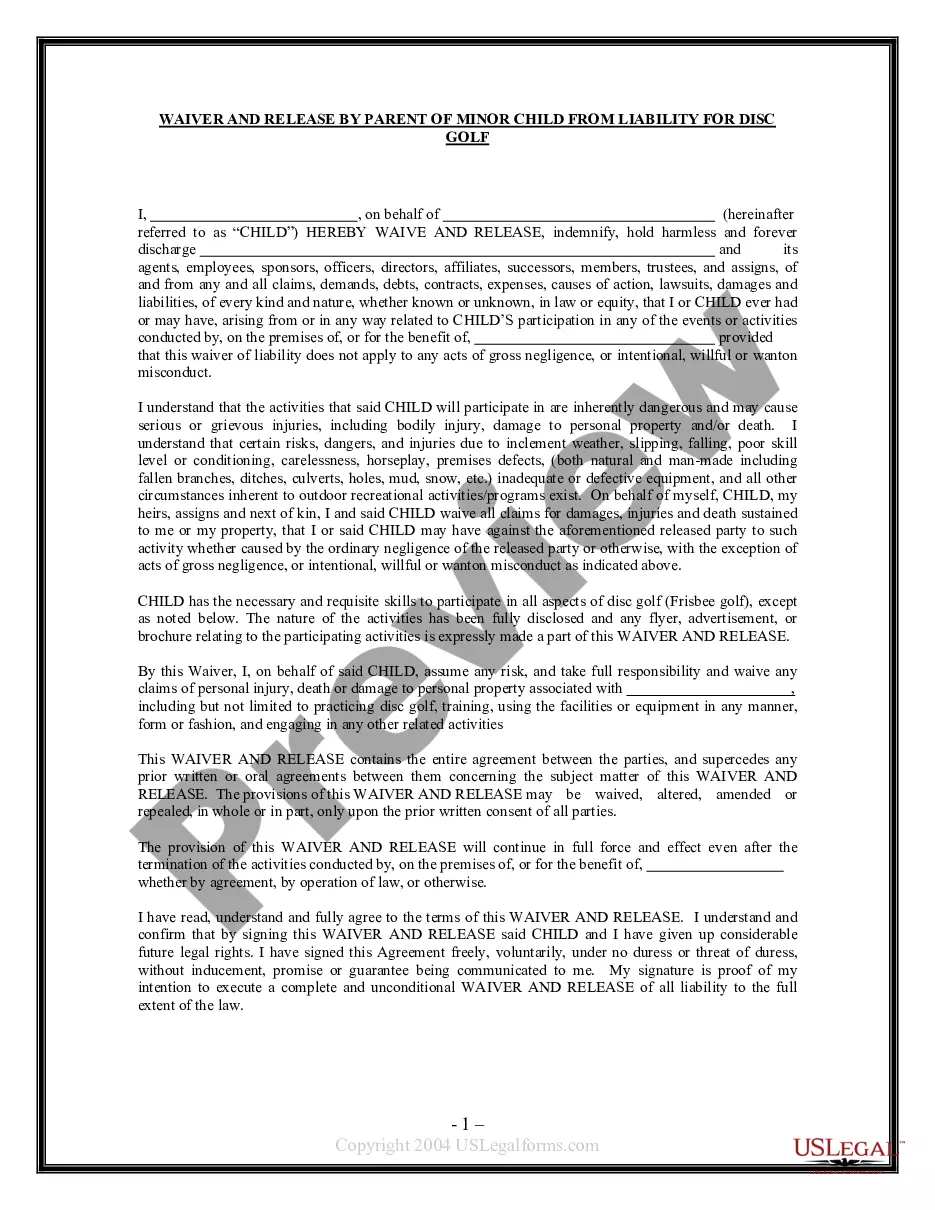
This form allows a parent or guardian to release a golf course facility from liability for injuries which may be incurred by a minor child while on the premises, taking part in activities, etc.
Connecticut Waiver and Release From Liability For Minor Child for Golf Course
Category:
State:
Multi-State
Control #:
US-WAV-07M
Format:
Word;
Rich Text
Instant download
Description
Free preview
How to fill out Waiver And Release From Liability For Minor Child For Golf Course?
US Legal Forms - one of the largest collections of legal documents in the United States - provides a vast array of legal document templates that you can download or print. By using the website, you can find numerous forms for business and personal use, categorized by types, states, or keywords. You can access the latest versions of forms such as the Connecticut Waiver and Release From Liability For Minor Child for Golf Course within minutes.
If you already have a subscription, Log In and download the Connecticut Waiver and Release From Liability For Minor Child for Golf Course from the US Legal Forms library. The Download button will appear on each form you view. You can access all previously acquired forms in the My documents section of your account.
If you are using US Legal Forms for the first time, here are some simple tips to help you get started: Ensure you have selected the correct form for your city/region. Click on the Review button to examine the form's details. Read the form description to confirm that you have chosen the right form. If the form does not meet your requirements, utilize the Search box at the top of the screen to find one that does. If you are satisfied with the form, confirm your selection by clicking on the Acquire now button. Then, choose the pricing plan you prefer and provide your information to register for an account.
- Process the payment. Use your Visa or Mastercard or PayPal account to complete the transaction.
- Select the format and download the form to your device.
- Make edits. Complete, modify, print, and sign the downloaded Connecticut Waiver and Release From Liability For Minor Child for Golf Course.
- Every template you add to your account has no expiration date and belongs to you permanently. Therefore, if you wish to download or print an additional copy, simply visit the My documents section and click on the form you need.
- Access the Connecticut Waiver and Release From Liability For Minor Child for Golf Course with US Legal Forms, the most extensive collection of legal document templates.
- Utilize a multitude of professional and state-specific templates that fulfill your business or personal requirements and needs.
Form popularity
FAQ
Connecticut is not considered a strict liability state in most cases, meaning that liability often requires proof of negligence. However, in certain situations, such as product liability, strict liability may apply. When it comes to the Connecticut Waiver and Release From Liability For Minor Child for Golf Course, understanding the liability landscape is crucial for both participants and golf course operators. Engaging with uslegalforms can provide insights into these legal distinctions.
Generally, waivers signed by minors may not be legally binding because minors lack the legal capacity to enter into contracts. In Connecticut, a waiver for a minor, such as the Connecticut Waiver and Release From Liability For Minor Child for Golf Course, typically requires a parent or guardian's signature for it to be enforceable. This ensures that the adult understands the risks involved and agrees to them on behalf of the minor. Utilizing uslegalforms can assist in drafting compliant waivers.
While waivers can limit the ability to sue, they do not completely eliminate it. A signed Connecticut Waiver and Release From Liability For Minor Child for Golf Course may prevent claims based on ordinary negligence, but it does not protect against gross negligence or willful misconduct. Understanding the nuances of waivers is essential to know your rights, and platforms like uslegalforms can help clarify these distinctions.
Liability waivers can be legally binding if they fulfill specific requirements set by state law. In Connecticut, for a waiver to hold up in court, it must clearly outline the risks involved and be signed voluntarily by the participant or their guardian. When creating a Connecticut Waiver and Release From Liability For Minor Child for Golf Course, it is essential to follow proper formatting and legal language to ensure its enforceability. Consulting resources like uslegalforms can provide valuable guidance.
A waiver may become unenforceable if it lacks clarity or fails to adequately inform the signer of its implications. Additionally, if the waiver is deemed to be overly broad or if it attempts to waive liability for gross negligence, a court may invalidate it. In the context of the Connecticut Waiver and Release From Liability For Minor Child for Golf Course, it is vital that the language used is precise and understandable. Using platforms like uslegalforms can help ensure that waivers meet legal standards.
In Connecticut, liability laws require individuals and organizations to take reasonable care to prevent harm to others. Specifically, the legal framework surrounding the Connecticut Waiver and Release From Liability For Minor Child for Golf Course emphasizes the importance of informed consent. This means that golf courses must clearly communicate the risks involved to participants, especially minors. By doing so, they can protect themselves from potential lawsuits.
To write a liability waiver form, begin with a clear title identifying the document's purpose. Include sections that outline the parties involved, a description of the activities, and a clear statement of the risks. It is also essential to have a section for the signature of the parent or guardian. Using resources such as USLegalForms can simplify this process and help you create an effective Connecticut Waiver and Release From Liability For Minor Child for Golf Course.
You can write your own liability waiver, but it is crucial to ensure that it includes all necessary elements to be legally binding. Be specific about the activities covered and the risks associated with them. Additionally, using a template from a trusted source like USLegalForms can provide you with a solid foundation for your Connecticut Waiver and Release From Liability For Minor Child for Golf Course.
Yes, liability waivers can be enforceable in Connecticut, provided they meet certain legal standards. The waiver must be clear and unambiguous, informing participants of the risks involved. Moreover, it should be signed by the parent or guardian on behalf of a minor. For the Connecticut Waiver and Release From Liability For Minor Child for Golf Course, using a well-drafted waiver can help ensure its enforceability.
To write a release of liability waiver, start by clearly stating the purpose of the document. Include the names of the parties involved, specifically the parent or guardian and the golf course. Next, outline the risks associated with participating in golf activities. Finally, ensure that the waiver is signed and dated by the parent or guardian to make it effective, particularly for the Connecticut Waiver and Release From Liability For Minor Child for Golf Course.