Connecticut New Resident Guide
Understanding this form
The New Resident Guide is an informational document designed to assist individuals moving to a new state. It outlines the essential requirements related to residency, such as voter registration, identification cards, driver's licenses, and vehicle registration. This guide differs from standard residency forms by providing comprehensive details specific to various state laws, making it an invaluable resource for newcomers navigating their new legal obligations.
What’s included in this form
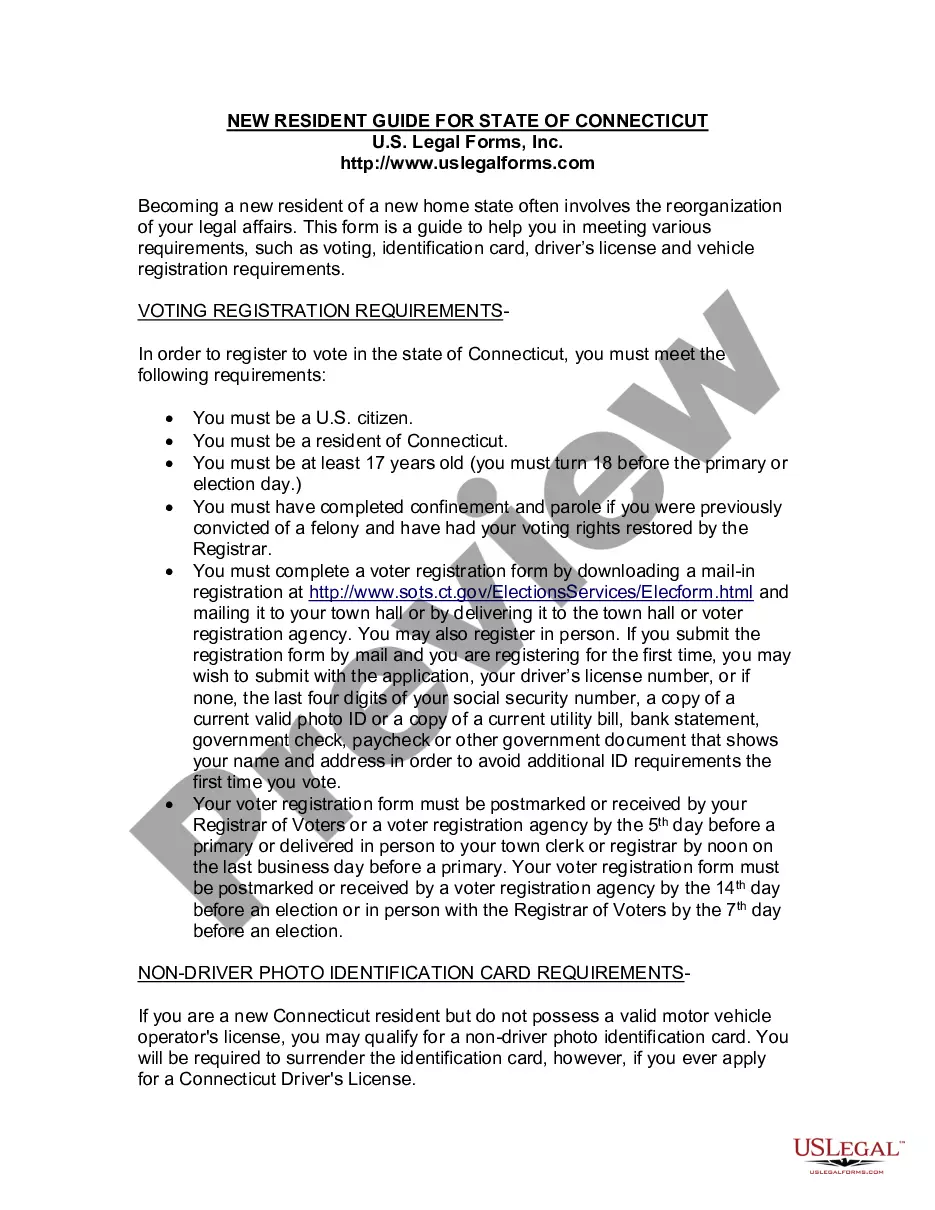
- Voter registration requirements including eligibility criteria and application process.
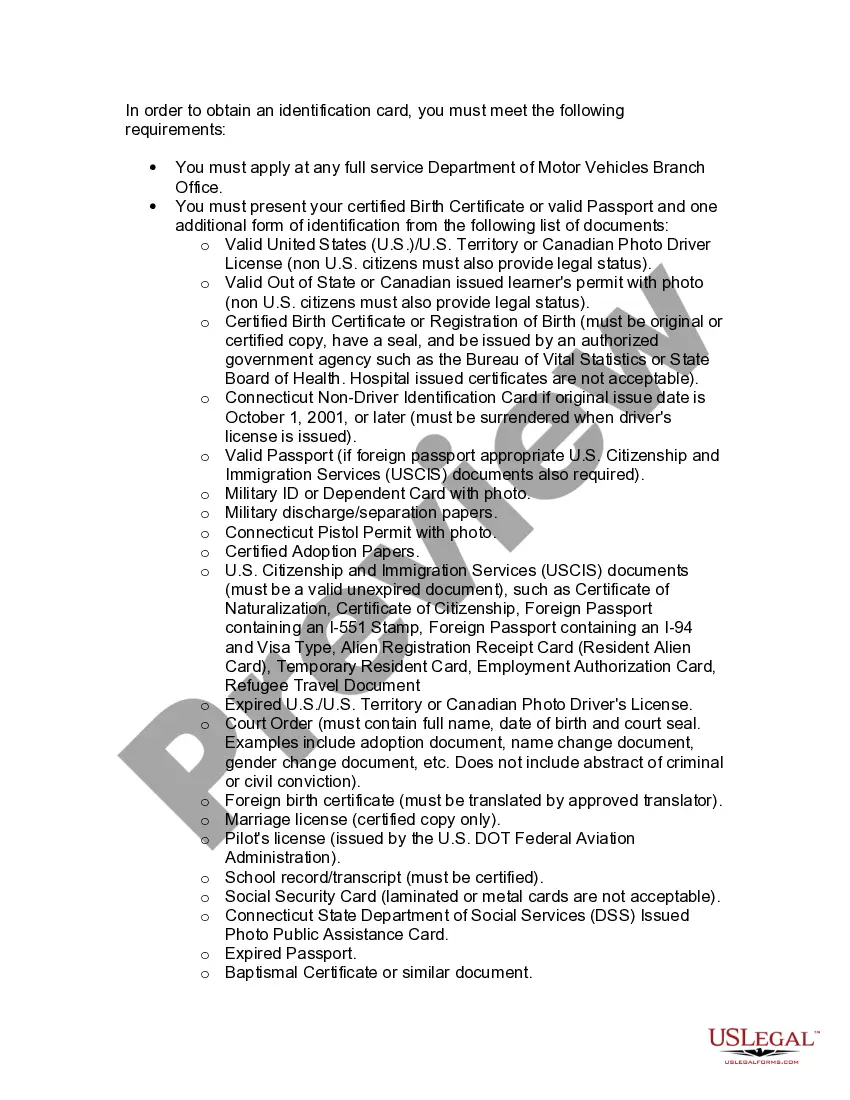
- Non-driver photo identification card requirements for residents without a driver's license.
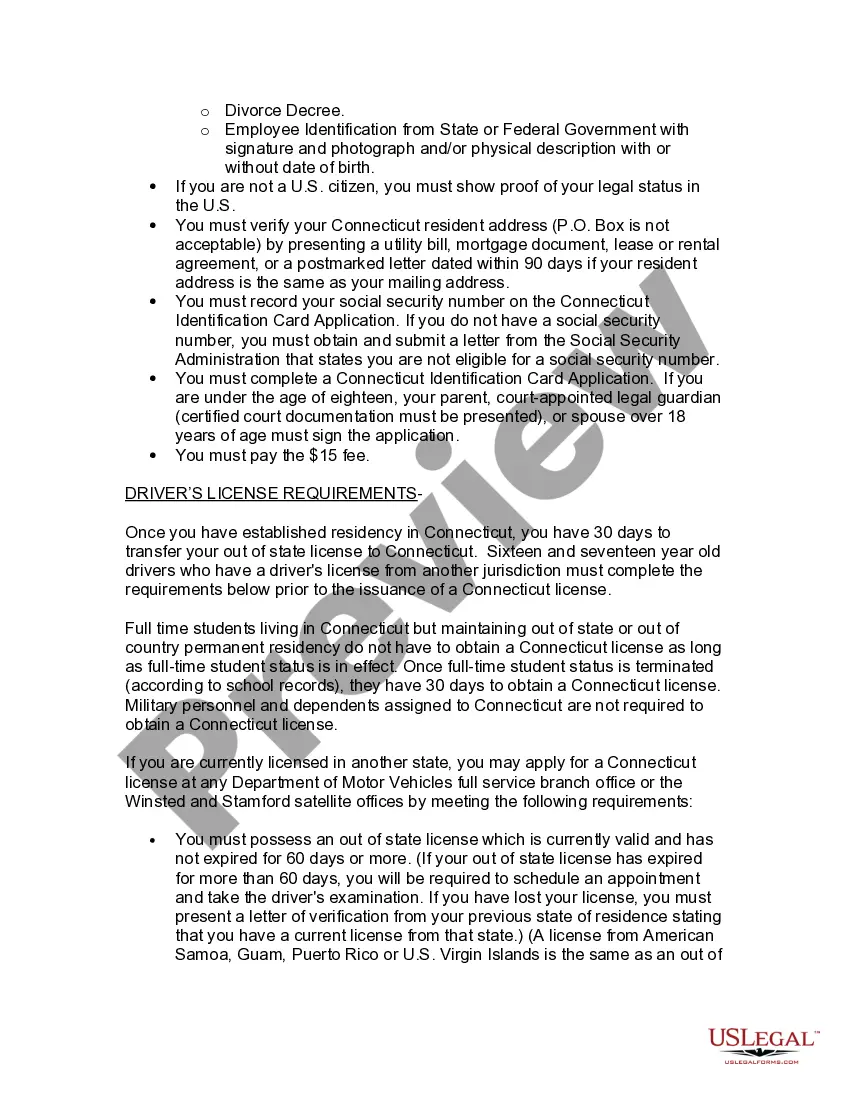
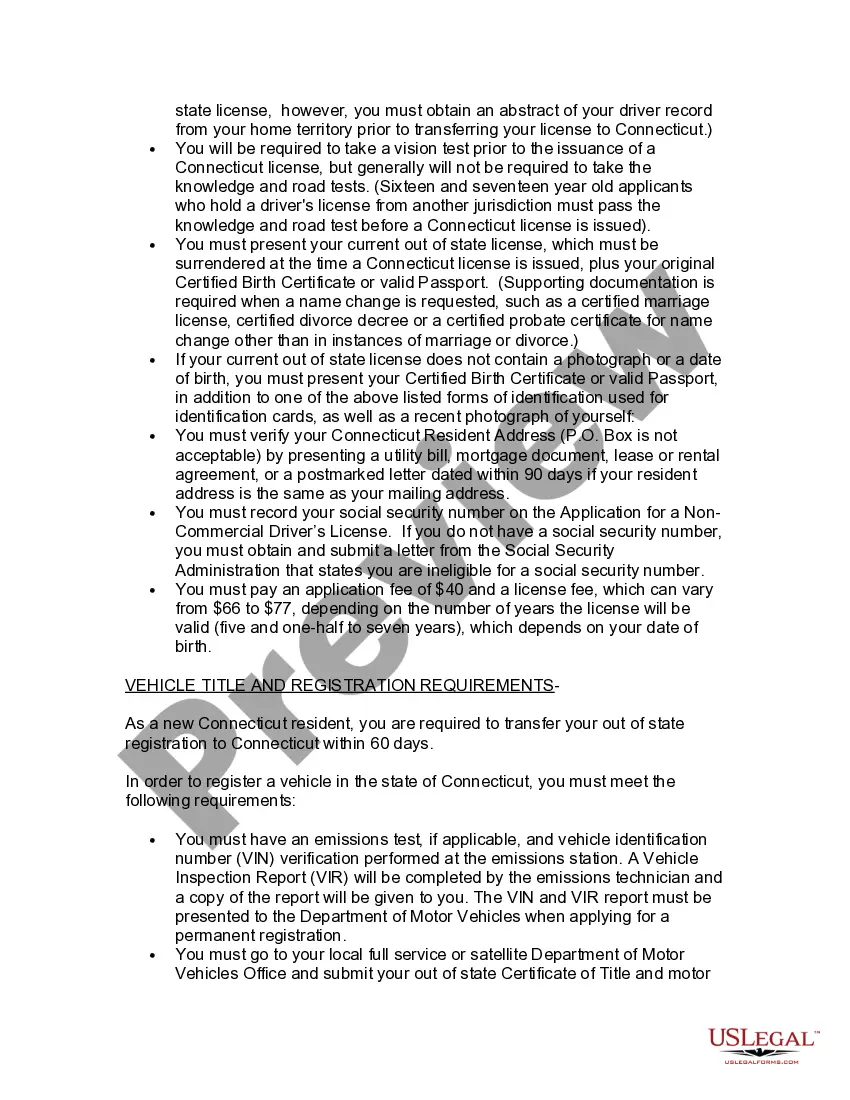
- Driver's license application process and requirements for new residents.
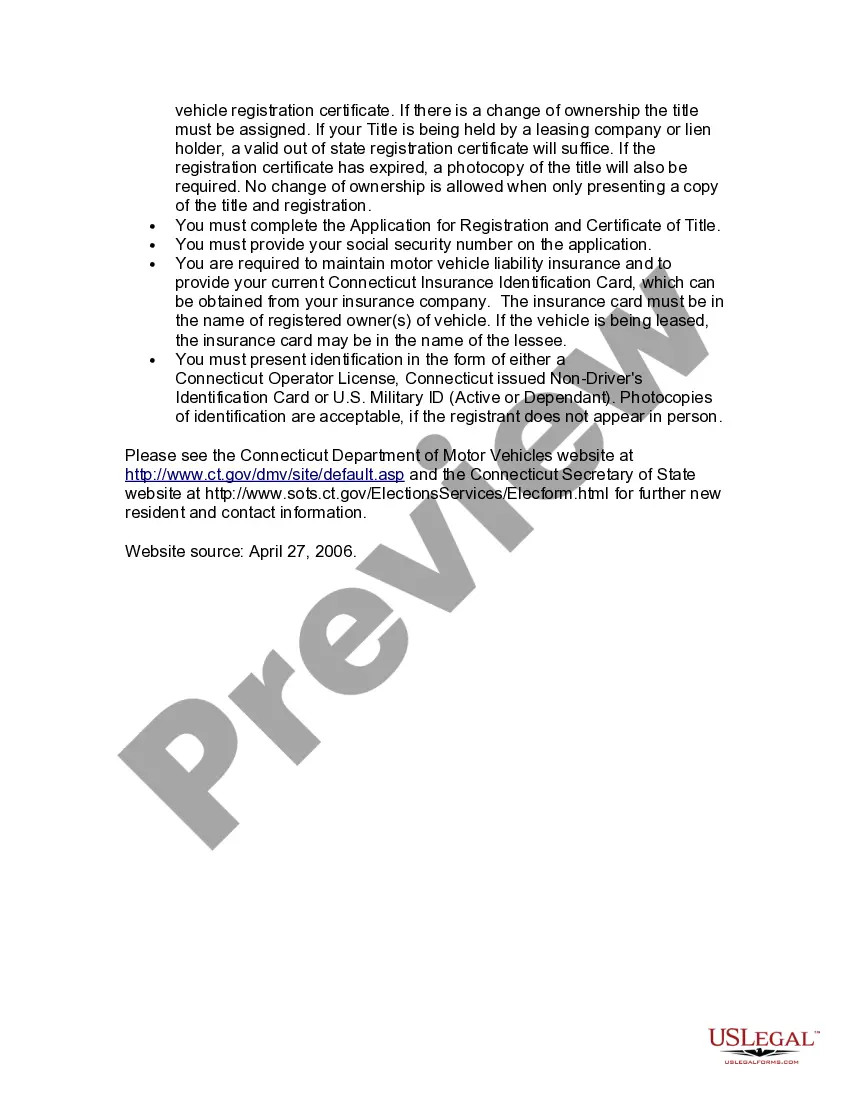
- Vehicle title and registration guidelines for transferring out-of-state vehicles.
- Links to relevant state agencies for additional information and resources.
When to use this form
This form is essential for individuals who have recently relocated to a new state and need to understand their responsibilities regarding voting, identification, and vehicle registration. It is useful when you are establishing residency, changing your driver's license, or ensuring compliance with state-specific regulations.
Intended users of this form
- New residents relocating to a different state.
- Individuals registering to vote for the first time in their new state.
- People who need to apply for a state-issued identification card.
- Drivers transferring their vehicle registration and title to a new state.
How to complete this form
- Review the voter registration requirements and check your eligibility based on citizenship and residency status.
- Gather necessary documentation for obtaining a non-driver identification card or driver's license, including proof of residency and identification.
- Complete the appropriate application forms for voter registration, identification cards, and driver's licenses as required by Connecticut law.
- Submit your applications by the deadlines provided, ensuring you include any necessary supporting documents.
- For vehicle registration, ensure you have your out-of-state title, proof of insurance, and complete the Application for Registration and Certificate of Title.
Does this form need to be notarized?
This form does not typically require notarization unless specified by local law. Ensure to check for any specific notarization requirements based on the type of application you are submitting.
Get your form ready online
Our built-in tools help you complete, sign, share, and store your documents in one place.
Make edits, fill in missing information, and update formatting in US Legal Forms—just like you would in MS Word.
Download a copy, print it, send it by email, or mail it via USPS—whatever works best for your next step.
Sign and collect signatures with our SignNow integration. Send to multiple recipients, set reminders, and more. Go Premium to unlock E-Sign.
If this form requires notarization, complete it online through a secure video call—no need to meet a notary in person or wait for an appointment.
We protect your documents and personal data by following strict security and privacy standards.

Make edits, fill in missing information, and update formatting in US Legal Forms—just like you would in MS Word.

Download a copy, print it, send it by email, or mail it via USPS—whatever works best for your next step.

Sign and collect signatures with our SignNow integration. Send to multiple recipients, set reminders, and more. Go Premium to unlock E-Sign.

If this form requires notarization, complete it online through a secure video call—no need to meet a notary in person or wait for an appointment.

We protect your documents and personal data by following strict security and privacy standards.
Mistakes to watch out for
- Missing deadlines for voter registration can lead to ineligibility to vote.
- Not providing the correct identification documentation when applying for a driver's license or identification card.
- Failing to transfer vehicle registration within the allotted time frame after moving.
- Overlooking the specific residency verification documents required by the state.
Why complete this form online
- Convenient access to up-to-date information tailored to your new state's requirements.
- The ability to download and fill out forms at your own pace.
- Reliable resources consolidated in one guide to aid with your legal transitions as a new resident.
Legal use & context
This guide serves as a reliable resource for new residents to understand and comply with state laws regarding voter registration, identification, and vehicle registration. Following the guidelines ensures that all legal requirements are met, providing peace of mind during your transition.
Summary of main points
- The New Resident Guide provides essential information on local residency requirements.
- Understanding voter registration and vehicle transfer rules is crucial for compliance.
- Gather all necessary documentation before starting your applications to avoid delays.
- Check for specific state requirements as they can vary significantly.
Looking for another form?

Form popularity
FAQ
Establishing residency in Connecticut involves several key factors, such as living in the state for most of the year, taking steps to integrate into the community, and changing your legal and financial documentation to reflect your Connecticut address. This can include registering to vote, obtaining a driver's license, and filing state taxes. For in-depth details, consult the Connecticut New Resident Guide.
Yes, you can hold a life producer license in multiple states, provided you comply with each state's licensing requirements. Be aware that some states may have specific regulations regarding nonresident licenses. It is essential to stay informed of these requirements to maintain your licenses. For a comprehensive understanding, refer to the Connecticut New Resident Guide.
To establish residency in Connecticut, you must demonstrate your intent to make the state your permanent home. This can be shown through actions like obtaining a Connecticut driver's license, registering to vote, and securing employment or housing in the state. Additionally, you should spend a considerable amount of time in Connecticut each year. The Connecticut New Resident Guide outlines these criteria clearly.
If you are a nonresident producer relocating from one state to another, you must notify the relevant insurance department of your new address. Depending on the states involved, you may need to update your licensing information accordingly. Keeping your information current ensures compliance and avoids potential issues. The Connecticut New Resident Guide supports producers in navigating these regulations.
As previously mentioned, a nonresident producer moving to Connecticut must apply for the appropriate license. This includes submitting an application with the necessary fees and documentation. Furthermore, make sure to comply with the state’s continuing education requirements to maintain good standing. For a complete overview, the Connecticut New Resident Guide is your go-to resource.
Yes, you can easily file Connecticut state taxes online. The Connecticut Department of Revenue Services offers an online platform for filing tax returns, making the process efficient and user-friendly. By using electronic filing, you can ensure timely submissions and receive confirmations. The Connecticut New Resident Guide provides information on how to access and utilize these online services.
If you are a nonresident producer moving to Connecticut, it is essential to apply for a Connecticut nonresident producer license. You must submit a completed application along with any required fees and documentation. Additionally, ensure that you have met the continuing education requirements for your license. The Connecticut New Resident Guide helps you navigate these steps effectively.
In Connecticut, proof of residency can include various documents that show your name and address, such as government mail, tax documents, or a rental agreement. Utility bills dated within the last 60 days also serve as valid evidence of your residency. Gathering these documents will assist you in fulfilling state requirements and integrating into your new community, as outlined in the Connecticut New Resident Guide.
New drivers in Connecticut must adhere to specific rules, including obtaining a learner's permit before qualifying for a driver's license. You need to complete a state-approved driver's education course and log a minimum number of practice hours. Following these steps ensures you meet state requirements and drive safely as you transition into Connecticut life. For thorough guidance, check the Connecticut New Resident Guide.
Proving your residency status in Connecticut requires a combination of documents and your presence in the state. You may use government-issued identification, tax returns, and documents that reflect your address. This information verifies that you have settled in Connecticut and supports your claims of residency effectively, as detailed in the Connecticut New Resident Guide.