Connecticut Motion for Particulars
Overview of this form
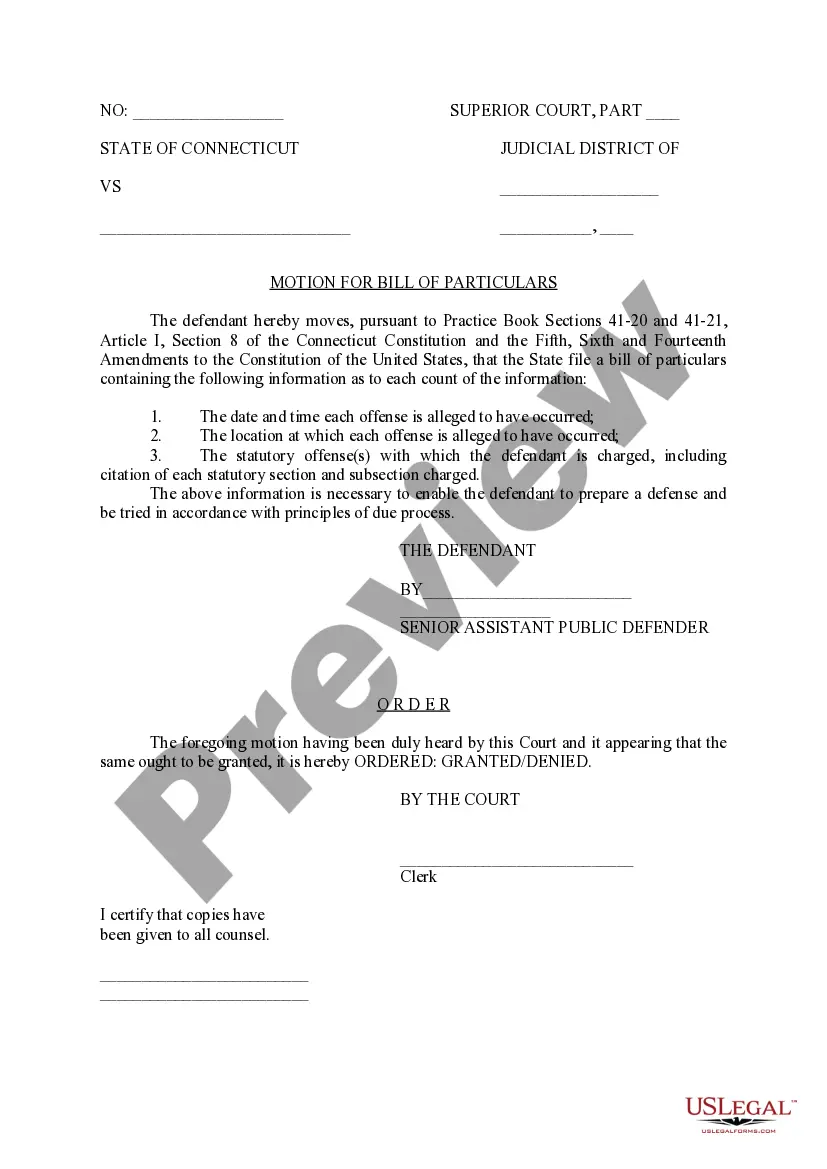
A Motion for Particulars is a legal document utilized in civil and criminal actions. This motion, filed by the plaintiff or prosecutor, requests detailed information from the defendant regarding the claims or charges against them. By seeking clarification on the specific elements of the charges, this form helps ensure that the defendant can adequately prepare a defense. Unlike other legal forms that may request general information, the Motion for Particulars is specifically designed to elicit precise details essential for the defendant's understanding of their case.
Key components of this form
- The case number and court details for identification.
- The date and time of each alleged offense.
- The location where each offense purportedly took place.
- The specific statutory offenses charged against the defendant.
- A declaration regarding the necessity of the requested information for a fair defense.
When to use this form
This form should be used when a defendant in a civil or criminal case seeks more detailed information about the charges filed against them. It is particularly relevant when the claims are vague or when the defendant believes they need additional details to mount a proper defense. Situations may include before a trial, during pre-trial motions, or whenever the defendant is uncertain about the specifics of the allegations made.
Who can use this document
- Defendants in criminal cases seeking clarity on charges against them.
- Individuals involved in civil litigation who feel the complaint lacks sufficient detail.
- Legal representatives, such as public defenders, advocating for a thorough understanding of the case.
Steps to complete this form
- Enter the case number and court information at the top of the form.
- Provide the name of the defendant and the specific charges if known.
- List the dates and times for each alleged offense, ensuring accuracy.
- Specify the locations where each offense is said to have occurred.
- Cite the statutory offenses by including the relevant sections and subsections.
- Include a signature and title of the person filing the motion, typically a lawyer or legal representative.
Does this document require notarization?
This form does not typically require notarization unless specified by local law. It is advisable to check Connecticut's specific regulations regarding notarization to ensure compliance.
Get your form ready online
Our built-in tools help you complete, sign, share, and store your documents in one place.
Make edits, fill in missing information, and update formatting in US Legal Forms—just like you would in MS Word.
Download a copy, print it, send it by email, or mail it via USPS—whatever works best for your next step.
Sign and collect signatures with our SignNow integration. Send to multiple recipients, set reminders, and more. Go Premium to unlock E-Sign.
If this form requires notarization, complete it online through a secure video call—no need to meet a notary in person or wait for an appointment.
We protect your documents and personal data by following strict security and privacy standards.

Make edits, fill in missing information, and update formatting in US Legal Forms—just like you would in MS Word.

Download a copy, print it, send it by email, or mail it via USPS—whatever works best for your next step.

Sign and collect signatures with our SignNow integration. Send to multiple recipients, set reminders, and more. Go Premium to unlock E-Sign.

If this form requires notarization, complete it online through a secure video call—no need to meet a notary in person or wait for an appointment.

We protect your documents and personal data by following strict security and privacy standards.
Common mistakes
- Failing to include accurate dates or times for alleged offenses.
- Not citing the correct statutory provisions related to the charges.
- Omitting to sign the document or provide the necessary titles.
- Submitting the motion without proper jurisdictional formatting.
Benefits of completing this form online
- Convenience of downloading and completing the form at your own pace.
- Editability allows for adjustments as needed before final submission.
- Reliable templates that comply with legal standards and requirements.
Key takeaways
- The Motion for Particulars provides critical details for defendants regarding charges against them.
- It is essential for ensuring a fair defense and due process rights.
- Properly completing this form is crucial to avoid common mistakes and delays in legal proceedings.
Looking for another form?



Form popularity
FAQ
A motion for clarification is a formal request to a court seeking a more detailed explanation of a prior ruling. This is vital when the terms of a ruling are ambiguous or when parties are unclear about their obligations. Filing this motion can prevent future disputes and ensure everyone is on the same page. If you require help with this process, consider resources like uslegalforms to assist in preparing your Connecticut motion for particulars.
To file pro se in Connecticut, you must prepare and submit your legal documents on your own behalf without an attorney. Familiarize yourself with the local court rules, complete the necessary forms accurately, and file them with the appropriate court clerk. The process can be daunting, so utilizing online platforms that offer legal form assistance can be a great help. A Connecticut motion for particulars might be one of the forms you need to complete.
A Motion for clarification in Connecticut serves to request further detail or an explanation from the court regarding its previous orders or judgments. This motion is important for ensuring that everyone involved in a case understands the terms and implications of a court decision fully. Understanding how to file this motion can ease potential conflicts or confusion. Resources like uslegalforms can help craft a well-rounded Connecticut motion for particulars.
Order clarification refers to a court's action requesting additional information or explanation about a previous ruling. This ensures that all parties understand the court's decision clearly, reducing misunderstandings regarding legal obligations. If you need to request clarification, it often involves filing a Connecticut motion for particulars to seek specific guidance from the court. Don't hesitate to utilize assistance if you're unsure about this process.
The three main grounds for a motion for reconsideration in Connecticut include newly discovered evidence, a change in the law, or an error of law in the original ruling. Each of these grounds must be clearly demonstrated to justify the request for reconsideration. Effectively presenting these elements is critical to the success of your motion. Consider using a trusted resource for guidance on creating a Connecticut motion for particulars.
When filling out a motion for court, you should start by clearly identifying the court and the parties involved. Include relevant case information and state your request in a straightforward manner. Provide supporting facts and legal reasons for your motion to enhance clarity. If you're uncertain, platforms like uslegalforms can assist you in creating a well-structured Connecticut motion for particulars.
In Connecticut, the grounds for a motion to dismiss often include lack of subject matter jurisdiction, lack of personal jurisdiction, and failure to state a claim upon which relief can be granted. These grounds can prevent a case from being heard if they are demonstrated effectively. Understanding these grounds is crucial for anyone considering a Connecticut motion for particulars. It is advisable to consult legal resources or professionals to navigate these aspects.
When someone files a Connecticut Motion for Particulars in court, the motion is officially recorded and brought to the attention of the judge. The court will schedule a hearing for the motion, allowing both parties to present their arguments. Following the hearing, the judge will issue a ruling based on the details of the motion and the law. For a smoother process, consider using platforms like US Legal Forms for drafting and filing your motion.
Filling out a Connecticut Motion for Particulars form requires clear and precise information. Start by providing your name, contact details, and the case number. Next, describe the particulars you seek in a straightforward manner. For assistance, you may want to consult resources like US Legal Forms, which can help you with the correct format and language.
You do not necessarily need a lawyer to file a Connecticut Motion for Particulars related to contempt, but legal advice can be beneficial. Navigating the court system can be challenging, and a lawyer can provide guidance on the correctness of your motion and improve your chances of success. If you decide to proceed without legal representation, consider using US Legal Forms to ensure your motion is properly prepared.