Connecticut Special Warranty Deed - Corporation to an Individual
Overview of this form
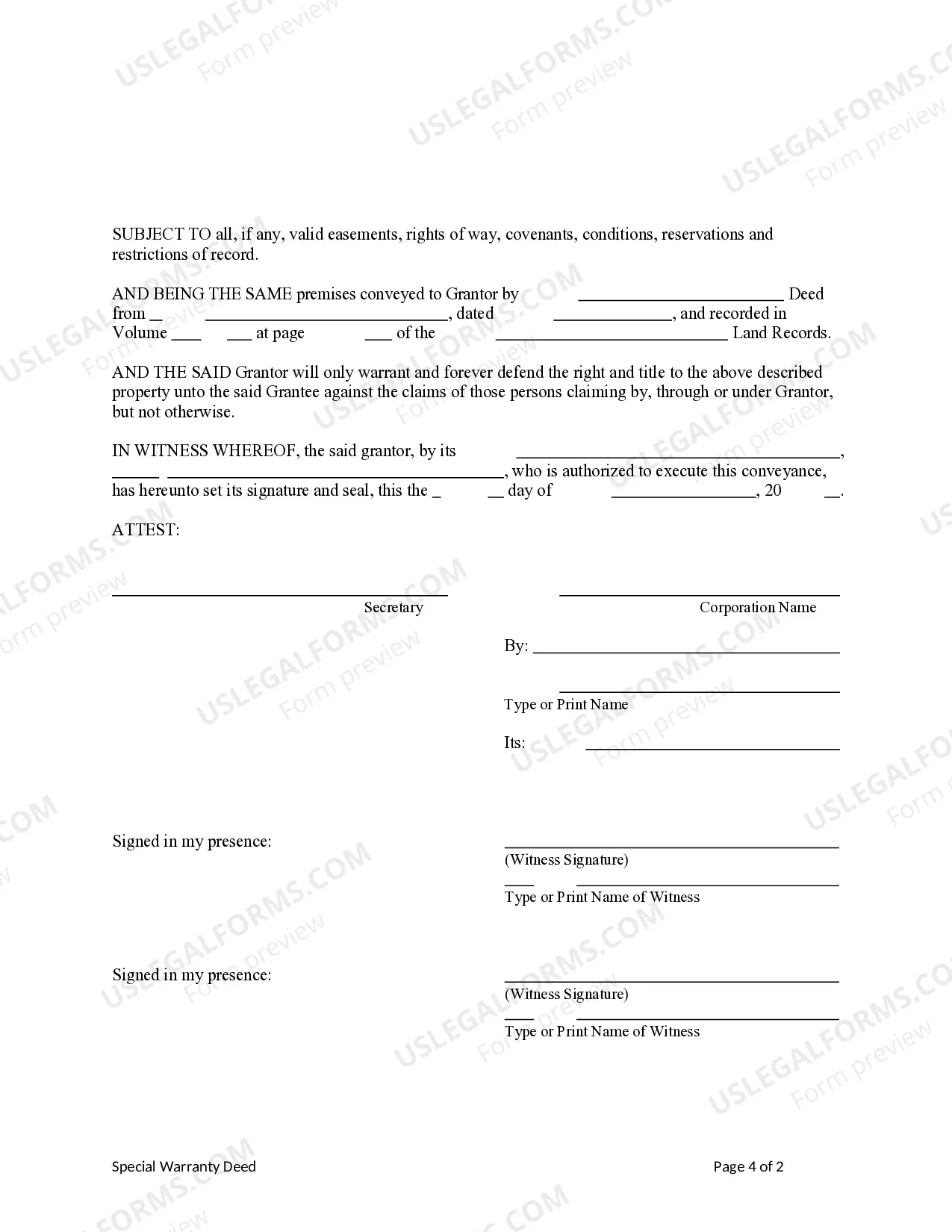
A Special Warranty Deed is a legal document used to transfer property from a corporation (the Grantor) to an individual (the Grantee). This form assures the Grantee that the property is free from claims made by parties claiming through the Grantor, but provides limited warranties compared to a general warranty deed. This makes it distinct in its assurances and protections during property transfer.
Main sections of this form
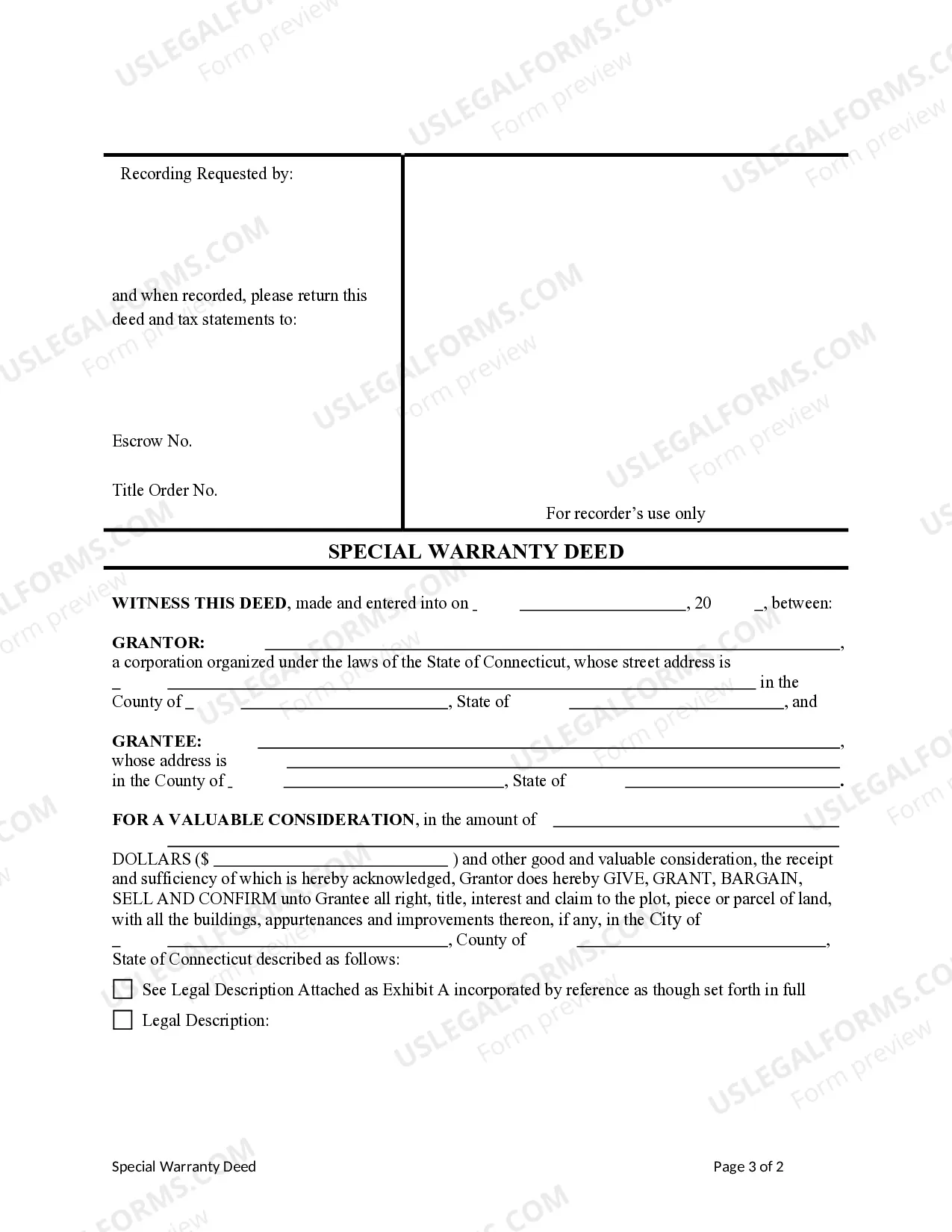
- Identification of the parties involved: Grantor (the corporation) and Grantee (the individual).
- Description of the property being transferred.
- Warranties provided by the Grantor regarding the title of the property.
- Signatures of authorized representatives of the corporation and the Grantee.
- Date of the transfer for legal records.
When to use this document
This form should be used when a corporation is transferring ownership of real property to an individual. It is suitable in situations like business property sales, liquidation of corporate assets, or any transfer of property where the corporation wants to limit its liability concerning past claims on the title.
Who needs this form
- Corporations looking to transfer property to an individual.
- Individuals receiving property from a corporation.
- Real estate professionals facilitating property transfers with corporations.
Completing this form step by step
- Identify and enter the names of the Grantor (corporation) and the Grantee (individual).
- Specify the legal description of the property being transferred.
- Detail the warranties provided by the Grantor regarding the title.
- Ensure the appropriate representatives of the corporation sign the deed.
- Complete the date and any additional provisions if necessary.
Is notarization required?
To make this form legally binding, it must be notarized. Our online notarization service, powered by Notarize, lets you verify and sign documents remotely through an encrypted video session.
Get your form ready online
Our built-in tools help you complete, sign, share, and store your documents in one place.
Make edits, fill in missing information, and update formatting in US Legal Forms—just like you would in MS Word.
Download a copy, print it, send it by email, or mail it via USPS—whatever works best for your next step.
Sign and collect signatures with our SignNow integration. Send to multiple recipients, set reminders, and more. Go Premium to unlock E-Sign.
If this form requires notarization, complete it online through a secure video call—no need to meet a notary in person or wait for an appointment.
We protect your documents and personal data by following strict security and privacy standards.

Make edits, fill in missing information, and update formatting in US Legal Forms—just like you would in MS Word.

Download a copy, print it, send it by email, or mail it via USPS—whatever works best for your next step.

Sign and collect signatures with our SignNow integration. Send to multiple recipients, set reminders, and more. Go Premium to unlock E-Sign.

If this form requires notarization, complete it online through a secure video call—no need to meet a notary in person or wait for an appointment.

We protect your documents and personal data by following strict security and privacy standards.
Common mistakes to avoid
- Failing to include accurate legal descriptions of the property.
- Not having the deed signed by an authorized corporate representative.
- Ignoring local laws that may impose additional recording requirements.
Advantages of online completion
- Convenient access to legal templates from anywhere.
- Editable format allows for easy customization to fit specific needs.
- Secure storage and retrieval of documents for future reference.
Legal use & context
- This form is legally binding once executed by both parties.
- It provides specific warranties, which are crucial for real estate transactions.
- Limitation of warranty may affect future claims against the title.
What to keep in mind
- A Special Warranty Deed limits the warranties provided by the Grantor.
- It is suitable for transactions between corporations and individuals.
- Proper completion and understanding of the form are essential for legal protection.
Looking for another form?
Form popularity
FAQ
A quitclaim deed is commonly used to transfer property without providing guarantees about the ownership status. It's often used in situations like transferring property among family members or resolving a divorce. If you're dealing with a Connecticut Special Warranty Deed - Corporation to an Individual, consider how a quitclaim deed may serve your needs, particularly when addressing uncertainties in ownership.
Buying a house with a Connecticut Special Warranty Deed - Corporation to an Individual requires careful consideration. While it offers some assurances, the protection is limited to only the time the seller owned the property. If you choose this route, ensure you conduct a title search to uncover any potential issues. It's advisable to partner with legal experts to navigate this process effectively.
You can sell your house with a Connecticut Special Warranty Deed - Corporation to an Individual. As the seller, you provide assurances for any claims that arose during your ownership period. This can attract certain buyers who are aware of its limitations. Be sure to communicate clearly about the deed type during negotiations to ensure a smooth transaction.
The safest type of deed is generally considered to be a general warranty deed. It offers the most comprehensive protection to the buyer by providing guarantees against claims from all previous owners. However, if you are dealing with a Connecticut Special Warranty Deed - Corporation to an Individual, remember that its protections are more limited, covering only the period the corporation held ownership. Always consult a legal expert to understand the best option for your situation.
Yes, two individuals can be listed on a warranty deed, including a Connecticut Special Warranty Deed - Corporation to an Individual. When two individuals are co-owners, they share rights and responsibilities regarding the property. This arrangement can facilitate joint ownership and help with decision-making regarding the property. It's vital to clearly outline each person's share in the deed.
Yes, you can file a warranty deed yourself, as long as you follow the proper recording procedures in your county. This includes filing the Connecticut Special Warranty Deed - Corporation to an Individual at the local land records office. Utilizing resources like USLegalForms can help ensure your filing process goes smoothly and correctly.
The best way to transfer property to a family member is typically through a deed, such as a Connecticut Special Warranty Deed - Corporation to an Individual. This method helps clarify ownership and provides legal assurance regarding the property's title. Consider using platforms like USLegalForms to guide you through creating and filing the necessary documentation.
A special warranty deed can be prepared by anyone with knowledge of real estate transactions, including homeowners and real estate professionals. However, you may prefer utilizing a service like USLegalForms for standardized documentation, especially for a Connecticut Special Warranty Deed - Corporation to an Individual. This ensures your deed meets state requirements and is accurately drafted.
Yes, you can transfer a deed without an attorney, especially if you are comfortable with legal documents. Many individuals successfully use the Connecticut Special Warranty Deed - Corporation to an Individual independently. However, it’s recommended to utilize trusted resources like USLegalForms to ensure accuracy and compliance.
To transfer a warranty deed, you need to prepare the deed document, ensuring all parties sign it according to state laws. Specifically, with a Connecticut Special Warranty Deed - Corporation to an Individual, this involves clear title representation. USLegalForms offers reliable templates and guidance to assist you during this process.