Colorado Notice of Disburser
Overview of this form
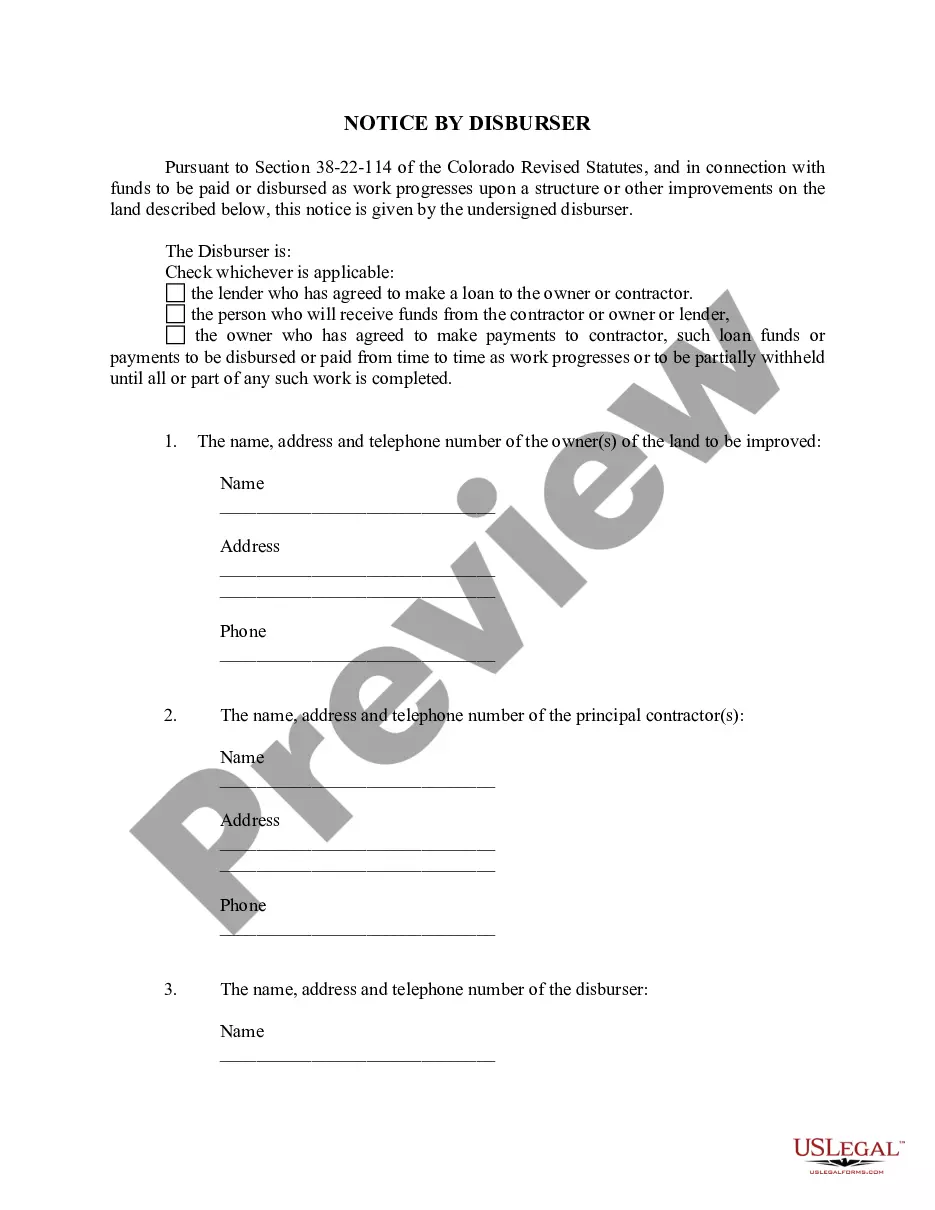
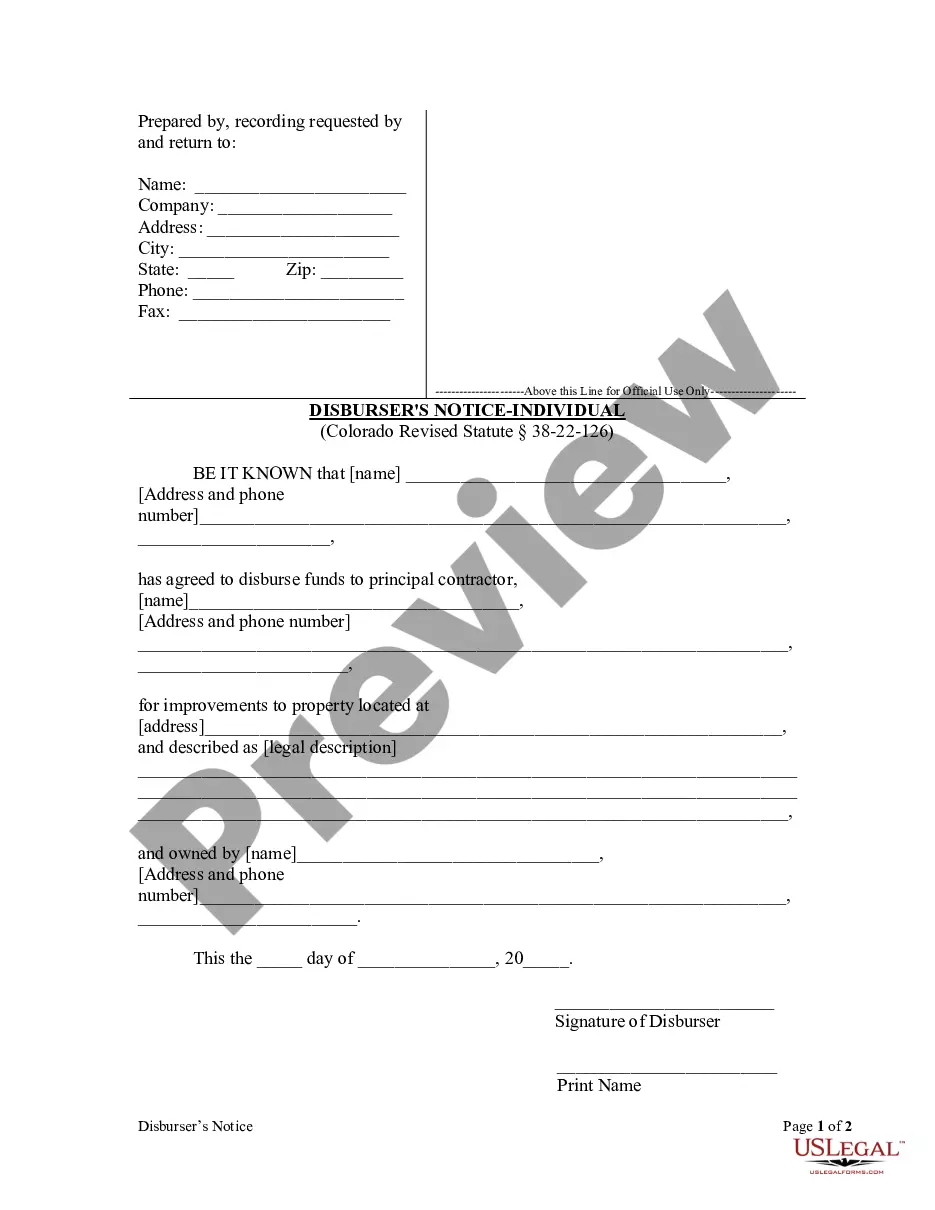
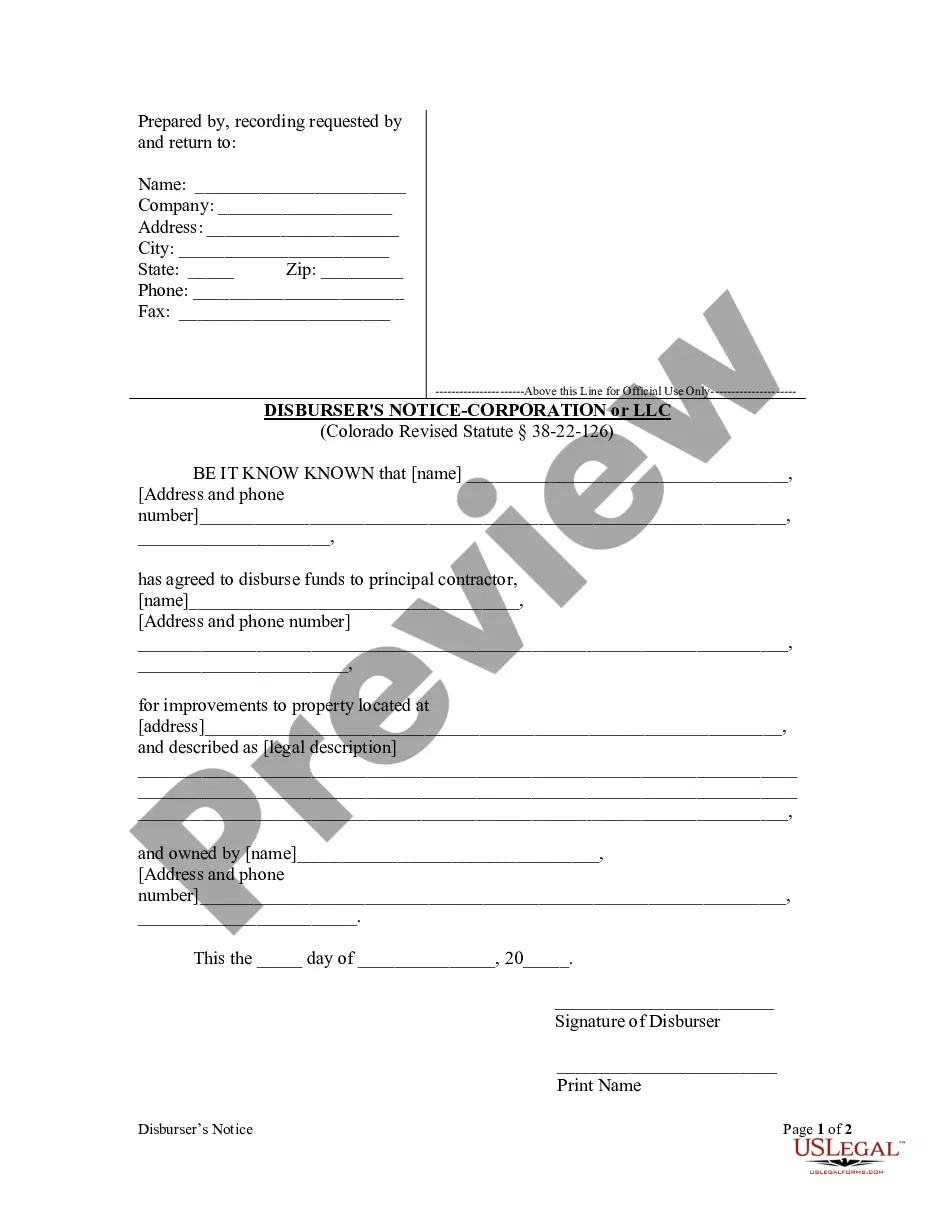
The Notice of Disburser is a legal document used in construction projects to inform relevant parties about the distribution of construction funds. This form is specifically important for ensuring transparency and accountability in financial transactions between lenders, owners, and contractors. Unlike other forms related to construction financing, the Notice of Disburser clearly outlines the roles of all parties involved in the payment process as work progresses on a project.
Key parts of this document
- Identification of the disburser, lender, owner, and contractor.
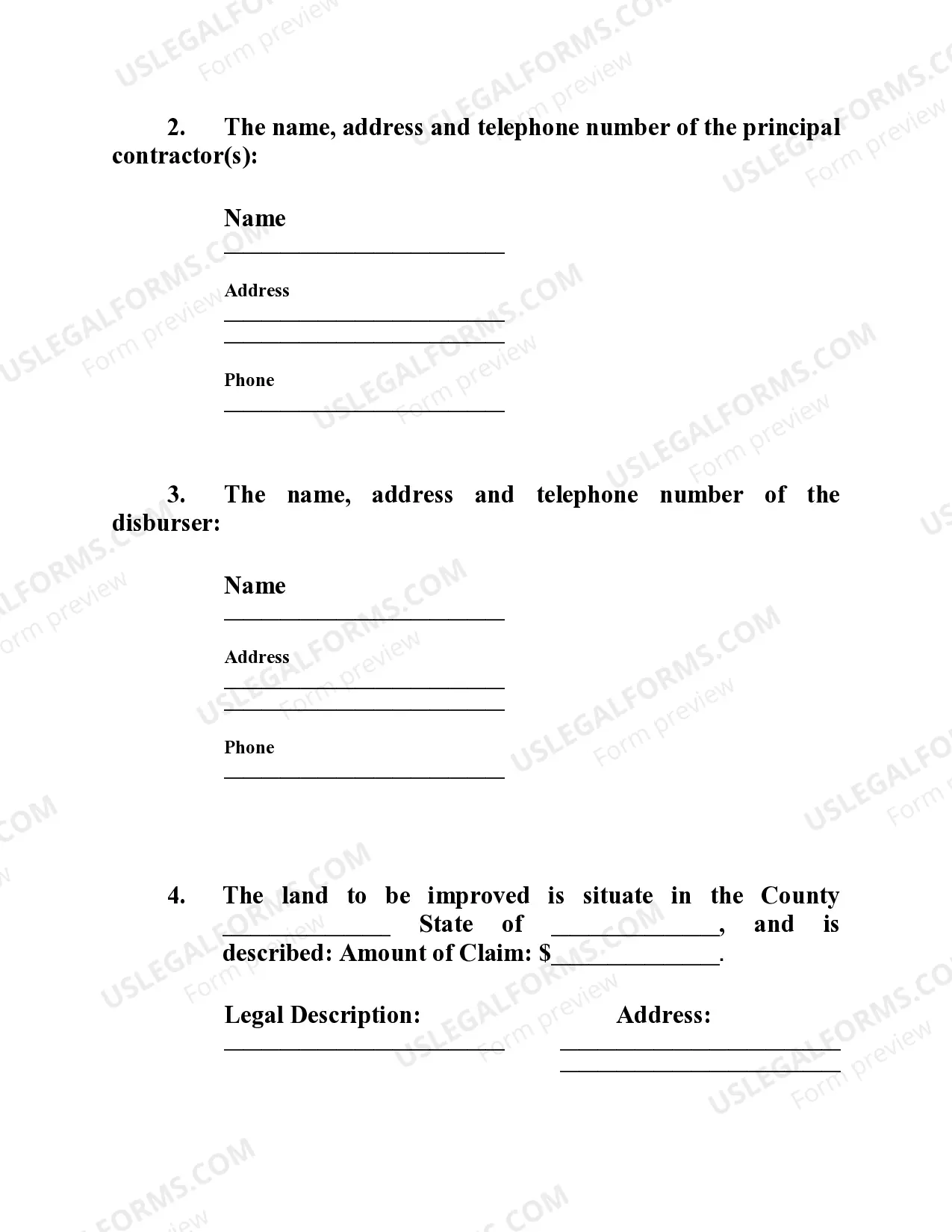
- Contact information for the involved parties, including names, addresses, and phone numbers.
- Description of the property where the improvements will occur.
- Amount of claim for the construction funding.
- Legal description of the property tied to the disbursement of funds.
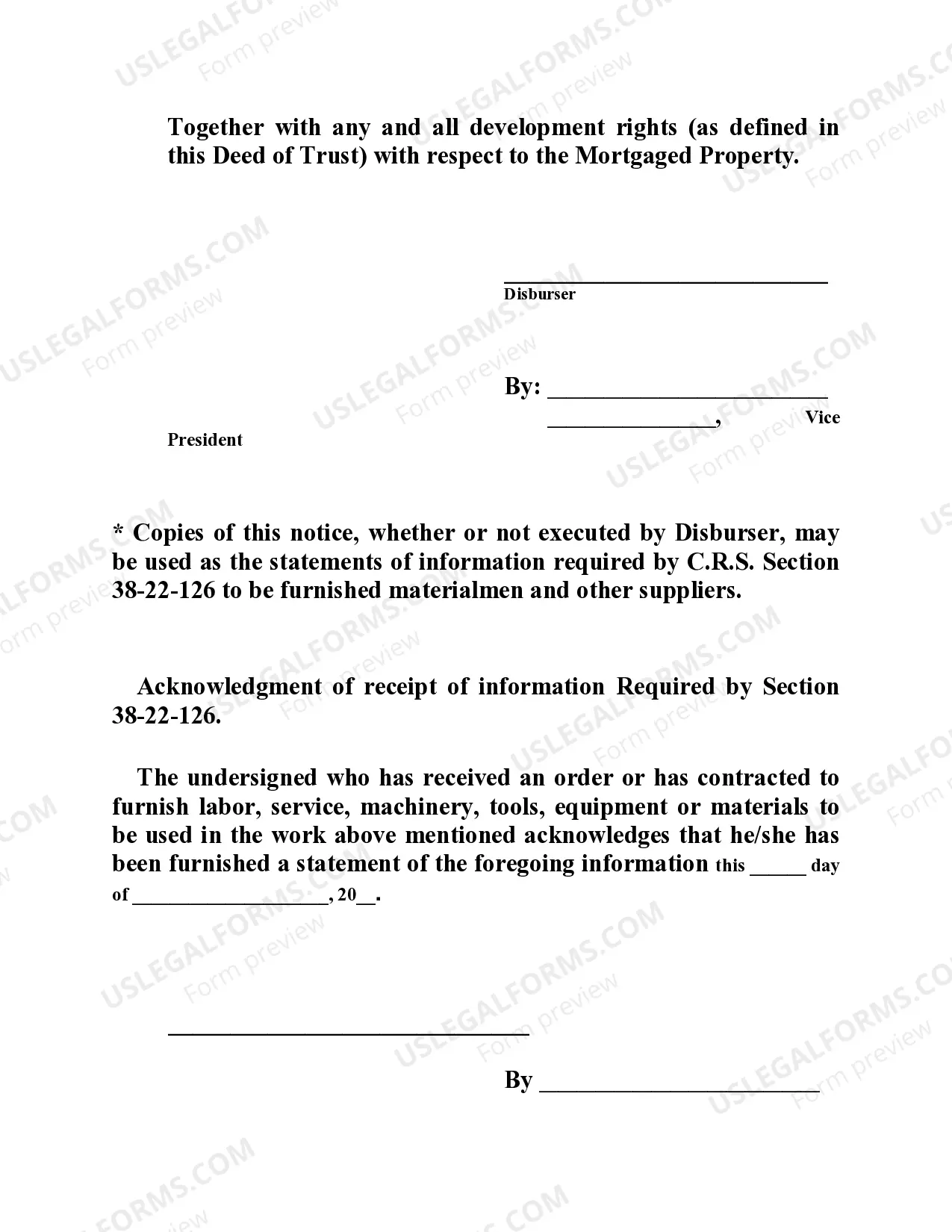
- Acknowledgment section for material providers regarding the receipt of notice.

Situations where this form applies
This form should be used when a disburser intends to distribute funds for construction work and needs to officially notify all involved parties. It is typically required whenever there are scheduled payments for ongoing work, ensuring that contractors, owners, and suppliers are aware of the financial arrangements and obligations. This helps prevent disputes regarding payment at each stage of the construction process.
Who this form is for
This form is intended for:
- Lenders providing funding for construction projects.
- Contractors who will receive payments during the project.
- Property owners who are hiring contractors for construction work.
- Material suppliers and service providers who require notification of disbursement arrangements.
How to complete this form
- Identify the disburser and check the applicable role (lender, contractor, owner).
- Fill in the contact information for the owner, contractor, and disburser.
- Specify the property to be improved with a clear legal description.
- Enter the amount of claim related to the construction funds.
- Obtain signatures from the disburser and other relevant parties as needed.
Does this document require notarization?
This form does not typically require notarization unless specified by local law. It is recommended to check any additional requirements specific to your jurisdiction to ensure compliance with local regulations.
Get your form ready online
Our built-in tools help you complete, sign, share, and store your documents in one place.
Make edits, fill in missing information, and update formatting in US Legal Forms—just like you would in MS Word.
Download a copy, print it, send it by email, or mail it via USPS—whatever works best for your next step.
Sign and collect signatures with our SignNow integration. Send to multiple recipients, set reminders, and more. Go Premium to unlock E-Sign.
If this form requires notarization, complete it online through a secure video call—no need to meet a notary in person or wait for an appointment.
We protect your documents and personal data by following strict security and privacy standards.

Make edits, fill in missing information, and update formatting in US Legal Forms—just like you would in MS Word.

Download a copy, print it, send it by email, or mail it via USPS—whatever works best for your next step.

Sign and collect signatures with our SignNow integration. Send to multiple recipients, set reminders, and more. Go Premium to unlock E-Sign.

If this form requires notarization, complete it online through a secure video call—no need to meet a notary in person or wait for an appointment.

We protect your documents and personal data by following strict security and privacy standards.
Typical mistakes to avoid
- Failing to provide complete contact information for all parties.
- Not specifying the correct property legal description.
- Omitting signatures or acknowledgments from necessary parties.
- Not using the form in conjunction with relevant legal statutes or agreements.
Benefits of completing this form online
- Immediate access to customizable templates that save time.
- Ability to edit the form to match specific project details easily.
- Ensures legal compliance with clear, professionally drafted language.
- Convenient download and storage of completed forms for future reference.
Looking for another form?
Form popularity
FAQ
In Colorado, a contractor can file a lien without a formal contract in specific situations. If a contractor can demonstrate that work was performed or materials were provided, they may have a valid claim. It is crucial to maintain documentation of the work done to support your position. Engaging with resources that outline the Colorado Notice of Disburser can provide further insights and assist you in properly filing your lien.
Yes, in certain cases, someone can place a lien on a house without a formal contract. This often occurs when debts related to work done or materials supplied remain unpaid. However, it is essential to follow specific legal procedures outlined in Colorado laws. Understanding the nuances of the Colorado Notice of Disburser can help you navigate these situations more effectively.
To release a lien on property in Colorado, you must file a release document with the county clerk and recorder's office where the lien was recorded. Typically, this involves completing a form and providing proof that the underlying debt has been satisfied. It’s advisable to keep a copy of the filed release for your records. Familiarity with the Colorado Notice of Disburser can streamline this process and avoid potential complications.
Yes, a contractor may sue a homeowner even without a written contract under certain conditions. If services were rendered or materials were supplied, the contractor can assert a claim through verbal agreements or implied contracts. In Colorado, understanding your rights and the implications of a Colorado Notice of Disburser can be invaluable during such disputes. Ensuring proper documentation can strengthen your case significantly.
To fill out a Colorado quit claim deed, start by downloading the appropriate form from a trusted source or legal service like US Legal Forms. Fill in the names of the grantor and grantee, along with a legal description of the property. Ensure all necessary signatures and notarization are completed, as any discrepancies could impact your claim later. Utilizing resources that address the Colorado Notice of Disburser can help clarify the process further.
Yes, you can file a lien in certain situations without a signed contract. In Colorado, the law allows for liens in specific instances, such as when services are provided or materials are delivered. However, it is important to document any agreement or acknowledgment of the work performed to support your claim. Ultimately, understanding the Colorado Notice of Disburser is crucial to navigating this process successfully.
In Colorado, a separation notice is typically required in various legal contexts, including family law cases. This notice must clearly outline the intention to separate and the relevant circumstances that support this action. Preparing such notices can be complex, but you can simplify the process by using the Colorado Notice of Disburser feature on US Legal Forms, which offers templates and instructions tailored to meet legal standards.
A notice of lis pendens in Colorado is a legal document that informs interested parties that a property is subject to a pending lawsuit. This notice serves as a warning that the property may be affected by the outcome of the case. If you find yourself needing to file such a notice, the Colorado Notice of Disburser tool on US Legal Forms can provide you with the completely prepared documentation you need to facilitate the process.
The judicial notice rule in Colorado allows courts to recognize certain facts as true without needing further evidence. This rule helps streamline court proceedings by eliminating the need for unnecessary proof on commonly accepted facts. If you are dealing with legal documentation and need clarity on what constitutes judicial notice, our Colorado Notice of Disburser can guide you efficiently.
In Colorado, landlords must provide proper notice to tenants before entering a rental property. Typically, a 24-hour notice is required, except in emergencies. This rule is important for maintaining tenant privacy and for fostering a good landlord-tenant relationship. If you need assistance with proper notice templates, the Colorado Notice of Disburser feature on US Legal Forms can help you navigate these requirements.