California Certification of Trust
What is this form?
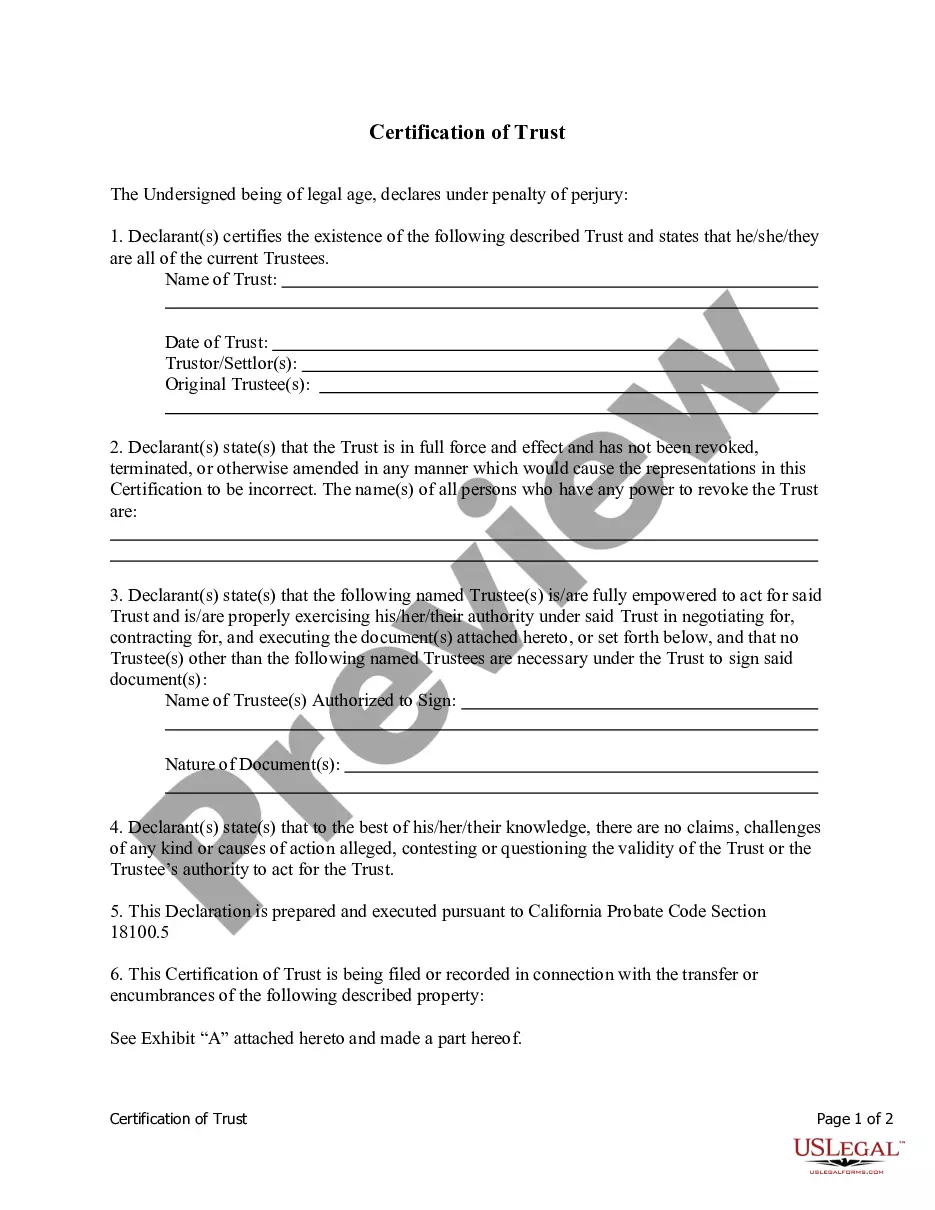
A Certification of Trust is a legal document that serves to confirm the existence of a trust and to verify the authority of the trustee(s) to act on behalf of the trust. This form is essential for situations where proof of the trust is needed, such as when dealing with financial institutions or real estate transactions. Unlike a trust agreement, which outlines the terms of the trust, the Certification of Trust is a concise declaration that affirms the trust's validity and the trustee's role in managing it.
Key components of this form
- Name of the trust and date established
- Identification of the trustor/settlor and current trustees
- Statement confirming the trust is active and has not been revoked
- List of trustees authorized to act on behalf of the trust
- Details of the documents related to the trust
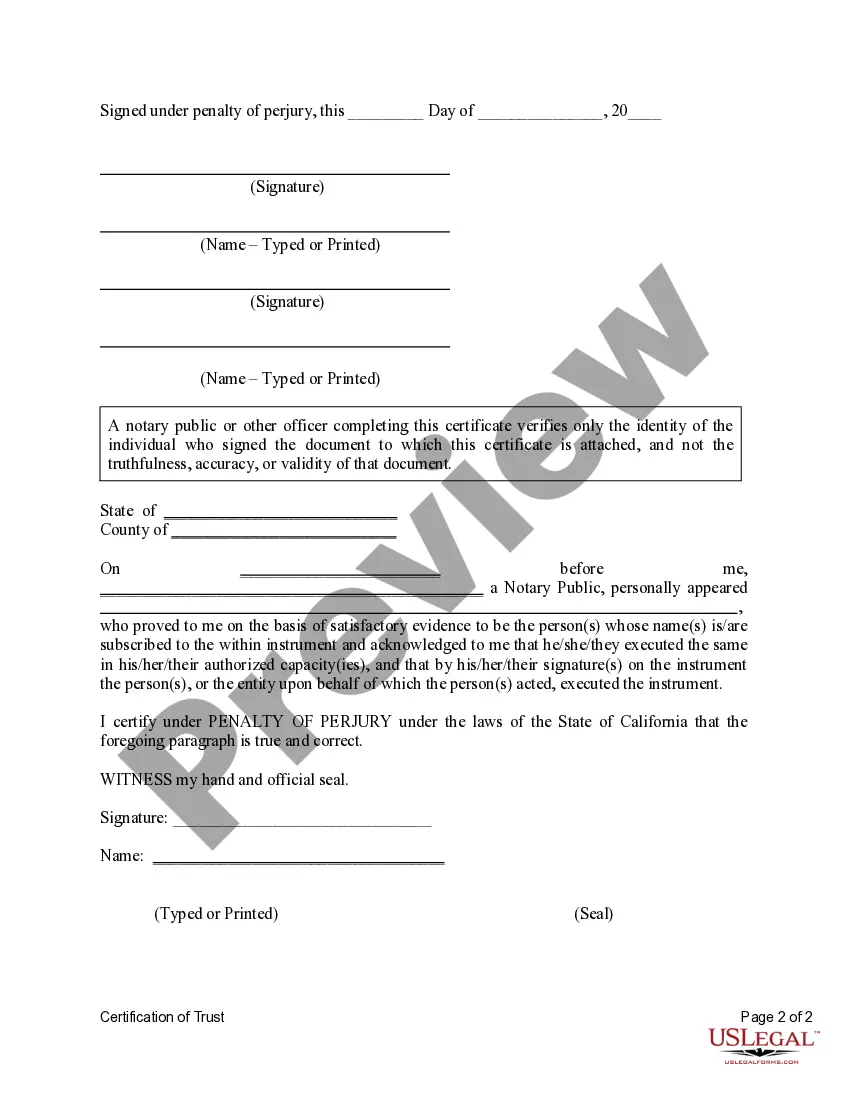
- Notary acknowledgment section for verification
When this form is needed
This form is typically used when a trustee needs to provide verification of their authority to third parties, such as banks, real estate agents, or other institutions. It is commonly required during financial transactions, property transfers, or any situation involving the management of trust assets.
Who can use this document
- Individuals acting as trustees of a trust
- Trustors or settlors who wish to confirm the existence of their trust
- Beneficiaries of a trust seeking to verify trustee authority
- Financial institutions or professionals requiring proof of trust documentation
How to complete this form
- Identify and enter the name of the trust and the date it was created.
- List the names of the trustor(s) and the original trustee(s).
- Confirm that the trust is active and note any individuals who have the power to revoke it.
- Specify the names of the trustees authorized to act on behalf of the trust.
- Provide a description of the documents that relate to the trust.
- Sign the certification and have it notarized to validate the document.
Notarization guidance
Yes, this form must be notarized to be legally valid. Notarization helps verify the identity of the individuals signing the document, which adds an essential layer of authenticity. US Legal Forms offers integrated online notarization, allowing you to complete the process securely via video call at your convenience.
Get your form ready online
Our built-in tools help you complete, sign, share, and store your documents in one place.
Make edits, fill in missing information, and update formatting in US Legal Forms—just like you would in MS Word.
Download a copy, print it, send it by email, or mail it via USPS—whatever works best for your next step.
Sign and collect signatures with our SignNow integration. Send to multiple recipients, set reminders, and more. Go Premium to unlock E-Sign.
If this form requires notarization, complete it online through a secure video call—no need to meet a notary in person or wait for an appointment.
We protect your documents and personal data by following strict security and privacy standards.

Make edits, fill in missing information, and update formatting in US Legal Forms—just like you would in MS Word.

Download a copy, print it, send it by email, or mail it via USPS—whatever works best for your next step.

Sign and collect signatures with our SignNow integration. Send to multiple recipients, set reminders, and more. Go Premium to unlock E-Sign.

If this form requires notarization, complete it online through a secure video call—no need to meet a notary in person or wait for an appointment.

We protect your documents and personal data by following strict security and privacy standards.
Typical mistakes to avoid
- Failing to list all current trustees, which may invalidate the certification.
- Not specifying the correct documents related to the trust.
- Neglecting to have the form notarized, crucial for its acceptance in legal matters.
- Providing incorrect information about the trust's status or authorized parties.
Benefits of using this form online
- Easy access to download and customize according to individual trust details.
- Ensures that the form meets current legal standards and requirements.
- Convenient editing options allow for quick adjustments before finalizing.
- Immediate availability without needing to visit an attorneyâs office.
Looking for another form?
Form popularity
FAQ
(1) The existence of the trust and date of execution of the trust instrument. (2) The identity of the settlor or settlors and the currently acting trustee or trustees of the trust. (3) The powers of the trustee.
A Standard Document used in California to certify the existence of a trust and to provide information regarding its essential terms, without providing a full copy of the trust instrument.
In California, the certification of trust is governed by Probate Code Section 18100.5. A certificate of trust is used by an acting trustee or trustees of a trust to prove to financial institutions or other third parties that he/she/they has/have the authority to act on behalf of the trust.
(1) The existence of the trust and date of execution of the trust instrument. (2) The identity of the settlor or settlors and the currently acting trustee or trustees of the trust. (3) The powers of the trustee.
To make your trust valid in California, you simply need to sign the trust document ? that's it! You don't need to have your document witnessed or notarized to make it valid. However, many people choose to sign their document in the presence of a notary public to help authenticate the document.
The certificate of the trust should also include a description of how the assets should be distributed to the beneficiaries of the trusts. The trust grantor and the trustee will have to sign and date the document and it will have to be notarized and signed by a notary public.
A Certificate of Trust may need to be recorded in the county that any real property is in. That said, if there's no real property owned by the Trust, there may not be any need to record it.