California Living Trust Property Record
What this document covers
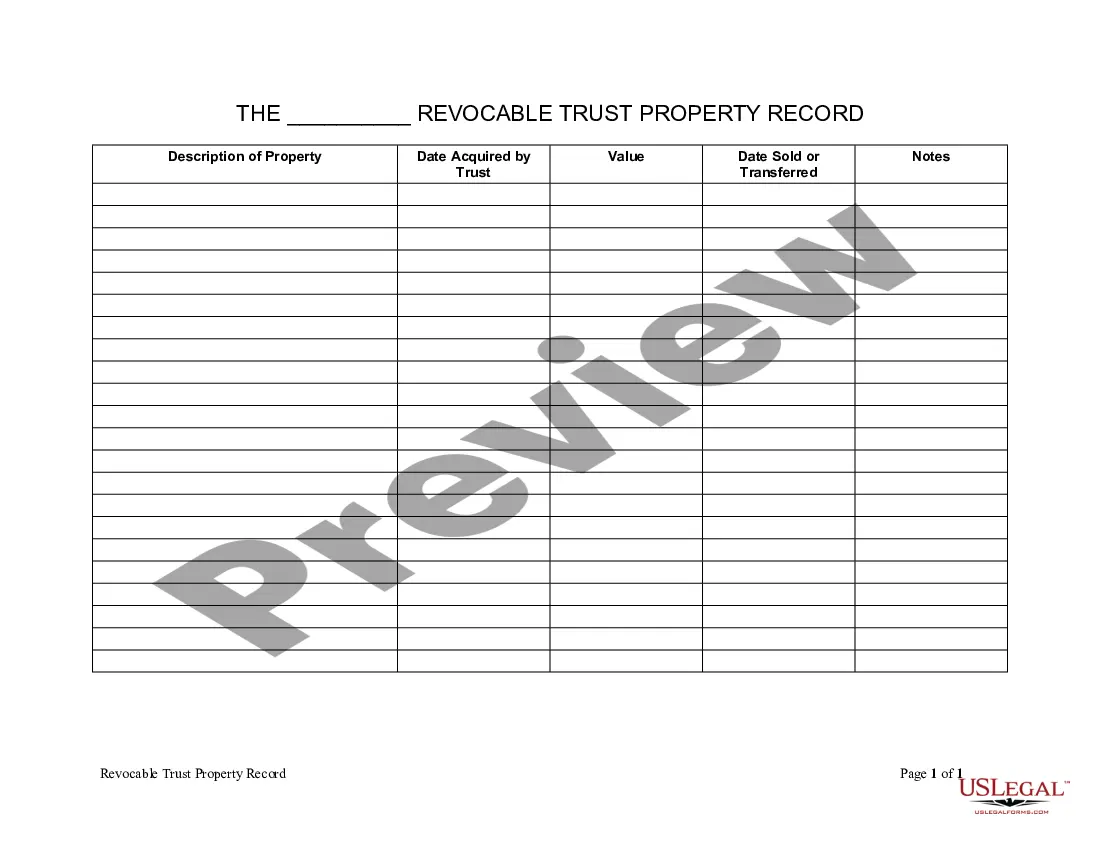
The Living Trust Property Record is an important document used to inventory the assets placed in a living trust. A living trust is established during a person's lifetime, allowing for the management and distribution of assets according to the grantor's wishes, generally for estate planning purposes. This form differentiates itself from other legal documents by enabling the trustee to maintain an organized account of all properties owned by the trust, including real estate, personal belongings, and intellectual property. By keeping these records updated, the trustee can ensure clarity and transparency in the management of the trust assets.
Main sections of this form
- Description of Property: A field for detailing each asset held in the trust.
- Date Acquired by Trust: A section to record when each asset was transferred into the trust.
- Value: A space to indicate the current value of each asset.
- Date Sold or Transferred: For noting when any asset is sold or passed to a beneficiary.
- Signature of Trustee: A line where the trustee confirms the accuracy of the recorded information.

When to use this form
This form should be used when creating or maintaining a living trust. It is particularly useful during estate planning stages, as well as for ongoing management of the trust's assets. If new property is added to the trust or if assets are sold or transferred, this form should be updated to reflect those changes. Additionally, this inventory can be vital when reassessing the trust's values for tax or distribution purposes.
Who this form is for
This form is intended for:
- Trustees who are responsible for managing a living trust
- Individuals establishing a living trust to better organize their estate
- Beneficiaries needing transparent records of the trust's property for their planning
- Legal advisors assisting clients with estate planning and trust management
Steps to complete this form
- Identify the property: List each asset held in the living trust.
- Record acquisition date: Enter the date when the property was transferred into the trust.
- Determine asset value: Assess and note the current market value of each asset.
- Document transfer details: Enter applicable dates when any property is sold or transferred.
- Sign and date: The trustee should sign and date the form to verify the accuracy of the recorded information.
Notarization requirements for this form
Notarization is generally not required for this form. However, certain states or situations might demand it. You can complete notarization online through US Legal Forms, powered by Notarize, using a verified video call available anytime.
Get your form ready online
Our built-in tools help you complete, sign, share, and store your documents in one place.
Make edits, fill in missing information, and update formatting in US Legal Forms—just like you would in MS Word.
Download a copy, print it, send it by email, or mail it via USPS—whatever works best for your next step.
Sign and collect signatures with our SignNow integration. Send to multiple recipients, set reminders, and more. Go Premium to unlock E-Sign.
If this form requires notarization, complete it online through a secure video call—no need to meet a notary in person or wait for an appointment.
We protect your documents and personal data by following strict security and privacy standards.

Make edits, fill in missing information, and update formatting in US Legal Forms—just like you would in MS Word.

Download a copy, print it, send it by email, or mail it via USPS—whatever works best for your next step.

Sign and collect signatures with our SignNow integration. Send to multiple recipients, set reminders, and more. Go Premium to unlock E-Sign.

If this form requires notarization, complete it online through a secure video call—no need to meet a notary in person or wait for an appointment.

We protect your documents and personal data by following strict security and privacy standards.
Typical mistakes to avoid
- Failing to update the inventory after selling or transferring assets.
- Not including adequate descriptions of properties, leading to confusion.
- Incorrectly estimating the value of assets, which can affect tax implications.
- Forgetting to sign the form, making it invalid.
Why complete this form online
- Convenience: Easily download and fill out the form from anywhere.
- Editability: Modify the document as needed to reflect changes in assets.
- Reliability: Ensures that the form meets standard legal requirements for living trusts.
Looking for another form?
Form popularity
FAQ
A trust can become invalid in California for several reasons, including lack of capacity, improper execution, or failure to fund the trust. Additionally, if the terms violate public policy or laws, the trust may be deemed invalid. Establishing a clear California Living Trust Property Record can mitigate potential disputes about the trust’s validity. Seeking legal advice can help ensure that your trust meets all requirements.
You do not usually have to file a trust with the court in California. However, if there's a dispute or the trust becomes part of probate proceedings, you might need to present your California Living Trust Property Record. Keeping organized records of your trust can help resolve issues effectively. For additional guidance, consider exploring resources available at uslegalforms.
Yes, a trust deed should be recorded in California, particularly when it involves real property. Recording a trust deed creates a California Living Trust Property Record that publicly documents the property’s ownership. This step ensures that your claim to the property is protected and easily verifiable. Using services such as uslegalforms can simplify the recording process significantly.
Finalizing a trust in California involves properly signing, notarizing, and funding the trust. You must ensure assets are transferred into the trust, which might include creating a California Living Trust Property Record for any real estate involved. It’s essential to review the trust's terms to confirm everything aligns with your intentions. Consulting a legal professional is advisable for a seamless process.
Trust documents do not need to be recorded in California unless they involve the transfer of real estate. In such cases, you must create a California Living Trust Property Record to ensure the property is properly titled. Recording these documents can protect your interests and provide clarity in ownership. Consider using platforms like uslegalforms to simplify the recording process.
In California, a trust generally does not need to be filed with the court. However, if the trust holds property that needs to be transferred, a California Living Trust Property Record may be required. It’s important to clearly outline the terms of the trust within the documents to avoid complications. Always consider consulting a professional to ensure compliance.
A potential downfall of having a trust is the complexity it may introduce to financial management. Beneficiaries might not fully understand the trust's terms and conditions, leading to misunderstandings. However, by utilizing resources such as US Legal Forms, you can simplify the process of managing your California Living Trust Property Record effectively.
One downside can be the initial setup costs and ongoing management requirements. Trusts require care to maintain, including filing taxes and keeping records updated. However, the long-term benefits often outweigh these challenges, especially when there's support available, like that from US Legal Forms, to help navigate a California Living Trust Property Record.
If your parents want to avoid probate and maintain control over their assets, establishing a trust can be beneficial. Trusts provide a clear plan for asset distribution after their passing, offering peace of mind. Engaging with professionals through US Legal Forms can also ensure that their California Living Trust Property Record is set up correctly.
Living trusts are generally not public records in California. Their contents and arrangements usually remain private, protecting the family’s financial affairs. However, certain aspects may need to be disclosed during probate. For further help in understanding your California Living Trust Property Record, you can explore solutions through US Legal Forms.