California Order Sustaining Defendants Demurrer to Complaint without Leave to Amend
What this document covers
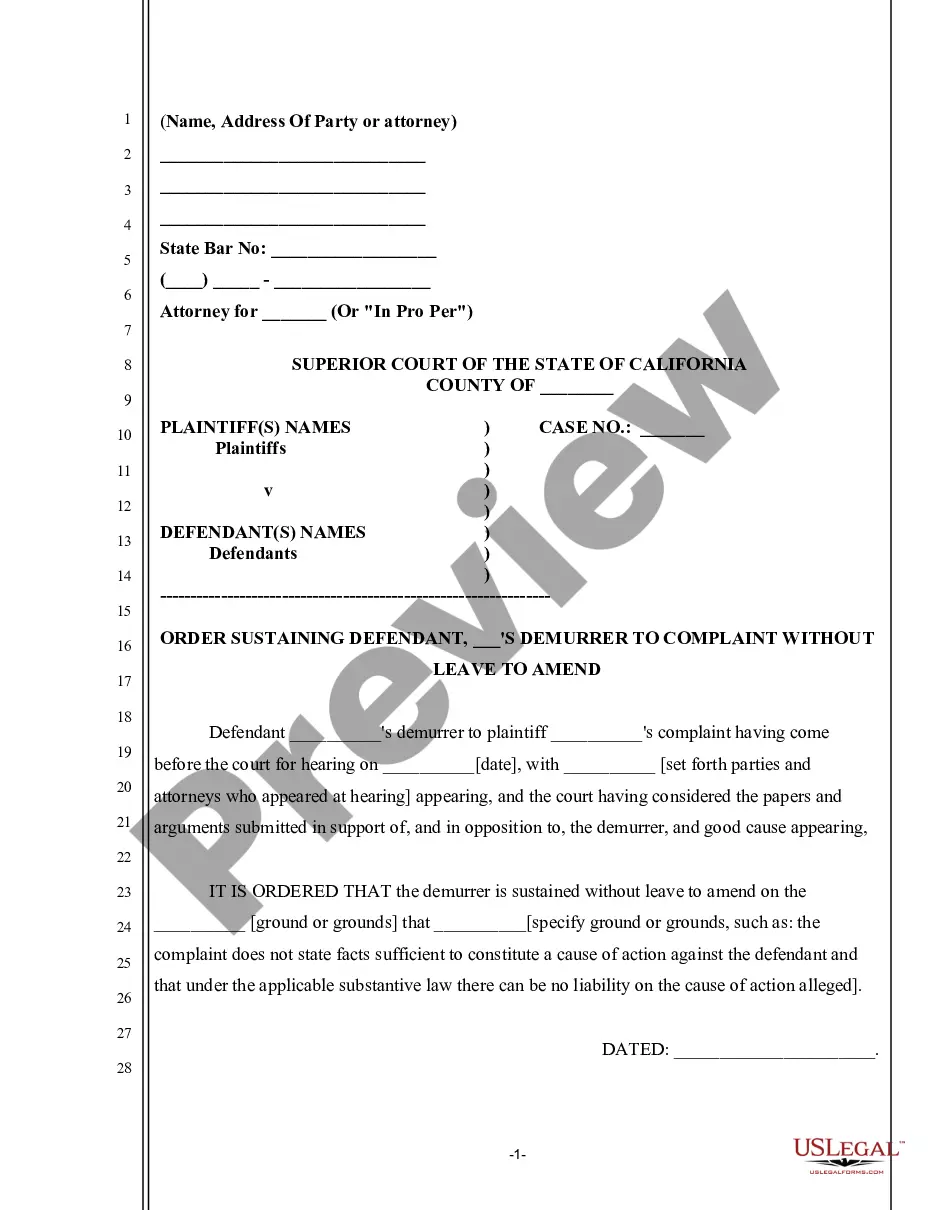
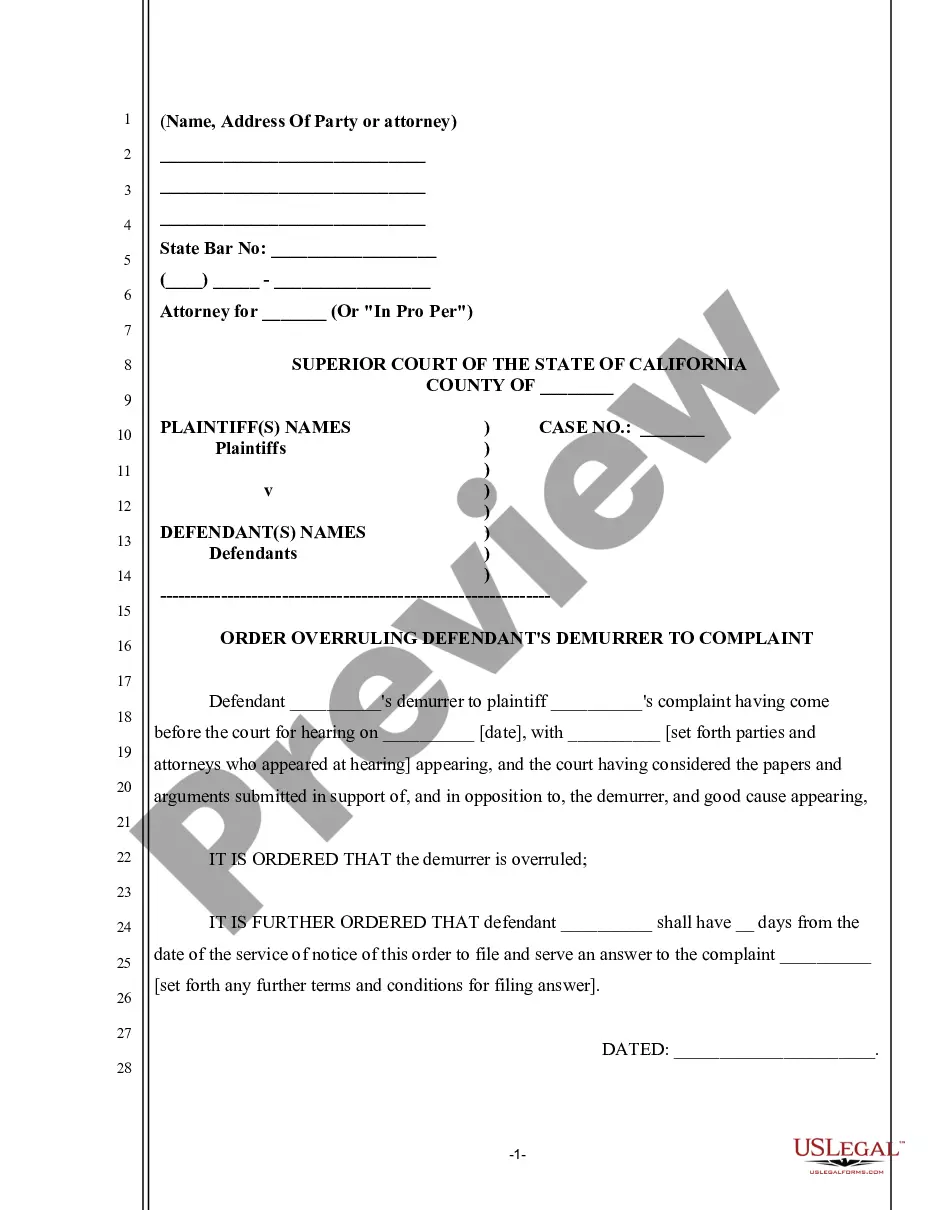
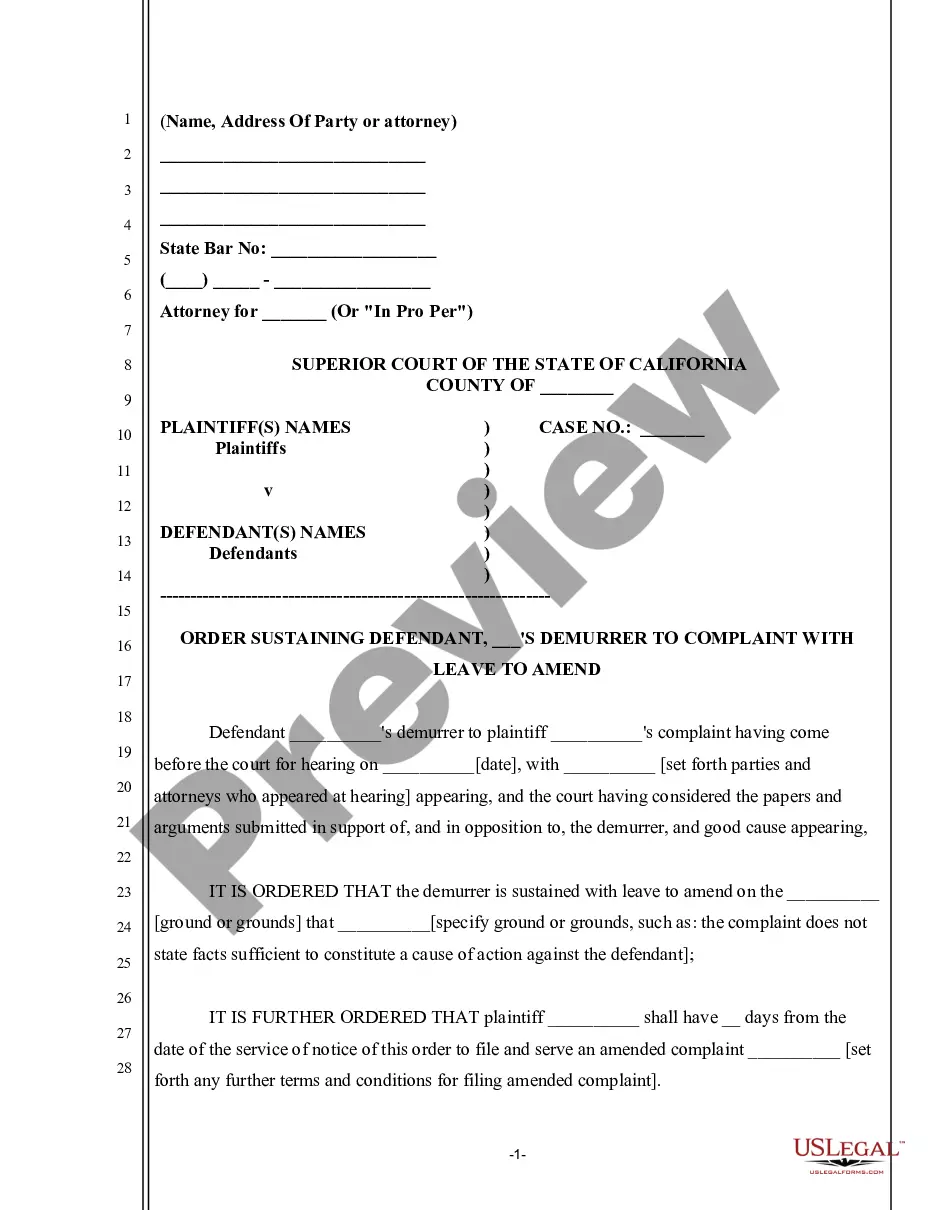
This form is an Order Sustaining Defendant's Demurrer to a Complaint without Leave to Amend. It serves as a legal ruling from a judge, indicating that the defendant's demurrer has been accepted. This form is used to dismiss a plaintiff's complaint when it is determined that it does not contain sufficient facts to support a legal claim against the defendant. Unlike other legal forms, this order specifically addresses the demurrer and confirms that no further amendments to the complaint are permitted.
Main sections of this form
- Fields for the names of the plaintiffs and defendants
- Case number for tracking the legal proceedings
- Grounds for sustaining the demurrer specified in detail
- Date of the court hearing
- Signature and title of the presiding judge
When to use this document
This form is needed when a defendant contests a complaint against them in court and seeks to have it dismissed based on legal insufficiencies. Specifically, it applies when the court determines that the complaint lacks the necessary facts to establish a valid cause of action. This situation often arises during civil litigation, where the plaintiff's claims are found to be legally flawed, and the defendant wants to avoid further proceedings on those claims.
Who should use this form
This form is intended for:
- Defendants in a civil lawsuit who wish to challenge a complaint against them
- Attorneys representing defendants in legal matters
- Individuals representing themselves in pro per (without an attorney) who need to file a demurrer
Instructions for completing this form
- Identify the parties involved by entering the names of the plaintiffs and defendants.
- Insert the case number as assigned by the superior court.
- Specify the grounds for sustaining the demurrer in the designated section.
- Fill in the date of the court hearing.
- Obtain the signature of the presiding judge, indicating their approval of the order.
Is notarization required?
This form does not typically require notarization unless specified by local law. Always check specific county requirements to ensure your submission meets all legal standards.
Get your form ready online
Our built-in tools help you complete, sign, share, and store your documents in one place.
Make edits, fill in missing information, and update formatting in US Legal Forms—just like you would in MS Word.
Download a copy, print it, send it by email, or mail it via USPS—whatever works best for your next step.
Sign and collect signatures with our SignNow integration. Send to multiple recipients, set reminders, and more. Go Premium to unlock E-Sign.
If this form requires notarization, complete it online through a secure video call—no need to meet a notary in person or wait for an appointment.
We protect your documents and personal data by following strict security and privacy standards.

Make edits, fill in missing information, and update formatting in US Legal Forms—just like you would in MS Word.

Download a copy, print it, send it by email, or mail it via USPS—whatever works best for your next step.

Sign and collect signatures with our SignNow integration. Send to multiple recipients, set reminders, and more. Go Premium to unlock E-Sign.

If this form requires notarization, complete it online through a secure video call—no need to meet a notary in person or wait for an appointment.

We protect your documents and personal data by following strict security and privacy standards.
Common mistakes
- Failing to specify the legal grounds for the demurrer clearly.
- Omitting critical information such as case numbers or party names.
- Not securing the judge's signature before submitting the form.
- Filing the form in the wrong jurisdiction or outside the required timeline.
Benefits of using this form online
- Convenience of accessing legal templates from anywhere at any time.
- Editable format allows customization to fit specific case details.
- Reliable templates drafted by licensed attorneys ensure legal compliance.
What to keep in mind
- The Order Sustaining Defendant's Demurrer formally dismisses a plaintiff's complaint when insufficient facts are presented.
- Proper completion of the form and adherence to state requirements are crucial for legal effectiveness.
- Attorneys and self-represented individuals should ensure all legal grounds for the demurrer are clearly articulated in the order.
Looking for another form?



Form popularity
FAQ
A demurrer in California must clearly state the grounds for objection to the complaint and cite specific legal deficiencies. If a California Order Sustaining Defendants Demurrer to Complaint without Leave to Amend has been issued, these requirements become even more critical to understand. Utilizing tools and resources, such as those offered by US Legal Forms, can help ensure that your demurrer meets all necessary criteria.
California Rule 3.1203 pertains to the procedures for serving and filing a demurrer. This rule outlines the necessary steps for ensuring that all parties are informed, especially in cases involving a California Order Sustaining Defendants Demurrer to Complaint without Leave to Amend. Familiarizing yourself with this rule can enhance your understanding of the legal process.
In California, once a demurrer is filed, it may be subject to amendments prior to a hearing. However, if a California Order Sustaining Defendants Demurrer to Complaint without Leave to Amend is issued, the demurrer cannot be changed. Understanding the rules around demurrers is essential for effective legal strategy.
Filing a demurrer in California usually does not automatically stay discovery. The court's California Order Sustaining Defendants Demurrer to Complaint without Leave to Amend may affect various aspects of the case, but discovery can often continue unless the court decides otherwise. Always check with your attorney for guidance based on your unique situation.
Yes, parties can agree to amend a complaint in California, and this is often done through a stipulation. However, if the court has issued a California Order Sustaining Defendants Demurrer to Complaint without Leave to Amend, the ability to amend may be restricted. It is wise to ensure that any amendments align with court rules and procedures.
In California, after receiving a ruling on a demurrer, you typically have 30 days to amend your complaint unless the court orders otherwise. However, if a California Order Sustaining Defendants Demurrer to Complaint without Leave to Amend is issued, you cannot make changes to the complaint. It is crucial to consult with an attorney to understand your specific timeframe and options.
Yes, an order sustaining a demurrer is appealable in California. If you receive a California Order Sustaining Defendants Demurrer to Complaint without Leave to Amend, you have the option to appeal that decision. However, before pursuing an appeal, it's important to consider the potential outcomes and whether you have strong grounds for appeal. Seeking guidance through platforms like USLegalForms can provide clarity on your options.
An order denying summary judgment is generally not appealable immediately. In most cases, parties must wait until the final judgment is made to appeal such decisions. This can be crucial when navigating complex cases. It is essential to understand how the California Order Sustaining Defendants Demurrer to Complaint without Leave to Amend might alter your strategy in handling summary judgments.
When a court sustains a demurrer, it typically means that the complaint has deficiencies that cannot be corrected. In the case of a California Order Sustaining Defendants Demurrer to Complaint without Leave to Amend, the plaintiff usually loses the chance to amend their complaint. This decision can effectively end the case unless the plaintiff pursues other legal avenues. Therefore, it's vital to address all concerns initially raised in the complaint.
In legal proceedings, a demurrer can either be sustained or overruled. If a court sustains a demurrer, it indicates that the complaint does not contain sufficient facts to support a claim. Conversely, if the demurrer is overruled, the plaintiff's complaint will proceed. Understanding the implications of a California Order Sustaining Defendants Demurrer to Complaint without Leave to Amend can significantly impact your case.