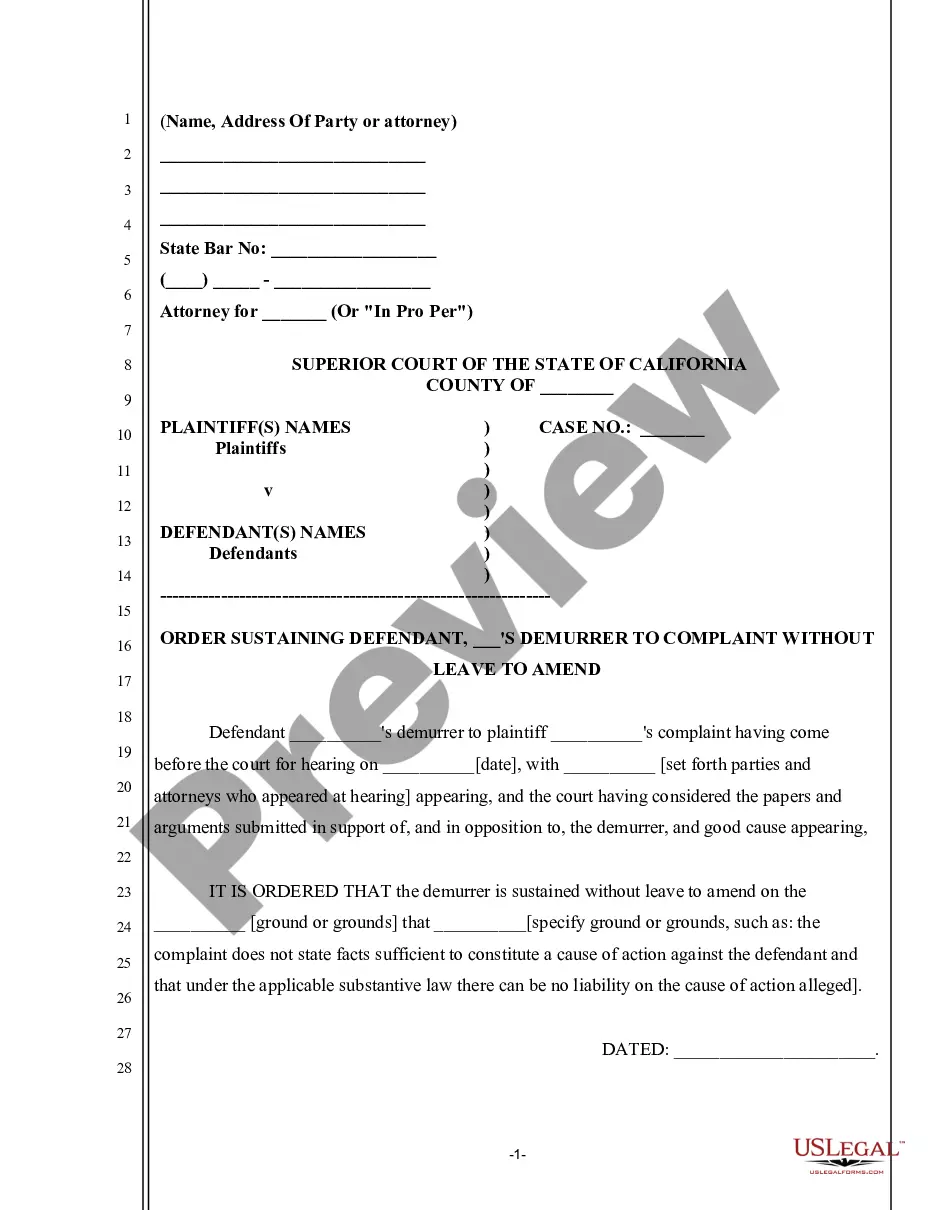
California Order Sustaining Defendants Demurrer to Complaint with Leave to Amend
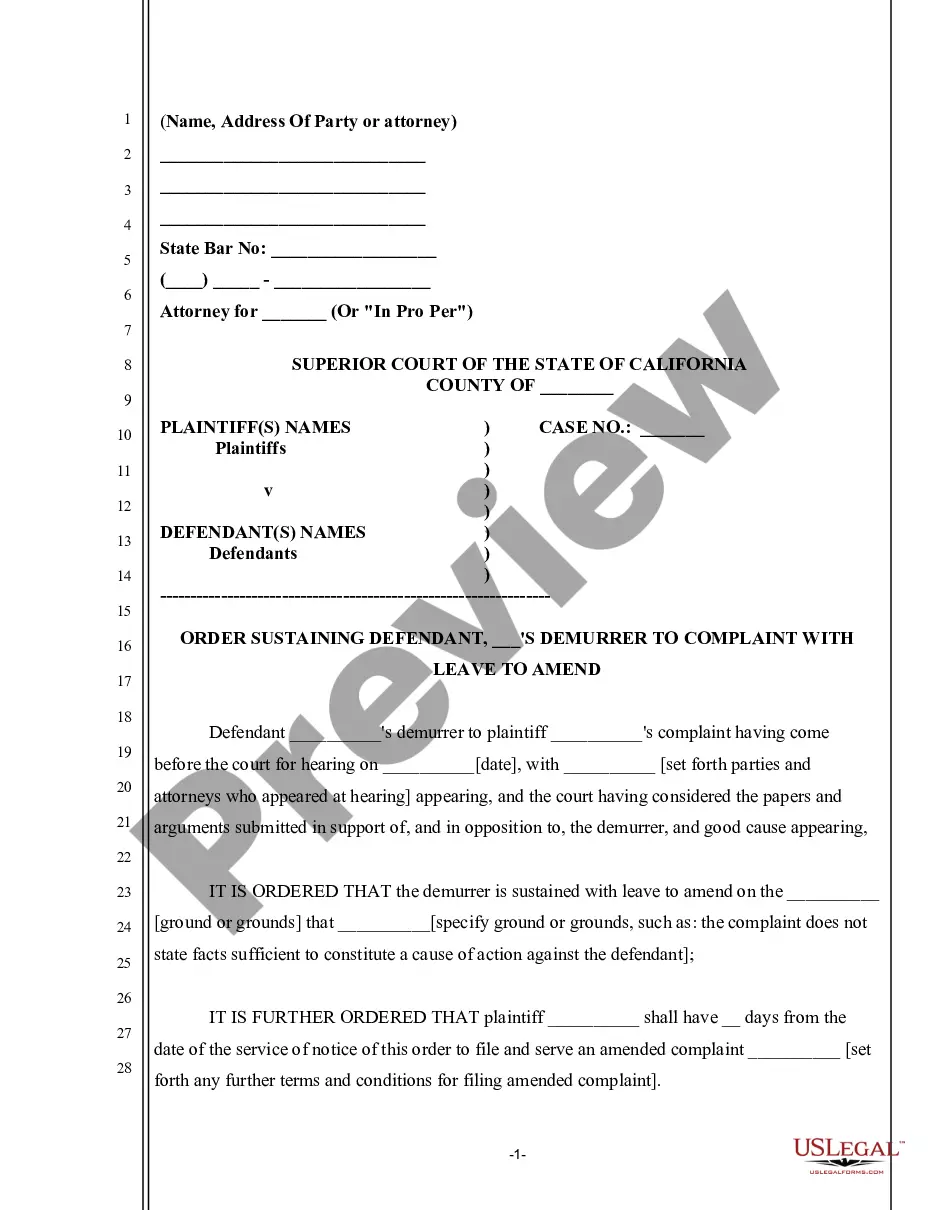
Understanding this form
This form is an order sustaining the defendant's demurrer to a complaint with leave to amend. It allows the court to dismiss certain claims in a lawsuit while giving the plaintiff an opportunity to revise and strengthen their case. This form is specific to the legal process in California, distinguishing it from other response options like motions to dismiss or summary judgments.
Key parts of this document
- Case number and names of parties involved.
- Details of the demurrer hearing date and participants.
- Grounds for sustaining the demurrer, specifying legal deficiencies in the complaint.
- Timeframe given to the plaintiff to amend their complaint.
- Judge's signature and date of the order.
When this form is needed
This form is used when a defendant believes that a complaint filed against them is legally insufficient, meaning it fails to state a claim upon which relief can be granted. It is appropriate in scenarios where the issues can be corrected through amendments to the complaint, allowing the case to continue instead of being dismissed entirely.
Who needs this form
- Defendants in a civil lawsuit seeking to challenge a complaint.
- Attorneys representing defendants who wish to formally respond to claims.
- Self-represented individuals (in pro per) who are navigating the court system without an attorney.
Completing this form step by step
- Fill in the case number and the names of the plaintiffs and defendants at the top of the form.
- Document the date when the demurrer hearing took place and list the parties that attended.
- Specify the legal grounds upon which the demurrer is based.
- Indicate the timeframe allowed for the plaintiff to amend their complaint.
- Have the judge sign and date the order to finalize it.
Notarization requirements for this form
This form does not typically require notarization to be legally valid. However, some jurisdictions or document types may still require it. US Legal Forms provides secure online notarization powered by Notarize, available 24/7 for added convenience.
Get your form ready online
Our built-in tools help you complete, sign, share, and store your documents in one place.
Make edits, fill in missing information, and update formatting in US Legal Forms—just like you would in MS Word.
Download a copy, print it, send it by email, or mail it via USPS—whatever works best for your next step.
Sign and collect signatures with our SignNow integration. Send to multiple recipients, set reminders, and more. Go Premium to unlock E-Sign.
If this form requires notarization, complete it online through a secure video call—no need to meet a notary in person or wait for an appointment.
We protect your documents and personal data by following strict security and privacy standards.

Make edits, fill in missing information, and update formatting in US Legal Forms—just like you would in MS Word.

Download a copy, print it, send it by email, or mail it via USPS—whatever works best for your next step.

Sign and collect signatures with our SignNow integration. Send to multiple recipients, set reminders, and more. Go Premium to unlock E-Sign.

If this form requires notarization, complete it online through a secure video call—no need to meet a notary in person or wait for an appointment.

We protect your documents and personal data by following strict security and privacy standards.
Mistakes to watch out for
- Failing to clearly state the grounds for demurrer.
- Not including the correct parties in the case caption.
- Omitting critical dates or details from the hearing section.
- Not having the judge's signature, making the order invalid.
Why complete this form online
- Easy access to professionally drafted legal forms.
- Editable templates that allow for customization to your specific case.
- Convenience of downloading your form immediately after filling it out.
Looking for another form?

Form popularity
FAQ
To add a defendant in California, you must file an amended complaint that includes the new defendant’s name and relevant charges. Make sure to explain the basis for including them, which often involves connecting them to the same events outlined in the original complaint. This action must comply with the California rules regarding amendments, particularly if responding to a California Order Sustaining Defendants Demurrer to Complaint with Leave to Amend. Legal services can assist in navigating this process effectively.
Yes, in California, you can amend a complaint to add a plaintiff under certain conditions. The court will evaluate whether the new party shares common questions of law or fact with the existing parties and if their inclusion serves justice. This action often enhances the litigation process and may align with a California Order Sustaining Defendants Demurrer to Complaint with Leave to Amend. For a smooth transition, leverage platforms like US Legal Forms to create the necessary documentation.
In California, an amended complaint can relate back to the date of the original complaint if it involves the same conduct and parties. This principle safeguards against statute of limitations issues while still adhering to the California Order Sustaining Defendants Demurrer to Complaint with Leave to Amend. However, it is essential to meet specific legal tests to ensure that the amendments do not introduce new causes that fundamentally alter the original complaint. Consulting with legal experts can help clarify this process.
Amending a complaint in California can occur for several reasons, such as correcting errors, adding necessary parties, or addressing new facts that emerge during the case. It’s important to demonstrate how your amendments will allow for a fair resolution of the issues at hand. The court often encourages amendments to avoid unnecessary dismissals, especially when it aligns with the California Order Sustaining Defendants Demurrer to Complaint with Leave to Amend. Utilize legal resources to ensure you meet the necessary criteria.
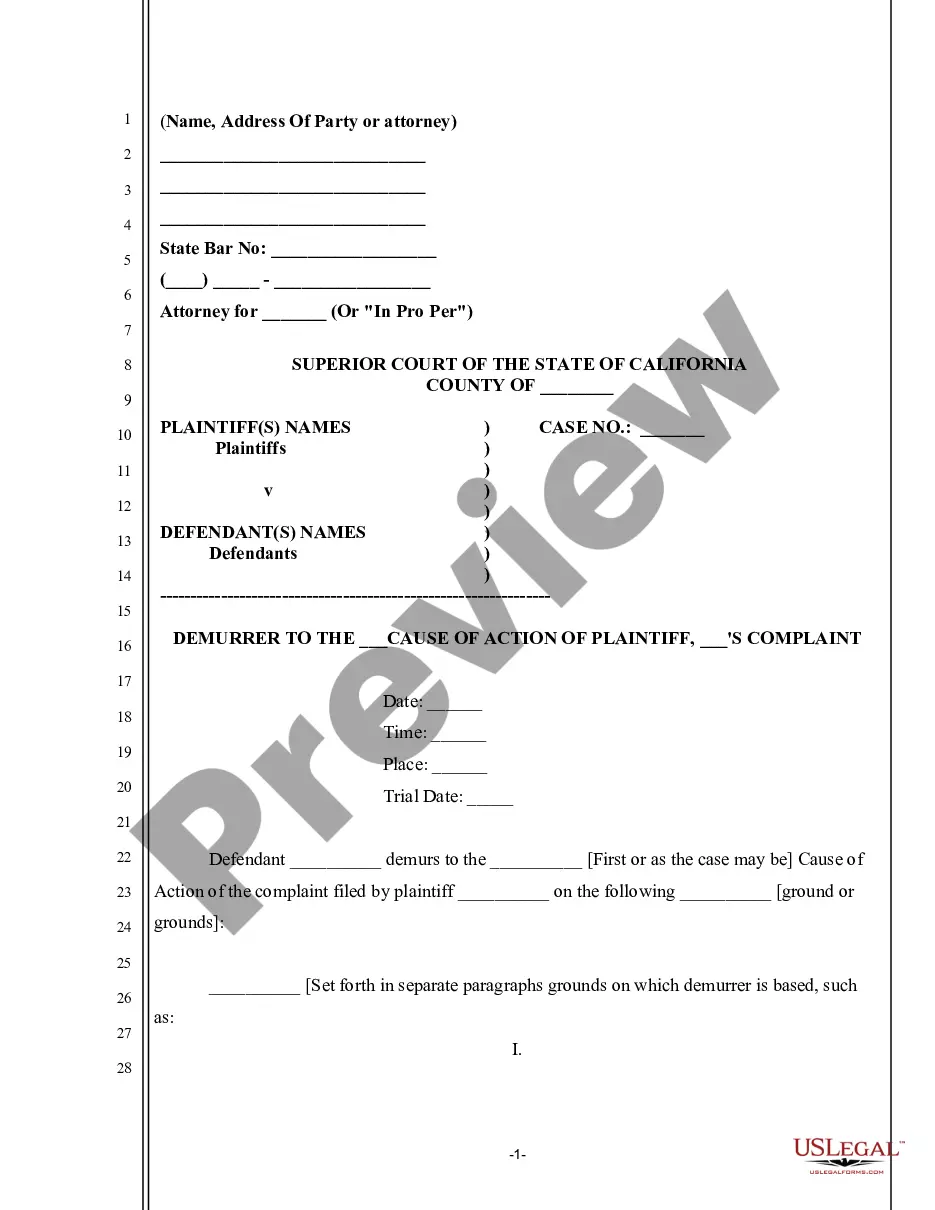
To write a demurrer in California, you must clearly outline the legal basis for challenging the complaint. Focus on the specific defects in the complaint, such as failure to state a claim or lack of jurisdiction. Ensure that you adhere to the court's formatting requirements, including the appropriate citation of statutes and case law. This process can be complex, but using platforms like US Legal Forms can provide guidance and templates to streamline your approach.
You can amend an unlawful detainer complaint in California, but certain rules apply. Typically, you must do this before the trial begins. Engaging in a California Order Sustaining Defendants Demurrer to Complaint with Leave to Amend requires careful consideration of these rules to ensure compliance and enhance the likelihood of a favorable ruling.
Yes, you can file a demurrer to an amended complaint in California. Once a party amends their complaint, the opposing party retains the right to challenge the new allegations. If you find yourself managing a California Order Sustaining Defendants Demurrer to Complaint with Leave to Amend, be aware that addressing the amended complaint promptly and effectively is critical.
In California, you can amend a complaint by either obtaining consent from the other party or securing the court's permission. Generally, the court favors allowing amendments unless they cause undue prejudice to the other party. When dealing with a California Order Sustaining Defendants Demurrer to Complaint with Leave to Amend, understanding this rule is essential for effectively modifying your pleadings.
The grounds for a general demurrer in California primarily include lack of jurisdiction, failure to state a claim, and issues with the sufficiency of the allegations. When facing a California Order Sustaining Defendants Demurrer to Complaint with Leave to Amend, understanding these grounds may provide valuable insight into your legal strategy. Identifying these factors early can significantly impact the litigation process.
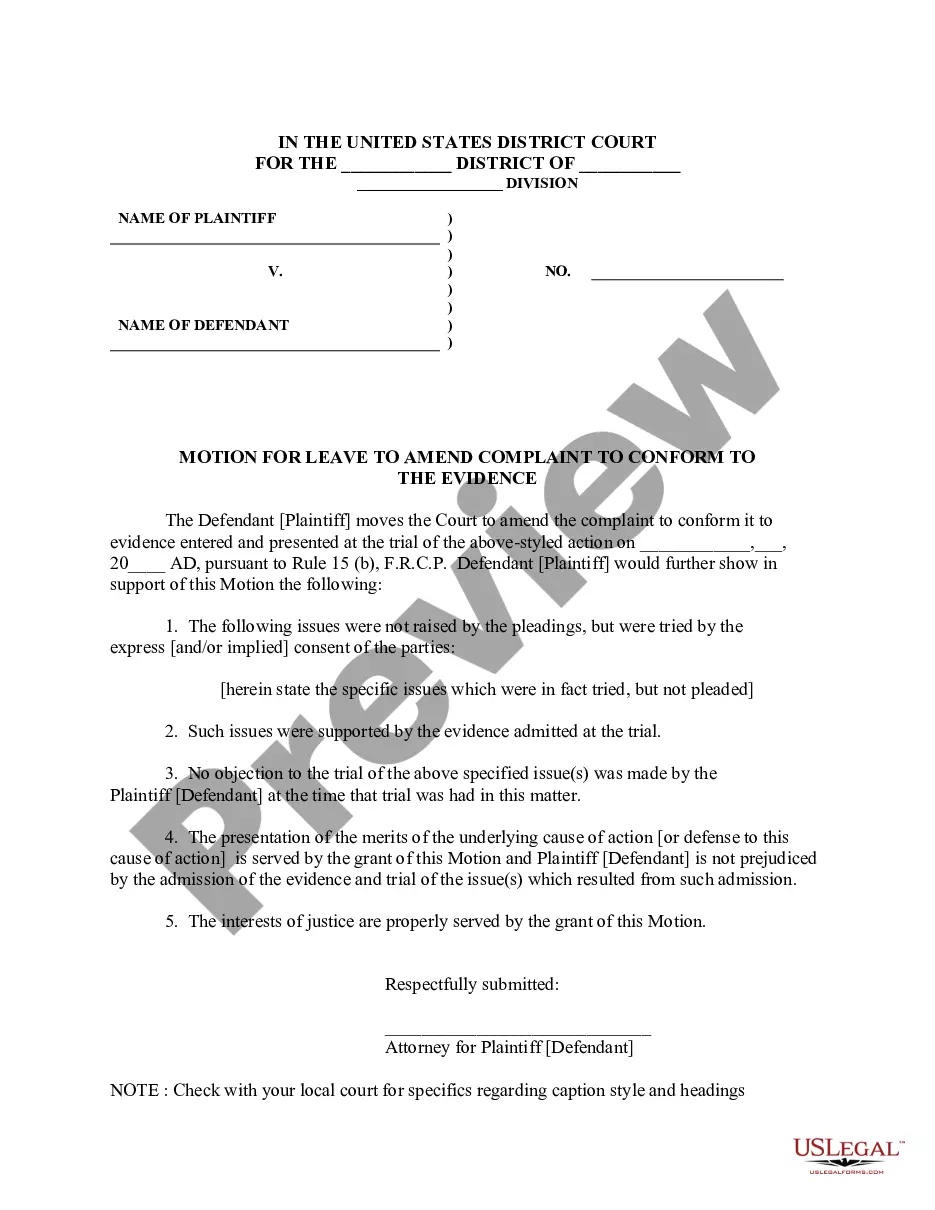
A motion for leave to file an amended complaint is a request made to the court, asking for permission to change the original complaint. This motion is vital if significant adjustments to the claims or parties involved are necessary. In situations involving a California Order Sustaining Defendants Demurrer to Complaint with Leave to Amend, filing this motion may be required to present a clearer case.