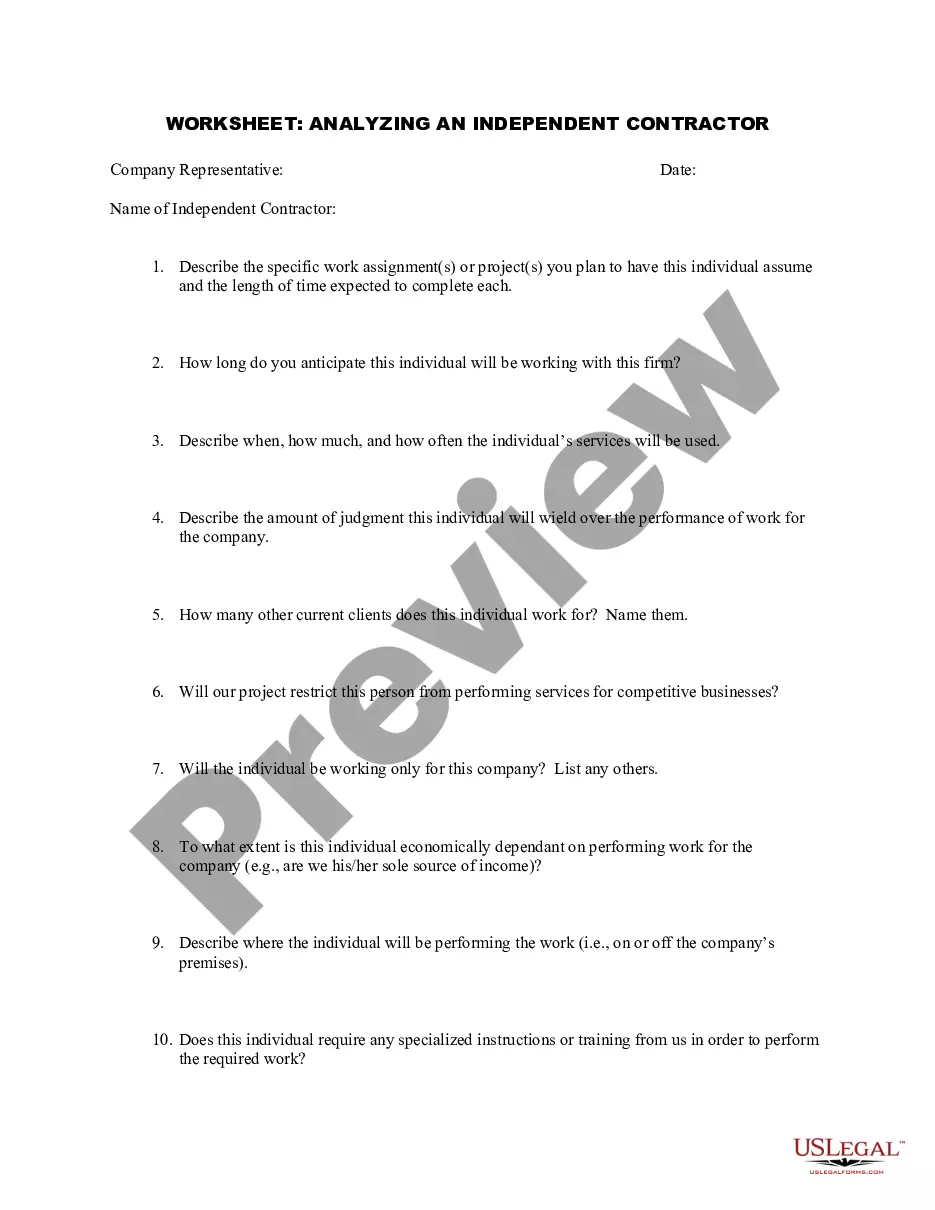
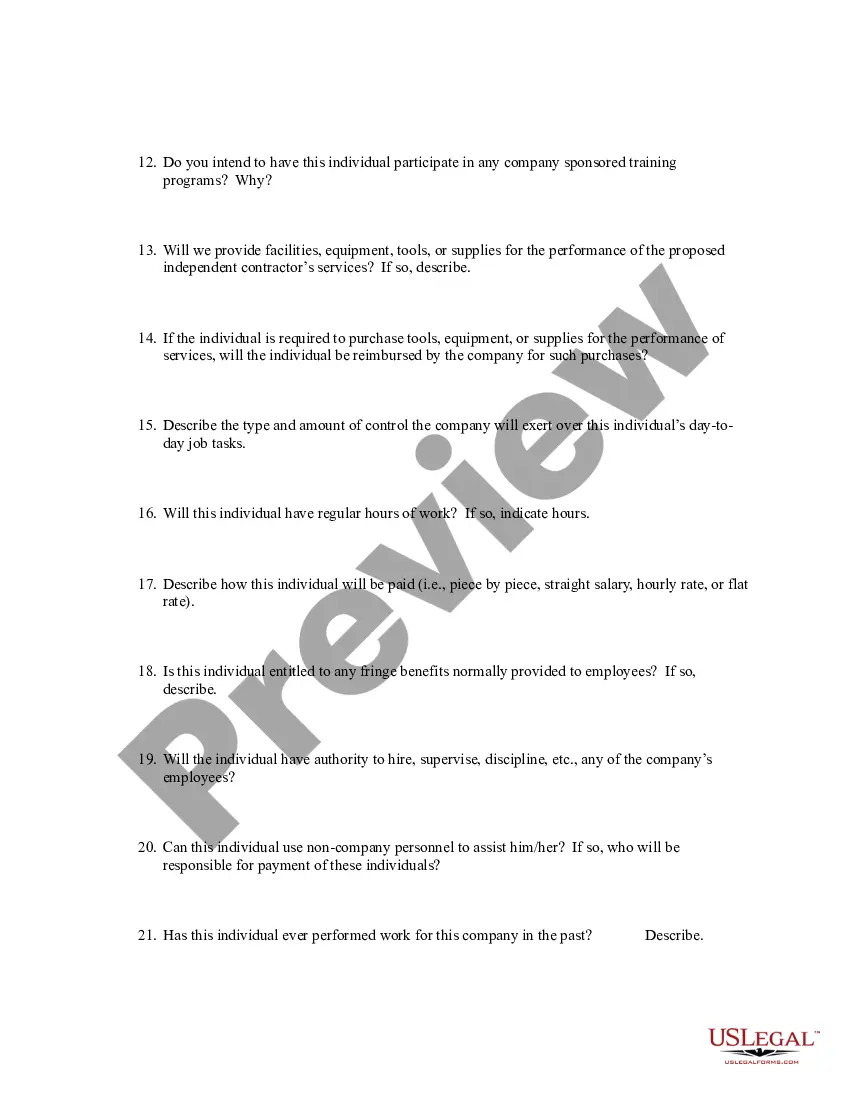
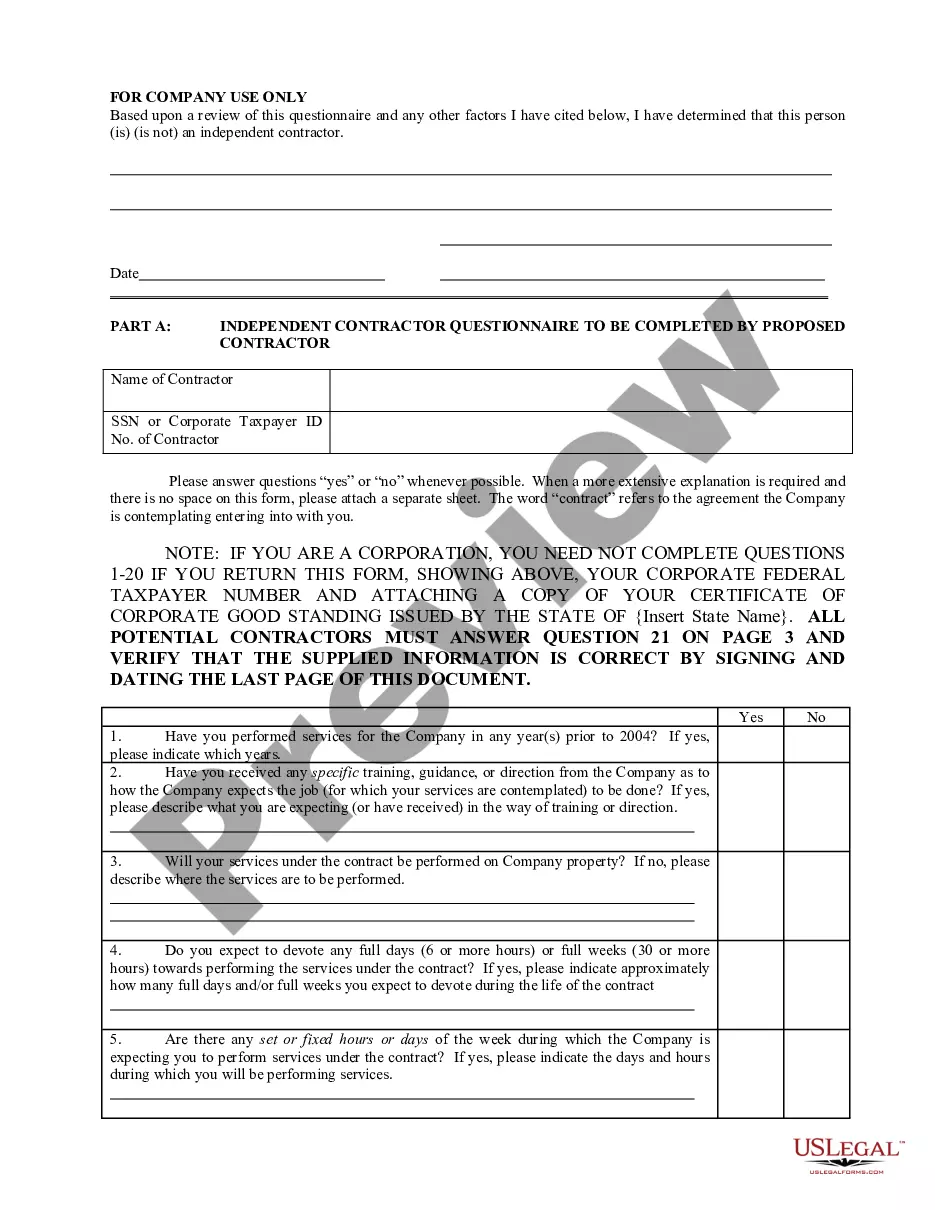
Arizona Worksheet Analyzing a Self-Employed Independent Contractor
Description
Get your form ready online
Our built-in tools help you complete, sign, share, and store your documents in one place.
Make edits, fill in missing information, and update formatting in US Legal Forms—just like you would in MS Word.
Download a copy, print it, send it by email, or mail it via USPS—whatever works best for your next step.
Sign and collect signatures with our SignNow integration. Send to multiple recipients, set reminders, and more. Go Premium to unlock E-Sign.
If this form requires notarization, complete it online through a secure video call—no need to meet a notary in person or wait for an appointment.
We protect your documents and personal data by following strict security and privacy standards.

Make edits, fill in missing information, and update formatting in US Legal Forms—just like you would in MS Word.

Download a copy, print it, send it by email, or mail it via USPS—whatever works best for your next step.

Sign and collect signatures with our SignNow integration. Send to multiple recipients, set reminders, and more. Go Premium to unlock E-Sign.

If this form requires notarization, complete it online through a secure video call—no need to meet a notary in person or wait for an appointment.

We protect your documents and personal data by following strict security and privacy standards.
Looking for another form?






How to fill out Worksheet Analyzing A Self-Employed Independent Contractor?
If you need to acquire, access, or print official document templates, utilize US Legal Forms, the largest assortment of legal forms available online.
Take advantage of the site's straightforward and user-friendly search feature to locate the documents you need.
Various templates for business and personal applications are organized by categories and states, or keywords.
Every legal document template you obtain is yours permanently. You can access every form you’ve downloaded in your account. Navigate to the My documents section and select a form to print or download again.
Complete, download, and print the Arizona Worksheet Evaluating a Self-Employed Independent Contractor with US Legal Forms. There are millions of professional and state-specific forms available for your business or personal needs.
- Use US Legal Forms to quickly locate the Arizona Worksheet Evaluating a Self-Employed Independent Contractor.
- If you are already a US Legal Forms customer, sign in to your account and click the Get button to obtain the Arizona Worksheet Evaluating a Self-Employed Independent Contractor.
- You can also access forms you have previously downloaded from the My documents section of your account.
- If you're using US Legal Forms for the first time, follow these steps.
- Step 1. Ensure you have selected the form for the correct region/state.
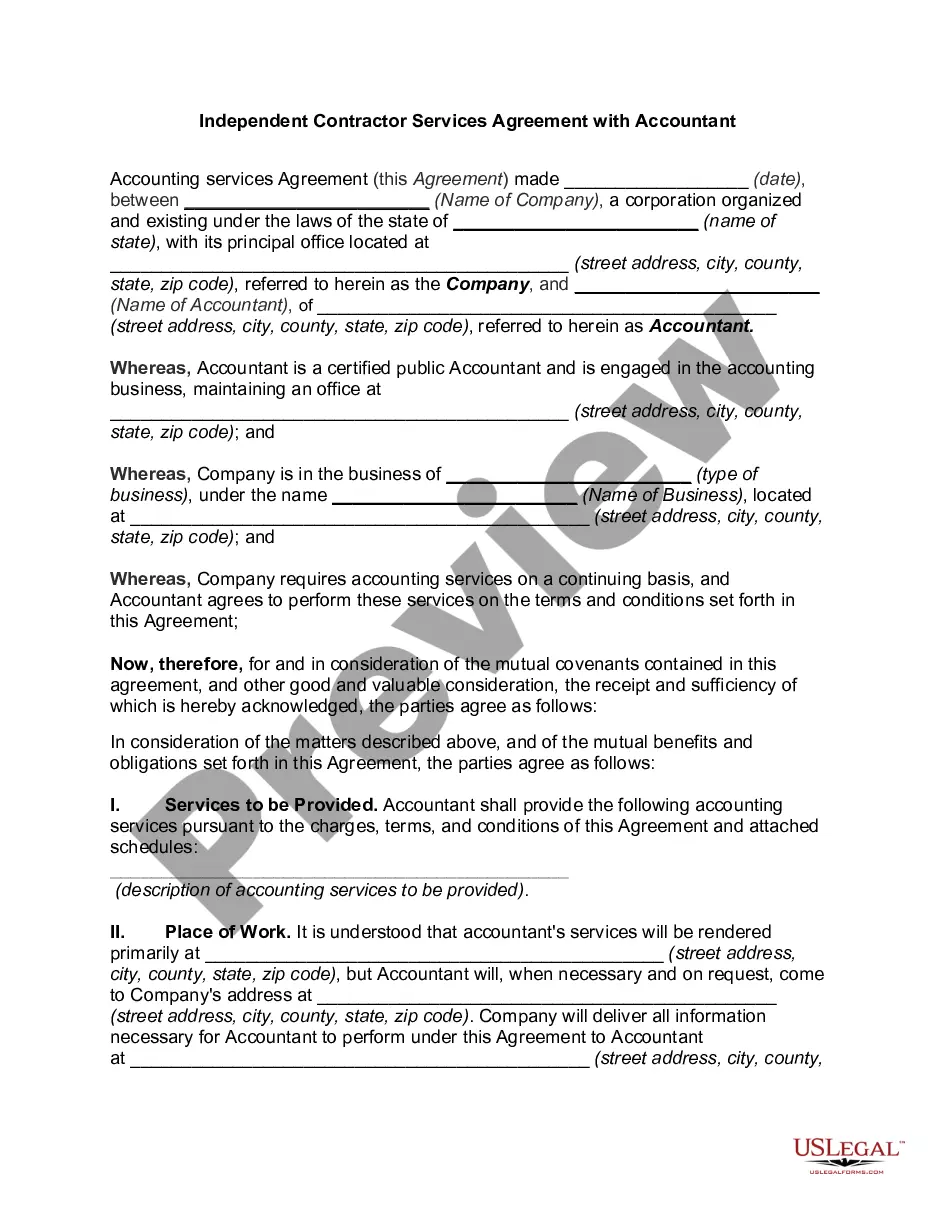
- Step 2. Use the Preview option to view the form's details. Remember to read the description.
- Step 3. If you are not satisfied with the form, utilize the Search box at the top of the screen to find other types of the legal form template.
- Step 4. Once you have found the form you need, click on the Purchase now button. Select the pricing plan you prefer and enter your details to create an account.
- Step 5. Complete the transaction. You can use your credit card or PayPal account to finish the payment.
- Step 6. Choose the format of your legal form and download it to your device.
- Step 7. Fill out, modify, and print or sign the Arizona Worksheet Evaluating a Self-Employed Independent Contractor.
Form popularity
FAQ
To calculate self-employment taxes for independent contractors, first determine your net earnings from self-employment. The IRS requires you to multiply your net income by 0.9235, then calculate 15.3% of that figure for self-employment tax. This includes both Social Security and Medicare contributions. Using resources like the Arizona Worksheet Analyzing a Self-Employed Independent Contractor can simplify this calculation.
The general rule is that an individual is an independent contractor if the payer has the right to control or direct only the result of the work and not what will be done and how it will be done. If you are an independent contractor, then you are self-employed.
A 1099 employee is a US self-employed worker that reports their income to the IRS on a 1099 tax form. Freelancers, gig workers, and independent contractors are all considered 1099 employees.
A worker does not have to meet all 20 criteria to qualify as an employee or independent contractor, and no single factor is decisive in determining a worker's status. The individual circumstances of each case determine the weight IRS assigns different factors.
Independent contractors are self-employed workers who provide services for an organisation under a contract for services. Independent contractors are not employees and are typically highly skilled, providing their clients with specialist skills or additional capacity on an as needed basis.
The general rule is that you will be: An employee if you work for someone and do not have the risks of running a business. Self-employed if you have a trade, profession or vocation, are in business on your own account and are responsible for the success or failure of that business.
If you are an independent contractor, then you are self-employed. The earnings of a person who is working as an independent contractor are subject to self-employment tax. To find out what your tax obligations are, visit the Self-Employed Individuals Tax Center.
What is the IRS 20-Factor Test? The IRS 20-Factor Test, commonly referred to as the Right-to-Control Test, is designed to evaluate who controls how the work is performed. According to the IRS's Common-Law Rules, a worker's status corresponds to the level of control and independence they have over their work.
Becoming an independent contractor is one of the many ways to be classified as self-employed. By definition, an independent contractor provides work or services on a contractual basis, whereas, self-employment is simply the act of earning money without operating within an employee-employer relationship.
The three types of self-employed individuals include:Independent contractors. Independent contractors are individuals hired to perform specific jobs for clients, meaning that they are only paid for their jobs.Sole proprietors.Partnerships.