Arizona Renouncement of Inheritance
Understanding this form
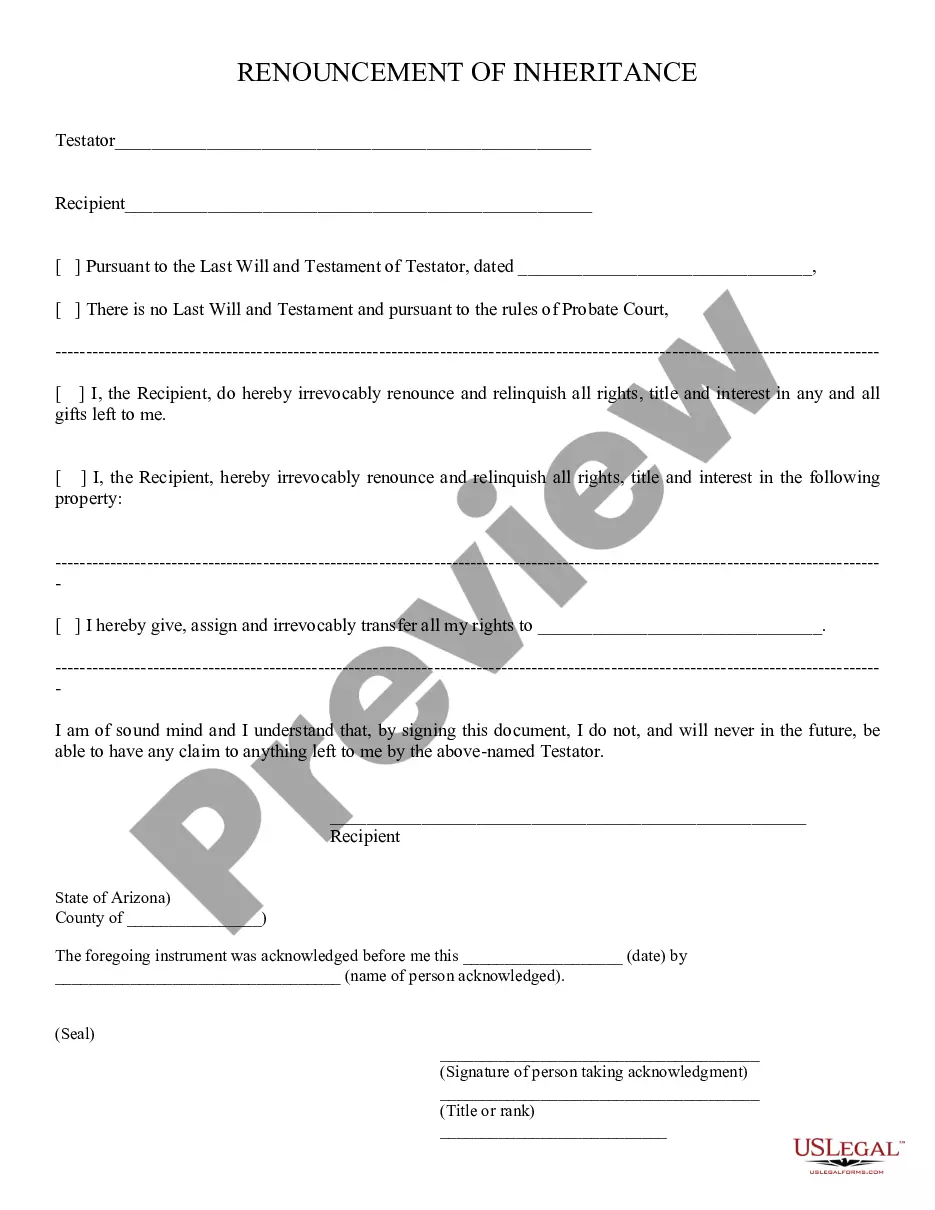
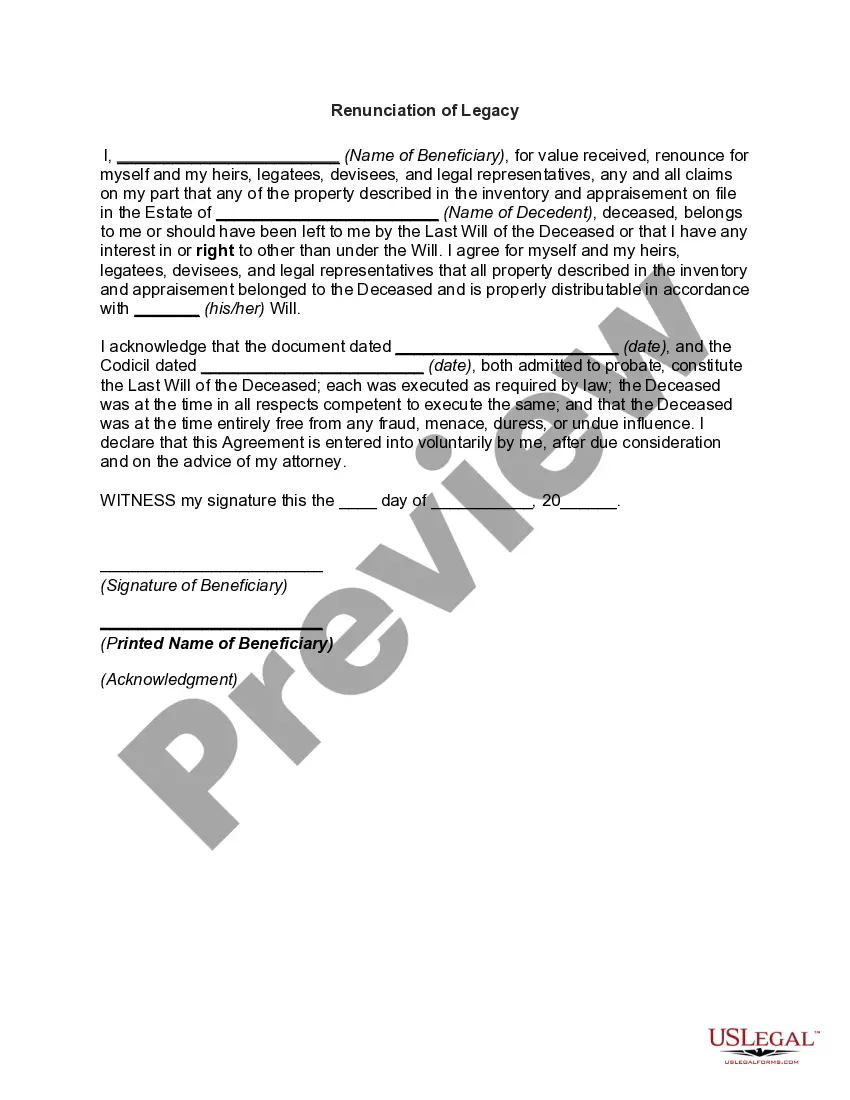
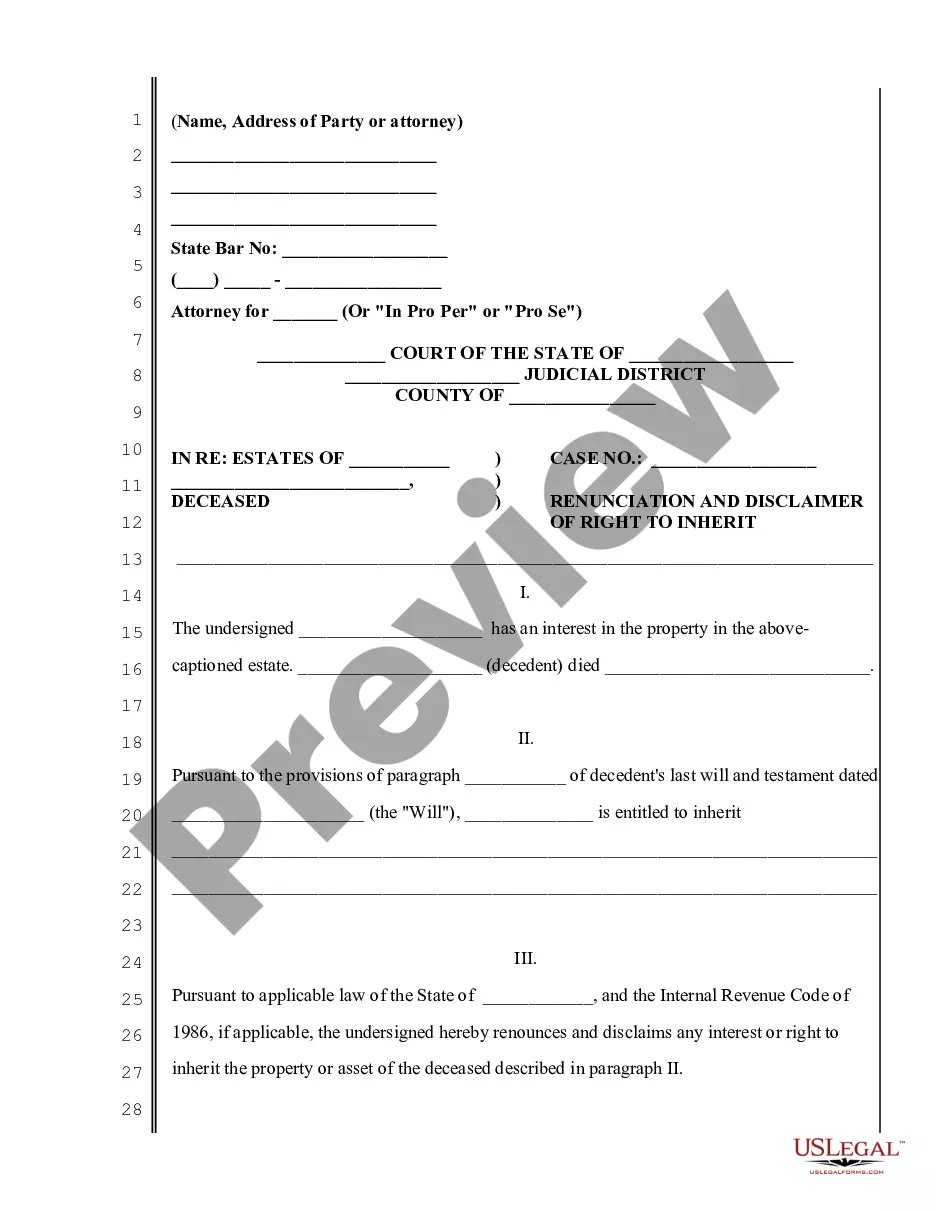
The Renouncement of Inheritance form allows an intended heir to formally relinquish their rights to an inheritance, such as property or money, that would have been received from the testatorâs estate. This form is beneficial for individuals who intentionally choose to give up their inheritance for personal or legal reasons. It differs from similar forms, like a Will, as it focuses specifically on the decision to renounce an inheritance rather than the distribution of assets after death.
Main sections of this form
- Identification of the testator and recipient.
- Specification of the Last Will and Testament or probate situation.
- Declaration of the irrevocable renouncement and relinquishment of rights.
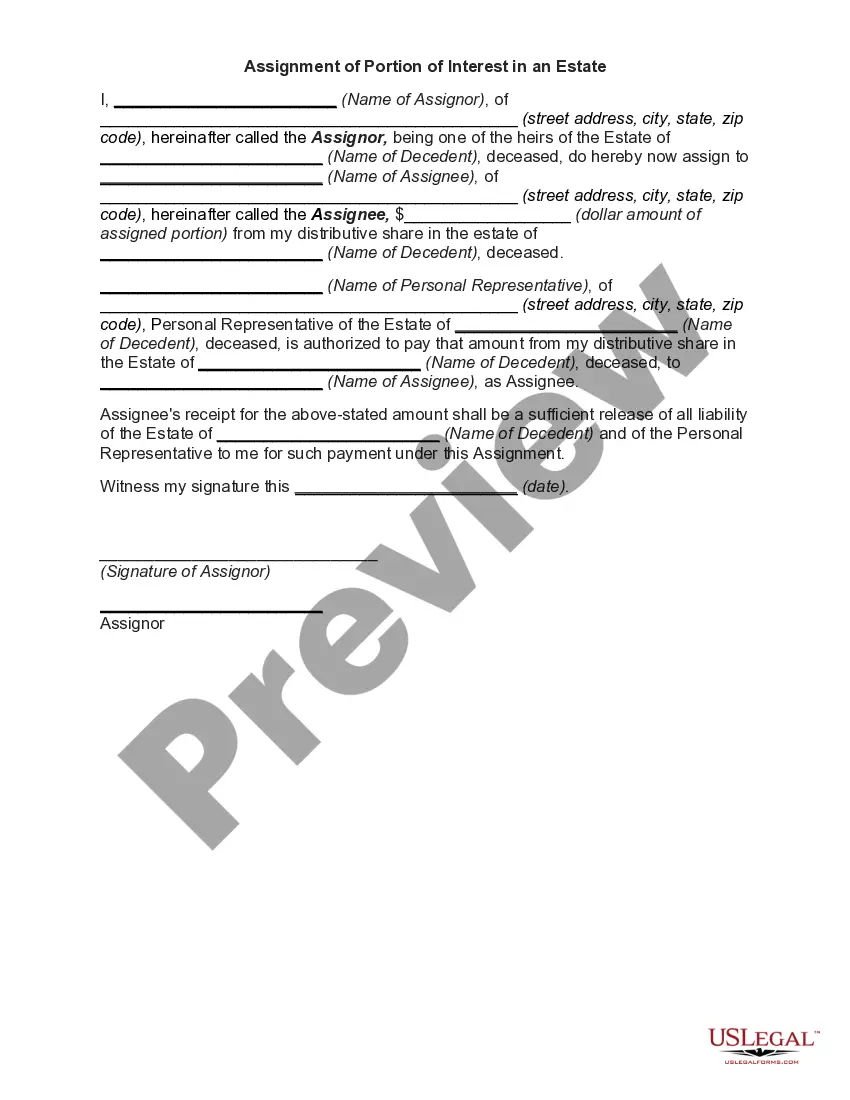
- Assignment of any rights to other parties if applicable.
- Notarization requirement to validate the form.

When this form is needed
This form should be used when an individual has been named as an heir in a will or is entitled to an inheritance through other legal means but has decided to forgo their rights to that inheritance. Common scenarios include wanting to remove oneself from a will due to family disputes, tax implications, or personal convictions.
Intended users of this form
- Individuals named as heirs in a will.
- Beneficiaries who wish to renounce their inheritance.
- Those advised by an attorney looking for a formal method to relinquish rights to property or assets.
Instructions for completing this form
- Enter the name of the testator and recipient.
- Specify the date of the Last Will and Testament or state if there is no will.
- Clearly declare the intention to irrevocably renounce all rights to the inheritance.
- If applicable, assign any rights to another party by naming them explicitly.
- Sign the form in front of a Notary Public, ensuring all signatures and seals are completed.
Does this form need to be notarized?
Yes, this form must be notarized to be legally valid. It must be signed in front of a Notary Public, which adds an additional layer of authenticity to the document. US Legal Forms provides integrated online notarization services, offering secure video calls with licensed notaries who can assist you anytime, ensuring your documents are legally compliant without the need for in-person visits.
Get your form ready online
Our built-in tools help you complete, sign, share, and store your documents in one place.
Make edits, fill in missing information, and update formatting in US Legal Forms—just like you would in MS Word.
Download a copy, print it, send it by email, or mail it via USPS—whatever works best for your next step.
Sign and collect signatures with our SignNow integration. Send to multiple recipients, set reminders, and more. Go Premium to unlock E-Sign.
If this form requires notarization, complete it online through a secure video call—no need to meet a notary in person or wait for an appointment.
We protect your documents and personal data by following strict security and privacy standards.

Make edits, fill in missing information, and update formatting in US Legal Forms—just like you would in MS Word.

Download a copy, print it, send it by email, or mail it via USPS—whatever works best for your next step.

Sign and collect signatures with our SignNow integration. Send to multiple recipients, set reminders, and more. Go Premium to unlock E-Sign.

If this form requires notarization, complete it online through a secure video call—no need to meet a notary in person or wait for an appointment.

We protect your documents and personal data by following strict security and privacy standards.
Avoid these common issues
- Failing to notarize the form, which may invalidate it.
- Not clearly identifying all property or interests being renounced.
- Leaving out necessary signatures or dates on the document.
Benefits of using this form online
- Convenient download options in Word and Rich Text formats for easy editing.
- Access to forms created by licensed attorneys, ensuring legal accuracy.
- Immediate availability, allowing users to complete and file their forms without delays.
Summary of main points
- The Renouncement of Inheritance form is crucial for heirs who wish to relinquish their rights to an inherited property or money.
- It must be filled out correctly and notarized to ensure its enforceability in Arizona.
- Understanding the implications of renouncing an inheritance is important, as it is an irrevocable decision.
Looking for another form?




Form popularity
FAQ
Inheritance law in Arizona is a combination of statutory provisions and common law that details how assets are distributed upon death. Arizona is a community property state, meaning assets acquired during marriage belong to both spouses. Understanding the nuances of the Arizona Renouncement of Inheritance ensures that you are well-equipped to address your legal rights and responsibilities during the distribution process.
In certain situations, you may be able to sell your deceased parents' house without going through probate in Arizona. If the property was held in a living trust or if it meets the requirements for a small estate, you could avoid a lengthy probate process. Consulting with experts about the Arizona Renouncement of Inheritance can provide clarity and options for managing inherited property smoothly.
The order of inheritance in Arizona begins with the surviving spouse and children, followed by parents, siblings, and then more distant relatives as necessary. If there are no immediate family members, the estate could ultimately go to the state. Familiarizing yourself with the Arizona Renouncement of Inheritance can guide you in understanding how your estate will be divided and could influence key decisions.
As of now, Arizona does not impose a state inheritance tax, which means you can inherit assets without any state tax obligations. However, federal estate tax laws might still apply based on the total value of the deceased's estate. Staying informed about your options through the Arizona Renouncement of Inheritance can help you navigate potential tax implications effectively.
When there is no will in Arizona, the state's intestacy laws dictate how the estate is divided. Generally, the spouse and children have the first rights to inherit, followed by parents, siblings, and more distant relatives as necessary. This emphasizes the importance of planning ahead and possibly consulting about the Arizona Renouncement of Inheritance if you wish to make specific arrangements regarding your estate.
In Arizona, a spouse does not automatically inherit everything if there are surviving children from the decedent's previous relationships. However, under community property law, the spouse is entitled to half of the community property accumulated during the marriage. Understanding your rights under the Arizona Renouncement of Inheritance can help clarify how assets will be distributed among heirs, including the spouse.
The renunciation of inheritance is the legal process by which an individual formally declines their right to receive inheritance or benefits from an estate. In Arizona, this procedure allows heirs to refuse their share, which may affect the distribution of assets. If you are considering this option, it is essential to understand the implications of the Arizona Renouncement of Inheritance, as it can impact both your financial situation and family dynamics.
In Arizona, an inheritance typically remains separate property, not marital property. However, if the inherited assets get commingled with marital assets, this can change their status. The Arizona Renouncement of Inheritance allows individuals to give up their rights to an inheritance, potentially simplifying matters related to marital property. Exploring this option can provide clarity and assist you in retaining greater control over your assets.
In Arizona, you have the option to turn down the entire inheritance, but not just a part of it. If you wish to customize the distribution, you might need to communicate with other beneficiaries or pursue alternative legal options. Full renouncement ensures that you do not inherit any assets or liabilities associated with the estate.
Yes, you can renounce your inheritance in Arizona, provided you follow the proper legal procedures. It is essential to file the renouncement in a timely manner, typically within a specified period after the individual's death. Leveraging the US Legal Forms platform can help ensure that you complete the necessary steps correctly and efficiently.