Arizona Petition for Subsequent Administration
About this form
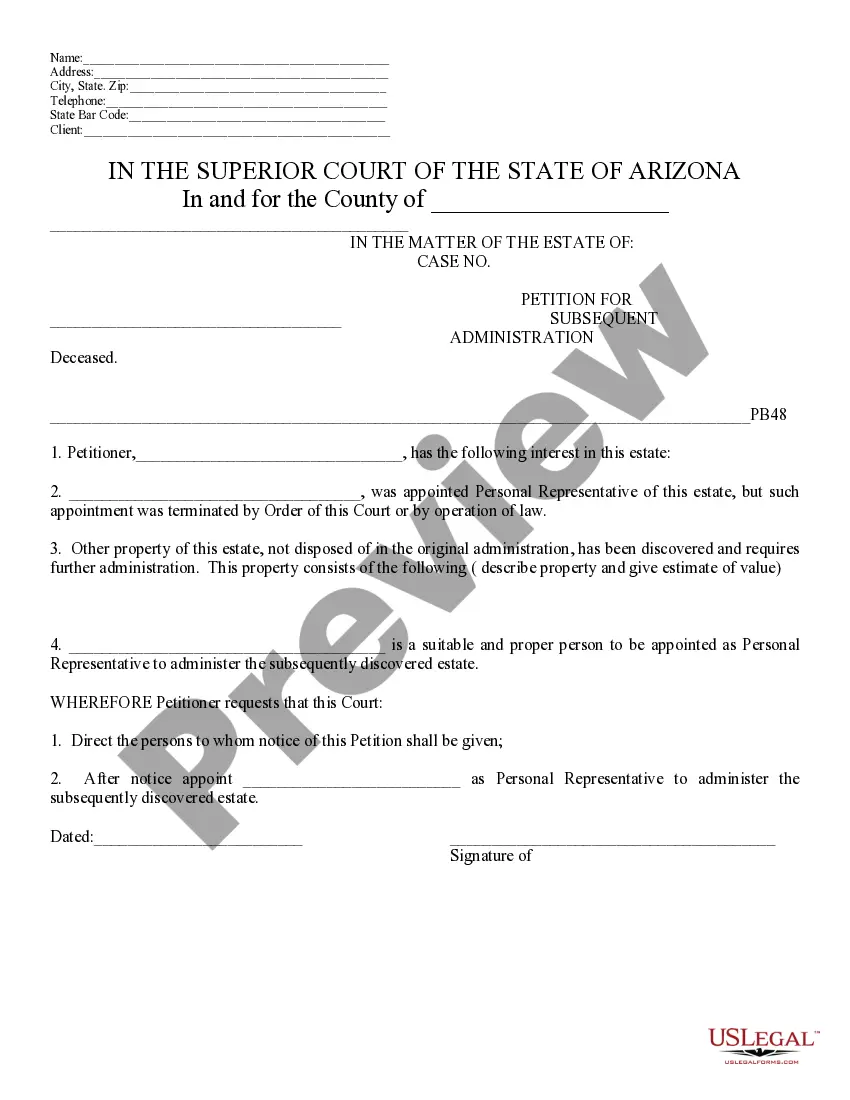
The Petition for Subsequent Administration is a legal document used to request the court to appoint a new personal representative for an estate when the original appointment has been terminated. This form is necessary when additional property not accounted for in the initial administration of the estate has been discovered and requires further management, distinguishing it from other estate administration forms that may not cover such scenarios.
Key components of this form
- Petitioner's information, including name and contact details.
- Identification of the deceased and the case number associated with the estate.
- Details regarding the termination of the original personal representative's appointment.
- Description and estimated value of the additional property discovered.
- Recommendation for a new personal representative to manage the estate.
- Request for the court to issue notice and appoint the new personal representative.
When to use this document
This form should be used in situations where the initial personal representative of an estate can no longer fulfill their duties, and there is new property that requires administration. Common scenarios include cases where an executor has resigned, died, or been removed by the court, and additional assets have come to light that must be managed. If you have recently discovered property after an estate was thought to be settled, this petition is essential for moving forward legally.
Intended users of this form
- Individuals seeking to administer an estate with newly discovered assets.
- Heirs or beneficiaries of an estate needing to appoint a new personal representative.
- Anyone involved in the probate process where the original personal representative is no longer available.
How to complete this form
- Identify and fill out your personal details as the petitioner, including your name and contact information.
- Provide the name of the deceased and the corresponding case number.
- State the reason for the termination of the previous personal representative's appointment.
- Clearly describe the newly discovered property, including an estimated value for each item.
- Nominate a suitable individual to be the new personal representative.
- Sign and date the petition to submit it to the court.
Is notarization required?
This form does not typically require notarization unless specified by local law. Always check if there are additional requirements in your jurisdiction to ensure compliance.
Get your form ready online
Our built-in tools help you complete, sign, share, and store your documents in one place.
Make edits, fill in missing information, and update formatting in US Legal Forms—just like you would in MS Word.
Download a copy, print it, send it by email, or mail it via USPS—whatever works best for your next step.
Sign and collect signatures with our SignNow integration. Send to multiple recipients, set reminders, and more. Go Premium to unlock E-Sign.
If this form requires notarization, complete it online through a secure video call—no need to meet a notary in person or wait for an appointment.
We protect your documents and personal data by following strict security and privacy standards.

Make edits, fill in missing information, and update formatting in US Legal Forms—just like you would in MS Word.

Download a copy, print it, send it by email, or mail it via USPS—whatever works best for your next step.

Sign and collect signatures with our SignNow integration. Send to multiple recipients, set reminders, and more. Go Premium to unlock E-Sign.

If this form requires notarization, complete it online through a secure video call—no need to meet a notary in person or wait for an appointment.

We protect your documents and personal data by following strict security and privacy standards.
Avoid these common issues
- Failing to provide complete information about the deceased and the estate.
- Not including a detailed description of the newly discovered property.
- Omitting the signature or date, which can invalidate the petition.
- Using outdated forms that do not comply with current legal standards.
Advantages of online completion
- Convenient access from anywhere, allowing for completion at your own pace.
- Editable templates that can be adapted to your individual case specifics.
- Reliable forms drafted by licensed attorneys to ensure compliance with legal standards.
Summary of main points
- The Petition for Subsequent Administration allows for the management of newly discovered estate assets.
- It is crucial for heirs or interested parties to file this form promptly after discovering additional property.
- Accurate and thorough completion of the form is necessary to facilitate a smooth review by the court.
Looking for another form?




Form popularity
FAQ
An executor has a reasonable timeframe to settle an estate in Arizona, typically ranging from six months to a year, depending on the estate’s complexity. Settlements involve paying debts, taxes, and distributing assets to beneficiaries. An efficient process is crucial to fulfilling your duties effectively. To help streamline the administration, an Arizona Petition for Subsequent Administration is a beneficial tool.
Yes, there is a two-year time limit for filing probate in Arizona after the person’s death. If you miss this deadline, you may lose the opportunity to administer the estate legally. Therefore, timely action is essential for securing your rights as an heir or beneficiary. Filing an Arizona Petition for Subsequent Administration promptly can help you adhere to this timeframe.
In Arizona, you must file for probate within two years of the individual’s death. However, it's advisable to initiate the process as soon as possible to prevent complications with the estate administration. By filing early, you can address any potential disputes and ensure timely distribution of assets. Consider using an Arizona Petition for Subsequent Administration to streamline your filing process.
Arizona probate rules require that all wills be filed with the court, and an executor is appointed to manage the estate. The process involves notifying beneficiaries and creditors, inventorying the estate, and eventually settling debts before distributions. Adhering to these rules is crucial to ensure lawful handling of the estate. Utilizing an Arizona Petition for Subsequent Administration can facilitate this process efficiently.
If you don't file for probate in Arizona, the court cannot validate the will, and the estate might remain in limbo. This situation can lead to complications, such as delays in distributing assets. Additionally, creditors may pursue claims against the estate, and heirs may face challenges in claiming their inheritance. To avoid these issues, consider filing an Arizona Petition for Subsequent Administration to ensure a smooth process.
In Arizona, several assets are typically exempt from probate. These include assets held in joint tenancy, trust assets, and life insurance policies with named beneficiaries. If you're dealing with such assets, you may not need to file an Arizona Petition for Subsequent Administration. It's prudent to review your assets to understand which ones can be transferred without probate.
While Arizona does not have a strict monetary threshold for triggering probate, it generally involves estates with assets that need formal transfer. If the value of the estate is significant and includes unaccounted assets, an Arizona Petition for Subsequent Administration can facilitate proper management and distribution. Assessing your estate's specifics is crucial for determining the need for probate.
Not all estates in Arizona must go through probate. For example, assets held in a trust or those with designated beneficiaries often bypass this process. However, when faced with managing an estate, an Arizona Petition for Subsequent Administration may still be beneficial for efficient administration. Evaluate your situation to determine the best approach.
Rule 51 in Arizona probate law pertains to the requirements for claims against an estate. It outlines the time frames within which claims must be filed, thus protecting both the estate and the heirs. Understanding this rule helps you determine whether an Arizona Petition for Subsequent Administration is necessary. Consult an expert to ensure compliance with these requirements.
To administer an estate in Arizona, you typically start by filing the deceased's will and an Arizona Petition for Subsequent Administration with the probate court. Next, you will identify and gather all assets, settle debts, and distribute what's left to the rightful heirs. It’s crucial to document each step and consider seeking legal help to navigate the complexities of the estate administration process.