Arizona Order of Formal Probate and Appointment of Personal Representative
What this document covers
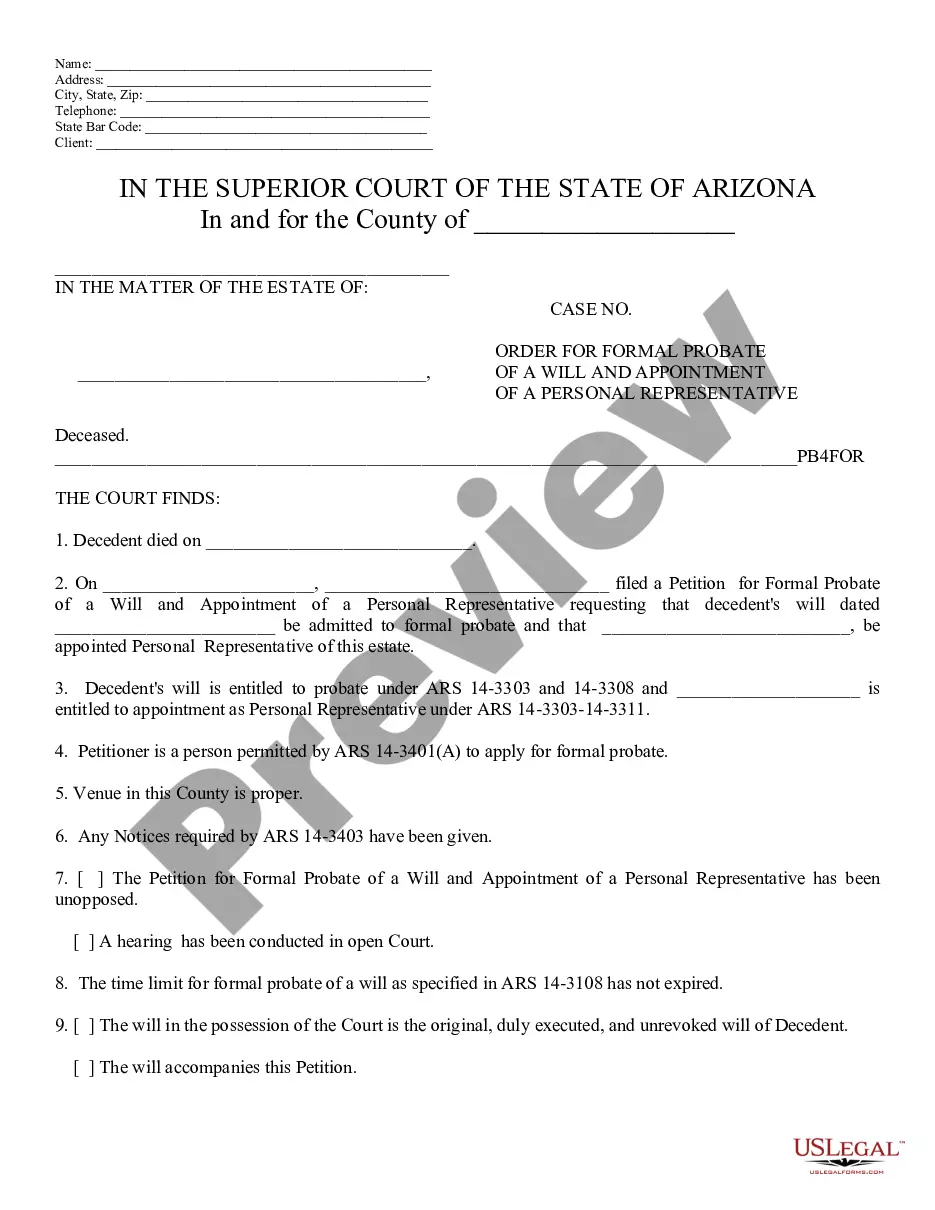
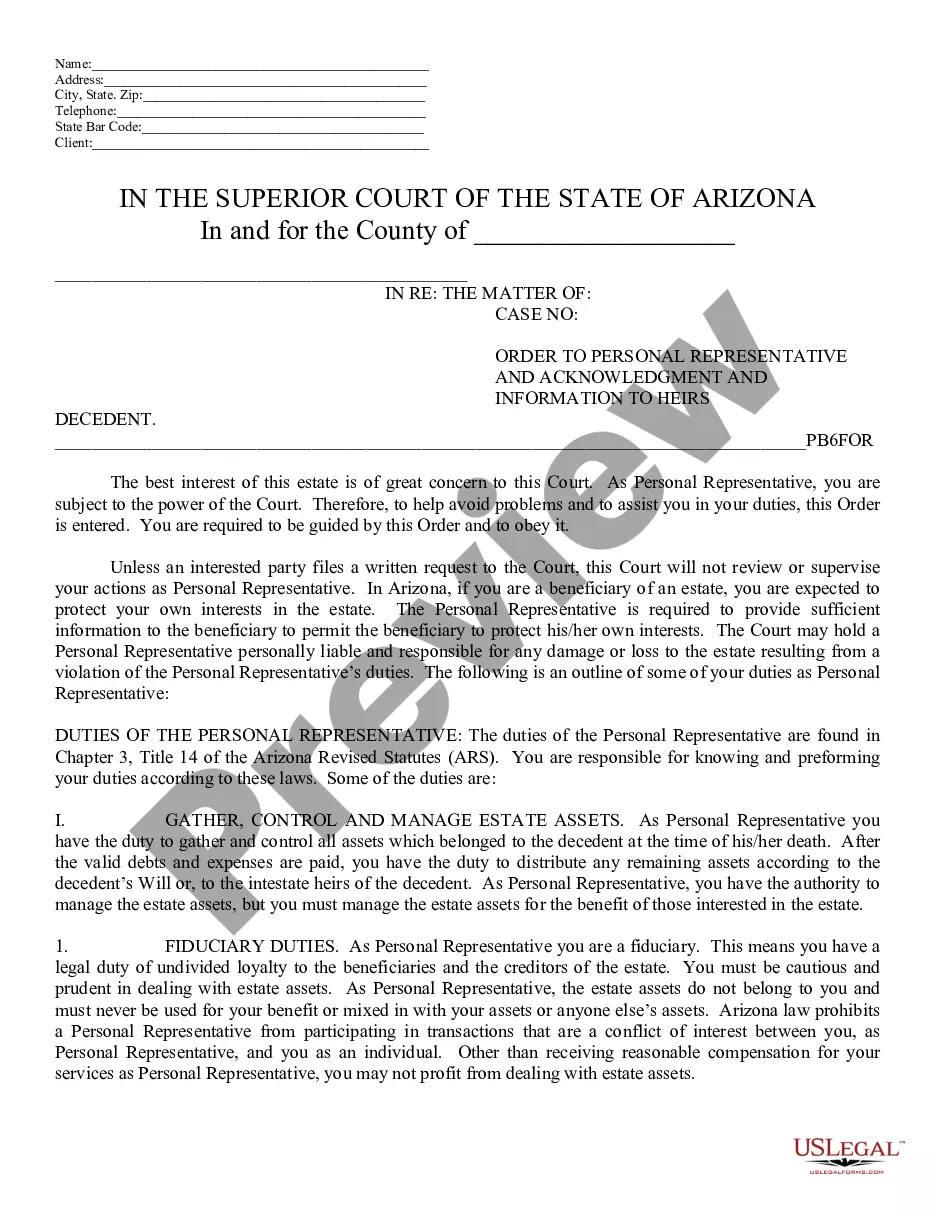
The Order of Formal Probate and Appointment of Personal Representative is a legal document issued by the court that validates a deceased person's will and appoints a personal representative to manage the estate. Unlike informal probate processes, this order follows a formal procedure and is typically used when the will is contested or when a formal court relationship is necessary. It serves to ensure the estate is handled according to the wishes of the deceased as outlined in their will.
Main sections of this form
- Identification of the court and case number.
- Details of the deceased, including name and date of death.
- Verification of the petition for probate, including the petitioner's information.
- Citations of relevant Arizona Revised Statutes (ARS) governing probate.
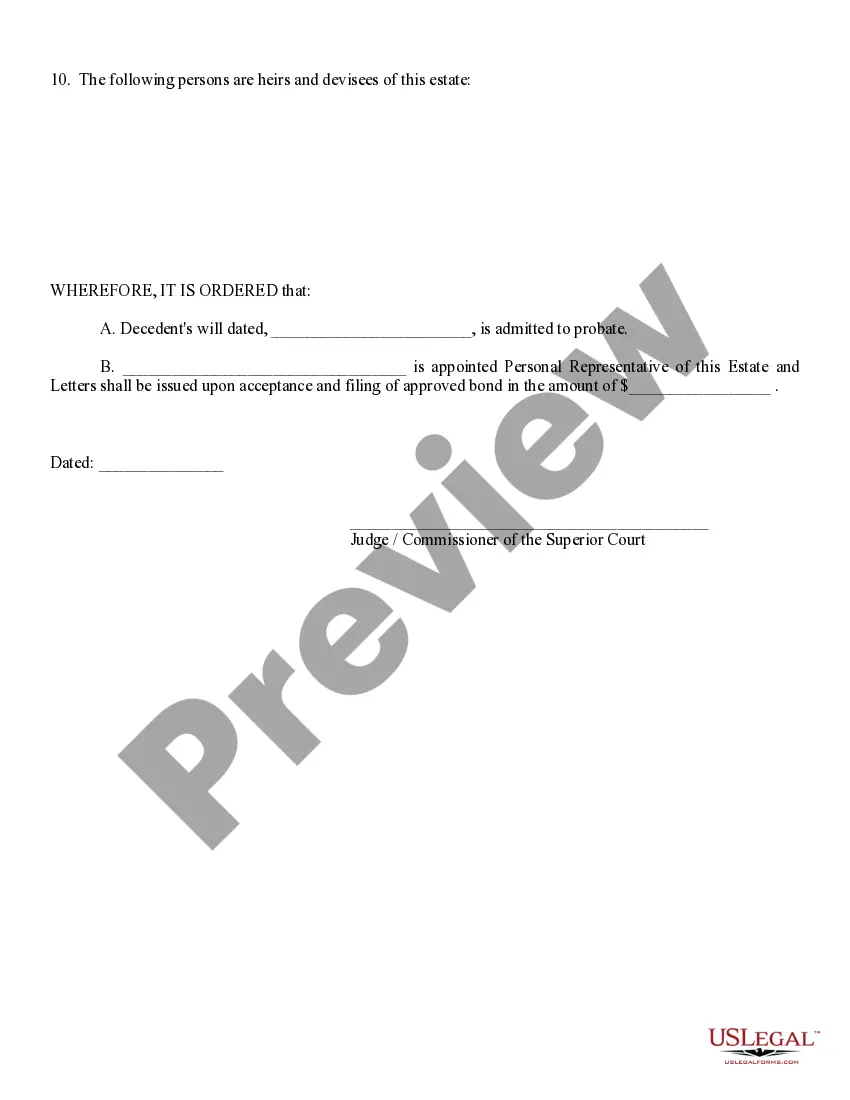
- Appointment of a personal representative and issuance of Letters.
- Signature of the judge or commissioner overseeing the probate process.
Common use cases
This form should be used when a person passes away and their will needs to be formally probated to ensure that their final wishes are followed. It is applicable in situations where there may be disputes over the validity of the will or when statutory requirements necessitate court oversight. Use this form when seeking to have a designated individual appointed as the personal representative responsible for settling the estate affairs.
Who can use this document
- Individuals filing for formal probate of a deceased personâs estate.
- Heirs or beneficiaries who need to appoint a personal representative.
- Attorneys representing clients in probate matters.
- Executors of a will who must navigate the court system.
How to complete this form
- Identify the correct court and fill in the case number.
- Enter the name and date of death of the decedent.
- Provide the details of the individual filing the petition along with their relationship to the decedent.
- List the relevant statutes that support the request for formal probate.
- Specify the chosen personal representative and ensure all required signatures are included.
Does this form need to be notarized?
This form does not typically require notarization unless specified by local law. Ensure that you are aware of any additional requirements that your local court may impose.
Get your form ready online
Our built-in tools help you complete, sign, share, and store your documents in one place.
Make edits, fill in missing information, and update formatting in US Legal Forms—just like you would in MS Word.
Download a copy, print it, send it by email, or mail it via USPS—whatever works best for your next step.
Sign and collect signatures with our SignNow integration. Send to multiple recipients, set reminders, and more. Go Premium to unlock E-Sign.
If this form requires notarization, complete it online through a secure video call—no need to meet a notary in person or wait for an appointment.
We protect your documents and personal data by following strict security and privacy standards.

Make edits, fill in missing information, and update formatting in US Legal Forms—just like you would in MS Word.

Download a copy, print it, send it by email, or mail it via USPS—whatever works best for your next step.

Sign and collect signatures with our SignNow integration. Send to multiple recipients, set reminders, and more. Go Premium to unlock E-Sign.

If this form requires notarization, complete it online through a secure video call—no need to meet a notary in person or wait for an appointment.

We protect your documents and personal data by following strict security and privacy standards.
Common mistakes to avoid
- Failing to provide complete and accurate information about the decedent.
- Omitting necessary statutory references that justify the probate request.
- Neglecting to include all required signatures before submission.
- Submitting the form past applicable deadlines.
Why complete this form online
- Immediate access to a professionally drafted template tailored for Arizona.
- Editable fields allow for personalization related to each specific case.
- Time-saving process with quick downloading options.
- Reliable and compliant with state law provisions, reducing the risk of legal errors.
Main things to remember
- The Order of Formal Probate is essential for validating a will and appointing a Personal Representative.
- Completing the form requires accurate information about the decedent and relevant parties.
- Using this form online streamlines the process and reduces errors.
Looking for another form?

Form popularity
FAQ
A personal representative in Arizona has the authority to manage the deceased’s estate, which includes paying debts, distributing assets, and ensuring that the probate process adheres to state laws. This role is crucial for maintaining the integrity of the estate and fulfilling the wishes of the deceased. The Arizona Order of Formal Probate and Appointment of Personal Representative clarifies these powers, allowing the representative to operate efficiently and transparently.
To become a personal representative in Arizona, you must file a petition for the Arizona Order of Formal Probate and Appointment of Personal Representative with the court. You will need to provide specific information about the deceased and their estate. It is important to gather necessary documents and possibly seek guidance from a legal professional to ensure a smooth application process.
In Arizona, the highest priority for appointment as a personal representative typically goes to the surviving spouse or registered domestic partner of the deceased. If there is no spouse or partner, adult children, parents, or siblings may be considered next in line. The Arizona Order of Formal Probate and Appointment of Personal Representative aims to streamline this process, ensuring that the right individual assumes this important role.
Formal probate in Arizona is the court-supervised process for managing a deceased person's estate, particularly when there are conflicts or significant assets involved. This process permits the appointment of a personal representative, as defined in the Arizona Order of Formal Probate and Appointment of Personal Representative. In formal probate, the court oversees the administration, ensuring compliance with legal obligations. It’s essential for those navigating estate matters to understand the intricacies of formal probate.
The steps for probate in Arizona typically start with filing a petition in the appropriate court, followed by notifying heirs and creditors. Then, the court will issue an order for appointment of a personal representative, which is an integral part of the Arizona Order of Formal Probate and Appointment of Personal Representative. Next, the personal representative identifies and collects assets, pays debts, and handles any disputes. Finally, the personal representative distributes assets according to the will or state law.
Arizona recognizes several types of probate processes, including formal probate, informal probate, and small estate probate. Formal probate is required for larger estates or when disputes arise, while informal probate is a simpler process for uncomplicated cases. Small estate probate provides an expedited process for estates below a certain value threshold. Knowing these types helps you choose the right path when dealing with the Arizona Order of Formal Probate and Appointment of Personal Representative.
A personal representative in Arizona probate is an individual appointed by the court to administer the decedent's estate. This role is vital for ensuring that the wishes expressed in a will are carried out, and debts are settled according to Arizona laws. The personal representative is responsible for managing the estate, which includes gathering assets, paying bills, and distributing any remaining assets to beneficiaries. Understanding this role helps in navigating the Arizona Order of Formal Probate and Appointment of Personal Representative effectively.
A letter of appointment of personal representative in Arizona serves as official documentation that grants authority to a designated individual to act on behalf of the estate. This letter is crucial in the Arizona Order of Formal Probate and Appointment of Personal Representative process. It enables the personal representative to manage the estate's affairs, which may include settling debts and distributing assets. Obtaining this letter typically requires filing specific forms with the probate court.
The formal probate process in Arizona involves several key steps to ensure the orderly distribution of an estate. Initially, the court must validate the will and appoint a personal representative. Subsequently, the representative manages estate assets, pays debts, and distributes the remaining assets according to the will or state law, all while adhering to the Arizona Order of Formal Probate and Appointment of Personal Representative.
To become a personal representative for an estate in Arizona, you must first be appointed by the court through the formal probate process. You can apply to serve if you are an eligible individual or institution, as outlined by state law. Submitting the required documents along with the petition for the Arizona Order of Formal Probate and Appointment of Personal Representative is the first step toward fulfilling this important role.