Arizona Notice of Option for Recording
Overview of this form
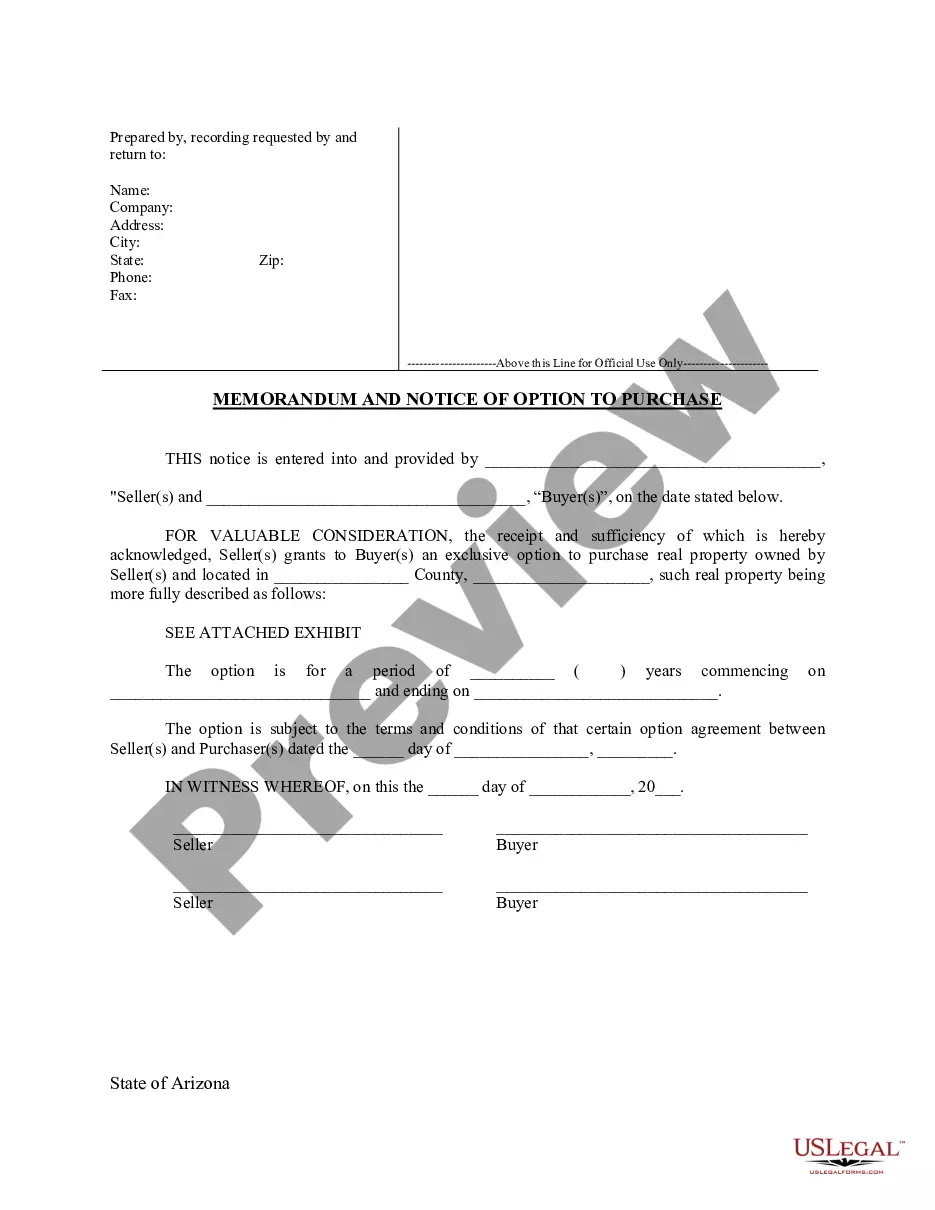
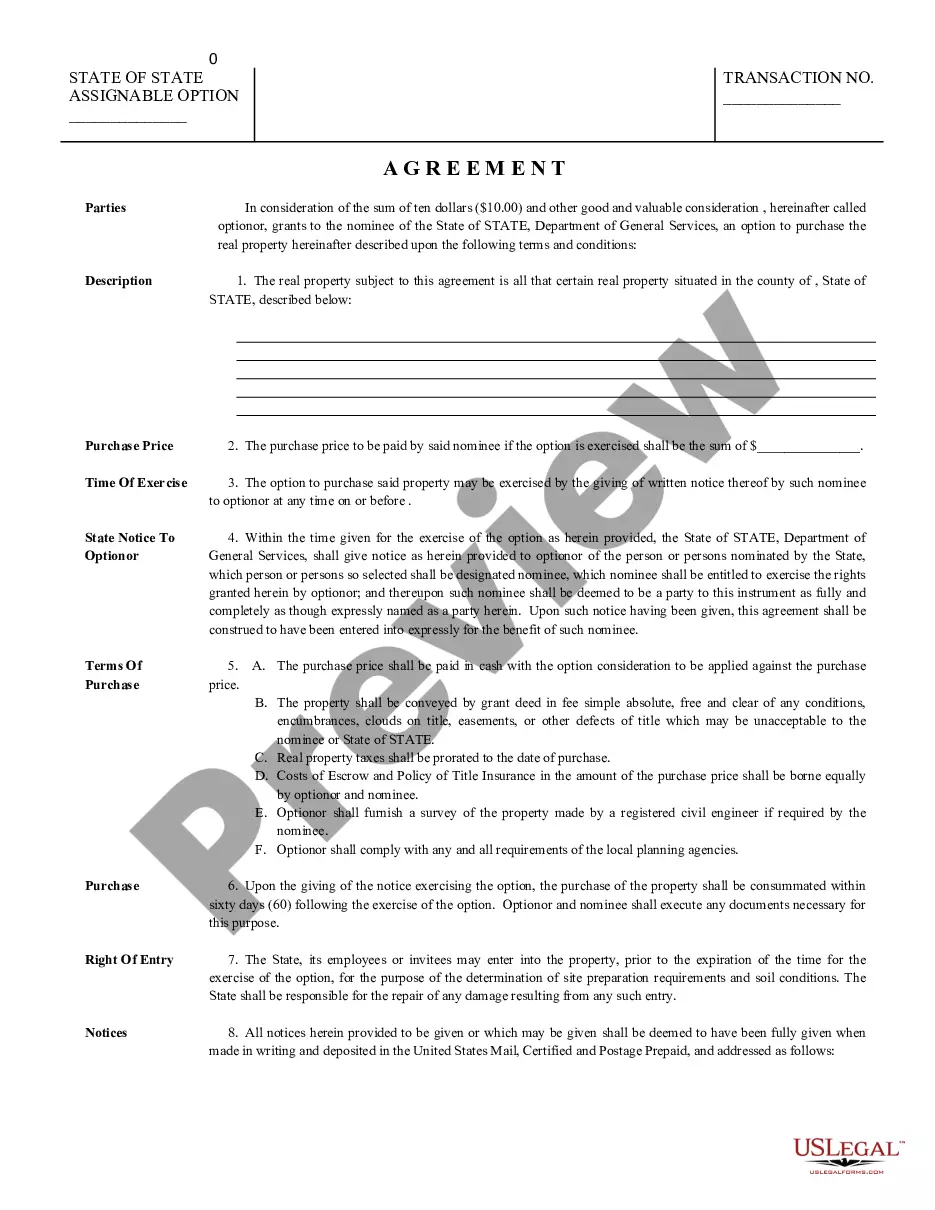
The Notice of Option for Recording is a legal document that serves to inform relevant parties and authorities that an option to purchase a specific parcel of real estate exists. This memorandum is recorded in official records to provide notice without the necessity of recording the entire option agreement, thereby streamlining the process and maintaining confidentiality regarding the full terms of the agreement.
Key parts of this document
- Prepared by and contacted details including name, company, address, and phone number.
- Identification of Seller(s) and Buyer(s) involved in the agreement.
- Description of the property which includes the county and specific legal descriptions.
- Effective dates outlining the term of the option.
- Signature lines for Seller(s) and Buyer(s) to acknowledge the agreement.
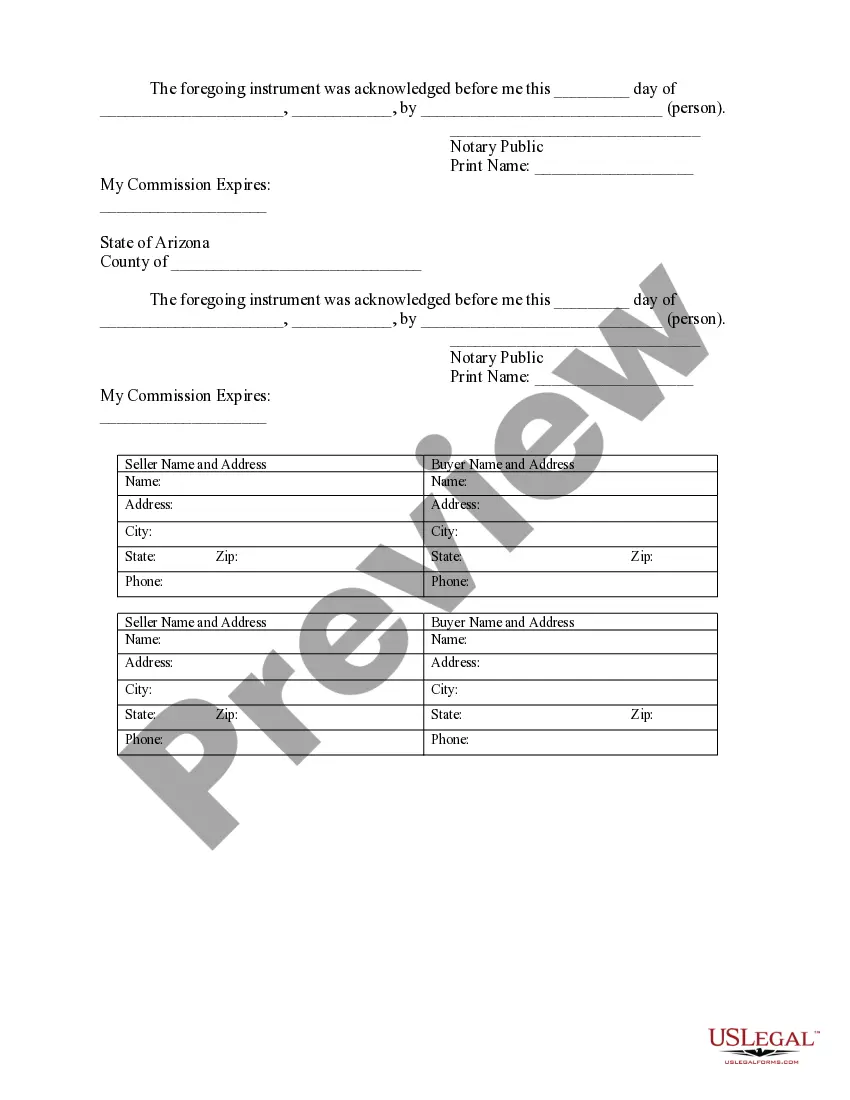
- Notary acknowledgment to validate the signatures and date of the agreement.
Common use cases
This form should be used when a Seller wishes to provide formal notice of an existing option to purchase property, allowing a potential Buyer to have legal grounds to assert their rights regarding the property without disclosing all details of the option agreement itself. It is particularly useful in real estate transactions where privacy and the protection of sensitive contract terms are a priority.
Who should use this form
This form is intended for the following parties:
- Property Sellers who want to publicly record their option to sell.
- Potential Buyers seeking to secure their rights to purchase real estate.
- Real estate professionals involved in managing or facilitating property transactions.
Instructions for completing this form
To successfully complete the Notice of Option for Recording, follow these steps:
- Identify the parties involved by entering the names of the Seller(s) and Buyer(s).
- Fill out the description of the property, including the county and specific legal details.
- Specify the duration of the option by entering the start and end dates.
- Provide the details of the original option agreement, including the date it was established.
- Obtain signatures from all parties involved to validate the document.
- If necessary, have the form notarized to ensure it meets legal standards.
Is notarization required?
Yes, this form must be notarized to be legally valid. During the notarization process, a notary public will verify the identities of the signers and witness the signing of the document, enhancing its enforceability. US Legal Forms provides integrated online notarization options, ensuring convenience and security.
Get your form ready online
Our built-in tools help you complete, sign, share, and store your documents in one place.
Make edits, fill in missing information, and update formatting in US Legal Forms—just like you would in MS Word.
Download a copy, print it, send it by email, or mail it via USPS—whatever works best for your next step.
Sign and collect signatures with our SignNow integration. Send to multiple recipients, set reminders, and more. Go Premium to unlock E-Sign.
If this form requires notarization, complete it online through a secure video call—no need to meet a notary in person or wait for an appointment.
We protect your documents and personal data by following strict security and privacy standards.

Make edits, fill in missing information, and update formatting in US Legal Forms—just like you would in MS Word.

Download a copy, print it, send it by email, or mail it via USPS—whatever works best for your next step.

Sign and collect signatures with our SignNow integration. Send to multiple recipients, set reminders, and more. Go Premium to unlock E-Sign.

If this form requires notarization, complete it online through a secure video call—no need to meet a notary in person or wait for an appointment.

We protect your documents and personal data by following strict security and privacy standards.
Common mistakes
- Failing to include accurate property descriptions.
- Not obtaining all required signatures.
- Missing the notarization step, if required.
- Leaving out critical information about the option duration.
- Not referencing the original option agreement correctly.
Why complete this form online
- Convenience of online form downloading without the need for an office visit.
- Editable templates allow personalized information to be added easily.
- Reliability as the forms are drafted by licensed attorneys.
- Time-saving by completing the form at the user's own pace.
- Access to a range of legal forms for various situations beyond the Notice of Option.
Key takeaways
- The Notice of Option for Recording informs that an option to purchase real property exists.
- It acts as a public record without disclosing the entire agreement's details.
- Key parties involved should carefully review and sign the document.
- Notarization is required for the form to be valid.
Looking for another form?
Form popularity
FAQ
You can easily request a copy of your house deed in Arizona from the county recorder's office. You may choose to visit in person or utilize their online services, which many counties provide. Using USLegalForms can be beneficial, as it offers step-by-step instructions to help you navigate obtaining your Arizona Notice of Option for Recording. By following their guidance, you can efficiently secure the documentation you need.
To obtain a copy of your house deed in Arizona, you can visit the county recorder's office where the property is located. Most counties offer online access to property records, which simplifies the process. If you are unfamiliar with the state’s procedures, you might consider using USLegalForms to guide you through acquiring your Arizona Notice of Option for Recording. This platform offers resources to help streamline the process and ensure you have all necessary documents.
In Arizona, a deed does not need to be recorded to be valid; however, recording it provides crucial legal protections. When you record your deed, you establish public notice of your ownership. This is particularly important in cases involving an Arizona Notice of Option for Recording, as it helps prevent disputes over property titles. Thus, while recording is not mandatory, it is highly recommended to secure your investment.
In Arizona, the most common type of deed is the warranty deed. This document guarantees that the seller has clear title to the property and can transfer it to the buyer. When dealing with an Arizona Notice of Option for Recording, using a warranty deed ensures that your ownership rights are well protected. It is an essential document in real estate transactions, providing peace of mind to all parties involved.
Arizona is a 'one-party consent' state, meaning you do not have to inform someone if you are recording a conversation in which you are participating. However, this applies only to audio recordings—video recordings may have different regulations. For clarity on your rights and responsibilities, consider the implications of the Arizona Notice of Option for Recording.
A 30-day notice to a tenant in Arizona serves as a declaration from the landlord that they intend to terminate the rental agreement without cause. It allows tenants a full month to prepare for the move. Understanding the implications of such notices is essential, especially relating to aspects like the Arizona Notice of Option for Recording.
In Arizona, written notice must be delivered in a manner specified by the lease agreement or state law. While email may be accepted in some circumstances, it is always best to confirm with the lease provisions. Utilizing the Arizona Notice of Option for Recording can provide clarity on acceptable methods of communication.
Statute 33-405 in Arizona pertains to the recording of notices and documents related to property and landlord-tenant relationships. This statute outlines the requirements for landlords and tenants regarding official notices and documents, such as the Arizona Notice of Option for Recording. Familiarity with this statute helps protect the rights of both parties.
In Arizona, the notice period for eviction depends on the reason for eviction. For non-payment of rent, landlords must provide a 5-day notice, while for lease violations, a 10-day notice is required. Knowing the appropriate notice periods is vital to ensure compliance with the legal processes, including the Arizona Notice of Option for Recording.
In Arizona, landlords cannot engage in self-help eviction methods, such as changing locks or removing tenants' belongings without a court order. Additionally, they must provide proper notice before entering the rental property, typically giving tenants 48 hours' notice. It is crucial for both parties to be aware of their rights, including those related to the Arizona Notice of Option for Recording.