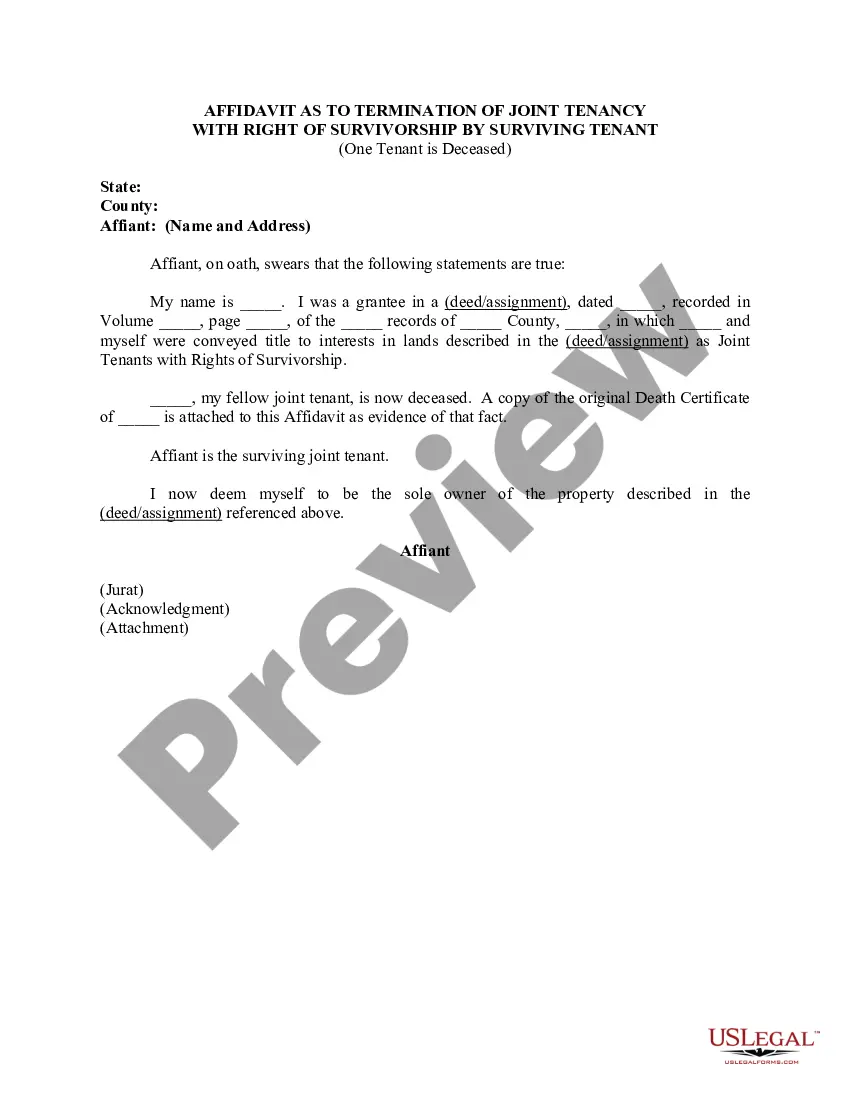
Affidavit as to Termination of Joint Tenancy with Right of Survivorship by Surviving Tenant (One Tenant is Deceased)
What is this form?
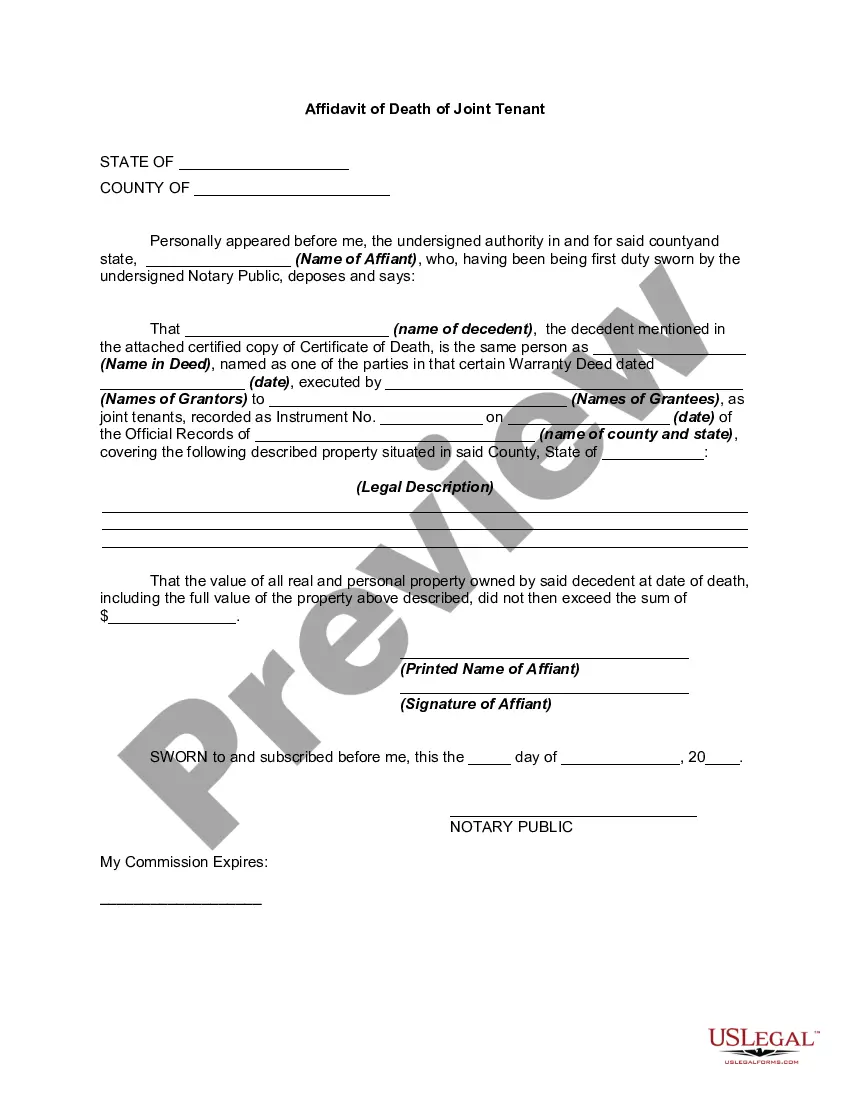
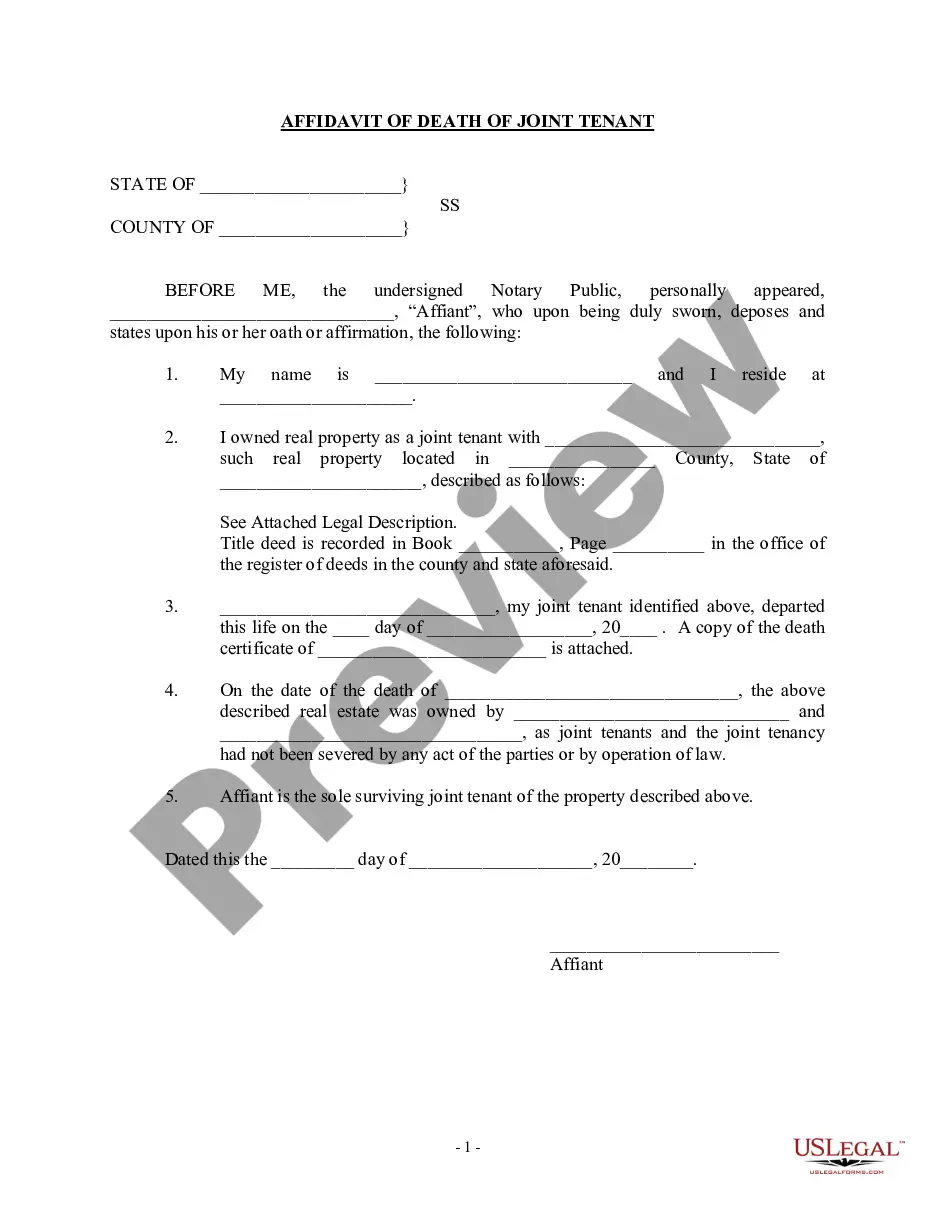
The Affidavit as to Termination of Joint Tenancy with Right of Survivorship by Surviving Tenant is a legal document that serves as evidence that one of the joint tenants has passed away. This form is essential for proving the death of a co-owner in a joint tenancy arrangement, allowing the surviving tenant to claim full ownership of the property. It is distinct from other property transfer forms, such as wills or quitclaims, as it specifically addresses the dissolution of joint tenancy due to the death of one tenant.
What’s included in this form
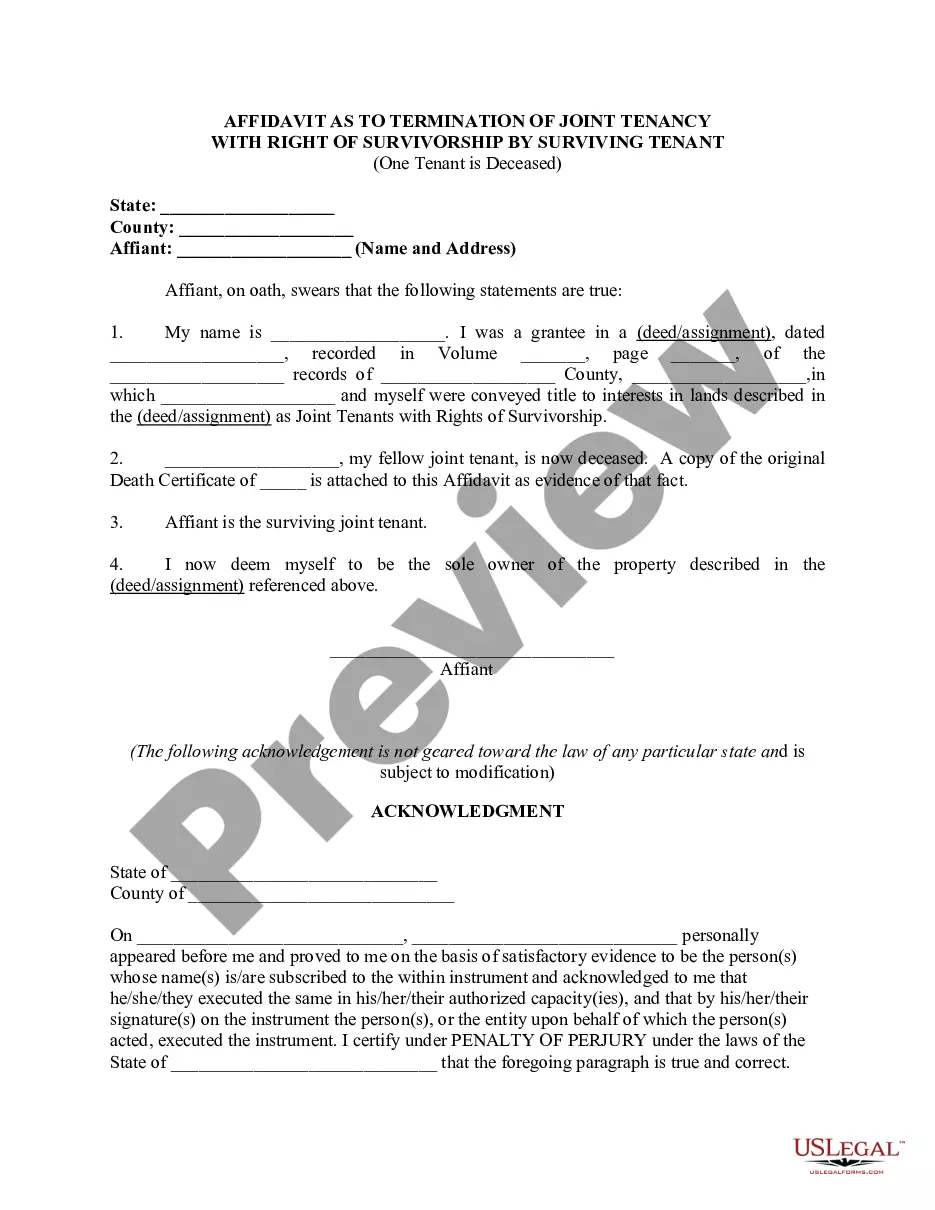
- Affiant's full name and address.
- Details of the original conveyance, including dates and recording information.
- Confirmation of the deceased co-tenant's identity and the attachment of the death certificate.
- A declaration by the affiant as the surviving joint tenant.
- Statement of ownership change for the property described in the original deed.
When to use this document
This affidavit is used in situations where one tenant in a joint tenancy arrangement has died. It is required to complete the transfer of ownership to the surviving tenant. If you are planning to handle the deceased's estate or clear title to the property, this form is necessary to finalize your legal claim as the sole owner.
Who can use this document
- Surviving tenants of a joint tenancy when one tenant has passed away.
- Individuals handling estate matters related to the deceased tenant.
- Anyone needing to prove sole ownership of property after a co-owner's death.
How to prepare this document
- Identify the full name and address of the affiant (the surviving tenant).
- Provide the details of the original deed, including the date it was recorded and its reference in public records.
- State the name of the deceased joint tenant and attach a copy of their death certificate.
- Affirm the affiant's status as the surviving joint tenant.
- Sign and date the affidavit in the presence of a notary, if required.
Notarization guidance
To make this form legally binding, it must be notarized. Our online notarization service, powered by Notarize, lets you verify and sign documents remotely through an encrypted video session.
Get your form ready online
Our built-in tools help you complete, sign, share, and store your documents in one place.
Make edits, fill in missing information, and update formatting in US Legal Forms—just like you would in MS Word.
Download a copy, print it, send it by email, or mail it via USPS—whatever works best for your next step.
Sign and collect signatures with our SignNow integration. Send to multiple recipients, set reminders, and more. Go Premium to unlock E-Sign.
If this form requires notarization, complete it online through a secure video call—no need to meet a notary in person or wait for an appointment.
We protect your documents and personal data by following strict security and privacy standards.

Make edits, fill in missing information, and update formatting in US Legal Forms—just like you would in MS Word.

Download a copy, print it, send it by email, or mail it via USPS—whatever works best for your next step.

Sign and collect signatures with our SignNow integration. Send to multiple recipients, set reminders, and more. Go Premium to unlock E-Sign.

If this form requires notarization, complete it online through a secure video call—no need to meet a notary in person or wait for an appointment.

We protect your documents and personal data by following strict security and privacy standards.
Common mistakes to avoid
- Not attaching the required death certificate.
- Failing to provide complete property details in the affidavit.
- Leaving out the notarization step if required by local law.
- Not accurately identifying the deceased co-tenant.
Advantages of online completion
- Convenience of downloading the form at any time.
- Editability to tailor the document to your personal circumstances.
- Access to forms reviewed by licensed attorneys for reliability and accuracy.
Quick recap
- The affidavit proves the death of a joint tenant and supports the claim of sole ownership.
- It is crucial for a surviving tenant to complete this form to ensure proper property transfer.
- Verify local requirements regarding execution and notarization of the form.
Looking for another form?

Form popularity
FAQ
For example, if one joint tenant wants to sell the property but the other joint tenant doesn`t want to sell, it is possible to ask for a court order to either physically divide the property or sell it and divide the sales proceeds among the joint tenant owners.
A Notice of Severance, signed and dated by the party who wishes to sever, will need to be served upon the co-owner. This could be done by simply sending the Notice of Severance to the other party in the post and asking that they sign and date the notice themselves and return it.
When a property is owned by joint tenants with survivorship, the interest of a deceased owner automatically gets transferred to the remaining surviving owners. For example, if four joint tenants own a house and one of them dies, each of the three remaining joint tenants ends up with a one-third share of the property.
The tenancy will continue if only one joint tenants leaves without having the right to do this. You will only have the right to leave a joint tenancy early if your landlord agrees to this arrangement or if your tenancy agreemetn allows you to.
In order to sever the right of survivorship, a tenant must only record a new deed showing that his or her interest in the title is now held in a Tenancy-in-Common or as Community Property.
While nothing needs to be done, the best practice is for a surviving owner to formally record the transfer of the interest. File an affidavit of survivorship with the recorder's office to remove the deceased person's name from the title.
This is known as 'Severing the Joint Tenancy'. It requires service of a written notice of change the 'severance'. It can be done without the other owner's cooperation or agreement. It is recorded at the Land Registry, and the other owner will know it has been done but only 'after the event' so to speak.
If you're joint tenants and you both want to leave, either you or your ex-partner can end the tenancy by giving notice. You'll both need to move out. If you've agreed one of you plans to stay, it's usually best to explain this to your landlord and ask them to update the tenancy agreement.
When one joint owner (called a joint tenant, though it has nothing to do with renting) dies, the surviving owners automatically get the deceased owner's share of the joint tenancy property.The surviving joint tenant will automatically own the property after your death.